




Homepage of the Drug War Philosopher, Brian Quass
blog icon orange rss icon with stylized radio waves bird icon for twitter bird icon for twitter substack icon


back navigation arrow forward navigation arrow


A Principle-Driven Approach to Ending Drug Prohibition

an open letter to American academics

by Brian Ballard Quass, the Drug War Philosopher

November 7, 2025


Whenever I consider how entirely my unique insights on drug prohibition have been ignored by all but a handful of authors, I take refuge in the words of Arthur Schopenhauer. When his criticism of Kant's Practical Reason was universally ignored by the university philosophers of his time, he responded to this ghosting as follows:

"Silence is all they have to oppose to intelligence, earnestness, and truth. 1"

In Schopenhauer's case, the university professors had a prior commitment to Christian theology and so refused to recognize insights that placed that theology in doubt. In my case, the professors have a prior commitment to the Drug War ideology of substance demonization, either because they fear to rock the boat on this topic, or because a lifetime of media censorship has persuaded them of the demonstrably false idea that an enormous and diverse category such as "drugs" can be bad in and of itself without regard to details.


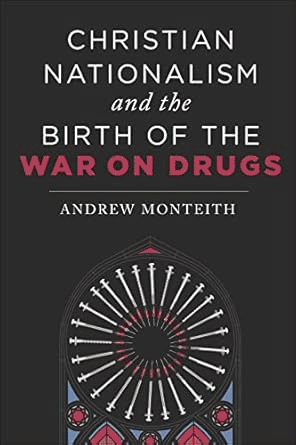
Book cover for Christian Nationalism and the Birth of the War on Drugs by Andrew Monteith
Monteith chronicles how the Puritan conservatives who lost their battle to criminalize liquor put all their zeal into outlawing all liquor alternatives. (They thereby actually increased the popularity of drinking, of course!)


This bias of western authors on the topic of drugs can scarcely be exaggerated. Indeed, it is almost universal. Even the most perceptive pundits are still arguing on the backfoot 2 when it comes to drug re-legalization. Take academic Andrew Monteith, for instance. The very title of his 2023 book, "Christian Nationalism and the Birth of the War on Drugs," would seem to suggest that he has risen above drug-war prejudices, and yet even Andrew doffs his hat to drug-war sensibilities with lines like the following:

"To be clear, there are legitimate medical reasons why someone should not smoke heroin or snort cocaine. 3"


First, notice the built-in bias of language here. One "takes" their meds, whereas one "snorts" cocaine, just like a pig. With all due respect to the author, that is not neutral language, especially as Andrew does not even place the word "snort" inside quotation marks. Sigmund Freud considered cocaine to be a cure for depression. He only ended his advocacy for the coca alkaloid when he saw which way the wind was blowing . Self-interested doctors judged the drug based only on its worst possible use, exactly as if they were to judge alcohol by studying only alcoholics. The last thing doctors wanted was a cure for depression. They made their living by treating depression, not by curing it. And so they destroyed the reputation of cocaine. Since then, both Drug Warriors and their enemies, like Monteith here, have been piling on by taking cocaine's evil to be obvious to everyone -- yes, folks, everyone except the hundreds of millions of the depressed who suffer unnecessarily in silence because of the self-interested outlawing of a godsend medicine!!! (Sorry for the triplicate punctuation, but some of us have skin in this game -- unlike many an armchair pundit who feels free to trash the drug simply because they see no need for it themselves. They'd rather do safer things in life than using cocaine, like collecting a private gun arsenal and/or getting as drunk as possible playing Beer Pong at the local bar.)

Monteith thus embraces the big lie of the Drug War: that there are, indeed, some substances whose use is "beyond the pale" and which can be judged outside of all context. To think so, however, is to confess one's faith in the drug-hating religion of Christian Science. By the logic here employed, we could say that there are medical reasons for not driving a car and for not climbing a mountain -- and for not drinking alcohol -- and for not using antidepressants! And of course there are! Everything is risky. Every choice has downsides. But the question is, do these activities make sense given the circumstances of a particular case: a potential user's goals in life, their risk tolerance, their general understanding of what life is all about! Do they want to emulate Sherlock Holmes and think as clearly as possible, or are they a hypochondriac, determined to avoid any abstract risk whatsoever?

As GK Chesterton wrote:

"It is said that the Government must safeguard the health of the community. And the moment that is said, there ceases to be the shadow of a difference between beer and tea. People can certainly spoil their health with tea or with tobacco or with twenty other things. And there is no escape for the hygienic logician except to restrain and regulate them all. If he is to control the health of the community, he must necessarily control all the habits of all the citizens...." --GK Chesterton, Eugenics and Other Evils 4

This is precisely the reason why the Drug War is tyranny: because it has us judging drugs "in general" based on the well-heeled branding operations of interested parties. But we have no business judging drugs based on our feelings about them, feelings that were inspired by the same kind of propaganda that makes us prefer Coca-Cola to Pepsi. Who cares what you or your brother-in-law think about drugs X, Y, or Z? Who cares about the good experience that one had or the bad experience that another went through? We should never outlaw drugs in advance of deciding if they can be helpful in a given unique case -- at some dose, in some circumstances, for some reasons, alone or in combination, etc.

In doing so, we outlaw drugs to "save" one demographic, while ignoring the rights to heal of millions of other demographics, including the rights of future generations to drug-using protocols, both known and yet to be discovered by the west. We thus "save" junior from opium by filling the world with far more powerful opiates, meanwhile completely ignoring the fact that nightly opium smoking is far safer than nightly beer drinking and that nightly opium smokers do not beat their wives 5. I say nothing of the violence that our drug laws create out of whole cloth and the fact that they have destroyed minority communities around the world 6 7.

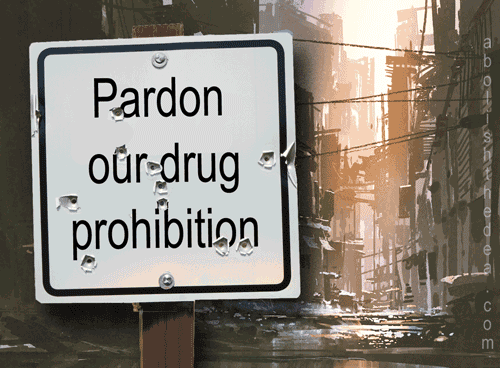
A city sign with bullet holes requests "Pardon our drug prohibition."
As Heather Ann Thompson wrote in "Inner-City Violence in the Age of Mass Incarceration":

"Without the War on Drugs, the level of gun violence that plagues so many poor inner-city neighborhoods today simply would not exist." 8


Let's look again at that quote from Monteith:

"To be clear, there are legitimate medical reasons why someone should not smoke heroin or snort cocaine. 9"


Monteith knows his audience -- and American audiences generally cherish the idea that there are indeed evil drugs out there. This line is written, then, for the same reason that a protestant mystic in the 16th-century would have written a line like the following:

"I still, of course, believe in the Father, Son and Holy Ghost."


This is an exercise in indemnification. The author is reassuring his highly skeptical audience that he has not lost his mind, that he still holds those logic-proof prejudices that are considered to be the entry price for acceptable discourse in America these days.

We live in a world, after all, where we say childish things like "Fentanyl kills!" -- failing to realize that such statements are the philosophical equivalent of crying "Fire bad!" as did our paleolithic ancestors. In both cases, we are attempting to get our audience to fear a dangerous substance rather than to learn how to use it as wisely as possible for the benefit of humanity.

It is interesting to note where this academic prejudice about drugs becomes apparent, by the way. It almost always presents itself in parenthetical throw-away lines, in print or in lectures, when the author is stating something that he thinks that everyone will agree about. Any time a drug pundit starts a sentence with the words "We all know that..." or else writes a sentence in which that phrase is implicit, then watch out! It is likely that the phrase that follows will be a popular prejudice rather than a demonstrable truth.

Six years ago, I was listening to a recorded lecture on formal logic by a professor at Gettysburg College 10. As he was giving examples of faulty argumentation, he mentioned the practice of suggesting that alcohol drinking was as bad as using heroin. It seemed to me that the professor was thereby saying the following: "Alcohol drinking should not be compared with using heroin because we all know that heroin use is far more dangerous than drinking alcohol." This is NOT, however, something that we all know: it is rather something that we all have been taught to FEEL to be true thanks to Drug War indoctrination and the total censorship of reports and depictions of positive drug use in the American media. That statement could only be "true" if those who employed it were to monkey around with the definition of "danger" in a very self-serving way.

It's not so much that the statement is false, however, (though in many senses, it is just that) but it is extremely FRAUGHT as well -- and as such should not be touted as an obvious example of faulty argumentation in a logic class. As far as the numbers show, heroin is far less deadly than alcohol11, especially when we remember that many opiate-related deaths are totally unnecessary and occur only because we refuse to regulate product, to teach safe use, and to offer alternative drugs. In other words, most opiate deaths occur because of drug prohibition.

What are the numbers? Alcohol is associated with 178,000 deaths a year in America alone12, exceeded only by nicotine, which causes roughly 480,000 American deaths13. The deaths from ALL OTHER DRUGS COMBINED in America is 105,000 a year, which is lower than alcohol-related deaths by an order of magnitude 14.

Of course, I am sure a resourceful Drug Warrior could find a way to spin the relevant facts into a "proof" of heroin's evil; but such an argument is far from self-evident and hence, again, the impropriety of taking heroin's comparative evil as a given, i.e., as "something we all know." For again, the subject of "what we all know" is extremely problematic in the age of the Drug War, since we all have been indoctrinated from birth in the drug-hating ideology of substance demonization.

I said above that my insights about drug use were being ignored. Let me conclude by explicitly stating a few of those ignored insights:

  1. No drug can or should be judged "up" or "down" outside of all context. No drug is bad in and of itself. We only think so because we fail to recognize all the stakeholders in the drug criminalization debate (which see the point that follows).


  2. There are far more stakeholders in the drug criminalization debate than the white American young people whom we refuse to educate about drugs. When America outlawed cocaine, they threw hundreds of millions of depressed under the bus, and outlawed whole ways of being in the world (think Robin Williams, Sigmund Freud, and Sherlock Holmes 15), essentially making the decision for us that achieving an illusory "safety" is more important than achieving a sharply focused and productive mental state. In a free world, government has no business predetermining the correct mental state for its citizens, especially if in so doing they favor the biochemistries of the beer-swilling smoker and the daily user of Big Pharma's dependence-causing "meds."


  3. The use of drugs that elate and inspire has prompted the creation of entire religions; wherefore it follows that the outlawing of such drugs is a crime against religious freedom-- nay, a crime against the religious impulse itself!


These points are off the radar of most drug pundits, who thus routinely argue on the back foot, pretending that drugs like opium and cocaine are evil and that the only stakeholders in the drugs debate are children and that drug criminalization outlaws only drugs -- when in reality it outlaws a host of other things, including religious liberty, the freedom of the press, and our ability to worship as we please. Indeed, drug criminalization is a corrosive acid that is eating its way through the Bill of Rights, thanks to a conservative court that never seems to have heard of the word "principle" and which instead hobbles together unprecedented excuses for ruling against drug-related liberties. Thus the courts have ruled regarding peyote use that an American's freedom of religion is contingent upon their ethnicity, that one has no freedom of religion if they choose to practice a faith that was unknown to their ancestors.

These clowns are not interested in time-honored principles, they are determined to rule against any and all freedom to use psychoactive substances, even if in so doing they utterly destroy all vestiges of American democracy. They are determined to rule as if Christian Science were America's state religion. They have thrown down the gauntlet, clearly revealing their anti-democratic intentions and essentially daring us to challenge them. So far the rest of us are simply quaking in our boots, saying, in effect, "Do as you please, we will not stand in your way." No one dares attract notice by appearing to be out of step with drug-demonizing orthodoxy. And this will not change until Drug Warriors stop arguing apologetically and instead focus on the kinds of home truths that I have enumerated above, those insights that have so far inspired the philosophical community to ghost me -- in response to which I close with one final quote from the poster child of ghosted philosophers everywhere: Arthur Schopenhauer.

"The instinct of self-preservation may, no doubt, be at the bottom of these artful tactics. For would not a philosophy, whose sole aim was truth, and which had no other consideration in view, be likely to play the part of the iron pot among the earthen ones, were it to come in contact with the petty systems composed under the influence of a thousand personal considerations by people whose chief qualification is the propriety of their sentiments? 16"


AFTERWORD

I actually consider Schopenhauer to be an optimist. Despite his Buddhistic belief in the primacy of suffering, he believed that truth would eventually be heard. Now, that's optimistic, if not positively Panglossian. For my part, I am not so sure that truth will triumph. The fact that such a logic-challenged and demonstrably pernicious policy as substance prohibition continues unabated today, facing only half-hearted, apologetic and literally "unprincipled" rebukes from our censored academia, makes me think that Homo sapiens have met their match with the advent of propaganda. We can be made to "feel" whatever we are meant to feel by those with money and motivation to control our feelings, at least if the feelings thus promulgated are in accord with our pre-existing prejudices. Homo sapiens, I fear, are a deeply flawed species. But then I am no doubt biased by current events. I am writing this at a time when the ostensibly grown-up leaders of the world's two major superpowers are sending notes back and forth saying in effect, "My ICBM is bigger than your ICBM!"

But that's a topic for another essay-- should both you and I live so long!


Notes for essay entitled A Principle-Driven Approach to Ending Drug Prohibition: an open letter to American academics:

1: The World as Will and Idea Schopenhauer, Arthur (up)
2: The Impact of Drug War Propaganda on Legalization Advocates DWP (up)
3: Monteith, Andrew. 2023. Christian Nationalism and the Birth of the War on Drugs. New York University Press EBooks. https://doi.org/10.18574/nyu/9781479817993.001.0001. (up)
4: “The Project Gutenberg eBook of Eugenics and Other Evils, by G.K. Chesterton..” 2019. Gutenberg.Org. https://www.gutenberg.org/files/25308/25308-h/25308-h.htm. (up)
5: The Truth About Opium by William H. Brereton DWP (up)
6: Firearm Violence in the United States Center for Gun Violence Solutions, Johns Hopkins University (up)
7: Gun Deaths in Big Cities Big Cities Health (up)
8: Heather Ann Thompson. 2014. The Atlantic. The Atlantic. October 30, 2014. https://www.theatlantic.com/national/archive/2014/10/inner-city-violence-in-the-age-of-mass-incarceration/382154/. (up)
9: Monteith, Andrew. 2023. Christian Nationalism and the Birth of the War on Drugs. New York University Press EBooks. https://doi.org/10.18574/nyu/9781479817993.001.0001. (up)
10: Heroin versus Alcohol DWP (up)
11: A Lee Robins study showed that only 5% of heroin-using U.S. soldiers in Vietnam required assistance getting off the drug upon returning to the States. Compare this with the 95% recidivism rate for the long-term users who try to kick the Big Pharma drug called Effexor. (up)
12: CDC. 2024. “Facts About U.S. Deaths from Excessive Alcohol Use.” Alcohol Use. July 8, 2024. https://www.cdc.gov/alcohol/facts-stats/?CDC_AAref_Val=https://www.cdc.gov/alcohol/features/excessive-alcohol-deaths.html. (up)
13: Por Jaijongkit. 2025. “Does Alcohol Cause More Deaths in the U.S. Than Any Other Drug?” The Colorado Sun. February 10, 2025. https://coloradosun.com/2025/02/10/does-alcohol-cause-more-deaths-in-the-u-s-than-any-other-drug/. (up)
14: Por Jaijongkit. 2025. “Does Alcohol Cause More Deaths in the U.S. Than Any Other Drug?” The Colorado Sun. February 10, 2025. https://coloradosun.com/2025/02/10/does-alcohol-cause-more-deaths-in-the-u-s-than-any-other-drug/. (up)
15: Other coca fans: HG Wells, Jules Verne, Alexander Dumas, Charles Gounod, and Jules Massenet. (up)
16: The World as Will and Idea Schopenhauer, Arthur (up)


read more essays here


Ten Tweets

against the hateful war on US


Anyone who has read Pihkal by Alexander Shulgin knows that the drug warriors have it exactly backwards. Drugs are our friends. We need to find safe ways to use them to improve ourselves psychologically, spiritually and mentally.

It is far better to "treat the symptoms" than to irreversibly modify brain chemistry in one particular way based on the theories of a financially-motivated biochemical determinist working for a pharmaceutical company.

To oppose the Drug War philosophically, one has to highlight its connections to both materialism and the psychiatric pill mill. And that's a problem, because almost everyone is either a Drug Warrior or a materialist these days and has a vested interest in the continuation of the psychiatric pill mill.

UNESCO celebrates the healing practices of the Kallawaya people of South America. What hypocrisy! UNESCO supports a drug war that makes some of those practices illegal!

If I smoke opium nightly, I am a drug scumbag. If I use Big Pharma "meds" every day of my life, I am a good patient.

In the board game "Sky Team," you collect "coffees" to improve your flying skills. Funny how the use of any other brain-focusing "drug" in real life is considered to be an obvious sign of impairment.

Drug Warriors should be legally banned from watching or reading Sherlock Holmes stories, since in their world, it is a crime for such people as Sherlock Holmes to exist, i.e., people who use medicines to improve their mind and mood.

In "The Book of the Damned," Charles Fort writes about the data that science has damned, by which he means "excluded." The fact that drugs can inspire and elate is one such fact, although when Fort wrote his anti-materialist broadside, drug prohibition was in its infancy.

Scientists cannot tell us if using drugs is worth the risk any more than they can tell us if free climbing is worth the risk, or horseback riding or parkour.

Most people think that drugs like cocaine, MDMA, LSD and amphetamines can only be used recreationally. WRONG ! This represents a very naive understanding of human psychology. We deny common sense in order to cater to the drug war orthodoxy that "drugs have no benefits."


Click here to see All Tweets against the hateful War on Us


back navigation arrow forward navigation arrow
Book Cover

Break the ice with a sledgehammer: place this book on your coffee table.

This book features 150 annotated images, designed to force brainwashed Americans to confront the fact that drug prohibition is wrong. Here is what author Richard Parrish II says of the book's compiler: "The drug prohibition philosopher provides first-hand, principled, persuasive, and insightful arguments against the current drug prohibition regime..."

Purchase Your Copy
Book Cover

Diary of a Drug Fiend

This is the only full-cast recording of Aleister Crowley's 1922 classic paeon to common sense. It is the first book -- and so far almost the only book -- to stake out a philosophy of drug use that is compatible with human freedom, one in which we learn to use drugs as wisely as possible for the benefit of humanity. This recording was produced by the Drug War Philosopher and your purchases help support his effort to push back against the tragically counterproductive policy of drug prohibition, in the name of human freedom and of humanity's right to heal.

Purchase Your Copy


No cookies, no ads paid for by amoral and immoral billionaires (or trillionaires).


Unless otherwise indicated, no AI is used in the creation of site content. These essays represent the original ideas of their author and not the ideas that the author SHOULD have based on an algorithmic parsing of existing data. For more on this subject, consider the AI-related viewpoints to which the author subscribes as delineated in the New York Times opinion piece entitled "What 370,000 College Essays Tell Us About A.I.’s Effects on Creativity" by Rebecca Winthrop of the Brookings Institution.

The Partnership for a Death Free America is a proud sponsor of The Drug War Philosopher website @ abolishthedea.com.


Copyright 2026, Brian Ballard Quass Contact: quass@quass.com

tombstone for American Democracy, 1776-2024, RIP (up)