





Homepage of the Drug War Philosopher, Brian Quass
blog icon orange rss icon with stylized radio waves bird icon for twitter bird icon for twitter substack icon


back navigation arrow


Are you still in favor of drug prohibition?

Read this.

by Brian Ballard Quass, the Drug War Philosopher

October 2, 2026


THANKS, JOE

I rarely receive pushback that is worth reading. For the most part I am simply ignored, and the rare criticism that I do receive is in the form of ad hominen invective. So on those rare occasions when a well-meaning individual expresses concerns about the re-legalization of psychoactive substances, I feel compelled to respond in detail. Today, therefore, I would like to respond to the concerns that were recently raised by substacker Joe C., a seemingly reasonable guy, who tells me that he sympathizes with my position as a disempowered 'patient', but that he nevertheless has qualms about the re-legalization of cocaine given his experience with what he believes were the cocaine 'abusers' whom he encountered while working at a bar. I will get to those specific concerns of his in a moment, but first I suggest that we "zoom out" for a moment and consider how we got here in the first place, how we came to be discussing the dangers (and ONLY the dangers) of such psychoactive substances in the first place. I maintain that the reason is as follows: the fact that, thanks to technological advances and the rise of real-time media, a largely "drug-naive" west is finally having to deal with what Aleister Crowley referred to as "the moral problem posed by the discoveries of organic chemistry."1

Note that this is not a problem (let alone a new problem) for indigenous people. Such non-western individuals have, generally speaking, always considered themselves to be a part of nature and saw no reason to be alarmed by the existence of psychoactive substances but rather chose to use them as wisely as possible for human benefit. This problem of mind-altering drugs arose for the scientific west because we have come to mistrust feelings and to value an analytical approach to knowledge. Given this mindset, we see a positive danger in substances that alter our perceptions, notwithstanding the fact that some of these substances drastically improve mental powers and improve mood, and have even inspired the creation of new religions, whatever we may have to say about their potential downsides.2 And here we already run into a fundamental problem with drug prohibition: it is no longer a scientific issue when we start talking about substances that cure depression and inspire religions (recognizing, of course, that psychiatrists believe that the "real" cures for such conditions as depression are the dependence-causing psychiatric "meds" that we are told that we must take every day of our life for a lifetime). This is why anyone who wishes to opine meaningly on the propriety of drug prohibition must start by declaring his or her fundamental assumptions about the world, about our rights or lack thereof to religious liberty, for example, and our right to take care of our own health (or not).

FIRST PRINICPLES

My assumptions, or my basic principles, include the following: that I am the owner of my own body, that I have a right to religious inspiration, that I have a right to take care of my own health, that I have a right to improve my mind and my emotions, and that a government has absolutely no right whatsoever to punish me (with the help of corporate collaborators) for the 'pre-crime' of having a given substance in my digestive system, and that the government's control of said digestive system is the most blatant form of tyranny imaginable, for it is a meta-tyranny: it controls the very way in which I am able to interpret and respond to the world around me by controlling my thoughts and feelings -- how? by dictating the substances that I am allowed to ingest. These are my starting assumptions, and they are all ones with which the founding fathers would have agreed as a matter of course. Indeed, they would have said that such rights go without saying, because they never would have imagined that a government founded on inalienable rights would one day seek to deprive the entire world of the benefits of Mother Nature's bounty. Certainly, the opium-loving Benjamin Franklin would have never thought so.

Of course, drug prohibitionists seldom reflect on the principles on which they are basing their proposed legislation, and this is not surprising given that they have come to think that ending what they hypocritically refer to as "drug use" must be accomplished "by any means necessary," without regard for principles. Instead, they create ad hoc justifications for drug demonization in the legal system that are designed to give a veneer of logic to the anti-drug outcomes that they wish to bring about. Yet we can deduce the principles held by these drug prohibitionists from their actions: they believe that religious liberty is not a right but a privilege, a privilege that government can give or withhold at will; they believe that freedom of thought is not a basic right, that the government can control how and how much you are allowed to think and feel in this life; they believe that taking care of one's own health is not a basic right and that the government has a right to know what you have in your digestive system at all times -- and that they can effectively remove you from the workforce (with the help of their corporate collaborators) if they do not like what is to be found in said digestive system, or even what WAS to be found there months before their latest probing of our once sacrosanct body.

Drug prohibitionists are basically telling us that American freedoms are incompatible with a world in which drugs exist, and they have turned this into a self-fulfilling prophecy by enacting all sorts of laws that erode time-honored freedoms. The whole point of the Bill of Rights was to stipulate fundamental freedoms that could not be ignored in the name of expediency, and yet that is exactly what America has done when it comes to drugs. I wish to make the reader understand that drug prohibitionists have thereby caused all of the problems that they were supposed to be solving and then some. They have made drug use as dangerous as possible by effectively outlawing education about drugs, preferring to instill fear instead. Meanwhile, they have refused to regulate product as to quality, dose and even identity, thereby leading to hundreds of thousands of totally unnecessary deaths of American young people.

This is the status quo of drug policy in America, and we must point this out whenever anyone suggests that we need more of the same.

YES, DRUGS HAVE BENEFITS

But the problem is that our conglomerate media purposefully leaves us blind to all these downsides of drug prohibition (and all the benefits of drugs). And no wonder. If we were awake to those downsides, we would see that it was drug prohibition that ensured the eventual election of a tyrant since it threw hundreds of thousands of generally left-leaning minorities in jail -- which some would argue was the reason for drug prohibition in the first place. Drug prohibition has always been justified as a way to punish "undesirables," after all -- the supposedly dangerous Chinese with their opium use, the Blacks with their perceived penchant for cocaine, the Hispanics with their use of hemp -- er, I mean marijuana. And the beat goes on. Today, we have backwoods extremist who we have been taught to contemptuously think of as "meth heads," even though they are merely using the same alternative to coffee that was safely popped in pill form by millions of mainstream Americans in the 1950s. When they're not busy demonizing drug users, these drug prohibitionists demonize drugs themselves, making superstitious statements like "Fentanyl kills," which is philosophically equivalent to saying "Fire bad" as did our prehistoric forebears. Such utterances would have us fear dangerous substances rather than to use them as wisely as possible for the benefit of humanity.

And here I have to add a reminder that no one seems to understand in the age of drug prohibition, the fact that it is antiscientific to outlaw drugs for everybody (including researchers) merely because a drug can be dangerous when used in one context, at one dosage, by one demographic. To do so is to outlaw pharmacological progress. Botulinum toxin is one of the most toxic substances in the world, but it has recently been found to be capable of treating migraine headaches. That is a benefit that we would never have encountered had we outlawed Botox on the grounds that it was an extremely toxic substance. Speaking of insane overreactions, it's amazing that Americans feel that they must outlaw drugs for everybody simply because they can be misused by a minority of people. This is exactly like removing guns from everybody merely because they are misused by criminals.

Let me provide one more bit of background before I respond to Joe C.'s worries about cocaine use in bars.

CENSORSHIP

In considering these issues, we must all acknowledge something that most people do not seem to understand -- that we live in a highly censored world when it comes to what we can even KNOW about drugs. To see this clearly, just ask yourself: "When was the last time that I saw a documentary or a book about how to use cocaine or opium wisely and for good reasons, like increasing my brain power or my mood or my creativity?" I can think of no such publications, although Jim Hogshire's books on opium come close3, as does Carl Hart's book entitled "Drug Use for Grown-Ups."4 Imagine if the government was spending $51 billion a year on teaching safe use rather than $51 billion a year on locking people up for trying to improve their mind and mood?5 Another sign of this censored world is the fact that we have a National Institute on Drug Abuse rather than a National Institute on Drug Use. The White House even helps rewrite the plots of our sitcoms to ensure that drug use will never be depicted as having any benefits whatsoever.6 This is why I find it difficult to be diplomatic on these topics, because drug prohibition, for 45 years now, has relied on such baseline biases to "justify" the outlawing of my right to heal.

Now about those cocaine 'abusers' in the local bar...

Let me begin by responding to what many may see as the most persuasive argument that Joe makes against drug re-legalization; he tells us that some people are predisposed to misuse cocaine. Science tells us that, after all. Okay, but let's think about this statement. This is a highly problematic conclusion to draw in the age of drug prohibition. If the government is spending $51 billion a year to make substance use as dangerous as possible by failing to regulate product and refusing to educate citizens -- and if the government, to the contrary, is spreading lies in taxpayer-funded public service announcements, telling us that time-honored panaceas that focus the mind actually fry the brain instead -- then it is presumptuous of us to blame drug misuse on the individual. That individual was set up to fail in Drug War America. It's kind of like you outlawed napkins and utensils and then told me that I had an eating disorder because I made a mess every time that I ate my dinner. But here's the point where Joe hauls out the heavy artillery in this science-loving world of ours: he tells us, basically, that science has proven that some people are so much biochemical putty in the hands of certain drugs, the implication being that enough people fall into this category as to require the outlawing of drugs. Drugs in this view have all-powerful effects that no amount of willpower can withstand.

To be fair, this is, indeed, the mainstream view of the matter. As Colleen Cowles tells us in her otherwise informative book War on Us: "...Brain imaging and behavioral research clearly show that addiction is a complex brain disease."7

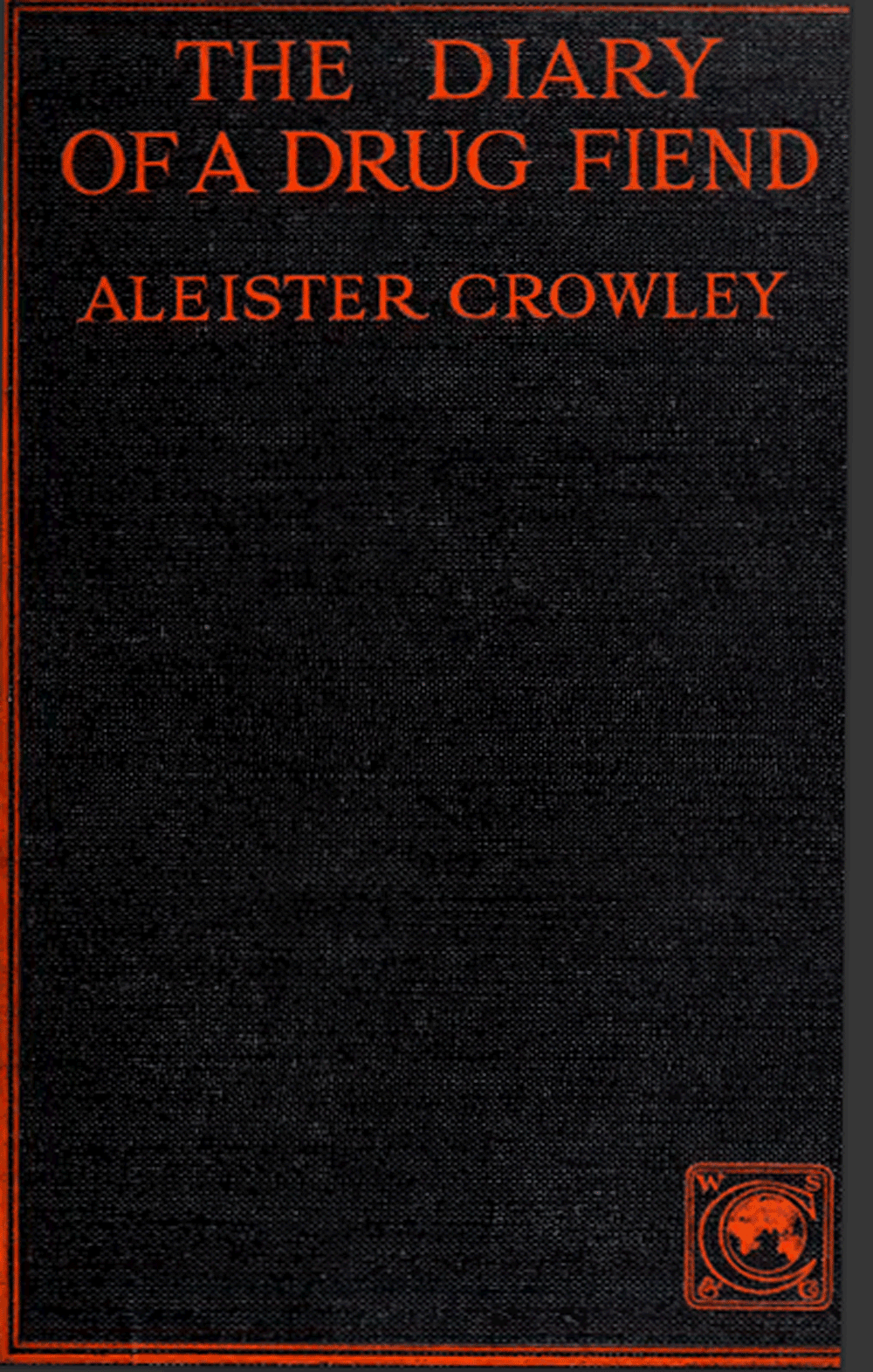
To which I say nonsense! (See below for my discussion of cause and correlation.) This is the self-interested line that rehab entrepreneurs have been feeding us since the early 1900s, the idea that we are helpless before drugs, that we need doctors to help us, not only now, when we're addicted, but for our entire lifetime, because once a drug addict, always a drug addict -- by which they mean "once a patient of mine, always a patient of mine." This is why Aleister Crowley wrote "Diary of a Drug Fiend," to offer an alternative to the doom-and-gloom outlook for drug users, by championing the power of free will and the human spirit over the self-interested fatalism of the endless doctors (certified and otherwise) who came out of the woodwork in the early 20th century to help people get off drugs, each and every one of them encouraging the users to consider themselves as lost without the help of a professional, many of whom claimed that the best they could offer is damage control for a lost soul. Whereas Crowley's rehab coach, King Lamus, said otherwise:

You have got to fear nothing. You have got to conquer everything. You have got to learn to make use of drugs as your ancestors learnt to make use of lightning. You have got to stop at the word of command, and go on at the word of command according to circumstances."8


Little did Crowley realize that science would end up deciding that trouble getting off drugs was an actual disease. Lamus championed human freedom, today's scientists champion biochemical determinism -- and let us not forget that they have a vested interest in doing so, just like the charlatans of yore who sought to profit from the collateral damage in the great battle of The West v. Drugs.

CORRELATION V CAUSE

I am not questioning the facts adduced by scientists on this topic, I am questioning the conclusions that they draw from those facts. I am not questioning their science, I am questioning their philosophy. There is always a measure of subjectivity when we declare that correlation is causation when it comes to human behavior. There has to be. Every human action is a complex outcome of an unimaginably large array of inputs, and to isolate a handful of these inputs and call them decisive is always problematic. And yet Americans seem to think that any conclusion drawn from scientists on this subject must be true. No, human behavior is not that simple. Scientists have not got us all figured out.

Do not mistake me here. I freely admit that some people, by dint of upbringing and/or genetics and/or their default biochemistry, may have, statistically speaking, more trouble "getting off" a given drug than others, but what science refuses to understand is that people need a reason to get off.

MALCOLM X

Consider Malcolm X.9 He told the fatalistic doctors of his day to beat it. They wanted to teach his heroin-loving followers that they were helpless before heroin and that they needed the white man to get off the drug. They needed science because they were helpless. Malcolm X replied, in effect, "Nonsense." He understood basic psychological common sense. He knew that he could get his followers off of heroin if he only gave them a heartfelt goal. He knew he had to give them a replacement for heroin -- a replacement that would motivate the users to WANT to get off the drug. He got his followers off of heroin by telling them to think of their drug habit as having been imposed on them by "The Man," and that when they got free of heroin, they will have gotten free of "The Man." This worked a charm, because it took advantage of basic psychological truths, the fact that people require the correct motivation to achieve their goals in life, no matter how much self-interested doctors and rehab coaches tried to convince them that they were lost without scientific intervention.

While most people praise scientists for "solving" the problem of addiction, I ask the following question: why are we even asking scientists about this subject in the first place? What do they know about human transcendence and religious inspiration and our craving for novel and inspiring experiences? Why have we placed dogmatically dispassionate lab coats in charge of deciding the value of ecstatic experiences based on an exclusive search for drug downsides? Why not ask someone about drugs who has actually used the drugs in question, and especially someone who has done so wisely and for good reasons? Are scientists the experts on the benefits of the psychoactive Soma juice that inspired the creation of the Vedic religion? If so, they are only experts in a very shallow sense indeed. They can tell us the chemical makeup of the concoction. But the real experts are those who have partaken of the juice and received the experiential truths that it imparted to them.

I must say, too, with all due respect to Joe, who is clearly a great guy: there is also something ironic about an employee of a bar worrying about cocaine users in that bar. The bar is serving up a drug that kills 178,000 a year in America alone, and we don't need the anecdotal stories of a bar employee to point out the victims of that drug. We see these downsides on inner city streets. We seem them in daily life, as the troubled vice president of the local bank or the new associate pastor at our local church who is occasional AWOL for no apparent reason. It is ironic. Alcohol has only one upside, and that is relaxing people at proper dosage. Cocaine has the power, on the other hand, to inspire the suicidal to live and to drastically increase the user's power to concentrate, all without making one feel that they are even on a drug. Are we really going to talk about such a drug from the divine plant of the Inca while never even mentioning the benefits? How exactly is that scientific?

But no one in America has ever discussed these upsides; we have essentially been frightened into never even allowing ourselves to think of those upsides. We have been taught only to recognize the downsides. Racist demagogue politicians has succeeded in brainwashing in this way only because the depressed and the cognitively impaired have never been considered stakeholders in the drugs debate, notwithstanding the fact that 45,000 Americans commit suicide each year, most of whom could have passed a drug test with flying colors. And this is why I am speaking up. Every time you save your kids from drugs, you are condemning others to lives of unnecessary suffering. As Thomas Szasz reminds us, "The laws that deny healthy people 'recreational' drugs also deny sick people 'therapeutic' drugs."10

This is why I may be perceived by drug pundits to be shouting at the top of my keyboard about this, because unlike them, I have skin in this game (although they do as well, did they only realize it). I am the first person to be speak up for the rights of my demographic, of the chronically depressed, to see themselves realistically for once, as the victims of drug prohibition. And while we're worrying about the health of those whom we are pleased to denominate as "coke heads" in conformance with the intolerant language encouraged by Drug Warriors, let us ask the following question: in what way are we helping these determined cocaine users when we champion laws that force them to use unregulated product and without any education about safe use whatsoever?

SAFETY FIRST IS THE MOTTO OF A HYPOCHONDRIAC

We can never make drug use completely safe, for the same reason that we cannot make horseback riding completely safe, or catamaran sailing, or climbing up a cliff. Freedom comes with dangers. The best we can do is to create safety-promoting policies that are consistent with basic American freedoms, policies that render use as safe as possible without infringing on the kind of rights whose very existence defines us as a people. This approach is sure to drastically reduce drug-related deaths in the long run. Or do we really believe that a policy of education and regulated product would kill more people than the millions who have died thanks to drug prohibition since 1914? Yes, millions. You won't find such statistics online because of the biased way in which the mainstream keeps count of such things, but it is true all the same. It is true because drug prohibition has been the sine qua non (an indispensable ingredient) for a variety of wars in Latin America, and it is therefore responsible for the death counts of those wars, including the hundreds of thousands who have been killed in Mexico in the 21st-century alone. How could drug prohibition NOT cause violence when it has destroyed the rule of law in Mexico and other Latin American countries. Nor were young people dying on American streets when opiates were legal in America, it took drug prohibition to accomplish that.

This is such a frustrating subject upon which to write because Americans have acquired a whole host of wrongheaded ideas and preconceptions about drugs that they take to be gospel truth, and unless one has been thorough enough to pop every one of these counterfactual balloons that are dancing over their heads, a brainwashed reader is bound to go away unconvinced. William Brereton might have been speaking of drugs in general when he said the following about opium in particular in his 19th-century lectures against the British Anti-Opium Society:

All these anti-opium articles, speeches, and resolutions are based upon the same model. They assume certain statements as existing and acknowledged facts which have never been proved to be such, and then proceed to draw deductions from those alleged facts.11


As do our drug prohibitionists.

They assume, for instance, that there are no positive uses for drugs. While that argument has always been demonstrably false given the well-known potential of opiates and cocaine to greatly improve human cognition and even creative power, that know-nothing viewpoint is becoming increasingly laughable these days (and increasingly irresponsible) in light of the latest developments in the fields of ethnobotany and pharmacology. The news has been so surprising that it would have even astonished Thomas Szasz, despite his typically unerring insight into all things drug-related. Szasz assumed, logically enough, that any substance that greatly improved mental function and/or mood would necessarily be of an addictive nature. It turns out that this is not always true, although any experience whatsoever can no doubt become addictive to somebody somewhere at some time or another.

TEACHER SUBSTANCES

We are finding that some substances seem to truly be "teacher" substances in the sense which aboriginal people employ that term for plant medicines that they feel can teach them something about life. Many of the drugs synthesized by Alexander Shulgin12 seem to fall into this category: they provide pedagogic benefits while not even potentially rendering the user addicted to use. The existence of such drugs in the natural world was well known to Aldous Huxley decades earlier when he wrote in The Human Situation of "naturally occurring drugs which open up the consciousness to the visionary experience and which appear to be relatively harmless to the physiology and not to be addictive in any way."

And what if a drug does cause dependence? Why is that considered to be a knockdown argument against drug use in a world in which we praise 1 in 4 American women for being dependent for life on psychiatric medicines?

The real question is this: Is the life of mental focus and inspiration that is provided by a drug actually so worthwhile that it justifies a life of dependency? Note that this is not a question that scientists can ever answer, even in theory! That is a question that each of us can only answer for ourselves while considering a host of very specific details, including the question of what we think that life is all about.

WHAT? DRUGS CAN ACTUALLY HELP?!!!

Despite our politically correct moralizing, drug users can do great things.

As Thomas Szasz wrote in Ceremonial Chemistry:

Dr. William Stewart Halsted (1852-1922), one of the greatest and most famous American surgeons and a founder of the Johns Hopkins medical school, was a lifelong morphine addict.... "He had worked so well [said a colleague] and so energetically that it did not seem possible that he could take the drug and do so much.” Actually, it was not despite his use of morphine but because of it that Halsted could do so much.13


And as Aleister Crowley tells us in Diary of a Drug Fiend:

We have Herbert Spencer taking morphia every day of his life, decade after decade. Without morphia, he would simply have been a querulous invalid, preoccupied with bodily pain. With it, he was the genius whose philosophy summarised the thought of the nineteenth century. 14


And we all know how Benjamin Franklin and Marcus Aurelius were big fans of opium -- or rather we WOULD all know this if historians did not try to spare our drug-war sensibilities by censoring that fact from their biographies of these men, just as Harvard University ignores the fact that the founder of their psychology department, William James, claimed to have found great philosophical significance in his visionary experiences under the influence of nitrous oxide.15 16

I hope the reader is beginning to understand that when I call for the re-legalization of drugs, I am also calling for a whole new mindset toward drugs, one that recognizes that our attempts to reduce dangers through drug prohibition only outsources drug dangers to other demographics. When white American parents prevailed upon President Jimmy Carter to crack down on marijuana use in the 1970s, they failed to realize that Blacks in inner cities were going to pay the price for that campaign thanks to the financial incentives that naturally result from decreasing the availability of a desired substance. Just so, the more that police crack down in order to "help" those cocaine users in the bar (who, let us remember, are already using the substance IN SPITE OF DRUG PROHIBITION), the more violent will become the attempts to sell a strongly desired substance: drug prohibitionists are thereby "helping" the drug misusers in the bar by facilitating torture and extortion elsewhere: torture and extortion.

IMAGINE

Let me end by asking the reader to imagine. Imagine a world in which people were actually free to talk about drug benefits. Imagine a world full of books like "How I smoked opium wisely to improve my life without becoming addicted," or "How I learned to use cocaine wisely," or "How I increased my love for the intricacies of Mother Nature with the help of a variety of non-addictive phenethylamines." One could never imagine anyone publishing such books in this supposedly free country of ours. Indeed, the mere existence of such titles would constitute an act of terrorism in light of the highly flexible way that Our Leader in Washington defines that term in his National Security Presidential Memorandum #7...17

Which brings me two one final point that I have to make. We are reaping the whirlwind today of drug prohibition, which is why it's so depressing to me to find that reasonable people are still believers in the efficacy of that failed policy. The downsides are not just for minorities any longer, they have destroyed America as a democratic country. How's that for a downside? We have stood by complacently as the bogus and anti-aboriginal imperative of "fighting drugs" has worked like a universal solvent to destroy American freedoms, to the point that a one-man junta in the White House is now murdering drug suspects without so much as filing charges against them, and this from a man who is in power today only because of drug prohibition, which has helped remove hundreds of thousands of minorities from the voting rolls.

In other words, let's re-legalize mental freedom and teach those cocaine users in that bar of yours a thing or two about personal responsibility. If they really cannot be taught to "use" wisely, no problem. Let's tell them about other drugs that will provide the self-transcendence and mental improvement that they are looking for but in a way in which they personally will have a far better chance of handling maturely. Let's deal with the one thing that our "experts" on drugs always avoid: the obvious reason that people use drugs, namely, to achieve states of self-transcendence. The fact that they do so is not an illness or a moral failing, except in the eyes of a drug-hating Christian Scientist. And let's offer this help for drug users in the same way that we would help anyone engaging in any other risky activity, namely, with the understanding that some people are going to "get it wrong" and that we can and should do no more than attempt to educate people. Folks are always going to fall off horses, fall of sailboats and fall off cliffs. And some are going to misuse drugs. That's what happens in a free world.

Drugs aren't going anywhere, after all, despite our insane attempts as a country to eradicate all psychoactive substances from the face of the earth. We have to recognize what should be obvious from the sorry state that the country is in today at this very moment: the fact that drug prohibition is incompatible with democratic freedom, and anyone who tries to tell us otherwise in light of the evidence adduced above has something very different in mind than the safety of our young people.

IT'S A SIN

One more thing about cocaine in specific. It is a sin that a drug with this brain-focusing profile is not available as an option for those experiencing cognitive decline. Indeed, opiates and so-called "meth" have such mind-focusing potential as well. And we do not need a scientist to tell us that! There is what philosophers call a "prima facie" case for the use of such drugs by people with such conditions. We are simply being gaslighted by government when they tell us otherwise. Scientists simply are not the experts when it comes to mind and mood medicine. Their role is simply to tell us of abstract risks, ideally while putting those risks in perspective so that they do not damn an outlawed substance for a sin that is far more pronounced in alcohol and/or in a popular psychiatric "med."


Notes for essay entitled Are you still in favor of drug prohibition?: Read this.:

1: “Diary of a Drug Fiend by Aleister Crowley.” 2026. Payhip. 2026. https://payhip.com/b/srNvV. (up)
2: Blue Tide: The Search for Soma: a philosophical review of the book by Mike Jay DWP (up)
3: Hogshire, Jim. 2009. Opium for the Masses. Feral House. (up)
4: “Drug Use for Grown-Ups by Dr. Carl L. Hart: 9781101981665 | PenguinRandomHouse.Com: Books.” n.d. PenguinRandomhouse.Com. Accessed August 29, 2026. https://www.penguinrandomhouse.com/books/534657/drug-use-for-grown-ups-by-dr-carl-l-hart/. (up)
5: “War on Us – the War on Drugs Is a War on All of Us.” 2019. Waronus.com. 2019. http://waronus.com/. (up)
6: “How the White House and the Media Package Government Propaganda as Entertainment.” 2000. World Socialist Web Site. January 24, 2000. https://www.wsws.org/en/articles/2000/01/drug-j24.html. (up)
7: “War on Us – the War on Drugs Is a War on All of Us.” 2019. Waronus.com. 2019. http://waronus.com/. (up)
8: Arthur Crowley. “Full Text of ‘the Diary of a Drug Fiend.’” 1922. Archive.org. 2017. https://archive.org/stream/b29826433/b29826433_djvu.txt. (up)
9: “Ceremonial Chemistry – Syracuse University Press.” 1974. Syr.edu. 2026. https://press.syr.edu/supressbooks/1114/ceremonial-chemistry/. (up)
10: Szasz, Thomas. 1992. Our Right to Drugs. Praeger. (up)
11: The Truth About Opium by William H. Brereton DWP (up)
12: Pihkal 2.0: Finding drugs that work for users rather than for pharmaceutical companies DWP (up)
13: “Ceremonial Chemistry – Syracuse University Press.” 1974. Syr.edu. 2026. https://press.syr.edu/supressbooks/1114/ceremonial-chemistry/. (up)
14: Arthur Crowley. “Full Text of ‘the Diary of a Drug Fiend.’” 1922. Archive.org. 2017. https://archive.org/stream/b29826433/b29826433_djvu.txt. (up)
15: How Harvard University Censored the Biography of William James DWP (up)
16: Stanford University rewrites the life of William James to conform with America's drug biases DWP (up)
17: Trump Will Find Me and Trump Will Kill Me DWP (up)


read more essays here


Ten Tweets

against the hateful war on US


If media were free in America, you'd see documentaries about people using drugs wisely for a wide variety of praiseworthy purposes.

We've created a faux psychology to support such science: that psychology says that anything that really WORKS is just a "crutch" -- as if there is, or there even should be, a "CURE" for sadness.

Getting off some drugs could actually be fun and instructive, by using a variety of other drugs to keep one's mind off the withdrawal process. But America believes that getting off a drug should be a big moral battle.

The Partnership for a Death Free America is launching a campaign to celebrate the 50th year of Richard Nixon's War on Drugs. We need to give credit where credit's due for the mass arrest of minorities, the inner city gun violence and the civil wars that it's generated overseas.

Getting off antidepressants can make things worse for only one reason: because we have outlawed all the drugs that could help with the transition. Right now, getting off any drug basically means becoming a drug-free Christian Scientist. No wonder withdrawal is hard.

This just in on the drug scene: A new New York Times report shows that America has been flooding the world with antidepressants, alcohol and cigarettes!

Immanuel Kant wrote that scientists are scornful about metaphysics yet they rely on it themselves without realizing it. This is a case in point, for the idea that euphoria and visions are unhelpful in life is a metaphysical viewpoint, not a scientific one.

Well, today's Oregon vote scuttles any ideas I might have entertained about retiring in Oregon.

This is why the foes of suicide are doing absolutely nothing to get laughing gas into the hands of those who could benefit from it. Laughing is subjective after all. In the western tradition, we need a "REAL" cure to depression.

Here is a sample drug-use report from the book "Pihkal": "More than tranquil, I was completely at peace, in a beautiful, benign, and placid place." Prohibition is a crime against humanity for withholding such drug experiences from the depressed (and from everybody else).


Click here to see All Tweets against the hateful War on Us


back navigation arrow
Book Cover

Break the ice with a sledgehammer: place this book on your coffee table.

This book features 150 annotated images, designed to force brainwashed Americans to confront the fact that drug prohibition is wrong. Here is what author Richard Parrish II says of the book's compiler: "The drug prohibition philosopher provides first-hand, principled, persuasive, and insightful arguments against the current drug prohibition regime..."

Purchase Your Copy
Book Cover

Diary of a Drug Fiend

This is the only full-cast recording of Aleister Crowley's 1922 classic paeon to common sense. It is the first book -- and so far almost the only book -- to stake out a philosophy of drug use that is compatible with human freedom, one in which we learn to use drugs as wisely as possible for the benefit of humanity. This recording was produced by the Drug War Philosopher and your purchases help support his effort to push back against the tragically counterproductive policy of drug prohibition, in the name of human freedom and of humanity's right to heal.

Purchase Your Copy


No cookies, no ads paid for by amoral and immoral billionaires (or trillionaires).


Unless otherwise indicated, no AI is used in the creation of site content. These essays represent the original ideas of their author and not the ideas that the author SHOULD have based on an algorithmic parsing of existing data. For more on this subject, consider the AI-related viewpoints to which the author subscribes as delineated in the New York Times opinion piece entitled "What 370,000 College Essays Tell Us About A.I.’s Effects on Creativity" by Rebecca Winthrop of the Brookings Institution.

The Partnership for a Death Free America is a proud sponsor of The Drug War Philosopher website @ abolishthedea.com.


Copyright 2026, Brian Ballard Quass Contact: quass@quass.com

tombstone for American Democracy, 1776-2024, RIP (up)
