








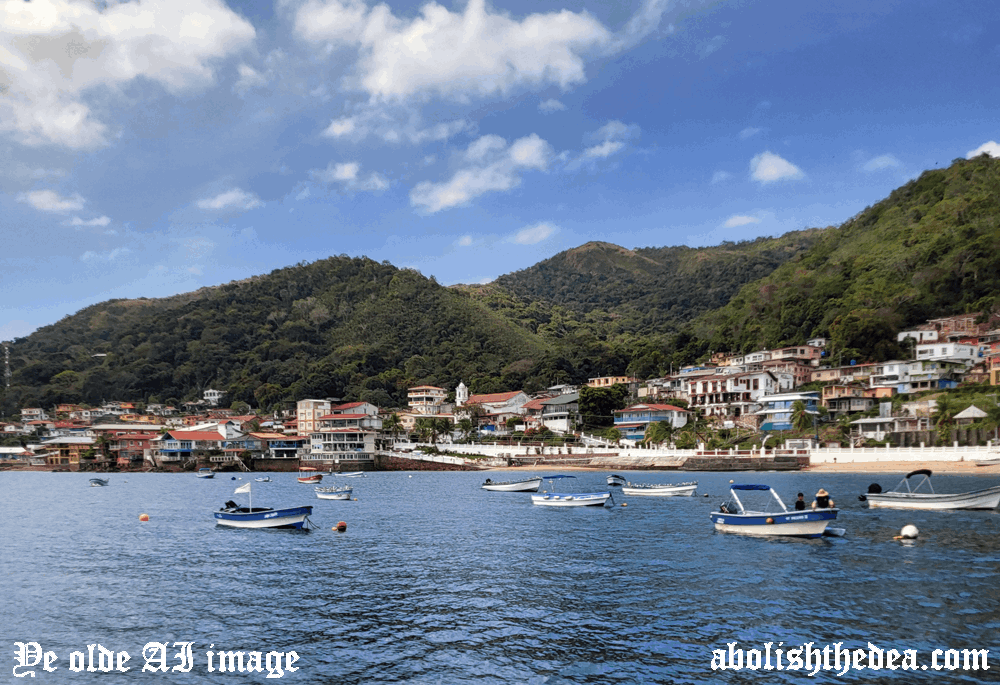
 During our stifling walk through Taboga Island on a typical summer day in Panama in February 2026, our resident tour guide brought us to the oceanside house of Francisco Pizarro, where the Conquistador lived the good life with the help of his encomienda of 150 indigenous slaves before setting off to conquer Peru, not once, but twice. I was startled to learn that a house with such a name even existed on the so-called "Island of Flowers," let alone that it was located on a street that unapologetically boasted the same controversial name. My astonishment only grew when our guide informed our small group of day trippers that the house is still in the hands of Pizarro's descendants to this very day. "What?", I thought to myself. "Did not the indigenous people of Peru successfully demand the removal of the equestrian statue of Pizarro from the Lima capital in 2003? Why is this house and street tolerated by the Mestizo population of the island, given their tangible connections with the peoples whom the Spaniard decimated for nepotistic gain, the encomiendas thus generated being shared with his three equally ruthless brothers?"
 Mad in America solicits personal stories about people trying to get off of antidepressants, but they will not publish your story if you want to use entheogenic medicines to help you. They're afraid their readers can't handle the truth.
Today's war against drug users is like Elizabeth I's war against Catholics. Both are religious crackdowns. For today's oppressors, the true faith (i.e., the moral way to live) is according to the drug-hating religion of Christian Science.
ECT is like euthanasia. Neither make sense in the age of prohibition.
The Petpedia website says that "German Shepherds need to have challenging jobs such as searching for drugs." How about searching for prohibitionists instead?
The drug war has created a whole film genre with the same tired plots: drug-dealing scumbags and their dupes being put in their place by the white Anglo-Saxon establishment, which has nothing but contempt for altered states.
If drug war logic made sense, we would outlaw endless things in addition to drugs. Because the drug war says that it's all worth it if we can save just one life -- which is generally the life of a white suburban young person, btw.
The goal of drug-law reform should be to outlaw prohibition. Anything short of that, and our basic rights will always be subject to veto by fearmongers. Outlawing prohibition would restore the Natural Law of Jefferson, which the DEA scorned in 1987 with its raid on Monticello.
Whether we judge people only by the words that they say or only by the substances of which they partake, we are ignoring the most important things: what they really mean and how they really behave.
Proof that materialism is wrong is "in the pudding." It is why scientists are not calling for the use of laughing gas and MDMA by the suicidal. Because they refuse to recognize anything that's obvious. They want their cures to be demonstrated under a microscope.
Some fat cat should treat the entire Supreme Court to a vacation at San Jose del Pacifico in Mexico, where they can partake of the magic mushroom in a ceremony led by a Zapotec guide.
Mad in America solicits personal stories about people trying to get off of antidepressants, but they will not publish your story if you want to use entheogenic medicines to help you. They're afraid their readers can't handle the truth.
Today's war against drug users is like Elizabeth I's war against Catholics. Both are religious crackdowns. For today's oppressors, the true faith (i.e., the moral way to live) is according to the drug-hating religion of Christian Science.
ECT is like euthanasia. Neither make sense in the age of prohibition.
The Petpedia website says that "German Shepherds need to have challenging jobs such as searching for drugs." How about searching for prohibitionists instead?
The drug war has created a whole film genre with the same tired plots: drug-dealing scumbags and their dupes being put in their place by the white Anglo-Saxon establishment, which has nothing but contempt for altered states.
If drug war logic made sense, we would outlaw endless things in addition to drugs. Because the drug war says that it's all worth it if we can save just one life -- which is generally the life of a white suburban young person, btw.
The goal of drug-law reform should be to outlaw prohibition. Anything short of that, and our basic rights will always be subject to veto by fearmongers. Outlawing prohibition would restore the Natural Law of Jefferson, which the DEA scorned in 1987 with its raid on Monticello.
Whether we judge people only by the words that they say or only by the substances of which they partake, we are ignoring the most important things: what they really mean and how they really behave.
Proof that materialism is wrong is "in the pudding." It is why scientists are not calling for the use of laughing gas and MDMA by the suicidal. Because they refuse to recognize anything that's obvious. They want their cures to be demonstrated under a microscope.
Some fat cat should treat the entire Supreme Court to a vacation at San Jose del Pacifico in Mexico, where they can partake of the magic mushroom in a ceremony led by a Zapotec guide.


 (up)
(up)