time again for the Drug War Philosopher to take Substackers to task for their propaganda-inspired misconceptions about psychoactive substances
by Brian Ballard Quass, the Drug War Philosopher (Substack version)
July 22, 2026
I have decided to respond to some of the plethora of bamboozled authors who write in complete ignorance of the effects of drug prohibition on subjects like depression and assisted suicide, for instance. I'm finding as I do so that some Stackers post multiple notes daily, while others post click-bait: where they ask an open question, or better yet, solicit links to "interesting" posts. These would be great strategies if my goal were simply to elevate my short-term Substack enrolment, but as I am attempting to persuade real people to make real changes in the status quo, I will refrain. The good thing about responding to these posts, by the way, is that my responses write themselves. These notes irritate me so thoroughly that my fingers cannot keep up with the indignant input that my brain is sending their way. (My fingers are like: "Hold on there, we're typing as fast as we can!")
SUBSTACK NOTES
FROM: Joseph Everett (WIL)
NOTE: Gabor Mate is Wrong
RESPONSE: Yes, Gabor is wrong, but so are almost all psychologists and psychiatrists in the age of the Drug War. They all assume that drug use can only be a problem and that there are no benefits to drugs. Those are ahistorical lies that we have come to believe thanks to the media’s total censorship of all positive uses of drugs. Drugs like opium and coca VASTLY increase one’s mental powers. You don’t have to have deep hidden problems to want to use such drugs. Anyone who wants inspiration, motivation, and an almost surreal level of concentration could find reason to use them. I could flip the script. I could say that there are hidden problems with people who are so susceptible to propaganda that they cannot even imagine any beneficial uses for drugs — the substances that indigenous people use for human benefit rather than demonizing wholesale like we do in the west. It is just too convenient to say that people who believe in drug benefits are “sick” or have an “illness.” That sounds like a Stalinist diagnosis to me, one designed to enforce the status quo. And yet that is the way the Gabor Mates seem to see the world. Gabor seems to be a great person — but he should stick to one-on-one counseling while yet advocating on behalf of his patients for the end of drug prohibition, which outlaws his patients’ right to heal — and even their right not to BE patients in the first place.
FROM: Maria Veronica Laguna
NOTE: Psychoanalysis and Social Justice is a growing collaborative database with articles, books, events and multimedia resources on Psychoanalysis and Social Justice.
RESPONSE: PSJ should be all about ending drug prohibition, which gave psychiatry a monopoly on mind and mood medicine. Psychiatry used that monopoly to turn 1 in 4 American women into lifetime patients with the help of “meds” for which dependency was a feature and not a bug. As a 67-year-old chronic depressive, I have written hundreds of essays on this topic based on my 45 years’ worth of experience on the dependence-causing “meds” of Big Pharma. I now have to see a doctor one-third my age every three months of my life to qualify for yet another refill on a “med” that is harder to kick than heroin. It is humiliating and the ultimate disempowerment. And yet everyone tells me, in one way or another, to "shut up and take my meds." And that includes Mad in America, who will not even publish my story. No one dares admit that outlawed drugs could have helped me -- even though some of the outlawed substances have been considered panaceas by all past cultures.
FROM: Bryan Shapiro, MD
NOTE: The taper that no one can agree on: recommendations for deprescribing a nation...
RESPONSE: I am an expert on this topic (or would be considered so in a sane world). I am a 67-year-old chronic depressive who has been “on” Big Pharma meds for over 40 years. The one I am on now is harder to kick than heroin and has turned me into a ward of the healthcare state, someone who has to see a “doctor” one-third his age every three months of his life to qualify for a refill on an underperforming and highly dependence-causing med. For me, the recommendation for “deprescribing a nation” is obvious: End America’s unprecedented wholesale outlawing of psychoactive substances which has denied me my right to heal for a whole lifetime now! Freud was right: cocaine is a godsend for depression — but self-interested doctors focused only on downsides. No one cared about the millions who suffer in silence when such drugs are outlawed. As Crowley said of his first use of cocaine: “The depression lifted from my mind like the sun coming out of the clouds.”
FROM: Mike Males
NOTE: Hundreds of splashy “studies” claiming social media harms teenagers are flooding press and political forums. 99.9% are completely worthless.
RESPONSE: It’s just another manifestation of the Drug War mindset which tells us that one negative outcome is enough to justify new laws. The real question about these studies is, “Why did so many people NOT develop problems after using social media?” See AI and Drugs.
FROM: James Zech
NOTE: Genuine question for people who champion the psychedelic underground: Is there any set of laws that would make you happy enough to give up the underground altogether? Presumably, if the laws were perfectly in line with your own views, there'd be no reason to stay underground in the first place—so what would it look like?
RESPONSE: The psychedelic underground only exists because of drug prohibition. Drug prohibition exists because the media simply will not print stories about positive drug use, which, combined with fearmongering politicians and media, convinces Americans that drugs are evil. But saying “Drugs kill” is the philosophical equivalent of saying “Fire bad.” Both statements would have us fear dangerous substances rather than to learn how to use them as wisely as possible for the benefits of humanity. As for psychedelics, William James himself encouraged us to use such substances to explore the nature of human consciousness. The filter theory of Bergson and Huxley shows how the west’s utilitarian “sober” consciousness is just one of many ways of perceiving the world. It is wrong to ignore or dismiss the importance of psychedelic states by associating them with a relatively unpopular demographic like the “hippies.” Yet I am the only philosopher who protested against the outlawing of laughing gas on behalf of academic freedom and the legacy of William James.
FROM: impoc
NOTE: Two-word solution to the hard problem of consciousness: drop physicalism.
RESPONSE: We don’t deserve to solve the problem of consciousness until we as academics have protested drug prohibition, which outlaws the research that William James encouraged us to undertake with respect to the topic. Kant presupposed a one-size-fits-all consciousness based on the strategically defined “sober” utilitarian mind of the westerner, but James discovered with his use of N2O that there are many kinds of consciousness. Yet I am the only philosopher who formally protested our FDA’s attempts to regulate laughing gas as a drug, thereby making it even less available than it already was on a practical basis to not only academics but to the severely depressed as well.
FROM: Eugene Lipov MD
NOTE: PTSD is not weakness. It is a nervous system that adapted to danger and never received the signal that it was safe to stand down. Understanding that changes everything about how we treat it.
RESPONSE: There are plenty of phenethylamines and tryptamines that can help those with PTSD. There are hundreds of drugs that we outlaw that have psychologically obvious uses for these conditions. But behaviorist psychiatrists and psychologists tacitly support the Drug War lie that outlawed substances can have no beneficial uses whatsoever. Americans have been brainwashed to the point where they would prefer that soldiers suffer from PTSD and that the elderly suffer from dementia rather than to treat them (or let them treat themselves!) with the brain-focusing drugs that we have been taught to despise. Cures and treatments come in second-place to our American religion of drug-hating. Our “experts” refuse to even point out that laughing gas has obvious uses for the suicidal. Drug propaganda has brought us to this sad prehistoric pass: that we now prefer death itself to the use of substances that we call “drugs.”
FROM: Julian Frazier, PhD
NOTE: The biggest lie that we were sold was that mental health and physical health are two different things.
RESPONSE: Holism is important, but the whole problem today is that we treat depression like a physical illness — and yet Mother Nature has created substances that can elate human beings in a trice! In a trice! As far as I can tell, every single psychologist and psychiatrist on Substack completely ignores this fact.
FROM: Aaron Balick
NOTE: Say what you want about Freud. He earned his keep with transference and projection alone.
RESPONSE: He earned his keep with the discovery that cocaine could end depression for most people. No one asked the depressed what they thought about the drug. Self-interested doctors decided to judge the drug only by its downsides, exactly as if they were to judge alcohol by studying only alcoholics. No one cared about the millions of depressed who would suffer unnecessarily and be turned into wards of the healthcare state by drug prohibition and shunted off onto “meds” that were harder to kick than heroin — people like myself.
Follow-up response after Aaron claimed that Freud never said that cocaine could end depression.
I disagree. Whether he actually said “end depression” is merely a technical point.
In “On Cocaine,” Freud wrote: "My impression has been that the use of cocaine over a long time can bring about lasting improvement..." But we outlawed cocaine to save me from “drugs”. The result? I am a 67-year-old who has to see a doctor one-third his age every three months of my life in order to get a refill on a “med” that he has found to be much harder to kick than heroin — after a year of self-paid hyperbolic reduction. Freud was ambitious. He moved onto psychoanalysis when he saw that cocaine was a nonstarter from the viewpoint of self-interested doctors. Besides, he was using the drug to help people who had obvious problems using drugs wisely. Whatever the background story, I would rather be dependent on a dealer’s drugs and be a man than to be dependent on the prescriptions of a condescending psychiatrist and be an eternal child. Sorry, but this is my life I’m writing about and I am so tired of all the experts seeing no benefits in obvious godsends — thanks, I guess, to the fact that the media will never show beneficial drug use. Mad in America will not erven publish my story. No one wants to mention “drugs” except in a negative light.
Aaron was kind enough to respond, saying that he had originally misread my comments as facetious....
Thanks, Aaron. I write with “skin in the game,” so I sometimes leave out important qualifiers, especially in discussion threads. The truth is certainly more complicated than “cocaine can end depression.” Even in a free world, that drug would be contraindicated in a variety of cases. However, I see drug prohibition as the outlawing of my right to heal. I have written hundreds of essays on these topics over the last seven years at abolishthedea.com. I have devoted my retirement years to the study of American drug attitudes from a philosophical point of view. I find that my views are so out of sync with the mainstream, that I always have to bear in mind the following advice from Alfred North Whitehead: "In the presentation of a novel outlook with wide ramifications, a single line of communications from premises to conclusions is not sufficient for intelligibility. Your audience will construe whatever you say into conformity with their pre-existing outlook." Thanks again for taking the time to respond!
If one reads the rare accounts of cocaine use that slip through the sieve of drug prohibition censorship, one finds that its use does often end depression. Whether the risk is worth it in any given case is another question, but there is simply no doubt that the drug works for that purpose for many if not most people. It is from the divine plant of the Inca, after all. We “patients” get gaslighted by scientists when they tell us that real proof must be found at the molecular level and not in the real world of living human beings.
FROM: Based Psychiatrist
NOTE: A few short months ago, Taper Community didn’t exist. Now we have hundreds of people helping each other, and growing like crazy.
RESPONSE: I am a 67-year-old who has been on Big Pharma meds for a lifetime now. I found Effexor harder to kick than heroin after one year of hyperbolic tapering. It is my belief that all med-dependent “patients” should be protesting drug prohibition as the outlawing of their right to heal, rather than just trying to make withdrawal “work,” which is something that Big Pharma and psychiatrists should be working on in any case. As it is, Viatris Pharmaceuticals does not even offer a small-dose version of their Effexor for tapering purposes, nor does it allow compounding pharmacists to use the company’s extended-release formula when compounding the drug. Drug prohibition made the pill mill possible by outlawing all substances that inspire and elate, most of which can be used without causing dependency (Drug War propaganda notwithstanding). Sigmund Freud knew that cocaine was a godsend for most depressives, before self-interested doctors focused only on downsides, never bothering to ask the depressed how they felt about the drug. As Aleister Crowley said of his first use of cocaine: “The depression lifted from my mind like the sun coming out of the clouds.” Med-dependent Americans need to join together to fight drug prohibition and to hold it responsible for the fact that it has turned them into patients for life.
FROM: Westley Spiro MD
NOTE: Something I learned in medical school that truly shocked me. Alcohol isn't just hard on your liver. It's a Group 1 carcinogen, which is the same category as tobacco and asbestos.
RESPONSE: There are certainly dangers to alcohol. There are dangers to everything. We have to develop a holistic view of substances so that people can assess risks, not based on factoids taken outside of context, but based on their entire life story. This is why drug prohibition is so wrong. It makes a one-size-fits-all assumption about substances based on worst-possible cases, always with the assumption that death itself is preferable to treating things like depression with the psychoactive bounty of Mother Nature. Had indigenous people behaved as we do, they would have foresworn the entire pharmacopoeia of the rainforest.
FROM: Daniel Moseley
NOTE: Can we tell whether a severely depressed patient is competent to choose death?
RESPONSE: The propriety of assisted suicide cannot be discussed ethically without discussing the propriety of drug prohibition, which outlaws all the substances that can help make people wish to live. As Aleister Crowley said after his first use of cocaine: “The depression lifted from my mind like the sun coming out of the clouds.”
Daniel responded, saying he had written about ethical considerations. I read the revelant papers but found nothing about drug prohibition.
Thanks, Daniel.
I have written over a dozen essays on the topic of depressed Canadian Claire Brosseau and her attempts to qualify for assisted suicide.
As a chronically depressed and med-dependent "patient for life," I found that story bizarre. None of the principals in the case (as reported by Stephanie Nolen in the New York Times in December 2025) ever mentioned drug prohibition. None of them answered my emails on that topic. It seems that most psychiatrists and ethicists (and depressed people and health reporters) are simply unaware of the power of drugs to inspire and elate -- having grown up in a world in which the media will simply not publish reports of beneficial drug use. And yet Aleister Crowley said of his first use of cocaine: "The depression lifted from my mind like the sun coming out of the clouds." Or consider the user reports of the phenethylamines created by American chemist Alexander Shulgin in the early 1990s: "I acknowledged rapture in the very act of breathing." Claire herself tells us that she "loved" using illicit drugs. Even if we suppose that Claire was not susceptible to the bliss that others receive from psychoactive substances, surely we can all agree that strategic drug use could inspire her to the point that we can justifiably ask her to "buck up" with the help of informed drug use and live life like the rest of us westerners, a people who are popularly supposed to be living "lives of silent despair" in any case.
I write from the standpoint of a 67-year-old male who has been unnecessarily depressed his entire life because drug prohibition has denied me the use of godsend medicines. Opium has been considered a panacea since the time of Galen and yet Drug Warriors tell us that it has no beneficial uses whatsoever, at least not psychologically speaking, and yet the known effects are so surreal and inspiring that it is simply a shame that fearmongers have made us foreswear such drugs completely. In doing so, they have turned me into a patient for life. And now they offer folks like myself the option to commit suicide because of the very depression that they have helped create and foster? If I were to accept that option, I would be dying on the altar of the west's unreasoning fear and hatred of psychoactive substances. In so doing, I would be helping to normalize the drug prohibition which has turned me into a ward of the healthcare state and destroyed the American legal system by throwing so many people in jail that the idea of a fair trial is no longer relevant, with 97% of cases being decided by plea deals. A plea deal comes about after the DA has successfully threatened the drug suspect with long jail terms if they insist on their right to a fair trial by a jury of their peers.
But I digress. I just will never understand how we can be talking about the propriety of assisted suicide for the depressed when we are not also talking about the propriety of drug prohibition. It seems that the state will let us use drugs to kill ourselves but it will not let us use drugs that might help make us wish to live.
And yet I am blocked from this discussion. I am told, in one way or another, to "shut up and take my meds." Mad in America will not even publish my viewpoint. The "experts" on my emotions are behind academic paywalls, carrying on a discussion in which the uselessness and irrelevance of psychoactive substances is always assumed.
As for your fear of going back to a time before drug prohibition when all drugs were still legal, I urge you to bear in mind all the problems that substance prohibition causes which you do NOT see. Americans think drug prohibition works – but that is only because drug prohibition outsources drug-related problems to poor communities by creating incentives for desired substances, hence domestic gunfire and civil wars overseas. But there are victims of drug prohibition even in white suburbs. It's just that they all suffer behind closed doors – and never fully appreciate life thanks to drug prohibition, which outlaws everything that actually works. But such people and such stories never make the evening news. But if one single young person misuses drugs – those people whom we have never taught safe use and for whom we have never regulated product – then we see whole documentaries (produced with the encouragement and help of the self-interested DEA) about the lives lost to drugs. It is just a bad joke designed to foster in the westerner the same disdain for the indigenous holistic mindset about drugs that Francisco Pizarro and his Conquistadors evinced toward the Inca's use of coca.
I write as someone who has "skin in the game." I have to see a doctor one-third my age every three months of my life to qualify for a refill on an underperforming and expensive "med" that I have found far harder to kick than heroin.
Finally, if assisted suicide really makes sense for Claire, then it makes sense for myself as well. This is why I have written to Claire, urging her to give up this fight for a "recherche" new right, a right that no one has had before in world history, and to fight instead for a right that everyone has always had before, until the west began its unprecedented campaign to outlaw Mother Nature's psychoactive medicines wholesale. I have asked her to fight for her right to take care of her own health as she sees fit, and that means ending the unconstitutional outlawing of Mother Nature's bounty.
I would add that drug prohibition is relevant to ALL discussions of assisted suicide and not just those about assisted suicide for the depressed. This is because the propriety of assisted suicide is thought to crucially depend on the ability of the patient to live a meaningful life, and that ability is in turn determined in large part by the patient's mental outlook. A condition that may be unbearable to a sober individual or to one using underperforming Big Pharma meds may yet be bearable (perhaps even enjoyable) to one using a strategically selected regimen of the kinds of substances that Americans love to demonize a priori. I would submit that those who do not agree with that statement are either not familiar with the state-of-the-art in the fields of pharmacology and ethnobotany, or else they are insisting on molecular proof of efficacy instead of looking at how people actually respond to psychological incentives in the real world.
FROM: Dr. Roger McFillin
NOTE: Psychiatry should be more concerned with the gut than the brain.
RESPONSE: As a 67-year-old chronic depressive, I see such arguments as a sideshow, Dr. McFillin. The headline news for me is that psychiatrists have used drug prohibition to turn me into a patient for life with dependence-causing pills that are harder to kick than heroin. I feel besides that the focus on the gut is a “western” approach to medicine in the problematic sense of that word: we’re always looking for a smoking gun, out of context, whereas the problems of the human condition are created by the interaction of a vast array of inputs, many of which we can never be aware. Finally, we will never know how inherently depressed we westerners really are until we re-legalize the ever-growing list of substances that can inspire and elate, some of which have inspired the creation of entire religions, as the drinking of the Soma juice inspired the Vedic, and hence the Hindu, religion.
The fact that some drugs can be addictive is no reason to outlaw drugs. It is a reason to teach safe use and to publicize all the ways that smart people have found to avoid unwanted pharmacological dependency -- and a reason to use drugs to fight drugs.
I'm told that science is completely unbiased today. I guess I'll have to go back and reassess my doubts about Santa Claus and the Tooth Fairy.
"Like Christians burning mosques and temples to spread the word of Jesus, modem drugabuseologists burn crops to spread the use of alcohol." -- Ceremonial Chemistry, p. 48
My depression would disappear overnight if religiously intolerant America would just allow me to live as freely as Benjamin Franklin.
Cocaine is not evil. Opium is not evil. Drug prohibition is evil.
The DEA stomped onto Thomas Jefferson's estate in 1987 and confiscated the founding father's poppy plants in violation of everything he stood for, politically speaking. And the TJ Foundation helped them! They sold out Jefferson.
We should no more arrest drug users than we arrest people for climbing sheer rock faces or for driving a car.
What prohibitionists forget is that every popular but dangerous activity, from horseback riding to drug use, will have its victims. You cannot save everybody, and when you try to do so by law, you kill far more than you save, meanwhile destroying democracy in the process.
Just saw a People's magazine article with the headline: "JUSTICE FOR MATTHEW PERRY."
If there was true justice, their editorial staff would be in jail for promoting user ignorance and a contaminated drug supply.
It's the prohibition, stupid!!!
Materialist scientists are drug war collaborators. They are more than happy to have their fight against idealism rigged by drug law, which outlaws precisely those substances whose use serves to cast their materialism into question.
Break the ice with a sledgehammer: place this book on your coffee table.
This book features 150 annotated images, designed to force brainwashed Americans to confront the fact that drug prohibition is wrong. Here is what author Richard Parrish II says of the book's compiler: "The drug prohibition philosopher provides first-hand, principled, persuasive, and insightful arguments against the current drug prohibition regime..."
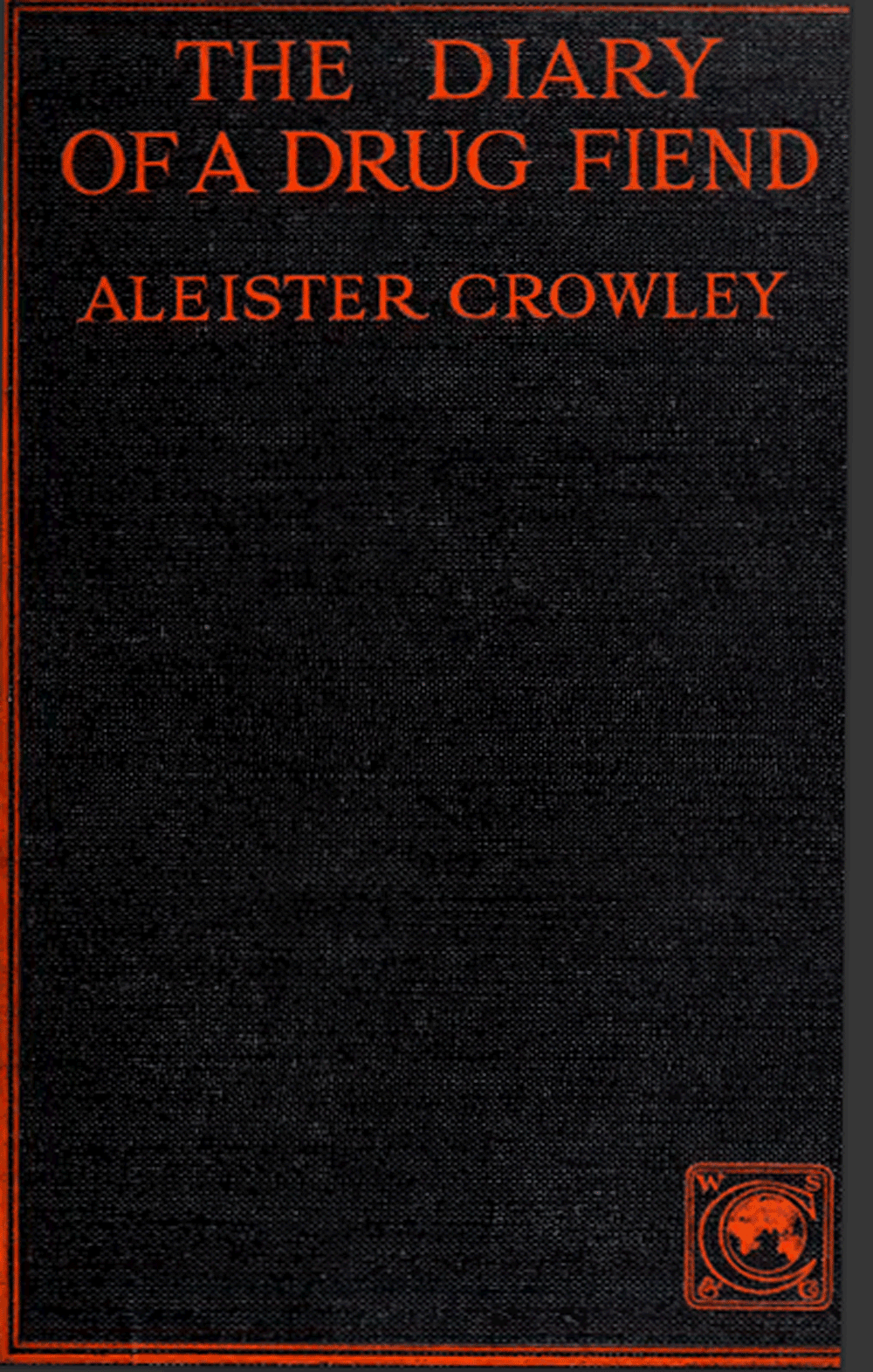
This is the only full-cast recording of Aleister Crowley's 1922 classic paeon to common sense. It is the first book -- and so far almost the only book -- to stake out a philosophy of drug use that is compatible with human freedom, one in which we learn to use drugs as wisely as possible for the benefit of humanity. This recording was produced by the Drug War Philosopher and your purchases help support his effort to push back against the tragically counterproductive policy of drug prohibition, in the name of human freedom and of humanity's right to heal.
No cookies, no ads paid for by amoral and immoral billionaires (or trillionaires).
Unless otherwise indicated, no AI is used in the creation of site content. These essays represent the original ideas of their author and not the ideas that the author SHOULD have based on an algorithmic parsing of existing data. For more on this subject, consider the AI-related viewpoints to which the author subscribes as delineated in the New York Times opinion piece entitled "What 370,000 College Essays Tell Us About A.I.’s Effects on Creativity" by Rebecca Winthrop of the Brookings Institution.









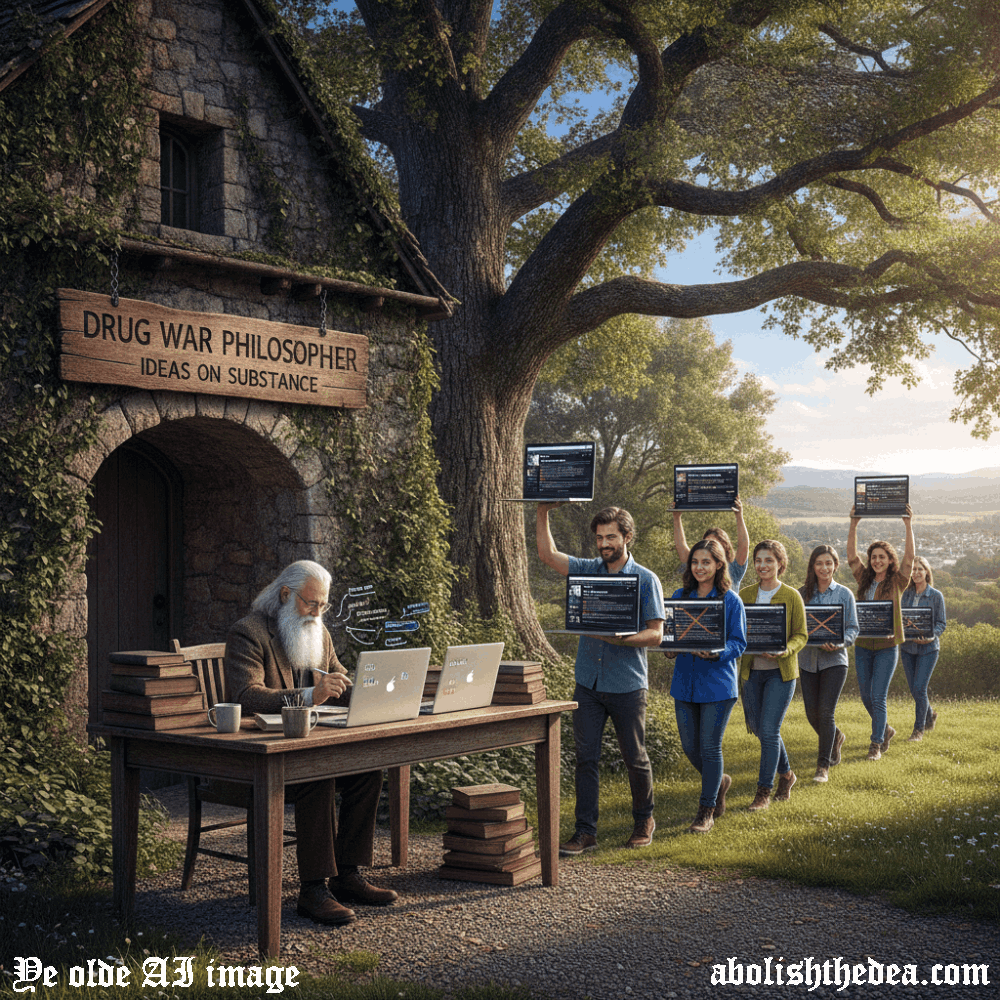 I have decided to respond to some of the plethora of bamboozled authors who write in complete ignorance of the effects of drug prohibition on subjects like depression and assisted suicide, for instance. I'm finding as I do so that some Stackers post multiple notes daily, while others post click-bait: where they ask an open question, or better yet, solicit links to "interesting" posts. These would be great strategies if my goal were simply to elevate my short-term Substack enrolment, but as I am attempting to persuade real people to make real changes in the status quo, I will refrain. The good thing about responding to these posts, by the way, is that my responses write themselves. These notes irritate me so thoroughly that my fingers cannot keep up with the indignant input that my brain is sending their way. (My fingers are like: "Hold on there, we're typing as fast as we can!")

 (up)
(up)