NEWS FLASH: American Medical Association invites a mere patient to speak at the 2027 annual conference in Chicago!
conference planners defend decision, claim it 'should be amusing if nothing else'
by Brian Ballard Quass, the Drug War Philosopher
November 8, 2026
Ladies and Gentlemen of the scientific community, laypeople, and med-dependent patients who have been turned into wards of the healthcare state thanks to the outlawing of virtually all psychoactive medicines in the universe: welcome to the 2027 Conference of the American Medical Association here at the Hyatt Regency Hotel in Chicago. I would especially like to thank the delegates of the AMA for permitting me to lecture on the subject of Behavioral Healthcare from a Patient's Point of View. After years of telling me to "shut up and take my meds," that esteemed body finally decided to give me a time slot in which to pontificate at this year's conference. This astonished me at first since I had been ghosted and gaslit for years by the medical-industrial complex. I could not believe that they had finally decided that a mere patient should have a voice about healthcare. The AMA's original Code of Ethics made it very clear that we patients should keep our opinions to ourselves. I guess they got tired of my complaints and so they decided to toss me a bone. Of course, my surprise was somewhat abated when I realized that the one o'clock speaking time that I had been assigned was in the A.M. rather than the P.M. I suppose that accounts for the meager attendance and the fact that at least a dozen of you have shown up in your nightclothes. On the bright side, it's going to be a cozy session this morning since there are apparently no more than 50 of us in this cyclopean auditorium altogether. Well, I say cozy: it WOULD be cozy if you guys weren't so spread out. It looks like each of you has commandeered your own eight-person dinner table in the hopes that some server will show up shortly with coffee and bagels. Yes, I see you guys looking over hopefully in the direction of the kitchen. Busted!
Again, my topic today is Behavioral Healthcare from a Patient's Point of view. The issues that I will be covering include... Siri, run the bullet-point slideshow on screens 1 and 3 and place a picture of a pile of empty prescription bottles on the center screen directly behind me...
family medicine in the Colonial Era
the demonizing of self-medication
the influence of money on medicine
judging the effectiveness of drugs
the problem with blinded experiments
and finally...
the future of healthcare
And I will be covering these issues by introducing each with a relevant quotation from a book or article and then commenting on same.
Oh, good, I see that the staff is wheeling in the bagels. I've worked up quite an appetite trekking across this mile-long auditorium to ascend the dais. While we're waiting for the goodies, here's a fun fact: Do you know that a one-night stay in this joint would set you back 424 clams -- I mean if your employer weren't footing the bill? 424 clams. Now we know where all our money is going when we pay those doctors that we have to see every three months of our lives to get a prescription refill on a drug that we've been taking for 40 years, as if we were absolute children who couldn't be trusted to swallow a pill wisely. And look at the three enormous LED screens behind me. And the LED ceiling panels! And the sheer size of this place! I'm told it takes up 24,282 square feet. No wonder they call it the Grand Ballroom. We could play at least three separate games of football here during a coffee break. Speaking of which, there are at least three other ballrooms in this hotel, but those are less capacious. I wonder why they didn't send me to one of those. You don't think they gave me the wrong address, do you? Maybe there's a full house of attendees waiting for me even as we speak at the Plaza Ballroom on the street level. Let's see here, it says that the Plaza Ballroom accommodates just 250 guests. That's more like it. But then they probably don't serve bagels in that location, at least not at one o'clock in the morning. By the way, let me urge my fellow med-dependent patients not to be bashful around the serving staff. Be sure to ask for seconds if you want them. You might even ask them if they could fry up an omelet for you. You yourselves have helped to pay for all of the bells and whistles that you are surrounded with here, believe me.
Siri, show the first quote from the book by E. Richard Brown entitled Rockefeller's Medicine Men1 on screens 1 and 3 and a photo of 18th-century rural life in Colonial America on the center screen. Oh, and, Siri, please use your powers of inference and deduction to correctly anticipate and act upon all of my future audiovisual requirements automatically since I do not wish to irritate my auditors with repeated requests for your assistance in this quarter.
Now, then, before we criticize the modern healthcare system, let us remember what the modern system ended up replacing in the 18th century. As medical historian E. Richard Brown informs us:
Folk medicine was still widely used in the United States, particularly in the countryside but also in the cities. Every family had its traditional remedies that were part of the family lore, believed in and passed down from generation to generation. Generally, the young woman's own family's remedies prevailed in her new family. Some of the remedies undoubtedly acted as placebos, but many were certainly effective in providing relief and even cures. Such traditions were effective obstacles to the acceptance of scientific medicine.2
In other words, no one in the 18th century was saying, "Gee, if only we could put someone else in charge of our health care, wouldn't that be grand?! Yes, I am getting so tired of this damn healthcare freedom! When is someone ELSE going to start calling the shots for me?! When is someone ELSE going to start deciding for me what I need and when I need it?"
But so-called "rationalized medicine" was on the way, like it or not. Healthcare freedom would soon be a thing of the past. Scientific experts were going to start controlling the healthcare of individual American citizens, at least if billionaire philanthropists like John D. Rockefeller had anything to say about it. But to accomplish this goal, doctors first had to disempower individual citizens and rid them of the notion that they had a right to take care of their own health as they saw fit. It is easy to see, from this perspective, why doctors and other medical professionals would be willing to go along with drug prohibition without raising a fuss about the rights of individuals to heal and so forth. Drug prohibition renders doctors relevant, after all, it ensures that they cannot be ignored with impunity, since they're the ones with the prescription pads. To paraphrase Voltaire in his comments about God: "If drug prohibition did not exist, someone would have to create it," at least in a capitalist society wherein healthcare is looked at as a business opportunity. But notice how this new approach to healthcare ended up punishing women in particular. Not only did doctors put women out of business when it came to providing healthcare for their families, they went on to punish these would-be competitors of theirs by pathologizing what they assumed to be the behavior peculiar to their gender, what Heidegger might have called their feminine way of "being in the world." Doctors started sanctifying their own gender biases by claiming that they referred to objective female illnesses. They started claiming that a variety of symptoms evinced by females -- including anxiety, irritability, fainting, etc. -- were just various expressions of an actual illness called "hysteria," a term which one popular medical website defines as "an alleged mental health condition that explained away any behaviors or symptoms that made men... uncomfortable."3
The stifling effect of this presumptuous treatment of women by the medical industry is made clear in a short story entitled "The Yellow Wallpaper" by Charlotte Perkins Gilman published in 1892 in The New England Magazine.4 It concerns a woman dealing with a variety of conflicting and troublesome emotions after having given birth to a child. This story is a very significant piece of literature for my purposes here today. Not only does the plot unveil a social evil of the Victorian Age that was hidden in plain sight (the fact that males of the period, and doctors in particular, failed to take women seriously), but we can also learn much by considering how the moral of the story has changed for Americans over the years. But first a little background. The female protagonist introduces us to John, her husband/doctor who refuses to believe her when she says that she is ill. "You are gaining flesh and color, your appetite is better," says John. "I feel really much easier about you." John prescribes bed rest for his "little girl," refusing for even one moment to acknowledge that her psychological complaints are anything more than willful vagaries on her part. "It is a false and foolish fancy," he tells her. He insists that she is getting better, and when she denies it, he gets mad -- or else extraordinarily condescending, as the following two citations make clear:
'Better in body perhaps'—I began, and stopped short, for he sat up straight and looked at me with such a stern, reproachful look that I could not say another word.5
'Bless her little heart!' said he with a big hug; 'she shall be as sick as she pleases! But now let’s improve the shining hours by going to sleep, and talk about it in the morning! 6'
It quickly becomes apparent to the reader that this troubled woman is being smothered both by the hawklike attention of her know-it-all husband and by the narrow confines of the bedroom in which she is encouraged (indeed almost ordered) to remain so that she can "rest" and get over this crazy idea of hers that she is ill. As she narrates her own story, we see that she understands her situation just as well as we do as her readers. She sees what's going on. She is just too unsure of herself to admit that fact to herself, let alone to her self-satisfied husband. She seems to have internalized her husband's impression of her as an indecisive non-entity on the intellectual front. But this stifled sagacity on her part is evident at the very beginning of the story when she tells the reader that:
John is a physician, and perhaps—(I would not say it to a living soul, of course, but this is dead paper and a great relief to my mind)—perhaps that is one reason I do not get well faster. You see, he does not believe I am sick!
Of course, the reader soon realizes that the narrator is indeed sick, but not in a way that John would be capable of imagining, or even willing to imagine, for that matter. She is sick, all right, but not from any physical illness. She is a sort of Everywoman of the Victorian era, a woman who is sick of being treated like a China doll and who wants to get out in the world and live and make a difference and be looked upon as a grown adult rather than as a child.
This, indeed, has been the generally accepted takeaway message of the story since its publication. It is a story about the sexism of the Victorian Age and the tendency of men to treat women like children, to refuse to take them seriously as responsible agents in life. But this takeaway message has changed in a significant and telling way in the 21st century, judging by the story synopsis that was provided for me this morning by ASK AI. Bear in mind here that the name "ASK AI" could be read as "ASK ANGLOPHONES," since the answers that it compiles for us are based on data created by that demographic. The AI answers represent what Anglophones, and especially Americans, tend to think about a given topic. That is why I was disturbed when ASK AI told me unequivocally, in the very first sentence of its story synopsis, that, and I quote...
The Yellow Wallpaper is a short story by Charlotte Perkins Gilman that follows an unnamed woman suffering from post-partum depression.
"Really?", I said to myself. Do you see what AI is telling us here, people? AI is telling us that the female protagonist of the story was NOT an Everywoman, after all. She was not suffering from the misogynistic effects of a pathological social mindset. She was merely a sick person whose condition had been misdiagnosed by a clueless doctor. She did not simply encounter the low spirits that sometimes follow child birth; she "had" a board-certified disease, in the way that some people "have" the flu: she was "suffering from post-partum depression." This is not a story about the complexity of human relationships in the complicated social milieu of modern society; according to AI, it's a story about brain chemistry gone awry. It's a story about the way that doctors failed to recognize the existence of a specific illness.
This synopsis does a great injustice to the author. I read her story as a protest in favor of liberty of action and the right to be taken seriously by society, especially if you are a woman, but also if you belong to any demographic that the mainstream finds it easy to ignore, like med-dependent patients, for instance. But AI has converted the tale into an infomercial about post-partum depression. John's real problem, according to this reading, was that he was born before medical doctors had discovered the illness of that name. And here we see the problem that results when we consider life challenges to be physical illnesses7. It takes our eyes off the prize. It blinds us to the social causes of problems. And this is not surprising. The whole medical system was created with a view toward "taking our eyes off the prize" when it comes to diagnosing social problems. The goal of Rockefeller's medical philanthropy as overseen by Frederick T. Gates was to generate profit while whitewashing the capitalist system in the eyes of its workers, to make the "system" seem fair to the hoi polloi. The last thing that Rockefeller wanted us to do was to blame society for health problems. But then everything could not be blamed on genes and biochemistry. This is why the medical pundits decided to play dirty in the mid-20th century: they started blaming poor people for the health problems caused by the shabby environmental conditions in which they lived.
Perhaps the ultimate absurdity of this position blames lead poisoning of young children in low-income neighborhoods on maternal deprivation and "permissive socialization of oral behavior" — instead of on landlords who fail to remove the lead-based paint peeling from walls of their rental units and to repaint with lead-free paint now required by law. 8
Sure, one can find biochemical correlates associated with post-partum depression, but then one could find biochemical correlates associated with anger and jealousy and fear as well. That does not mean that any of these human responses to life challenges are literal illnesses. And before we let the medical-industrial complex convince us otherwise, we should consider the financial interest that they have in doing so. And I want you to notice something here, folks. The modern healthcare professionals are on the side of John in this story by Charlotte Perkins Gilman. They are on the side of the presumptuous bad guy. They are like so many bulls in a china shop, storming into the protagonist's bedroom and saying: "All right, we've got this, lady. Friends and loved ones, leave the room. This is our territory, we call dibs. This woman is an obvious victim of post-partum depression, if we've ever seen one. She may yammer, as it were indirectly, about her need to be free and to express herself in life and so forth, but that's just her illness talking. What she really needs are 'meds' and plenty of them -- scientifically created meds made by scientific doctors -- meds that will fix her brain chemistry so that she will no longer be so unreasonable and uncooperative. In other words, folks: it's time for us to break out the appointment book and start writing prescriptions, after charging her $300 for this first-time visit, of course, after which we'll closely monitor her condition every three months going forward and provide her with her refill prescriptions at $200 a pop."
And yet Americans remain charmingly naive about the motivations of the members of the medical-industrial complex, apparently just as naive as the self-deluded medical professionals themselves. And what about their blithe acceptance of drug prohibition? They seem to think that doctors are merely being loyal to their Hippocratic oath when they denounce the use of near-panaceas like opium and coca, failing to realize that these doctors have an enormous financial interest for despising drugs, even if they are not consciously aware of the fact. The medical-industrial complex would be significantly smaller than it is today -- and the behavioral healthcare sector would scarcely even exist! -- were it not for drug prohibition that outlaws all the substances wherewith Americans used to be able to treat their own dispositions by themselves in the Colonial Era. As Falstaff used to say, "Reason, you rogue! Reason!" This helps explain why our scientific experts cannot understand how cocaine or opium or laughing gas could help the depressed. All of those drugs could be used without causing unwanted dependency for most people, and where's the money in that? Doctors need to be able to prescribe drugs for which dependency is a feature, not a bug, if they are going to buy McMansions in the suburbs -- or spend so much as one single night at the Hyatt Regency Hotel in Chicago on their own dime. Hence the psychiatric pill mill that has turned some of us here today into children for life and into wards of the healthcare state.
But it's not just that medical scientists are motivated by financial considerations. The very fact that they are medical scientists renders them unqualified to discuss the propriety of drug use, by which I mean the use of psychoactive substances. This is because drug use creates a variety of mental states that that people consider to be beneficial to them. Mental states, not physical states. Now, the doctors may think that these states are not "really" beneficial, but that is a metaphysical claim on their part, not a rational fact with which all reasonable minds must concur. Consider the following report recorded by the user of a phenethylamine in Pihkal by American chemist Alexander Shulgin:
I am overcome by the profundity of the experience, and how much more powerful it was than previous experiences, for no apparent reason, other than a continually improving state of being. All the next day I felt like 'a citizen of the universe' rather than a citizen of the planet, completely disconnecting time and flowing easily from one activity to the next.9
Now, imagine a medical doctor responding to that report as follows:
"No, you only FELT like you were 'a citizen of the universe', Sally, you were not really turned into an actual 'citizen of the universe.'" You see the problem here? The feeling of the experience is all that matters when it comes to psychoactive medicines. The user felt like a citizen of the universe? Okay, then, that was a benefit of her drug use in this case, end of story. But the doctor is not satisfied. After all, Sally's viewpoint is subjective. He's like, "Well, you're entitled to your own opinion, I suppose, Sally, but only I as a doctor get to decide if the experience REALLY helped you -- so check back with me in a couple weeks and I'll let you know." Sounds nutty? You bet it is.
This brings up a related problem: namely, the scientific fetish for blind and double-blind experiments in the clinical realm when it comes to researching drug effects. Researchers don't realize that mind is a necessary part of the drug-aided experience -- that drug experiences are created as part of a joint venture between mind and substance. It's pointless to ask, "Yes, but what does this substance do when the mind is not prepared to use it and is not expecting any positive results whatsoever?" That's like asking, "Yes, but how will this car drive when we remove all the wheels?" The answer to such questions would not tell us anything about the price of tea in China. If scientists want to find out what a drug does by itself, they can always slip a mickey into the soda cans of their study participants, but such studies will tell us nothing about what a psychoactive substance will achieve when used correctly, i.e., when it is used purposefully by a goal-directed mind for the purpose of bringing about a desired state of mind.
Let me end my harangue with another quotation from Joseph Gabriel, author of "Medical Monopoly - Intellectual Property Rights and the Origins of the Modern Pharmaceutical Industry":
The past teaches us that the world can be other than it is, that we have arrived at the current moment through contingent processes, and that the future is up for grabs. The therapeutic market might be organized differently; science and profit might be delinked from one another or rear-arranged in some unforeseeable way; patenting, trademarks, and other forms of intellectual property might be replaced by some other type of social arrangement. Health itself might mean something completely different. Who knows? 10
"Who knows?", asks Joseph, to which I respond as follows, like a grade-schooler with a brainstorm:
Oh, me! Me! I know, Joseph! I know how to delink science and profit when it comes to healthcare! Me, me, me!
Mind you, my solution is not going to go over well with the John D. Rockefellers of the world, but here goes. We delink science and profit by restoring the power of families and individuals to take care of their own health as they see fit. That's it. Surely, this is the solution to the problem that best satisfies the requirements of Occam's Razor. All we need to do is to restore a right that has been in effect since the beginning of recorded history, one's right to take care of their own health as they see fit. And how do we accomplish that? Simply by ending drug prohibition, AKA our country's deadly and unprecedented experiment with the wholesale outlawing of psychoactive medicine.
It's funny, really. In Medical Monopoly, we learn of the attempts of self-styled "ethical" doctors to eliminate the financial motive in the healthcare field and of their opposition to medical patents in particular, a repugnance that the medical field in America would require almost a century to overcome. But these doctors failed to realize that they themselves were part of the problem. In fact, they themselves created the problem out of whole cloth. The medical field became financially motivated the moment that doctors placed themselves in charge of our personal healthcare, the healthcare of individuals like you and I. This was the silent coup that transpired rapidly in the early 19th century under the cover of America's naive faith in the powers of "objective science," a coup in which healthcare power was taken from the individual and handed to condescending doctors like John from the story mentioned above, with the considerable help of billionaire philanthropy of course. If doctors really wished to behave ethically, they would, 1, restore our healthcare rights, and 2, rebrand themselves as healthcare counselors, as medically informed resources that could be tapped for a fee by those who believe that medical science as an institution has something to offer them in any particular instance. Because as William James well knew, the materialist approach is not the only way to provide healthcare. There are other ways of healing about which today's scientist are dogmatically blind, as for instance the psychological healing described above in the user report of the phenethylamine synthesized by Alexander Shulgin. If I want an holistic approach to my mental, emotional or spiritual state, I should not need a "by your leave" from materialist doctors. We need to revoke the materialist's monopoly on health care and end drug prohibition. Only then will we have healthcare empowerment in America.
Siri, play some canned applause and then display the following takeaway message on all three screens:
END DRUG PROHIBITION NOW. RESTORE OUR RIGHT TO HEAL.
Notes for essay entitled NEWS FLASH: American Medical Association invites a mere patient to speak at the 2027 annual conference in Chicago!: conference planners defend decision, claim it 'should be amusing if nothing else':
The 1932 movie "Scarface" starts with on-screen text calling for a crackdown on armed gangs in America. There is no mention of the fact that a decade's worth of Prohibition had created those gangs in the first place.
If I have no right to mother nature's bounty, then I surely have no right to manmade guns. If hysterical fearmongering justifies the eradication of the Fourth Amendment, then the Second Amendment should go as well.
We drastically limit drug choices, we refuse to teach safe use, and then we discover there's a gene to explain why some people have trouble with drugs. Science loves to find simple solutions to complex problems.
I might as well say that no one can ever be taught to ride a horse safely. I would argue as follows: "Look at Christopher Reeves. He was a responsible and knowledgeable equestrian. But he couldn't handle horses. The fact is, NO ONE can handle horses!"
Drug prohibition is a crime against humanity.
A company will be put out of business if someone happens to die while using "drugs," even if the drug was not really responsible for the death.
M. Pollan says "not so fast" when it comes to drug re-legalization. I say FAST? I've gone a whole lifetime w/o access to Mother Nature's plants. How can a botanist approve of that? Answer: By ignoring all legalization stakeholders except for the kids whom we refuse to educate.
Prohibition turned habituation into addiction by creating a wide variety of problems for users, including potential arrest, tainted or absent drug supply, and extreme stigmatization.
Ann Lemke's case studies make the usual assumptions: getting free from addiction is a morality tale. No reference to how the drug war promotes addiction and how banned drugs could solve such problems. She does not say why daily SSRI use is acceptable while daily opium use is not. Etc.
Drug warriors do not want to end "addiction": it's their golden goose. They use the threat of addiction to scare us into giving up our democratic freedoms, like that once supplied by the 4th amendment.
Break the ice with a sledgehammer: place this book on your coffee table.
This book features 150 annotated images, designed to force brainwashed Americans to confront the fact that drug prohibition is wrong. Here is what author Richard Parrish II says of the book's compiler: "The drug prohibition philosopher provides first-hand, principled, persuasive, and insightful arguments against the current drug prohibition regime..."
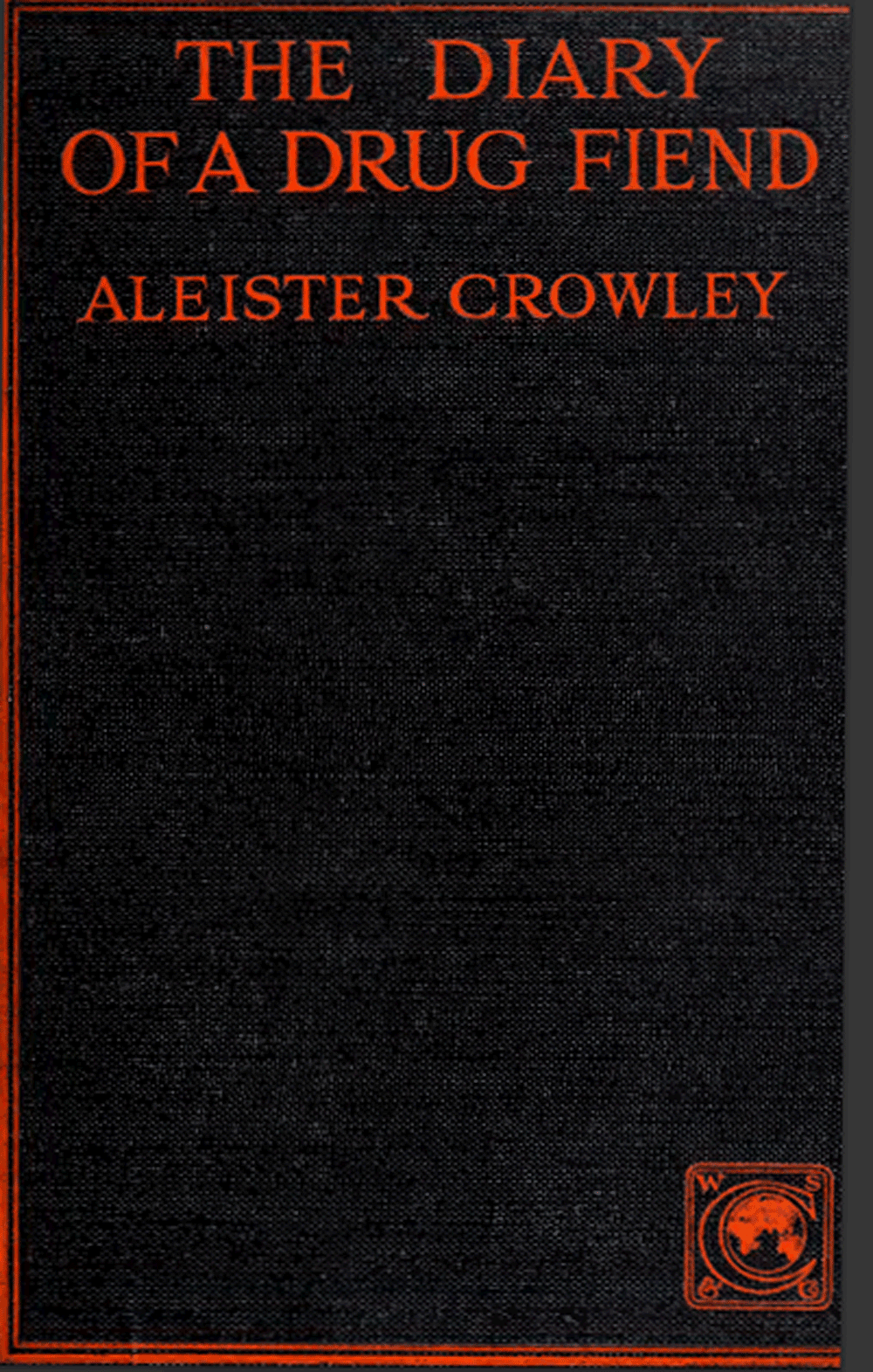
This is the only full-cast recording of Aleister Crowley's 1922 classic paeon to common sense. It is the first book -- and so far almost the only book -- to stake out a philosophy of drug use that is compatible with human freedom, one in which we learn to use drugs as wisely as possible for the benefit of humanity. This recording was produced by the Drug War Philosopher and your purchases help support his effort to push back against the tragically counterproductive policy of drug prohibition, in the name of human freedom and of humanity's right to heal.
No cookies, no ads paid for by amoral and immoral billionaires (or trillionaires).
Unless otherwise indicated, no AI is used in the creation of site content. These essays represent the original ideas of their author and not the ideas that the author SHOULD have based on an algorithmic parsing of existing data. For more on this subject, consider the AI-related viewpoints to which the author subscribes as delineated in the New York Times opinion piece entitled "What 370,000 College Essays Tell Us About A.I.’s Effects on Creativity" by Rebecca Winthrop of the Brookings Institution.








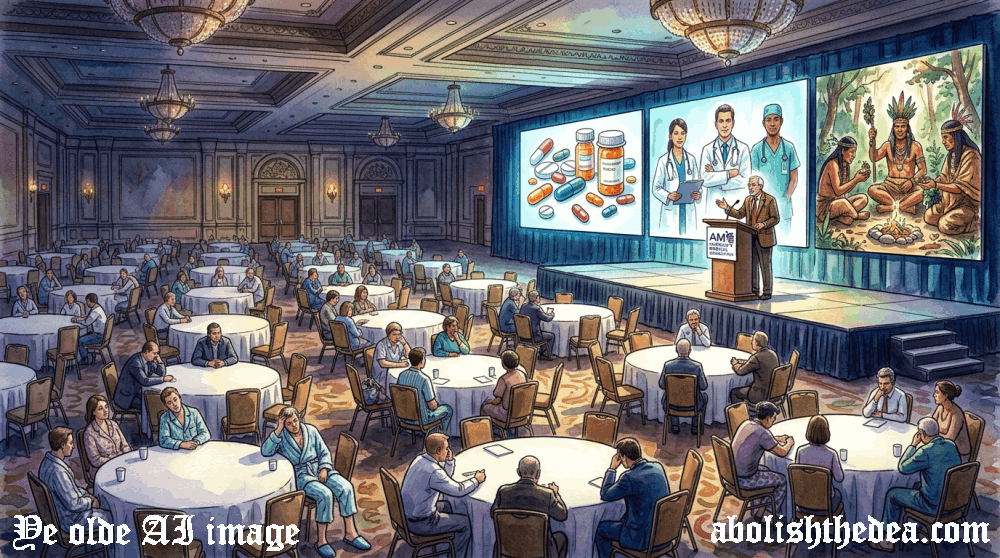 Ladies and Gentlemen of the scientific community, laypeople, and med-dependent patients who have been turned into wards of the healthcare state thanks to the outlawing of virtually all psychoactive medicines in the universe: welcome to the 2027 Conference of the American Medical Association here at the Hyatt Regency Hotel in Chicago. I would especially like to thank the delegates of the AMA for permitting me to lecture on the subject of Behavioral Healthcare from a Patient's Point of View. After years of telling me to "shut up and take my meds," that esteemed body finally decided to give me a time slot in which to pontificate at this year's conference. This astonished me at first since I had been ghosted and gaslit for years by the medical-industrial complex. I could not believe that they had finally decided that a mere patient should have a voice about healthcare. The AMA's original Code of Ethics made it very clear that we patients should keep our opinions to ourselves. I guess they got tired of my complaints and so they decided to toss me a bone. Of course, my surprise was somewhat abated when I realized that the one o'clock speaking time that I had been assigned was in the A.M. rather than the P.M. I suppose that accounts for the meager attendance and the fact that at least a dozen of you have shown up in your nightclothes. On the bright side, it's going to be a cozy session this morning since there are apparently no more than 50 of us in this cyclopean auditorium altogether. Well, I say cozy: it WOULD be cozy if you guys weren't so spread out. It looks like each of you has commandeered your own eight-person dinner table in the hopes that some server will show up shortly with coffee and bagels. Yes, I see you guys looking over hopefully in the direction of the kitchen. Busted!


 (up)