








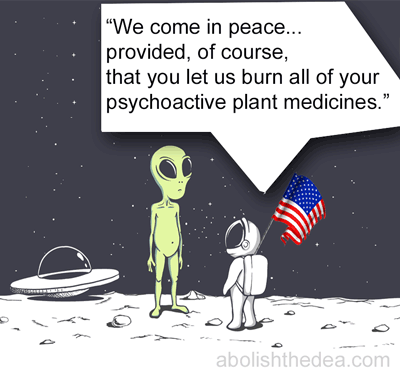
 1) What is the satirical message of this short drama?
 Cop and detective shows are loaded with subtle drug war propaganda, including lines like, "She had a history of drug use, so..." The implication being that anyone who uses substances that politicians hate cannot be trusted.
If I smoke opium nightly, I am a drug scumbag. If I use Big Pharma "meds" every day of my life, I am a good patient.
I have nothing against science, BTW (altho' I might feel differently after a nuclear war!) I just want scientists to "stay in their lane" and stop pretending to be experts on my own personal mood and consciousness.
"They have called thee Soma-lover: here is the pressed juice. Drink thereof for rapture." -Rig Veda
(There would be no Hindu religion today had the drug war been in effect in the Punjab 3,500 years ago.)
We give kids drugs to improve their concentration -- but if adults use drugs to concentrate, we call them names and throw them in jail.
That's another problem with "following the science." Science downplays personal testimony as subjective. But psychoactive experiences are all ABOUT subjectivity. With such drugs, users are not widgets susceptible to the one-size-fits-all pills of reductionism.
Drug war pundits need to stop using the word "snorts" when it comes to cocaine. We "take" our "meds," and yet we "snort" cocaine, just like a pig. That is NOT neutral language, folks!
The DEA conceives of "drugs" as only justifiable in some time-honored ritual format, but since when are bureaucrats experts on religion? I believe, with the Vedic people and William James, in the importance of altered states. To outlaw such states is to outlaw my religion.
In the Atomic Age Declassified, they tell us that we needed hundreds of thermonuclear tests so that scientists could understand the effects. That's science gone mad. Just like today's scientists who need more tests before they can say that laughing gas will help the depressed. Science today is all about ignoring the obvious.
Drug Warriors never take responsibility for incentivizing poor kids throughout the west to sell drugs. It's not just in NYC and LA, it's in modest-sized towns in France. Find public housing, you find drug dealing. It's the prohibition, damn it!
Cop and detective shows are loaded with subtle drug war propaganda, including lines like, "She had a history of drug use, so..." The implication being that anyone who uses substances that politicians hate cannot be trusted.
If I smoke opium nightly, I am a drug scumbag. If I use Big Pharma "meds" every day of my life, I am a good patient.
I have nothing against science, BTW (altho' I might feel differently after a nuclear war!) I just want scientists to "stay in their lane" and stop pretending to be experts on my own personal mood and consciousness.
"They have called thee Soma-lover: here is the pressed juice. Drink thereof for rapture." -Rig Veda
(There would be no Hindu religion today had the drug war been in effect in the Punjab 3,500 years ago.)
We give kids drugs to improve their concentration -- but if adults use drugs to concentrate, we call them names and throw them in jail.
That's another problem with "following the science." Science downplays personal testimony as subjective. But psychoactive experiences are all ABOUT subjectivity. With such drugs, users are not widgets susceptible to the one-size-fits-all pills of reductionism.
Drug war pundits need to stop using the word "snorts" when it comes to cocaine. We "take" our "meds," and yet we "snort" cocaine, just like a pig. That is NOT neutral language, folks!
The DEA conceives of "drugs" as only justifiable in some time-honored ritual format, but since when are bureaucrats experts on religion? I believe, with the Vedic people and William James, in the importance of altered states. To outlaw such states is to outlaw my religion.
In the Atomic Age Declassified, they tell us that we needed hundreds of thermonuclear tests so that scientists could understand the effects. That's science gone mad. Just like today's scientists who need more tests before they can say that laughing gas will help the depressed. Science today is all about ignoring the obvious.
Drug Warriors never take responsibility for incentivizing poor kids throughout the west to sell drugs. It's not just in NYC and LA, it's in modest-sized towns in France. Find public housing, you find drug dealing. It's the prohibition, damn it!


 (up)
(up)