








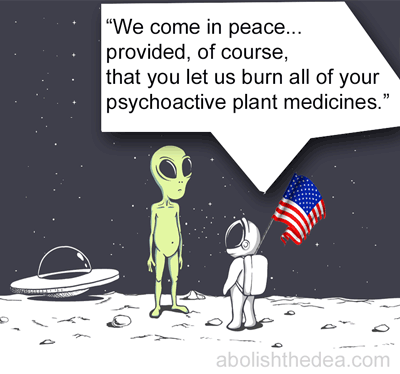
 1) What is the satirical message of this short drama?
 In "Psychedelic Refugee," Rosemary Leary writes:
"Fueled by small doses of LSD, almost everything was amusing or weird." -- Rosemary Leary
In a non-brainwashed world, such testimony would suggest obvious ways to help the depressed.
If drug war logic made sense, we would outlaw endless things in addition to drugs. Because the drug war says that it's all worth it if we can save just one life -- which is generally the life of a white suburban young person, btw.
Drug war pundits need to stop using the word "snorts" when it comes to cocaine. We "take" our "meds," and yet we "snort" cocaine, just like a pig. That is NOT neutral language, folks!
I'm told that science is completely unbiased today. I guess I'll have to go back and reassess my doubts about Santa Claus and the Tooth Fairy.
One merely has to look at any issue of Psychology Today to see articles in which the author reckons without the Drug War, in which they pretend that banned substances do not exist and so fail to incorporate any topic-related insights that might otherwise come from user reports.
It is evil to give the depressed drugs to help them die while barring them from using drugs that could make them wish to live.
If there were no other problem with antidepressants, they would be wrong for the simple reason that they make a user dependent for life -- not as a bug (as in drugs like opium) but rather as a feature: that's how they "work," by being administered daily for a lifetime.
Pundits tell us that there are medical reasons not to "snort" cocaine. So what? There are medical reasons not to drive a car: you may have an accident. The question is: does cocaine use or car driving make sense in a given case! Details matter!
The Drug Warriors say: "Don't tread on me! (That said, please continue to tell me what plants I can use, how much pain relief I can get, and whether my religion is true or not.)"
If opium and cocaine were re-legalized, hospital buildings would no longer be the secular cathedrals of our time. Some of that wealth would actually go to healthy people.
In "Psychedelic Refugee," Rosemary Leary writes:
"Fueled by small doses of LSD, almost everything was amusing or weird." -- Rosemary Leary
In a non-brainwashed world, such testimony would suggest obvious ways to help the depressed.
If drug war logic made sense, we would outlaw endless things in addition to drugs. Because the drug war says that it's all worth it if we can save just one life -- which is generally the life of a white suburban young person, btw.
Drug war pundits need to stop using the word "snorts" when it comes to cocaine. We "take" our "meds," and yet we "snort" cocaine, just like a pig. That is NOT neutral language, folks!
I'm told that science is completely unbiased today. I guess I'll have to go back and reassess my doubts about Santa Claus and the Tooth Fairy.
One merely has to look at any issue of Psychology Today to see articles in which the author reckons without the Drug War, in which they pretend that banned substances do not exist and so fail to incorporate any topic-related insights that might otherwise come from user reports.
It is evil to give the depressed drugs to help them die while barring them from using drugs that could make them wish to live.
If there were no other problem with antidepressants, they would be wrong for the simple reason that they make a user dependent for life -- not as a bug (as in drugs like opium) but rather as a feature: that's how they "work," by being administered daily for a lifetime.
Pundits tell us that there are medical reasons not to "snort" cocaine. So what? There are medical reasons not to drive a car: you may have an accident. The question is: does cocaine use or car driving make sense in a given case! Details matter!
The Drug Warriors say: "Don't tread on me! (That said, please continue to tell me what plants I can use, how much pain relief I can get, and whether my religion is true or not.)"
If opium and cocaine were re-legalized, hospital buildings would no longer be the secular cathedrals of our time. Some of that wealth would actually go to healthy people.


 (up)
(up)