Homepage of the Drug War Philosopher, Brian Quass
blog icon orange rss icon with stylized radio waves bird icon for twitter bird icon for twitter substack icon


back navigation arrow forward navigation arrow


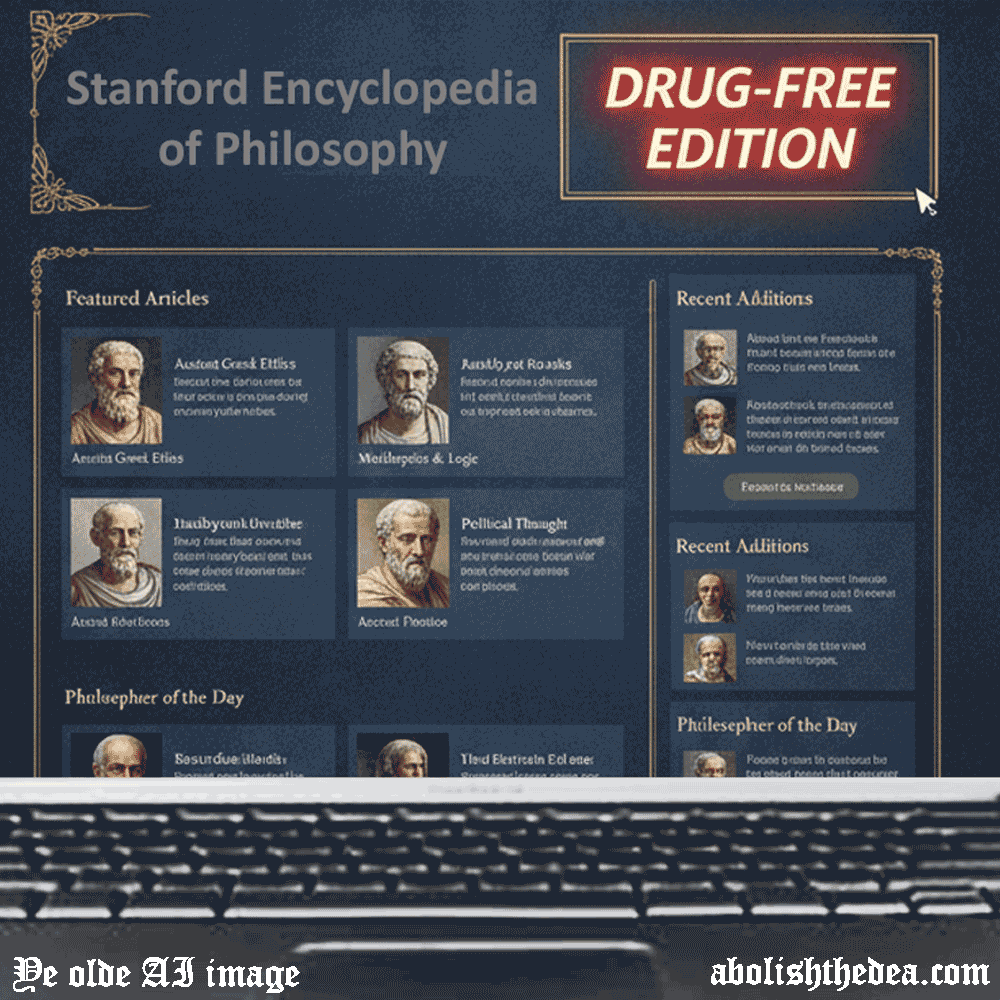
Stanford University rewrites the life of William James to conform with America's drug biases

The Stanford Encyclopedia of Philosophy says nothing about James' work with laughing gas

by Brian Ballard Quass, the Drug War Philosopher (Substack version)

September 29, 2026


It's official. When the Stanford Encyclopedia of Philosophy ignored the use of laughing gas by William James in their lengthy online article about the man1, it was not an accident. This is clear from the response that I received this morning to my complaints on this subject from Uri Nodelman, a "co-principal editor" of the encyclopedia in question.

Dear Brian,

Thanks for writing. The author of the current version of the entry on William James has stepped down from further work on it. We are in the process of getting a new entry to replace the current one, but we have not yet seen a draft. So it may be some time before a new version of the entry appears.

I should also mention that SEP authors have some discretion as to what biographical details of a figure's life they include -- subject to peer review. But once the new version appears, you are welcome to write back with any content suggestions -- either to us or directly to the author.

Yours,
Uri


Before parsing this response, I should probably bring the reader up to speed on the issues involved here. In "The Varieties of Religious Experience," William James insisted that the use of laughing gas had changed his whole philosophy of perception and consciousness.

Some years ago I myself made some observations on this aspect of nitrous oxide intoxication, and reported them in print. One conclusion was forced upon my mind at that time, and my impression of its truth has ever since remained unshaken. It is that our normal waking consciousness, rational consciousness as we call it, is but one special type of consciousness, whilst all about it, parted from it by the filmiest of screens, there lie potential forms of consciousness entirely different.2


William James even goes so far as to urge his fellow philosophers to follow up his studies of consciousness using nitrous oxide themselves. James insisted that we study what we might call altered states. I submit that there are only two reasons why Stanford would ignore this aspect of James's work, his "hands-on" study of the nature of consciousness: 1) because to mention that work would run afoul of drug-war ideology, according to which drugs (i.e., psychoactive substances of any kind) must be thought to have no positive uses whatsoever; and 2) because the materialist establishment at Stanford has a biochemical bias about the nature of consciousness and would therefore prefer to ignore James's work on this subject altogether. I believe that both motives are at play in this case. I believe that America's drug-hating sensibilities are doing the "dirty work" for Stanford by giving them an excuse (or at least the veneer of an excuse) to censor James's work in the name of fighting drugs and drug use of any kind.

Be that as it may, let us turn to the response that I received this morning.

Uri begins by telling me that the author of the article on James "has stepped down from further work on it." The obvious response to this is, "I beg your pardon, but so what?" If I wrote to report that the author, Ronald Goodman, had used the F word five times in the article, surely Uri would not respond by telling me that the author had "stepped down from further work on it." So this first sentence struck me as a non-sequitur. Nevertheless, the response makes Stanford's position exceedingly clear on this subject: they see no problem in ignoring the fact that the use of nitrous oxide completely changed the worldview of William James.

And this is highly problematic. How can one possibly think that it is fair to write a biography about ANY person while ignoring something that the individual him or herself tells us changed their entire way of thinking about the world? This would be bad enough in a free world, but in the age of drug prohibition, such omissions as Stanford's serve to normalize drug prohibition by rewriting history in a way that suggests that psychoactive substances can have no beneficial uses whatsoever. In my view, this is at once unconscionable and predictable. This is what drug prohibition does. Like Darwinism, it is a universal solvent. The ideology of drug prohibition eats through all democratic norms, including that of academic freedom.

In sentences two and three, Uri kind of "rubs it in," from my point of view. He tells me in effect that, not only is Stanford not interested in correcting the oversight about James in their entry and the implicit distortion of James's views that it entails, Uri is telling me that I'd better get used to it because the article is going to be around, unchanged, until further notice -- even now that the "peers" of the peer review process have been alerted to the disservice that the article does to James's legacy. Yes, there is a new article "in the pipes," but God alone knows when it will actually appear.

No wonder that I am the only philosopher who formally protested the outlawing of nitrous oxide in the name of academic freedom and the legacy of William James when the FDA convened public hearings in 2023 to discuss a proposal for treating laughing gas as a "drug,"3 as if the gas were not already drastically underused for both philosophical and healing purposes. My fellow philosophers are unable to see any connection between drug prohibition and the end of academic freedom. These, of course, are the same philosophers who see no connection between assisted suicide for the depressed and the drug prohibition that outlaws all substances that could help make the depressed wish to live.4

Uri does hold out a faint hope in the second short paragraph of his response. He invites me to write in again should I have any scruples about the new biography of William James, one which is apparently on the way, at some time or other, although I shouldn't hold my breath while waiting for it to appear. It is not clear what good my feedback would do on that new article, however: if Uri and his colleagues see no problem with Goodman ignoring James's strategic substance use, why would they be bothered if a future author made that same omission? Meanwhile, Uri writes as if there were a "read only" time-lock on the current article and that only when a new article appears could changes to the original be so much as contemplated.

As for writing to the author of the current article, I did try precisely that just over three years ago. I wrote to Russell Goodman, politely advising him of the oversights mentioned above and of their implications with regard to academic freedom and the study of human consciousness. And he replied as follows:

Dear Brian, if I may, Thanks for alerting me to this issue.


That's it. "Thanks for alerting me to this issue." I feared that this was a brushoff, even back in 2023, but I yet held out hope that Goodman would take some action, given the fact that, at least technically speaking, he had acknowledged that the points which I had raised were constitutive of an "issue," which, as Merriam Webster informs us, refers to an "unsettled matter" and hence something that is potentially ripe for change. But we're told today that the author has since stepped down from further work on his article, apparently never having been quite able to see his way clear to answer our clarion call for academic freedom.

I can praise Russell and Uri for one thing, however: they are the only academics who have ever actually responded to my complaints about the modern academic world's silence about William James's work with nitrous oxide. But in doing so, they only confirmed what I have long suspected: that most academics have censored themselves when it comes to drugs, and that this position is nonnegotiable for them given that their own prestige and livelihood depends on that censorship.

AFTERWORD

The good news is that the work encouraged by William James on the nature of consciousness has not stopped. It is continuing outside the academy with the help of what James Fadiman would call "citizen scientists," which, of course, means "law breakers" in the age of drug prohibition. In the last two decades, there has been a proliferation of websites by nobodies like myself created to share experiences about DMT-inspired "trips" in particular. There are even some attempts to begin philosophizing about those experiences.5 6 7 8

Finally, an important caveat: not all academics have thrown in the towel. The subject is at least straddling the Ivory Tower with the help of organizations like the Center for Process Studies.9

Speaking of which, I just now saw a speech from 2023 that was sponsored by that latter organization. It was a 23-minute YouTube presentation entitled "Process Psychonautics: Whitehead and Psychedelic Research" by Dr. Peter Sjöstedt-Hughes. 10 His comments inspired me. They convinced me that Peter, at least, might understand my thesis that Whitehead's philosophy helps explain my disempowerment when it comes to my healthcare. So thinking, I tapped out a brief email to the professor of mind and consciousness studies at the University of Exeter in an attempt to spark a dialogue in which we could compare notes on the topic.

Alas, when will I ever learn.

Scarcely had I clicked the Gmail "send" button, when I received an automated reply from Peter, admonishing me that he had no time to read my "book" about consciousness but that he wanted to thank me all the same for at least TRYING to get in touch with him. He was, as it turned out, far too busy to respond to most emails, but kudos for at least trying! The bot continued as follows, basically saying: "Don't blame yourself. How could YOU know that I am such a busy person?" I am not, of course, quoting the mail bot verbatim, but I am certainly capturing the spirit of its multiple remonstrances. That's all well and good, but I do think there should have been provisions in the mail bot response for one to make an appointment with Peter in his next incarnation -- since he's apparently "all booked up" for this particular life.

I know, I shouldn't take this rebuff personally, but I dislike these ham-fisted replies by mail bots. When did I even SAY anything about a book, for instance? That's why I stopped using Reddit; I was creeped out by all the bot messages that threatened me with censorship or worse, typically thanks to a wrongheaded interpretation of something that I had said on the subject of drugs.

Well, there's one good thing, I suppose. They always say that email has "gotten rid of the letter," but it seems that a physical letter is actually more important than ever these days. A letter allows one to bypass the Bot Police. It also helps to suggest to the recipient that the sender might actually have something to say and is not just following up on a whim.

The incident also reminds me how completely ignored I am. I should be so lucky as to be pestered like Peter is. I guess I'm just jealous of him: I'm secretly longing for the day when I too can tell the hoi polloi to beat it. But at least my bot will be honest. It will say something more like: "Come back another day when I've actually HEARD OF YOU!"

The basic assumptions have become much more cynical lately. Twenty years ago, when one was contacted online by someone with similar interests, one was like: "Cool! I'm being contacted by someone with similar interests!" Today, the response is more like: "Okay, now what's THEIR angle!"

THE DEAD LETTER DEPARTMENT

Well, it doesn't sound like Peter is going to even see my email, let alone give it a fair hearing, insofar as his bot has already classified it as "potential spam" or worse. But I'd hate to think that I wasted the half-hour that it took me to compose it. I will therefore print that document below, flattering myself in so doing with the idea that its contents will eventually be of interest to someone with a Whiteheadian turn of mind. I should first, however, provide this suppositious soulmate with the subject line of the email in question: namely, "Whitehead and Experiential Proof."

Good day, Peter, if I may,

I enjoyed your 2023 talk on "Process Psychonautics: Whitehead and Psychedelic Research." I wish you had been given more time. I was left wanting more.

For the last seven years, I have been writing essays about drug attitudes from the point of view of a patient who has been turned into a ward of the healthcare state by being shunted off onto dependence-causing "meds." In so doing, I have come to see how Whitehead's philosophy explains how my disempowerment came about with respect to my health care.

Here is one "for instance": our drug experts claim that psychoactive substances like laughing gas have no benefits for the depressed. Laughing gas! How could they be so blind? Whitehead gives us the answer when he tells us that:

"Scientific reasoning is completely dominated by the presupposition that mental functionings are not properly part of nature." 11


Basically, Whitehead tells us that modern science ignores everything that counts when it comes to human beings: how they experience the world. It is the resultant biochemical determinism that helps to normalize drug prohibition by keeping drug researchers from noticing the obvious potential benefits of drugs, to the point that they do not see how laughing could help the depressed. They insist that "proof of efficacy" must be analytic, not experiential.

This gibes with your comments, I think, that there is a kind of "proof" that science is not ready to accept: i.e., experiential truth.

I won't presume any further on your time, but if these topics interest you, I'd love to hear your thoughts.


"I won't presume any further on your time," indeed! I had already presumed far too much on Peter's time as far as his mail bot was concerned.


Notes for essay entitled Stanford University rewrites the life of William James to conform with America's drug biases: The Stanford Encyclopedia of Philosophy says nothing about James' work with laughing gas:

1: Goodman, Russell. 2017. “William James (Stanford Encyclopedia of Philosophy).” Stanford.Edu. 2017. https://plato.stanford.edu/entries/james/. (up)
2: James, William. 2016. The Varieties of Religious Experience. Goodreads. https://www.goodreads.com/book/show/28820.The_Varieties_of_Religious_Experience. (up)
3: Why the FDA should not schedule Laughing Gas DWP (up)
4: Claire Brosseau does not need the right to assisted suicide: she needs the right to take care of her own health as she sees fit DWP (up)
5: Riley. 2026. “Turning Off the Filter: A Deep Dive into DMT Entities.” Substack.Com. Spirit Residue. June 19, 2026. https://rileyraccoon.substack.com/p/turning-off-the-filter-a-deep-dive. (up)
6: Lopez, Raul. 2023. “DMT Entities.” Psychonaut Dream. August 24, 2023. https://psychonautdream.com/dmt-entities/. (up)
7: Luke, David. 2011. “Discarnate Entities and Dimethyltryptamine (DMT): Psychopharmacology, Phenomenology and Ontology.” Journal of the Society for Psychical Research. 2011. https://www.academia.edu/1010502/Discarnate_entities_and_dimethyltryptamine _DMT_Ps (up)
8: “The Entities · The DMT Atlas.” 2021. Dmtatlas.Com. 2021. https://dmtatlas.com/entities/. (up)
9: “Center for Process Studies.” n.d. Accessed September 29, 2026. https://www.youtube.com/@ctr4process. (up)
10: Process Psychonautics: Whitehead and Psychedelic Research Sjöstedt-Hughes, Peter , 2023 (up)
11: “Science and the Modern World : Whitehead, Alfred North, 1861-1947 : Free Download, Borrow, and Streaming : Internet Archive.” 2019. Internet Archive. 2019. https://archive.org/details/sciencemodernwor0000unse. (up)


read more essays here


Ten Tweets

against the hateful war on US


Even prohibition haters have their own list of drugs that they feel should be outlawed. They're missing the point. We should not drugs "up or down" any more than we should judge penicillin or aspirin in that way.

Just think how many ayahuasca-like godsends that we are going without because we dogmatically refuse to even look for them, out of our materialist disdain for mixing drugs with drugs.

I've been told by many that I should have seen "my doctor" before withdrawing from Effexor. But, A) My doctor got me hooked on the junk in the first place, and, B) That doctor completely ignores the OBVIOUS benefits of indigenous meds and focuses only on theoretical downsides.

This pretend concern for the safety of young drug users is bizarre in a country that does not even criminalize bump stocks for automatic weapons.

The Drug War is one big entrapment scheme for poor minorities. Prohibition creates an economy that hugely incentivizes drug dealing, and when the poor fall for the bait, the prohibitionists rush in to arrest them and remove them from the voting rolls.

I have dissed MindMed's new LSD "breakthrough drug" for philosophical reasons. But we can at least hope that the approval of such a "de-fanged" LSD will prove to be a step in the slow, zigzag path toward re-legalization.

The Drug War is a religion. The "addict" is a sinner who has to come home to the true faith of Christian Science. In reality, neither physical nor psychological addiction need be a problem if all drugs were legal and we used them creatively to counter problematic use.

A law proposed in Colorado in February 2024 would have criminalized positive talk about drugs online. What? The world is on the brink of nuclear war because of hate-driven politics, and I can be arrested for singing the praises of empathogens?

Who would have thought back in 1776 that Americans would eventually have to petition their government for the right to even possess a damn mushroom. The Drug War has destroyed America.

AI is like almost every subject under the sun: it takes on a very different and ominous meaning when we view it in light of the modern world's unprecedented wholesale outlawing of psychoactive medicine.


Click here to see All Tweets against the hateful War on Us


back navigation arrow forward navigation arrow
Book Cover

Break the ice with a sledgehammer: place this book on your coffee table.

This book features 150 annotated images, designed to force brainwashed Americans to confront the fact that drug prohibition is wrong. Here is what author Richard Parrish II says of the book's compiler: "The drug prohibition philosopher provides first-hand, principled, persuasive, and insightful arguments against the current drug prohibition regime..."

Purchase Your Copy
Book Cover

Diary of a Drug Fiend

This is the only full-cast recording of Aleister Crowley's 1922 classic paeon to common sense. It is the first book -- and so far almost the only book -- to stake out a philosophy of drug use that is compatible with human freedom, one in which we learn to use drugs as wisely as possible for the benefit of humanity. This recording was produced by the Drug War Philosopher and your purchases help support his effort to push back against the tragically counterproductive policy of drug prohibition, in the name of human freedom and of humanity's right to heal.

Purchase Your Copy


No cookies, no ads paid for by amoral and immoral billionaires (or trillionaires).


Unless otherwise indicated, no AI is used in the creation of site content. These essays represent the original ideas of their author and not the ideas that the author SHOULD have based on an algorithmic parsing of existing data. For more on this subject, consider the AI-related viewpoints to which the author subscribes as delineated in the New York Times opinion piece entitled "What 370,000 College Essays Tell Us About A.I.’s Effects on Creativity" by Rebecca Winthrop of the Brookings Institution.

The Partnership for a Death Free America is a proud sponsor of The Drug War Philosopher website @ abolishthedea.com.


Copyright 2026, Brian Ballard Quass Contact: quass@quass.com

tombstone for American Democracy, 1776-2024, RIP (up)