








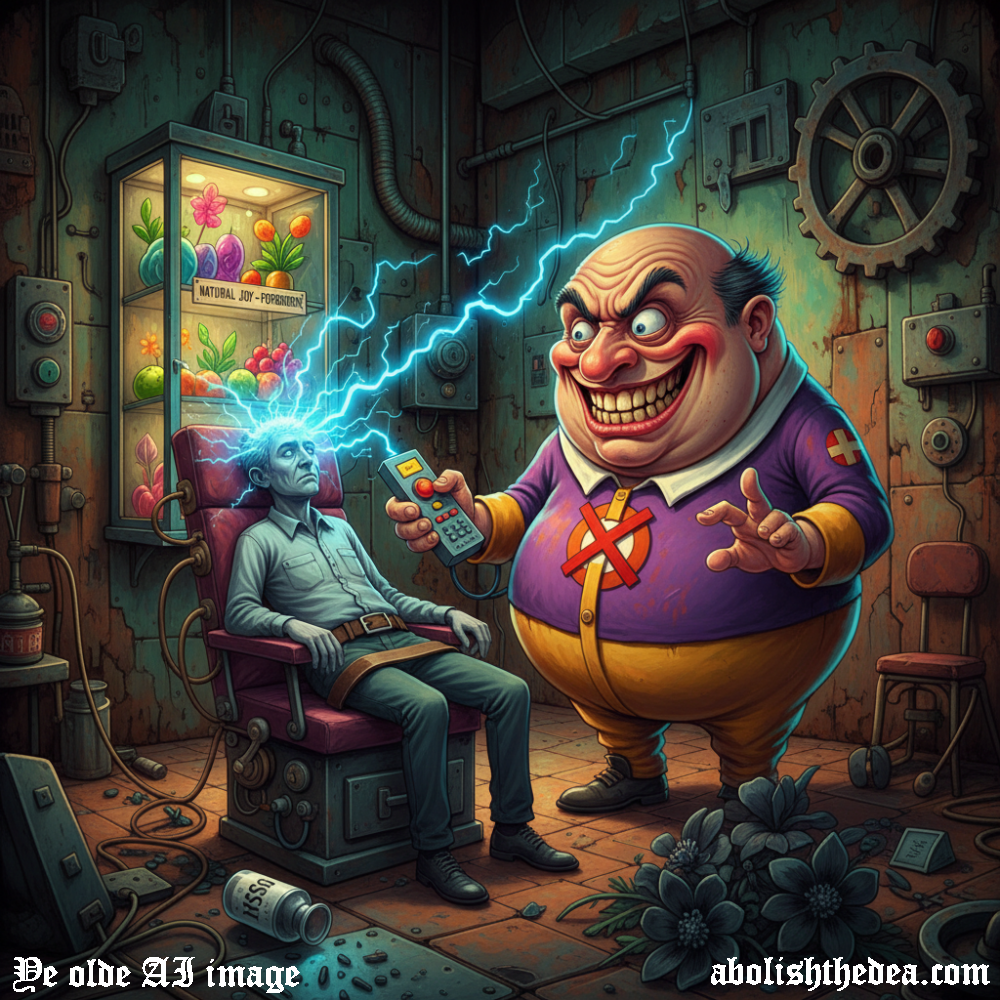
 The following comments are written in response to an article on the Mad in America website entitled "Which Would You Prefer: Electroshock or a Safe Taper?" by Jennifer Giordano. 1
NIDA is just a propaganda arm of the U.S. government -- and will remain so until it recognizes the glaringly obvious benefits of drugs -- as well as the glaringly obvious downsides of prohibition. We need a National Institute on Drug Use, not a National Institute on Drug Abuse.
Science knows nothing of the human spirit and of the hopes and dreams of humankind. Science cannot tell us whether a given drug risk is worthwhile given the human need for creativity and passion in their life. Science has no expertise in making such philosophical judgements.
In America, they save the depressed from cocaine and opium by turning them into patients for life with dependence-causing "meds." Now 30-year-old doctors get to treat 67-year-olds like children, with new visits every damn three months.
Properly speaking, MDMA has killed no one at all. Prohibitionists were delighted when Leah Betts died because they were sure it was BECAUSE of MDMA/Ecstasy. Whereas it was because of the fact that prohibitionists refuse to teach safe use.
Before anyone receives shock therapy -- or the right to assisted suicide -- they should have the option to start using opium or cocaine daily -- in fact, any drug that makes them feel that life is worth living again.
That's another problem with "following the science." Science downplays personal testimony as subjective. But psychoactive experiences are all ABOUT subjectivity. With such drugs, users are not widgets susceptible to the one-size-fits-all pills of reductionism.
Imagine if there were drugs for which dependency was a feature, not a bug. People would stop peddling that junk, right? Wrong. Just ask your psychiatrist.
There are endless creative ways to ward off addictions if all psychoactive medicines were at our disposal. The use of the drugs synthesized by Alexander Shulgin could combat the psychological downsides of withdrawal by providing strategic "as-needed" relief.
The formula is easy: pick a substance that folks are predisposed to hate anyway, then keep hounding the public with stories about tragedies somehow related to that substance. Show it ruining lives in movies and on TV. Don't lie. Just keep showing all the negatives.
Outlawing substances like laughing gas and MDMA makes no more sense than outlawing fire.
The following comments are written in response to an article on the Mad in America website entitled "Which Would You Prefer: Electroshock or a Safe Taper?" by Jennifer Giordano. 1
NIDA is just a propaganda arm of the U.S. government -- and will remain so until it recognizes the glaringly obvious benefits of drugs -- as well as the glaringly obvious downsides of prohibition. We need a National Institute on Drug Use, not a National Institute on Drug Abuse.
Science knows nothing of the human spirit and of the hopes and dreams of humankind. Science cannot tell us whether a given drug risk is worthwhile given the human need for creativity and passion in their life. Science has no expertise in making such philosophical judgements.
In America, they save the depressed from cocaine and opium by turning them into patients for life with dependence-causing "meds." Now 30-year-old doctors get to treat 67-year-olds like children, with new visits every damn three months.
Properly speaking, MDMA has killed no one at all. Prohibitionists were delighted when Leah Betts died because they were sure it was BECAUSE of MDMA/Ecstasy. Whereas it was because of the fact that prohibitionists refuse to teach safe use.
Before anyone receives shock therapy -- or the right to assisted suicide -- they should have the option to start using opium or cocaine daily -- in fact, any drug that makes them feel that life is worth living again.
That's another problem with "following the science." Science downplays personal testimony as subjective. But psychoactive experiences are all ABOUT subjectivity. With such drugs, users are not widgets susceptible to the one-size-fits-all pills of reductionism.
Imagine if there were drugs for which dependency was a feature, not a bug. People would stop peddling that junk, right? Wrong. Just ask your psychiatrist.
There are endless creative ways to ward off addictions if all psychoactive medicines were at our disposal. The use of the drugs synthesized by Alexander Shulgin could combat the psychological downsides of withdrawal by providing strategic "as-needed" relief.
The formula is easy: pick a substance that folks are predisposed to hate anyway, then keep hounding the public with stories about tragedies somehow related to that substance. Show it ruining lives in movies and on TV. Don't lie. Just keep showing all the negatives.
Outlawing substances like laughing gas and MDMA makes no more sense than outlawing fire.


 (up)
(up)