a sequel to the Charles Fort classic of 1919, featuring the thrice damned accounts of the positive use of drugs
by Brian Ballard Quass, the Drug War Philosopher
December 3, 2023
PROCESSION of the damned.
By the damned, I mean the excluded.
We shall have a procession of data that Science has excluded.
With those three lines, Charles Fort 1 launched his attack on the exclusionary practices of dogmatic science in the Book of the Damned 2 . "I have gone into the outer darkness of scientific and philosophical transactions and proceedings:", wrote Fort, "ultra-respectable, but covered with the dust of disregard. I have descended into journalism."
I now descend into journalism myself in an attempt to eke out Fort's book with some data of my own, drawn from newspapers published before 1900, when the Drug War ideology of substance demonization was still just a glint in the jaundiced eyes of puritanical politicians.
Fort's many well-documented examples of arbitrarily excluded scientific data were drawn from sightings of anomalous phenomena either in the sky or issuing therefrom. But my excluded data are of another type entirely. They come from the many positive reports about psychoactive substances that used to appear in newspapers prior to the 20th century and the codification of substance prohibition. Now those reports about positive drug use are damned, gathering dust, totally invisible to modern science. Worse yet, there are very few new reports of positive drug use even reaching the stage where they would be eligible for damnation these days since scientists (amateur and professional alike) know that it's risky to report anything positive about the modern scapegoat called drugs.
Those few who successfully run this gauntlet of disincentives find a science establishment that is unmoved by common sense. You say that laughing gas cheers you up? Modern scientists see no sign of that, or if they do, they fail to see any benefit in such a state. You say that MDMA makes you compassionate? Modern scientists see no sign of that, or if they do, they fail to see any benefit in such a state. You say that coca helps you obtain a prolific output in your chosen field and thus achieve vocational self-fulfillment? Modern scientists see no sign of that, or if they do, they fail to see any benefit in such a state.
The fact is that the damnation process now has the backing of the federal government and scientists do not want to alienate their benefactor by acknowledging that there are any benefits whatsoever to drug use. This Drug War collaboration comes easy to modern science, however, thanks to its outdated materialist viewpoint that consciousness is a mere epiphenomenon. If that's so, then a millennia's worth of anecdotal reports of positive drug use can be safely ignored as so much subjective blather. All that really counts are biochemistry and genetics, and human beings are interchangeable widgets amenable to one-size-fits-all cures for mental and emotional problems.
Sure, it is technically legal for scientist and layperson alike to sing the benefits of drugs that have been criminalized by racist politicians, but anyone who praises coca or opium is setting themselves up for reprisals in the workplace and society in general. In fact, I fear that the DEA is holding meetings even as we speak trying to find a way to arrest or otherwise silence the self-avowed responsible drug user Carl Hart, author of "Drug Use for Grown-ups," one of the handful of prominent people in the world who's actually daring to speak the simple truth about drugs. In Charles' Day, they merely ignored folks who spoke truths that failed to gibe with modern dogma: in our day they seek to arrest such reporters or, barring that, to remove them from all roles of importance in American society.
In short, Fort was lucky. He lived before Drug War ideology had made data damnation a civic duty. If I could travel back to 1919 and confront the author, I would tell him just one thing: "You don't know from damnation, Charles!"
On page 2 of the Boston Globe from New Year's Day 1886, JJ Tschudi praises the value of coca in what appears to be an extended selection from his 'Travels of Peru'. He quotes a certain Dr. William S. Searie to the effect that: "[Coca] is one of the most remarkable productions of the world, and has powerful therapeutic properties." It was considered to be a gift to the Inca from the sun god, for whom it was the living embodiment here on earth. This plant was said to satisfy the hungry, give strength to the weak and make them forget their misfortunes. It made oracles speak and its presence in their homes kept away all accidents and crime. None could visit the tomb of his ancestors, or invoke their spirits, unless he had some Coca in his mouth.
Fast-forward 150 years and bureaucrats in Washington, D.C. have decided that the coca plant has no positive uses for anybody, anywhere, ever. No, not one single benefit. What's more, they have determined that it is downright immoral to suggest otherwise. Who knew? One wonders if the DEA is getting their information about drugs from Mary Baker Eddy via a Ouija Board.
Scientists must be ecstatic because they now have the green light from their own government to pretend not simply that the coca plant has no positive uses, but that the plant does not even exist. Coca would have never passed scientific muster with them anyway due to its failure to produce the kind of results that would satisfy a reductive materialist, namely those that would show up under a microscope or in a brain scan. That's why Dr. Robert Glatter wrote a 2021 article in Forbes magazine entitled "Can nitrous oxide help those with treatment resistant depression?" Could it help? Was Dr. Glatter serious? Was he channeling Dr. Spock of Star Trek when he wrote that piece? He had to ask that amazingly naïve question because the laughter of the depressed does not count for him: he's a materialist who needs lab scans to see if folks like myself are "really" happy - whatever that means. I'd be more than happy to give him an affidavit to that effect ("Yes, laughing gas actually works for me, thank you very much, Doc!") if Robert would only sign off on my use of a plant medicine that the Inca considered to be divine. Then we'll let bygones be bygones and say nothing about the fact that the government had no right whatsoever to outlaw Mother Nature in the first place, least of all in a country that was founded on the principles of natural law.
But no such luck. When it comes to the outlawing of coca, materialist science says "Good riddance," I'm afraid.
Meanwhile the patriotic editors of magazines like Scientific American and Psychology Today play dumb for the government on the subject of drugs by producing endless feel-good pieces about the "latest treatment" for depression, this month telling depressives like myself that we need to go to bed earlier (or was that later?) , the next month telling us to drink less coffee (or was that more coffee?), and never a word about the outlawed godsends that grow at our very feet. Whenever they start to run out of politically acceptable bromides for fighting depression, they recycle a therapeutic blast from the past that one had naively thought to have been long since discredited: see, for instance, the Shock Therapy 2.0 now being promoted by Sci News in a series by Laura Sanders. Well, shock therapy worked before for the severely depressed, didn't it? In fact, the nursing staffs could not say enough about the treatment. It rendered their hitherto excitable charges so tractable and uncomplaining that it seemed little less than a miracle. Turns out such treatment has a time-honored history, dating back to caveperson days when the first cro-magnon gave his brother-in-law a sharp whack on the head with a club, only to discover to his amazement that he had thereby transformed the erstwhile obstreperous neanderthal into an eminently pliable (if perhaps somewhat morose) cave mate.
Charles Fort was right: the scientific establishment is hypnotized by the existing weltanschauung. "The coca leaf?" ask the modern scientists. "What coca leaf? Never heard of the stuff. What MDMA 4 for that matter? What laughing gas 5 ? What opium 6 ?"
Of course coca already had its detractors back in 1886, "but mark one thing," writes Tschudi.
"This detraction has not come from scientific investigators, nor from those who have patiently examined into the facts, such as Sir Robert Christison, Baronet (M. D., D.C.L., LL. D., F.R.S., President of the British Medical Association, Professor of Materia Medica in the University of Edinburgh, Physician to her Majesty the Queen), Prof. Fauvel of Paris, Prof. John M. Carnochan of New York, the distinguished surgeon. Dr. W. S. Searie of Brooklyn, the eminent writer, and a score of men equally distinguished for honest devotion to the truths of science."
No, the detraction came from the great great ancestors of grumpy puritans like William Bennett and Kevin Sabet, whom Tshcudi refers to as "kickers." "In all professions and in all callings," writes Tschudi, "there is a class of men who gain notoriety by their adoption of the role of kickers. Their success in life -- their stock in trade as 'twer. -- lies in the notoriety they gain by detracting."
It won't surprise the modern reader to learn that the main "kickers" against the coca plant at the time were also the principals of a firm that produced a tonic for which coca proved to be a fearsome rival. "The real secret of the yarns about Coca which have recently been appearing in the papers," Tschudi reports, "lies in the jealousy of a large manufacturer of certain tonic preparations the sale of which has become greatly abridged by the growing popular appreciation of Coca as a tonic."7
Notes for essay entitled The Book of the Damned continued: a sequel to the Charles Fort classic of 1919, featuring the thrice damned accounts of the positive use of drugs:
The Hindu religion was created thanks to the use of a drug that inspired and elated. It is therefore a crime against religious liberty to outlaw substances that inspire and elate.
Almost every mainstream article about psychology and consciousness is nonsense these days because it ignores the way that drug prohibition has stymied our investigation of such subjects.
Assisted suicide cannot be discussed meaningfully without discussing the drug prohibition that renders it necessary in the first place.
The Drug War is based on a huge number of misconceptions and prejudices. Obviously it's about power and racism too. It's all of the above. But every time I don't mention one specifically, someone makes out that I'm a moron. Gotta love Twitter.
By reading "Drug Warriors and Their Prey," I begin to understand why I encounter a wall of silence when I write to authors and professors on the subject of "drugs." The mere fact that the drug war inspires such self-censorship should be grounds for its immediate termination.
"The depression lifted from my mind like the sun coming out of the clouds." -- Arthur Crowley after using cocaine
In "The Book of the Damned," Charles Fort shows how science damns (i.e. excludes) facts that it cannot assimilate into a system of knowledge. Fort could never have guessed, however, how thoroughly science would eventually "damn" all positive facts about "drugs."
The front page of every mycology club page should feature a protest of drug laws that make the study of mycology illegal in the case of certain shrooms. But no one protests. Their silence makes them drug war collaborators because it serves to normalize prohibition.
News flash: certain mushrooms can help you improve your life! It's the biggest story in the history of mycology! And yet you wouldn't know it from visiting the websites of most mushroom clubs.
I knew democracy was in trouble when most Americans in the '80s saw no problem with allowing drug testers to go on a fishing expedition in their bodily fluids for substances of which politicians disapprove.
Break the ice with a sledgehammer: place this book on your coffee table.
This book features 150 annotated images, designed to force brainwashed Americans to confront the fact that drug prohibition is wrong. Here is what author Richard Parrish II says of the book's compiler: "The drug prohibition philosopher provides first-hand, principled, persuasive, and insightful arguments against the current drug prohibition regime..."
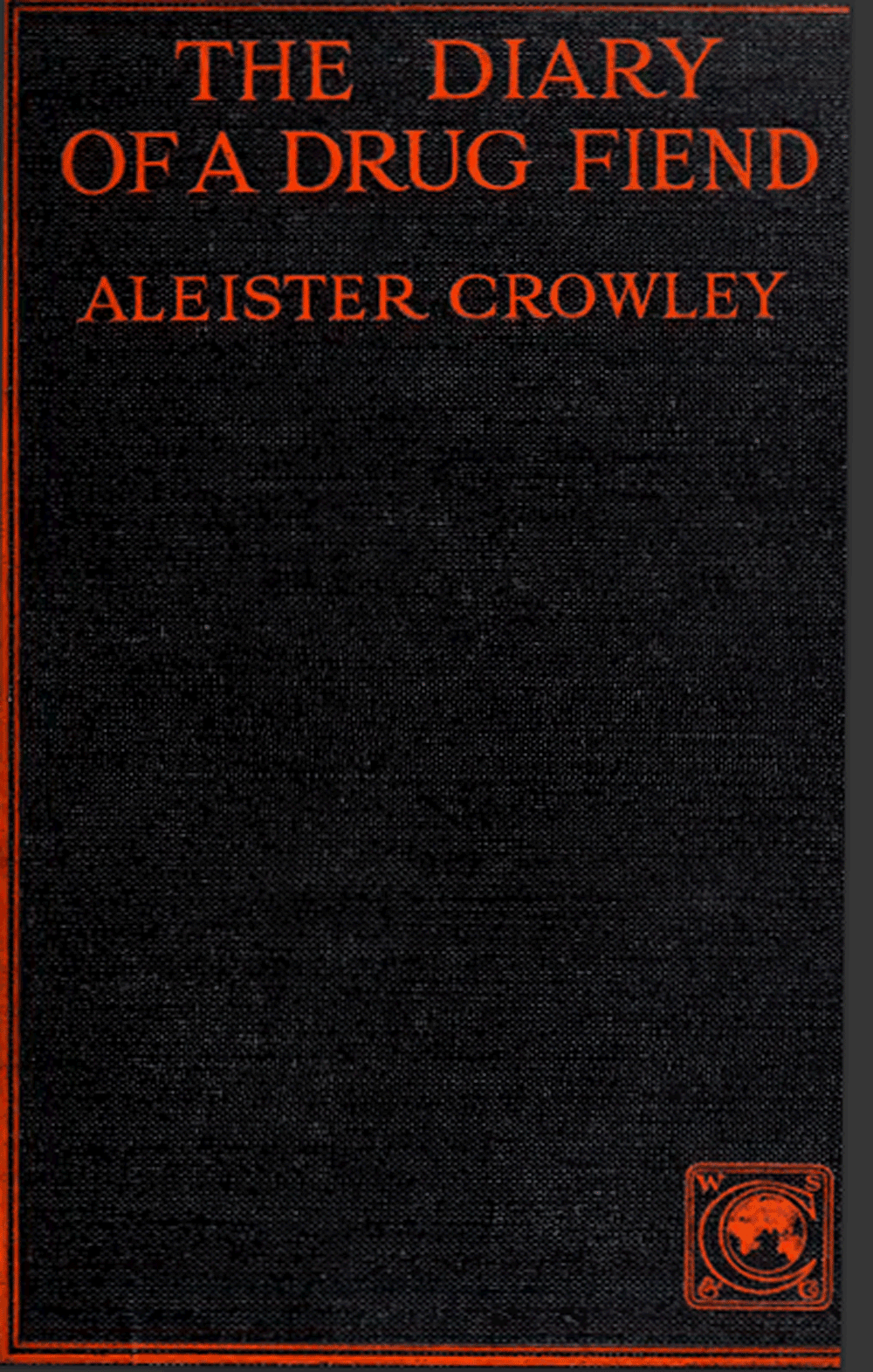
This is the only full-cast recording of Aleister Crowley's 1922 classic paeon to common sense. It is the first book -- and so far almost the only book -- to stake out a philosophy of drug use that is compatible with human freedom, one in which we learn to use drugs as wisely as possible for the benefit of humanity. This recording was produced by the Drug War Philosopher and your purchases help support his effort to push back against the tragically counterproductive policy of drug prohibition, in the name of human freedom and of humanity's right to heal.
No cookies, no ads paid for by amoral and immoral billionaires (or trillionaires).
Unless otherwise indicated, no AI is used in the creation of site content. These essays represent the original ideas of their author and not the ideas that the author SHOULD have based on an algorithmic parsing of existing data. For more on this subject, consider the AI-related viewpoints to which the author subscribes as delineated in the New York Times opinion piece entitled "What 370,000 College Essays Tell Us About A.I.’s Effects on Creativity" by Rebecca Winthrop of the Brookings Institution.









 PROCESSION of the damned.
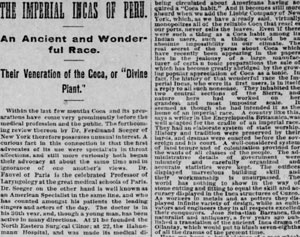 On page 2 of the Boston Globe from New Year's Day 1886, JJ Tschudi praises the value of coca in what appears to be an extended selection from his 'Travels of Peru'. He quotes a certain Dr. William S. Searie to the effect that: "[Coca] is one of the most remarkable productions of the world, and has powerful therapeutic properties." It was considered to be a gift to the Inca from the sun god, for whom it was the living embodiment here on earth. This plant was said to satisfy the hungry, give strength to the weak and make them forget their misfortunes. It made oracles speak and its presence in their homes kept away all accidents and crime. None could visit the tomb of his ancestors, or invoke their spirits, unless he had some Coca in his mouth.

 (up)
(up)