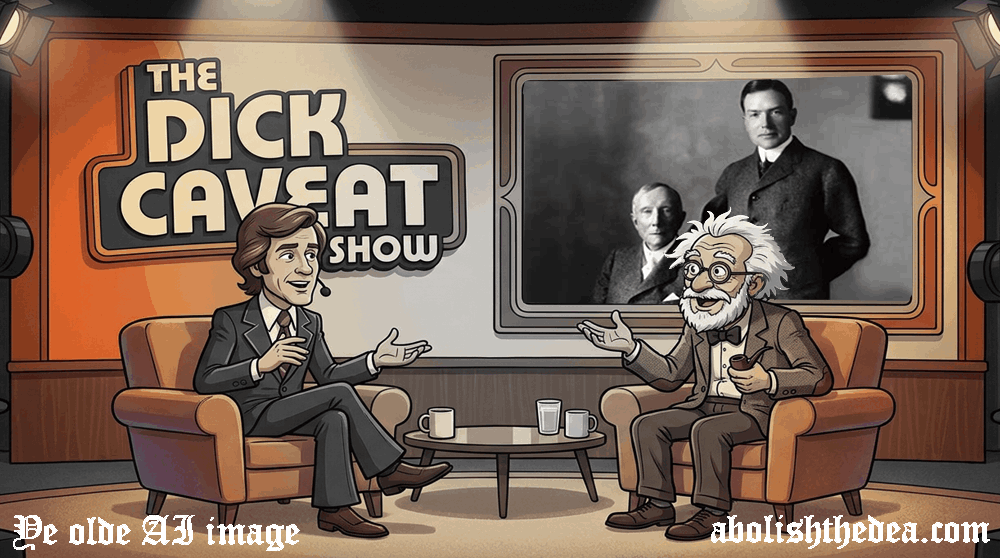
DICK CAVEAT: Welcome to Books Friday. I'm your host, Dick Caveat. Today we have with us a med-dependent philosopher who has been trashing drug prohibition for the last eight years on his website called AbolishTheDEA.com
1 and on his substack called The Drug War Philosopher.
2
DWP: If I might just clarify, Dick?
DICK CAVEAT: Oh, please proceed.
DWP: I've been trashing drug prohibition because that deadly policy turned me into a ward of the healthcare state by denying me godsends that grow at my very feet and which could have ended my depression in a trice, only to shunt me off onto big pharma meds that turned out to be far harder to kick than heroin, thereby turning me into a ward of the healthcare state and an eternal child.
DICK CAVEAT:I understand.
DWP: I'm not sure you do, Dick. Do you know that I have to see a doctor one-third my age every three months of my life in order to qualify for a refill on a prescription that I have been taking for decades? And that on each visit I have to answer humiliating questions such as, are you hearing voices? And have you considered suicide lately?
DICK CAVEAT: Oh dear.
DWP: And do you know what the kicker is, Dick?
DICK CAVEAT: I'm afraid to ask.
DWP: The kicker is that absolutely no one in the medical field will even acknowledge the existence of a problem here. In fact, my last psychiatrist actually fired me as a patient, when I finally, after 30 years, told him that I saw no reason why I had to see a doctor for a refill in the 1st place, and that I was sick and tired of being treated like an eternal patient and a child.
DICK CAVEAT: And how did he respond to that?
DWP: He was like, "But I have to get to KNOW you, Brian." To which I shot back, "Why? Why do you have to get to know me? I'm a grown man, and you have 30 years' worth of documented evidence there in front of you on your laptop, confirming that I know how to take medicines wisely. Why can't I be treated like an adult?"
[pause]
I'm sorry, I didn't mean to interrupt your introduction, but I didn't want the viewers to think that I'm some nutjob who hates drug prohibition just in order to be contrary, so to speak.
DICK CAVEAT: No, I get it.
DWP: So please continue.
DICK CAVEAT: I was merely going to add that you have just read a 1979 book by the late California researcher E. Richard Brown entitled Rockefeller Medicine Man: Medicine and Capitalism in America.
3
DWP: Guilty as charged, Your Honor.
DICK CAVEAT: And that you were going to Comment on the same. So, whenever you're ready,
DWP: Where to begin? I should first inform the viewers that the book demonstrates how big-money philanthropy helped create the medical-industrial complex of today, and that the point of that system was to treat illness in a way that it would become a job opportunity for doctors and especially for medical researchers.
DICK CAVEAT: And when you say treat illness, do you mean both medical and behavioral problems?
DWP: That's the thing, Dick. The movers behind the creation of our current system, led by one-time Baptist preacher Frederick T. Gates on behalf of John D. Rockefeller Sr., made no distinction between behavioral health and physical health. And guess what? That helps explain how doctors began to think that behavioral problems represented actual illnesses. That conclusion, after all, was implicit in the granting of a healthcare monopoly to so-called scientific medicine in the first place. When you're a hammer, everything you see is a nail. When you're a doctor with a monopoly on healing, everything you see is an illness.
DICK CAVEAT: Interesting point. It seems like the financial and vocational interests of the scientific medical establishment made it inevitable that they would eventually tell us that problems with mind and mood were actually physical problems, i.e., actual board-certified diseases, so to speak.
DWP: Yes, the writing was on the wall. It was just a matter of time before the various spokespeople of the medical industrial complex created by Rockefeller and his cronies was going to tell us that psychological issues are real-live diseases too, just like whooping cough and bird flu.
DICK CAVEAT: I see.
DWP: Fortunately, there was at least one man who knew better.
DICK CAVEAT: You are referring to Thomas Szasz, I believe, author of The Myth of Mental Illness.
4
DWP: Bingo. And you can see how loudly money speaks here, Dick. When medical science came forth with what Francis Crick might have called the "astonishing hypothesis" that human misbehaviors were actually diseases, and when they further insisted that this hypothesis was actually a fact with which no sane person could disagree, no one in the scientific community protested on behalf of common sense. No one pointed out how this viewpoint made a mockery of the great moral battles of human history, as, for instance, the Bible itself, under this paradigm, would just be a collection of pathologies that were being given full rein in a world that had yet to be blessed with the all-knowing field of psychiatry. There was scarcely a peep of protest from the self-interested professionals, but when Thomas Szasz merely begged to differ, he was pilloried as if he were a madman from outer space. We see here how massive expenditures, combined with self-interest, end up determining what an intelligent person is even allowed to say in a capitalist-driven medical society without being dismissed a priori as a lunatic.
DICK CAVEAT: I know that the book by E. Richard Brown is detail-rich and raises countless questions.
DWP: Word.
DICK CAVEAT: But can you give our viewers some of your overall insights from your reading?
DWP: First, I was struck by the sheer presumption of these philanthropists and the capitalists with whom they worked. No one ever stopped to question the propriety of placing reductionist scientists in charge of matters of human behavior.
DICK CAVEAT: No one?
DWP: No one. It never occurred to them to get the ideas of John and Jane Doe on this subject. No one asked everyday people what they wanted in the way of healthcare. At best, the guys in charge, especially Frederick Gates and Rockefeller Jr., wanted to HELP these people, not to LISTEN to them -- except, that is, when the displeasure of the hoi polloi rose to such a fever pitch that it threatened the very existence of the capitalist system itself. As Brown points out, Gates could write with the passion of Karl Marx on behalf of human rights, but he only did so out of fear, when the headlines of the day suggested that the public was sick and tired of billionaires calling the shots.
The end goal of Gates' wholesale philanthropy was always to promote the interests of capitalism and capitalists. The recipients of healthcare services were just supposed to "shut up and take their meds," as we might phrase this attitude today. And this disdain for the end user was not just implicit, it was codified as a sort of "best practices" for the medical profession. It was reflected in the 19th-century Code of Ethics for the American Medical Association, about which E. Richard Brown writes as follows.
The association commanded patients to trust their doctors. The obedience of a patient to the prescriptions of his doctor should be prompt and implicit, the code of ethics instructed. The patient should never permit his own crude opinions as to their fitness to influence his attention to them.
DWP: "Crude opinions," indeed. How's that for condescension? But then, our professionals in the medical field hate nothing so much as our failure to take them seriously. They've had this chip on their shoulder ever since the time of Moliere, as the following quotation from The Imaginary Invalid makes clear. But first, a little backstory. The brother of the hypochondriacal protagonist has just told his sibling to stop taking his doctor-prescribed enemas and to start thinking for himself for a change. Argan remains unconvinced. But when the on-site physician, Dr. Purgon, gets wind of that colloquy, he explodes as follows.
I have just heard nice news downstairs. You laugh at my enemas and refuse to take the remedy which I ordered. Unheard of! What an unprecedented revolt of patient against doctor.
DICK CAVEAT: But didn't John Rockefeller Sr. himself believe in herbal cures and the like?
DWP: Yes, indeed. But he was considered an ideological dinosaur by the time the distinctions in question were being cemented with the help of self-interested parties. Brown writes as follows:
In 1919, when Rockefeller Sr. was considering a $45 million gift to his General Education Board to support medical education, Rockefeller again warned his son and staff: Homeopathic teaching should not be excluded, it should be provided for, the same as Allopathic. His son and his staff firmly and repeatedly explained that scientific medicine has rendered obsolete the former distinctions between the so-called Homeopathic and the so-called regular or Allopathic schools. The new medicine is "free of dogma, free of values." It represents not "preconceived notions about the world, but only ascertained facts." Medical science is devoid of medical dogma of any kind.
DWP: In that citation we see manifested the self-interested myopia and philosophical cluelessness that affects medical scientists to this very day.
DICK CAVEAT: How so?
DWP: It is still a matter of faith in the ivory tower that medical scientists work with ascertained facts, while "quacks," such as herbalists and hypnotists and so forth, work with wishy-washy feelings that cannot be quantified or demonstrated by looking under a microscope, and which therefore are "unscientific." But any philosopher worth their bust of Socrates knows that this latter viewpoint represents a specific philosophy and not a mere set of facts that must be acknowledged as true by any rational human being. The dogma in question is that of scientific materialism. Not only is that a highly debatable philosophy, but it represents a viewpoint that is losing adherence every year thanks to its increasingly obvious failure to accord with quantum theory and relativity, notwithstanding its obvious practical benefits when it comes to facilitating technological progress.
DICK CAVEAT: Could you help out our readers who may not be familiar with the doctrines of scientific materialism?
DWP: It's the idea that consciousness, and hence feelings and emotions, are just epiphenomena produced by the brain, and that the only thing that scientists should concern themselves with are theoretically quantifiable phenomena of the body, such as molecules and genes, etc.
DICK CAVEAT: Gotcha.
DWP: To learn more about the decline of materialist ontology in modern philosophy, I suggest that your viewers read the 2010 book Mind and Cosmos by Thomas Nagel. Nagel
5 is one of the more noteworthy philosophers among those who have abandoned ship when it comes to the philosophy in question.
DICK CAVEAT: Thomas Nagel. Check.
DWP: I will now list some other similarly disaffected parties in rough chronological order...
DICK CAVEAT: Wait for the viewers to get their pens out.
[pause]
DWP: ...Including Henri Bergson, Alfred North Whitehead, Alvin Noe, Aldous Huxley, Bruce Rosenblum, and Bernardo Kastrup.
DICK CAVEAT: ...and Bernardo Kastrup. Check.
DWP: See also the work of hundreds of scientists and philosophers who in 2014 released the Manifesto for a Post-Materialist
Science.
6 7
DICK CAVEAT: We're running out of time, but could you please tell our viewers what this whole topic has to do with drugs and
drug prohibition?
DWP: Well, think about it. We have placed medical professionals in charge of deciding if psychoactive drugs have any beneficial uses. And why? Because robber barons wanted capitalists to be able to treat as many conditions as possible in an efficient and therefore marketable way.
DICK CAVEAT: Yes?
DWP: Well, don't you see? It was all about making money and establishing a world in which capitalists got their cut of everything, including human behavior. How? By declaring that efficient, capitalist-oriented scientists were the experts on said behavior.
DICK CAVEAT: I see.
DWP: This turned out to be such a profitable business model that these medical professionals started inventing diseases to treat. They started making them up out of whole cloth. The Diagnostic and Statistical Manual might well be called the Disease-Mongering Manual. The whole world was suddenly their oyster. It was the oyster of our efficient and scientific medical practitioners and increasingly well-paid researchers.
DICK CAVEAT: I see. But drugs?
DWP: Keep your shirt on. I'm getting to it.
DICK CAVEAT: Fair enough.
DWP: These well-financed clowns could henceforth profit from the emotional vagaries of human beings, from our ups and from our downs, from our anger and from our sorrow, from our eccentricities and from our obsessions, from our lack of spirituality and from our excessive spirituality, etc., etc. They could turn each and every problem of daily life into a new disease, one that would be covered by insurance companies, of course, which also stood to amass fortunes from the triumph of this efficient medical care system of the capitalists, first proposed by Frederick T. Gates on behalf of the American Croesus, John D. Rockefeller Sr.
DICK CAVEAT: Of course!
DWP: So they went for it. They started treating problematic human behavior as board-certified illnesses.
DICK CAVEAT: And this is related to drugs because...?
DWP: Well, don't you see? This meant that drug use was henceforth a threat to their monopoly on providing healthcare for both mind and mood.
DICK CAVEAT: Got it. So, how did they respond?
DWP: With a brainwashing campaign supported by good old Mr. Money Bags. Suddenly, we were told, on talk shows and in psychiatric offices, that drug use was a cop-out if you please and that only medical doctors had a real cure for our human problems.
DICK CAVEAT: Aha. One might say that this dictum is almost a corollary to the idea that herbal healers are quacks, this idea that drug use is wrong, or at very best pointless.
DWP: Beginning to see, eh? And what was the result, Dick?
DICK CAVEAT: Say on.
DWP: This presumptuous lie, combined with the evils of drug prohibition, resulted in the psychiatric pill mill and the fact that one in four American women take a dependence-causing med every day of their life, as do millions of luckless males like myself.
8
DICK CAVEAT: Got it. (Do you love this man, folks?)
DWP: In other words, Dick, old buddy, old pal, author E. Richard Brown wants us to wake up as Americans and ask the following question: Cui friggin' bono.
DICK CAVEAT: "Cui frIggin' bono"?
DWP: Who benefits from the healthcare status quo that robber barons have brought about in order to provide prestigious and well-paying job opportunities for medical professionals?
DICK CAVEAT: Who?
DWP: Not the patients, David, that's for sure. And not the people like myself who never wanted to be patients in the first place.
DICK CAVEAT: You say it was a category error to place materialist scientists in charge of mind and mood medicine. What do you mean?
DWP: Materialist scientists pride themselves on being passion-free, David. It's almost like they're all emulating Dr. Spock of Star Trek. The more they live up to that image, the more scientific they think they become. But this brings about absurd results when it comes to behavioral healthcare. These scientists are so passion-free that they do not even understand that substances like laughing gas could help the depressed.
9 It's like they say to themselves, "Laughter is highly illogical, Captain." And so a severely depressed young person comes to the ER at 3 o'clock in the morning, like several friends of mine have done over the years, wishing that they were dead. They are just looking for one good reason why they should continue to live.
DICK CAVEAT: Right.
DWP: Common sense tells us that these people need to "Pull up! Pull up!" in terms of their mood, just like a plummeting aircraft needs to regain altitude. The situation is urgent, in other words. And yet how does air traffic control -- i.e., hospital triage -- respond to such cases? They tell the patient to calm down while a nurse rummages through their pharmacy shelves to look for an antidepressant that the suicidal person hasn't tried yet. Then, when they finally locate one, the doctor signs off on the new med or med combination, which the nurse then assures the patient will certainly work THIS time, notwithstanding the failure of the last three antidepressants to keep that same patient out of the emergency room. "Don't worry," says the medical professional, "this drug will make you feel better. Although, of course, you'll have to give it two to three weeks to start working, so you'll need to refrain from killing yourself in the meantime."
What cruel nonsense this is, in a world that is full of substances that could cheer these suicidal people up in a trice! What cruel Christian Science nonsense this is! These suicidal people need to be shown experientially that there is always light at the end of any tunnel. And this can only be done with the informed use of psychoactive substances in such cases, not with pious lectures about the value of hiking and jogging and getting eight hours of sleep every night and keeping diaries and eating less starch, ad pablum.
DICK CAVEAT: I'll have to stop you there.
DWP: Long story short, Dick, the upshot of the machinations of the robber barons have left a chronic depressive like myself as a disempowered ward of the healthcare state, one who is specifically barred from using precisely those substances that could help me heal. This self-interested medical-industrial complex, of which Brown writes, has forced me to become a patient for life, not for my own benefit, but in order to benefit the parties that Rockefeller Jr. and Frederick Gates sought to benefit all along: not mere patients, but well-paid doctors and scientists and their capitalist overseers.
DICK CAVEAT: You're watching Books Friday. We'll be back after this message.
WOMAN: Wait till my Twitter followers realize that I am at the Grand Canyon. I'll take a picture of myself standing at the end of the cliff here at the top of the South Rim. I'll just back up a little closer to the edge and...
[screams]
ANNOUNCER: More teens die from taking selfies than from shark attacks. Tell your representative that it's time to outlaw mobile phones.
CHILD: For 87 kids this year, it's already too late.
ANNOUNCER: This message brought to you by the Partnership for a Death-Free America.
DICK CAVEAT: We're back with the Drug War philosopher. We're discussing the book by E. Richard Brown entitled Rockefeller Medicine Man: Medicine and Capitalism in America. Thanks for being with us.
DWP: It's my pleasure.
DICK CAVEAT: We have just a few more moments, but I'd like to ask you how the influence of John Rockefeller Sr. can be seen in the healthcare world today.
DWP: First, we've got to recognize the fact that it was big money, not democracy, which decided how the concept of healthcare would be defined in the States and henceforth in the Western world.
DICK CAVEAT: And how was healthcare defined?
DWP: It was defined in terms of efficiency and with the understanding that any non-reductionist cures were a quack cure.
DICK CAVEAT: Are we talking about a conspiracy here?
DWP: Not according to the author. Brown tells us that it was not a conscious conspiracy; it was just the predictable result of allowing ambitious capitalists to decide what "health care" actually meant and who the experts should be.
DICK CAVEAT: I see.
DWP: Brown points out that Rockefeller Sr.'s main motivations for supporting healthcare in America did not involve a concern for public health.
DICK CAVEAT: No!
DWP: No. His concern was with malcontents who might blame capitalism for America's obvious healthcare problems, especially those caused and/or aggravated by labor conditions and poverty. He wanted to mollify the critics of capitalism by giving them what could be promoted as improved healthcare, but he wanted to do so in a very specific way, namely by, one, supporting medical research that would ignore the role of an unjust society in creating illness and injury, and by, two, turning healthcare into a respected, predictable, and efficient source of income for investors and, if you'll pardon my French, for robber barons.
DICK CAVEAT: And is this playbook still in use today, do you think?
DWP: In spades, David. In spades. In fact, the anti-democratic results of such philanthropic largesse are highly problematic today, not just in the healthcare world, but in the political world as well, wherein a certain trillionaire I know is attempting to buy elections even as we speak.
DICK CAVEAT: I see, and THEN some.
DWP: And now with the Citizens United precedent in our courts, these robber barons have more power than ever to spread their ideology by strategically throwing around bags of money to promote the mindsets and policies of their choice, and even to brazenly buy elections for that purpose.
DICK CAVEAT: But some would say that medicine has made great strides under the status quo.
DWP: Oh, tush. "Some would say. Some would say." Yes, but as writers like E. Richard Brown and Ivan Illich
10 have pointed out, most of the advances in longevity over the last 200 years have come about from improvements in nutrition and environment, especially those involving the treatment of filth and the establishment of a purified water supply. Consider what Brown writes about public health in Europe from the 18th to the present, bearing in mind that his book, Rockefeller Medicine Men, was published in 1979.
While science greatly extended the original non-technological advances in agriculture, hygiene, and birth control, the contribution of medical science to the overall reduction in death rates and improved health was relatively quite small.
DWP: The promoters of the medical-industrial complex have tried to leverage such improvements into an argument for the complete medicalization of human life, under the highly debatable assumption that human beings are biochemical widgets susceptible to one-size-fits-all treatments. It cannot be said enough, however, that our whole money-backed medical approach to health care was established, first and foremost, to benefit capitalists and capitalism, not to empower patients.
DICK CAVEAT: Why should a doctor wish to disempower a patient?
DWP: Because, from their own financial point of view, the ideal patient is a hypochondriac. It is therefore in the doctor's interest to scare us into focusing as much as possible on our health, under the assumption that being healthy is the number-one priority in the life of any sane human being.
DICK CAVEAT: Isn't health the most important thing in life?
DWP: Not a bit of it. Health is not as important as freedom. The reason is simple, because health is of no use to us if we are not free, at least if we are the kind of person that I believe that we should be in life. Remember what the opium-loving Avicenna said: he said he preferred a short and wide life to a long and narrow one.
11
DICK CAVEAT: But let me play the devil's advocate. Suppose that you had a devastating illness. Wouldn't you feel differently? What if you were dangerously ill and someone said that they could give you a cure, but that in order to obtain that cure, you would first have to give up all the freedoms that you valued?
DWP: In that case, we have to distinguish between what I would probably do and what I SHOULD do. This is because I have not yet attained full enlightenment, David, believe it or not.
DICK CAVEAT: You haven't?
DWP: I know, right? You would think THAT I had, but I actually haven't.
DICK CAVEAT: You learn something new every day.
DWP: In other words -- my actions, like the actions of most people, I'm afraid -- do not always accord with what I know is right in my heart of hearts.
DICK CAVEAT: No!
DWP: Yes. Now, if I actually lived according to the ideals that I have acquired from studying history and philosophy, I would definitely say no to a cure on the terms that you have offered. I would prefer death to the loss of my freedom. I would, in a word, choose to emulate Socrates. Socrates, it will be remembered, was told that he could live if he gave up his freedom to speak the truth as he knew it and his freedom to pursue knowledge without fetters. He chose freedom, knowing that we are all fated to die eventually, and that we can either die honorably or otherwise. I might not have the guts to make the Socratic choice myself. I might cry out after experiencing a certain amount of pain as follows: "Give me that bloody cure of yours, David. I renounce my God-given freedoms!" But in so doing, I would at least be enlightened enough to recognize, as it were, deep down inside, that I was wrong in a fundamental sense for doing so, that I was acting out of cowardice rather than principle.
DICK CAVEAT: We have been discussing the book entitled Rockefeller Medicine Men: Medicine and Capitalism in America by E. Richard Brown with the Drug War Philosopher of the United States of America. Thank you for joining us today, Brian.
DWP: There are two recent books on this topic that I encourage your viewers to read, Dick. In fact, I encourage MYSELF to read them.
DICK CAVEAT: Yes?
DWP: I located them on my smartphone during that admittedly fascinating commercial about cell phones.
DICK CAVEAT: And those two books would be...?
DWP: Those two books would be The Bill Gates Problem
12 and The Price of Humanity: How Philanthropy Went Wrong and How to Fix It
13, written respectively by Tim Schwab and Amy Schiller.
DICK CAVEAT: ...and Amy Schililer. Got it. Thank you, sir. Until next time, this is David Caveat, reminding you to just say no to America's childish, anti-scientific, and superstitious attitude towards psychoactive medicines, and to the drug prohibition for which it stands...
DWP: One nation under surveillance...
DICK CAVEAT: ...with handcuffs and ankle bracelets for all.










 (up)