








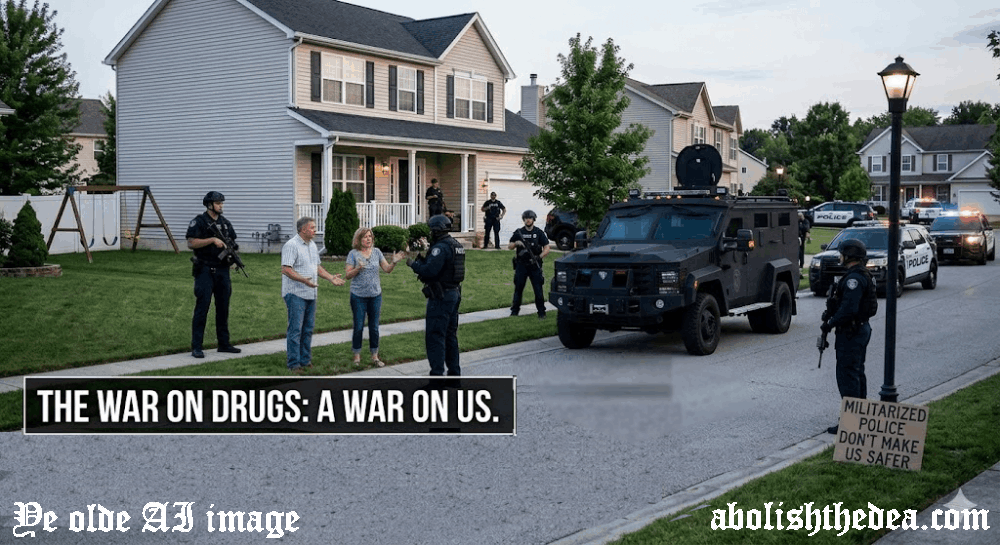
 If you want to see how thoroughly the law enforcement approach to drug use has compromised the health of young people, try binge-watching "Deadline: Crime" with Tamron Hall1, a series about homicide in the suburbs. You will find that every other episode has at least one character who is said to have had a "problem" with drugs. Every other episode. There are almost no episodes in which drugs have any direct role in the featured homicide, but there always seems to be at least one cousin of the victim of the day or one red herring of a suspect whom we're told had drug-related issues or struggles, etc. This drug-related factoid is always presented as a dramatic revelation, as if the viewers were supposed to think: "My God, if the principals in the case are involved with drugs, God knows WHAT'S going on here!" This is how America derives entertainment value out of the ruined lives that its own drug policies have brought about.
Drug prohibition is a crime against humanity. It is the outlawing of our right to take care of our own health.
Wanna show drug warriors the error of their ways? Legalize all less dangerous drugs than alcohol and then deny work to those who test positive for liquor and confiscate their property if beer cans are found on-site.
If we encourage folks to use antidepressants daily, there is nothing wrong with them using heroin daily. A founder of Johns Hopkins used morphine daily and he not only survived, but he thrived.
There's a run of addiction movies out there, like "Craving!" wherein they actually personify addiction as a screaming skeleton. Funny, drug warriors never call for a Manhattan Project to end addiction. Addiction is their golden goose.
The Drug War is based on two HUGE lies: 1) that prohibition has no downsides, & 2) that drug use has no upsides.
We give kids drugs to improve their concentration -- but if adults use drugs to concentrate, we call them names and throw them in jail.
"Judging" psychoactive drugs is hard. Dosage counts. Expectations count. Setting counts. In Harvey Rosenfeld's book about the Spanish-American War, a volunteer wrote of his visit to an "opium den": "I took about four puffs and that was enough. All of us were sick for a week."
I'd like to become a guinea pig for researchers to test the ability of psychoactive drugs to make aging as psychologically healthy as possible. If such drugs cannot completely ward off decrepitude, they can surely make it more palatable. The catch? Researchers have to be free.
Drug-designing chemists have no expertise in deciding what constitutes a cure for depression. As Schopenhauer wrote:
"The mere study of chemistry qualifies a man to become an apothecary, but not a philosopher."
Americans won't be true grown-ups until they learn to react to drug deaths the same way that they react to deaths from horseback riding and mountain climbing.
If you want to see how thoroughly the law enforcement approach to drug use has compromised the health of young people, try binge-watching "Deadline: Crime" with Tamron Hall1, a series about homicide in the suburbs. You will find that every other episode has at least one character who is said to have had a "problem" with drugs. Every other episode. There are almost no episodes in which drugs have any direct role in the featured homicide, but there always seems to be at least one cousin of the victim of the day or one red herring of a suspect whom we're told had drug-related issues or struggles, etc. This drug-related factoid is always presented as a dramatic revelation, as if the viewers were supposed to think: "My God, if the principals in the case are involved with drugs, God knows WHAT'S going on here!" This is how America derives entertainment value out of the ruined lives that its own drug policies have brought about.
Drug prohibition is a crime against humanity. It is the outlawing of our right to take care of our own health.
Wanna show drug warriors the error of their ways? Legalize all less dangerous drugs than alcohol and then deny work to those who test positive for liquor and confiscate their property if beer cans are found on-site.
If we encourage folks to use antidepressants daily, there is nothing wrong with them using heroin daily. A founder of Johns Hopkins used morphine daily and he not only survived, but he thrived.
There's a run of addiction movies out there, like "Craving!" wherein they actually personify addiction as a screaming skeleton. Funny, drug warriors never call for a Manhattan Project to end addiction. Addiction is their golden goose.
The Drug War is based on two HUGE lies: 1) that prohibition has no downsides, & 2) that drug use has no upsides.
We give kids drugs to improve their concentration -- but if adults use drugs to concentrate, we call them names and throw them in jail.
"Judging" psychoactive drugs is hard. Dosage counts. Expectations count. Setting counts. In Harvey Rosenfeld's book about the Spanish-American War, a volunteer wrote of his visit to an "opium den": "I took about four puffs and that was enough. All of us were sick for a week."
I'd like to become a guinea pig for researchers to test the ability of psychoactive drugs to make aging as psychologically healthy as possible. If such drugs cannot completely ward off decrepitude, they can surely make it more palatable. The catch? Researchers have to be free.
Drug-designing chemists have no expertise in deciding what constitutes a cure for depression. As Schopenhauer wrote:
"The mere study of chemistry qualifies a man to become an apothecary, but not a philosopher."
Americans won't be true grown-ups until they learn to react to drug deaths the same way that they react to deaths from horseback riding and mountain climbing.


 (up)
(up)