








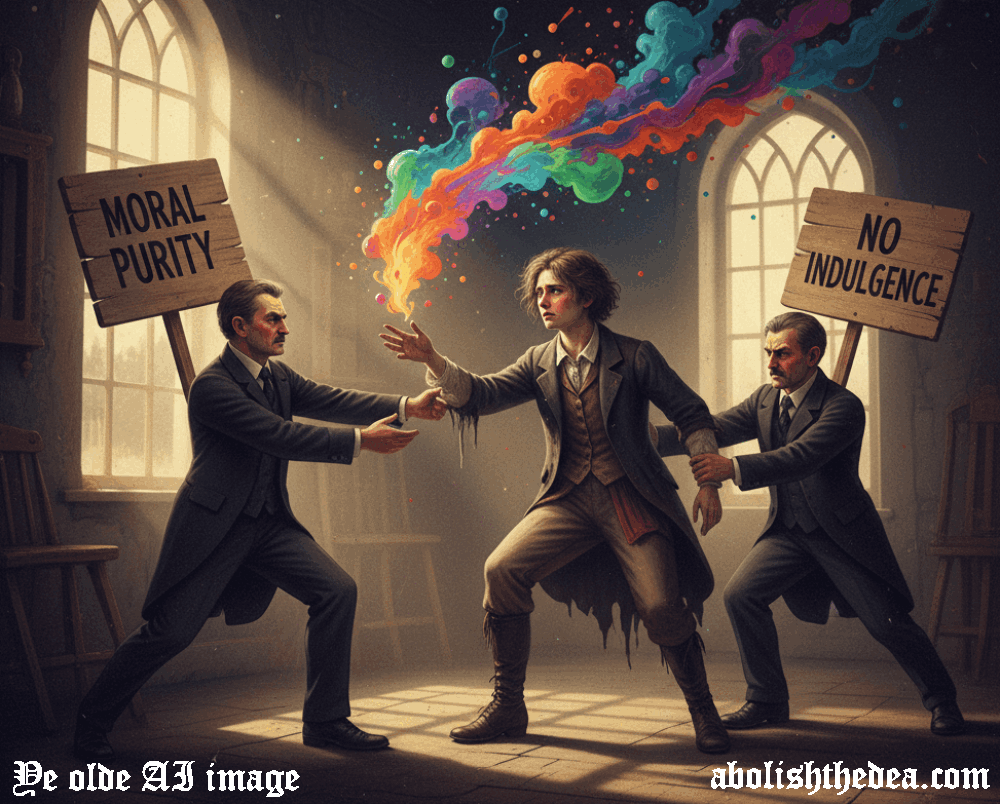
 Normally, I would consider it bad form for essayists to tell you that they are "feeling down today." It would be a case of what we used to call TMI as kids: "too much information." But this admission by a drug-war philosopher is highly relevant to his essays given that the lack of motivation referred to has been brought about by drug policy, which outlaws all substances that could help one to transcend this feeling and so be productive in life. This is why I call drug prohibition a meta injustice, because it does far worse than censor you as to what you can talk about: it seeks to limit the amount of passion and zeal that you can devote to your cause as a naysayer against the status quo.
AI is like almost every subject under the sun: it takes on a very different and ominous meaning when we view it in light of the modern world's unprecedented wholesale outlawing of psychoactive medicine.
Americans love to hate heroin. But there is no rational reason why folks should not use heroin daily in a world in which we consider it their medical duty to use antidepressants daily.
"Those gentlemen who adopt the anti-opium doctrine... are only comparable to the monomaniac, who, sane upon every subject but one, is thoroughly daft upon that." --William Brereton
Every time I see a psychiatrist, I feel like I'm playing a game of make-believe. We're both pretending that hundreds of demonized medicines do not exist and could be of no use whatsoever.
Big pharma drugs are designed to be hard to get off. Doctors write glowingly of "beta blockers" for anxiety, for instance, but ignore that fact that such drugs are hard -- and even dangerous -- to get off. We have outlawed all sorts of less dependence-causing alternatives.
Freud had the right idea: He noticed that cocaine use actually ended depression in his patients. Unfortunately, he was ambitious and was more interested in making a name for himself than in pushing back against the statistically challenged fear mongering of prohibitionists.
Today's doctors are "quacks" because they fail to see any of the many obvious uses for psychoactive substances.
No imaginable downside could persuade westerners that guns and alcohol were too dangerous. Yet the DEA lies about almost all psychoactive drugs, saying there are no good uses.
To say that taking SSRIs daily is better than using opium daily is a value judgement, not a scientific one.
The FDA approves of shock therapy and the psychiatric pill mill, but they cannot see the benefits in MDMA, a drug that brought peace, love and understanding to the dance floor in 1990s Britain.
Normally, I would consider it bad form for essayists to tell you that they are "feeling down today." It would be a case of what we used to call TMI as kids: "too much information." But this admission by a drug-war philosopher is highly relevant to his essays given that the lack of motivation referred to has been brought about by drug policy, which outlaws all substances that could help one to transcend this feeling and so be productive in life. This is why I call drug prohibition a meta injustice, because it does far worse than censor you as to what you can talk about: it seeks to limit the amount of passion and zeal that you can devote to your cause as a naysayer against the status quo.
AI is like almost every subject under the sun: it takes on a very different and ominous meaning when we view it in light of the modern world's unprecedented wholesale outlawing of psychoactive medicine.
Americans love to hate heroin. But there is no rational reason why folks should not use heroin daily in a world in which we consider it their medical duty to use antidepressants daily.
"Those gentlemen who adopt the anti-opium doctrine... are only comparable to the monomaniac, who, sane upon every subject but one, is thoroughly daft upon that." --William Brereton
Every time I see a psychiatrist, I feel like I'm playing a game of make-believe. We're both pretending that hundreds of demonized medicines do not exist and could be of no use whatsoever.
Big pharma drugs are designed to be hard to get off. Doctors write glowingly of "beta blockers" for anxiety, for instance, but ignore that fact that such drugs are hard -- and even dangerous -- to get off. We have outlawed all sorts of less dependence-causing alternatives.
Freud had the right idea: He noticed that cocaine use actually ended depression in his patients. Unfortunately, he was ambitious and was more interested in making a name for himself than in pushing back against the statistically challenged fear mongering of prohibitionists.
Today's doctors are "quacks" because they fail to see any of the many obvious uses for psychoactive substances.
No imaginable downside could persuade westerners that guns and alcohol were too dangerous. Yet the DEA lies about almost all psychoactive drugs, saying there are no good uses.
To say that taking SSRIs daily is better than using opium daily is a value judgement, not a scientific one.
The FDA approves of shock therapy and the psychiatric pill mill, but they cannot see the benefits in MDMA, a drug that brought peace, love and understanding to the dance floor in 1990s Britain.


 (up)
(up)