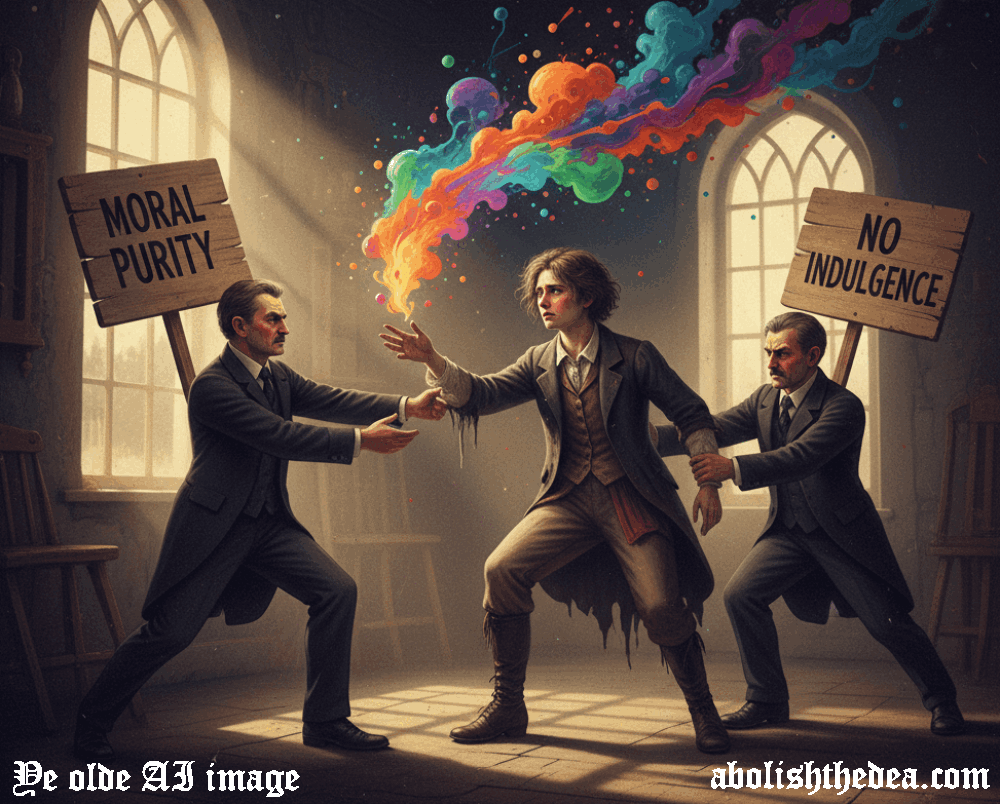
Normally, I would consider it bad form for essayists to tell you that they are "feeling down today." It would be a case of what we used to call TMI as kids: "too much information." But this admission by a drug-war philosopher is highly relevant to his essays given that the lack of motivation referred to has been brought about by drug policy, which outlaws all substances that could help one to transcend this feeling and so be productive in life. This is why I call drug prohibition a meta injustice, because it does far worse than censor you as to what you can talk about: it seeks to limit the amount of passion and zeal that you can devote to your cause as a naysayer against the status quo.
Take me, for instance. There are numerous "behind-the-scenes" steps that I could take to improve the potential indexability of each of my essays. These steps would not take long and I have custom forms that I can, in theory, easily fill out for this purpose. And yet I find it quite hard to follow through. It's kind of like that broken yellow water dish that sits out on my porch under the table on which I place peanuts for my blue jays and cardinals. The plate has been sitting there for months now, and I never think much about it; but when I analyze my failure to act (to pick up the two large ceramic pieces and throw them in a trash bag at long last), I realize that I'm always basically thinking to myself: "Why bother?" I actually like neatness and attention to detail, and yet I have difficulty cleaning up "in real time."
Fortunately, I have long since learned to compensate for this shortcoming by conducting condo clean-up operations on a semi-regular basis on my "good days" while listening to a variety of provocative philosophical screeds on my Bose headset, thereby keeping the morbid reflections at bay. And so, as I tote the garbage bag to the door, I'm no longer thinking, "What's the point of doing this, the bag's just going to fill up again after all!"; instead, I'm thinking to myself: "Where does this so-called philosopher 'get off' concluding that the sober mindset is the nonpareil of unbiased baselines, emotionally speaking!? I'll show him: I'll write an essay about this claptrap this very minute -- or at least after the one-hour timer has sounded, announcing the end of this particular battle in my ongoing war against entropy."
Thanks to these compensatory skills that I have acquired over the years, my place is quite attractive, if I do say so myself. And yet there are so many broken yellow water dishes sitting on the metaphorical porch of my life -- so many steps that could in theory be taken to advance my goals -- were I only allowed the same freedom that everyone had just over 100 years ago, the freedom to control how I take care of my own mind and mood.
Of course, if a psychiatrist were to read these thoughts, they would conclude that I have an addictive personality. From their point of view, I don't need any symptomatic incentives (except maybe for coffee and beer, of course): I need to have my brain chemistry changed once and for all with a one-size-fits-all pill that I will have to take for the rest of my life. Speaking of which, this is one of the most surprising realizations that I have come to over my last seven years of studying American drug attitudes, the fact that healthcare pundits never seem to see any downsides in turning their clientele into patients for life. This is odd, because so many of these pundits preach sermons about the horrors of dependency when it comes to illegal medicines, yet they tout dependency as a positive patient attribute when it comes to Big Pharma meds. They have become so blasé on the subject that the Mayo Clinic does not even mention "dependence" in their write-up of Effexor1, which is surely one of the most dependence-causing drugs in the world2 -- a fact that will never be "scientifically" established, however, in a world in which biopharma pays 75% of The FDA’s drug division budget3.
Key Takeaways:
Drug prohibition outlaws motivation and incentive.
We all have -- or had -- the freedom to take care of our own mind and mood.
Healthcare pundits see no downsides in dependency on Big Pharma meds.
The American Philosophy Association should make itself useful and release a statement saying that the drug war is based on fallacious reasoning, namely, the idea that substances can be bad in themselves, without regard for why, when, where and/or how they are used.
If there is an epidemic of "self-harm," prohibitionists never think of outlawing razor blades. They ask: "Why the self-harm?" But if there is an epidemic of drug use which they CLAIM is self-harm, they never ask "Why the self-harm?" They say: "Let's prohibit and punish!"
Using the billions now spent on caging users, we could end the whole phenomena of both physical and psychological addiction by using "drugs to fight drugs." But drug warriors do not want to end addiction, they want to keep using it as an excuse to ban drugs.
"Users" can be kept out of the workforce by the extrajudicial process of drug testing; they can have their baby taken from them, their house, their property -- all because they do not share the intoxiphobic attitude of America.
People are talking about re-scheduling psilocybin, but they miss the point. We need to DE-schedule everything. It's anti-scientific to conclude in advance that any drug has no uses -- and it's a lie too, of course. End drug scheduling altogether! It's childish and wrong.
There's more than set and setting: there's fundamental beliefs about the meaning of life and about why mother nature herself is full of psychoactive substances. Tribal peoples associate some drugs with actual sentient entities -- that is far beyond "set and setting."
Classic prohibitionist gaslighting, telling me that "drugs" is a neutral term. What planet are they living on?
I don't believe in the materialist paradigm upon which SSRIs were created, according to which humans are interchangeable chemical robots amenable to the same treatment for human sadness. Let me use laughing gas and MDMA and coca and let the materialists use SSRIs.
If I smoke opium nightly, I am a drug scumbag. If I use Big Pharma "meds" every day of my life, I am a good patient.
This hysterical reaction to rare negative events actually creates more rare negative events. This is why the DEA publicizes "drug problems," because by making them well known, they make the problems more prevalent and can thereby justify their huge budget.
Unless otherwise indicated, no AI is used in the creation of site content. These essays represent the original ideas of their author and not the ideas that the author SHOULD have based on an algorithmic parsing of existing data. For more on this subject, consider the AI-related viewpoints to which the author subscribes as delineated in the New York Times opinion piece entitled "What 370,000 College Essays Tell Us About A.I.’s Effects on Creativity" by Rebecca Winthrop of the Brookings Institution.







 Normally, I would consider it bad form for essayists to tell you that they are "feeling down today." It would be a case of what we used to call TMI as kids: "too much information." But this admission by a drug-war philosopher is highly relevant to his essays given that the lack of motivation referred to has been brought about by drug policy, which outlaws all substances that could help one to transcend this feeling and so be productive in life. This is why I call drug prohibition a meta injustice, because it does far worse than censor you as to what you can talk about: it seeks to limit the amount of passion and zeal that you can devote to your cause as a naysayer against the status quo.
 (up)
(up)