








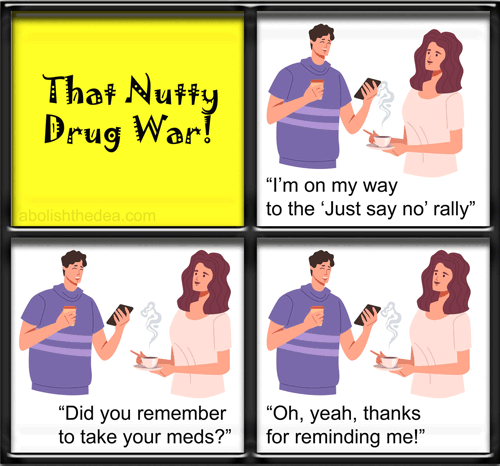
 No wonder the "Justice" Department relies on plea deals; otherwise juries could use nullification to free those charged with mere drug possession.
I'd like to become a guinea pig for researchers to test the ability of psychoactive drugs to make aging as psychologically healthy as possible. If such drugs cannot completely ward off decrepitude, they can surely make it more palatable. The catch? Researchers have to be free.
Drug prohibition is the biggest tyranny imaginable. It is the government control of pain relief. It is government telling us how and how much we are allowed to think and feel in this life.
We're living in a sci-fi dystopia called "Fahrenheit 452", in which the police burn thought-expanding plants instead of thought-expanding books.
Racist drug warriors make cities dangerous with drug prohibition -- then they use that danger as an excuse to send in the National Guard.
Endless drugs could help with depression. Any drug that inspires and elates is an antidepressant, partly by the effect itself and partly by the mood-elevation caused by anticipation of use (facts which are far too obvious for materialists and drug warriors to understand -- let alone materialist drug warriors!).
Mayo Clinic is peddling junk. They are still promoting Venlafaxine, a drug that is harder to kick than heroin.
When the FDA tells us in effect that MDMA is too dangerous to be used to prevent school shootings and to help bring about world peace, they are making political judgments, not scientific ones.
The Cabinet of Caligari ('62) ends with a shameless display of psychiatric triumphalism. Happy shock therapy patients waltz freely about a mansion in which the "sick" protagonist has just been "cured" by tranquilizers and psychoanalysis. Did Robert Bloch believe his own script?
In "How to Change Your Mind," Michael Pollan says psychedelic legalization would endanger young people. What? Prohibition forces users to decide for themselves which mushrooms are toxic, or to risk buying contaminated product. And that's safe, Michael?
No wonder the "Justice" Department relies on plea deals; otherwise juries could use nullification to free those charged with mere drug possession.
I'd like to become a guinea pig for researchers to test the ability of psychoactive drugs to make aging as psychologically healthy as possible. If such drugs cannot completely ward off decrepitude, they can surely make it more palatable. The catch? Researchers have to be free.
Drug prohibition is the biggest tyranny imaginable. It is the government control of pain relief. It is government telling us how and how much we are allowed to think and feel in this life.
We're living in a sci-fi dystopia called "Fahrenheit 452", in which the police burn thought-expanding plants instead of thought-expanding books.
Racist drug warriors make cities dangerous with drug prohibition -- then they use that danger as an excuse to send in the National Guard.
Endless drugs could help with depression. Any drug that inspires and elates is an antidepressant, partly by the effect itself and partly by the mood-elevation caused by anticipation of use (facts which are far too obvious for materialists and drug warriors to understand -- let alone materialist drug warriors!).
Mayo Clinic is peddling junk. They are still promoting Venlafaxine, a drug that is harder to kick than heroin.
When the FDA tells us in effect that MDMA is too dangerous to be used to prevent school shootings and to help bring about world peace, they are making political judgments, not scientific ones.
The Cabinet of Caligari ('62) ends with a shameless display of psychiatric triumphalism. Happy shock therapy patients waltz freely about a mansion in which the "sick" protagonist has just been "cured" by tranquilizers and psychoanalysis. Did Robert Bloch believe his own script?
In "How to Change Your Mind," Michael Pollan says psychedelic legalization would endanger young people. What? Prohibition forces users to decide for themselves which mushrooms are toxic, or to risk buying contaminated product. And that's safe, Michael?


 (up)
(up)