




Homepage of the Drug War Philosopher, Brian Quass
blog icon orange rss icon with stylized radio waves bird icon for twitter bird icon for twitter substack icon


back navigation arrow forward navigation arrow


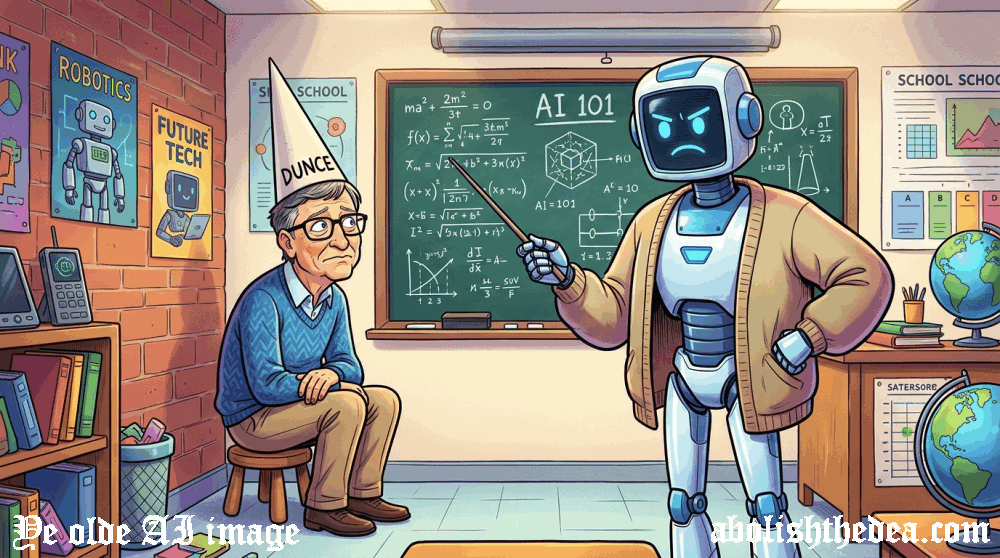
AI Will Soon Be More Intelligent than Bill Gates, experts warn

after parsing the latest harebrained statement by the Microsoft billionaire

by Brian Ballard Quass, the Drug War Philosopher (Substack version)

October 28, 2026


It's been a record 48 hours since I've pestered my subscribers with an essay of mine, but I have an excuse. I have been poring over an important book from 1979 by E. Richard Brown entitled Rockefeller Medicine Men - Medicine & Capitalism in America 1, which I am finding highly instructive on the subject of how America ended up adopting such a jaundiced view of so-called drugs, to the point that today we would actually prefer that depressed individuals commit suicide than to make use of substances that could make them wish to live. Unfortunately, I am not yet ready to confront you with my findings in that quarter. Suffice it to say that Brown's heavily researched analysis helps us understand how a combination of scientism and self-interest created a climate in which drug benefits became invisible to the healthcare industry. Scientists were in charge of health, and since feelings could not be viewed under a microscope, they had no interest in substances that merely made a person feel better. Anybody could make someone FEEL better, after all, even a quack! No, our distinguished scientists were after the metaphysical holy grail of a real cure -- you know, a medical cure. That's where the money and prestige lay -- thanks to the spending preferences of America's unimaginably rich benefactors.

Speaking of America's unimaginably rich benefactors, the point of today's essay is to comment on the latest papal bull delivered by Gates, by which I mean Bill Gates, of course, not the Reverend Frederick T. Gates who oversaw philanthropic spending for Rockefeller Sr. in the late 19th century, as we learn from the book that I've mentioned above. This Bill Gates of ours recently declared, as it were ex cathedra, that AI will eventually become the most intelligent entity in the world. Most intelligent! I picked up this factoid as a news blurb that I happened to overhear on the UK streaming channel known as Sky News. The "presenters" had been boring me to tears with their debate over Andy Burnham's latest comments in Parliament about the possibility of a new Brexit referendum, when they suddenly gained my full and undivided attention. "What?" I said to myself. "Does Bill Gates even know what the word 'intelligence' means? If he did, he would never have embarrassed himself in public like this by making such a claim. He should have heeded the advice of Mark Twain, that it's better to remain silent and be thought a fool than to speak and remove all doubt."

I am sure the reader knows whereof I speak, but let us consider the definition of "intelligence" as given by the Merriam-Webster Dictionary, just for the record:

Intelligence: the ability to learn or understand things or to deal with new or difficult situations.


Gates displays the shortcoming that I fear is typical of many techies: they fail to realize that all our solutions to social problems are based on philosophical assumptions, no matter how much we may claim that philosophy is useless for us. Now, AI is indeed great at re-hashing the knowledge of humankind without our permission and then pretending that it is smarter than us for doing so. But in terms of giving us advice to help us "deal with new or difficult situations," AI is only as good as the principles that it has inferred from the data that we have provided it and upon which it then bases its responses. Drug prohibition is a perfect example. Suppose we wanted to ask AI for the best way to deal with drugs. Every imaginable solution it can devise will depend on value judgments, on answers to such questions as: "Is it better for hundreds of millions to remain unnecessarily depressed in order to save a distinct minority of irresponsible and undereducated people from themselves? Is the right to experience union with God more important than the safety of 1 in 10,000 high-schoolers who cannot handle a substance wisely?" These are questions that AI could never answer meaningfully because they are not amenable either to calculation or even utilitarian analysis, since attempts to quantify the terms will involve the rendering of value judgements by those who are attempting to parse the data.

"What is the best response to the fact that the world is full of psychoactive substances?" The answer depends on what we value in life -- and frankly, who cares what a piece of code values in life? If we value freedom and we believe in the power of education, we will keep Mother Nature free. If we value violence and we believe in the power of law enforcement and the military, we will criminalize Mother Nature. AI cannot tell us what to do in such cases. Why not? Because -- news flash, Bill -- AI is not now, nor ever will be, "intelligent." Highly knowledgeable, yes. Intelligent, no. Indeed, there is great danger in thinking of AI as intelligent. If future governments believe that myth, then we will have a tyranny run by the Dr. Spocks of the world, for whom protest and the desire for mental and emotional freedom will seem "highly illogical, Captain." It will be the triumph of the god of Efficiency for whom our techies have been working all along, a world dependent on cogs in a wheel and indifferent to the individual. There is no place for unique mental experiences in such an environment, only for group think. Worse yet, if the techie believers in AI consciousness have their way, we will not only have to abide by the decisions that AI eventually makes for us regarding drugs and other social issues, but we will have to refrain from complaining about their supposedly "logical" and therefore supposedly "correct" solutions, lest in so doing we should hurt the feelings of our digital oppressor.


Notes for essay entitled AI Will Soon Be More Intelligent than Bill Gates, experts warn: after parsing the latest harebrained statement by the Microsoft billionaire:

1: Richard, Brown E. n.d. Rockefeller Medicine Men : Medicine and Capitalism in America. Accessed October 27, 2026. https://ia801507.us.archive.org/4/items/RockefellerMedicineMen_201903/ Rockefeller%20Medicine%20Men.pdf. (up)


read more essays here


Ten Tweets

against the hateful war on US


Both physical and psychological addiction can be successfully fought when we relegalize the pharmacopoeia and start to fight drugs with drugs. But prohibitionists do not want to end addiction, they want to scare us with it.

Drug warriors have harnessed the perfect storm. Prohibition caters to the interests of law enforcement, psychotherapy, Big Pharma, demagogues, puritans, and materialist scientists, who believe that consciousness is no big "whoop" and that spiritual states are just flukes.

Another problem with MindMed's LSD: every time I look it up on Google, I get a mess of links about the stock market. The drug is apparently a godsend for investors. They want to profit from LSD by neutering it and making it politically correct: no inspiration, no euphoria.

Aleister Crowley actually TRIED to get addicted to drugs and found he could not. These things are not inevitable. The fact that there are town drunkards does not mean that we should outlaw alcohol.

Prohibitionists will me that we're all children when it comes to drugs, and can never -- but never -- use them wisely. That's like saying that we could never ride horses wisely. Or mountain climb. Or skateboard.

The New York Times gets it wrong again. Yes, kratom, like all drugs, has downsides. The problem is not kratom, it's drug prohibition which limits choice. Nor are young people the only stakeholders in the debate, as the Times always assumes.

No wonder conservatives are terrified of drugs. It is not safety that worries them, else they would demand education. They are terrified of new ways of seeing life. The outlawing of drugs is the outlawing of whole mindsets. It is a meta injustice.

Psst! Drug use has benefits too. Pass it on!

Two weeks ago, a guy told me that most psychiatrists believe ECT is great. I thought he was joking! I've since come to realize that he was telling the truth: that is just how screwed up the healthcare system is today thanks to drug war ideology and purblind materialism.

I'm on SNRIs. But SSRIs and SNRIs are both made with materialist presumptions in mind: that the best way to change people is with a surgical strike at one-size-fits-all chemistry. That's the opposite of the shamanic holism that I favor.


Click here to see All Tweets against the hateful War on Us


back navigation arrow forward navigation arrow
Book Cover

Break the ice with a sledgehammer: place this book on your coffee table.

This book features 150 annotated images, designed to force brainwashed Americans to confront the fact that drug prohibition is wrong. Here is what author Richard Parrish II says of the book's compiler: "The drug prohibition philosopher provides first-hand, principled, persuasive, and insightful arguments against the current drug prohibition regime..."

Purchase Your Copy
Book Cover

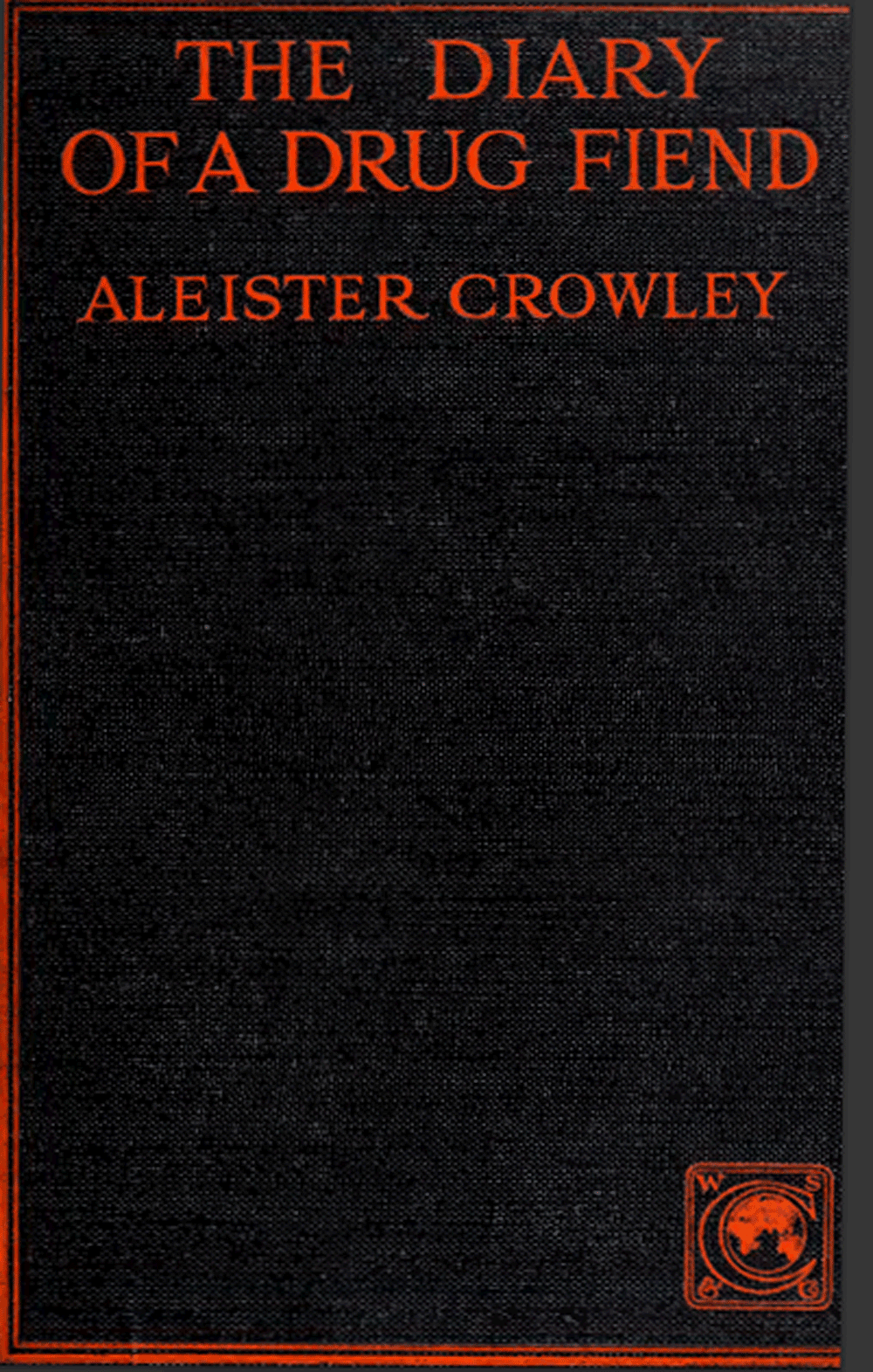
Diary of a Drug Fiend

This is the only full-cast recording of Aleister Crowley's 1922 classic paeon to common sense. It is the first book -- and so far almost the only book -- to stake out a philosophy of drug use that is compatible with human freedom, one in which we learn to use drugs as wisely as possible for the benefit of humanity. This recording was produced by the Drug War Philosopher and your purchases help support his effort to push back against the tragically counterproductive policy of drug prohibition, in the name of human freedom and of humanity's right to heal.

Purchase Your Copy


No cookies, no ads paid for by amoral and immoral billionaires (or trillionaires).


Unless otherwise indicated, no AI is used in the creation of site content. These essays represent the original ideas of their author and not the ideas that the author SHOULD have based on an algorithmic parsing of existing data. For more on this subject, consider the AI-related viewpoints to which the author subscribes as delineated in the New York Times opinion piece entitled "What 370,000 College Essays Tell Us About A.I.’s Effects on Creativity" by Rebecca Winthrop of the Brookings Institution.

The Partnership for a Death Free America is a proud sponsor of The Drug War Philosopher website @ abolishthedea.com.


Copyright 2026, Brian Ballard Quass Contact: quass@quass.com

tombstone for American Democracy, 1776-2024, RIP (up)