introduction to the Drug War Philosopher website at abolishthedea.com
blog icon orange rss icon with stylized radio waves bird icon for twitter bird icon for twitter substack icon


back navigation arrow


Alfred North Whitehead on Drugs

how the process philosopher pays short shrift to altered states of consciousness

by Brian Ballard Quass, the Drug War Philosopher

July 14, 2026


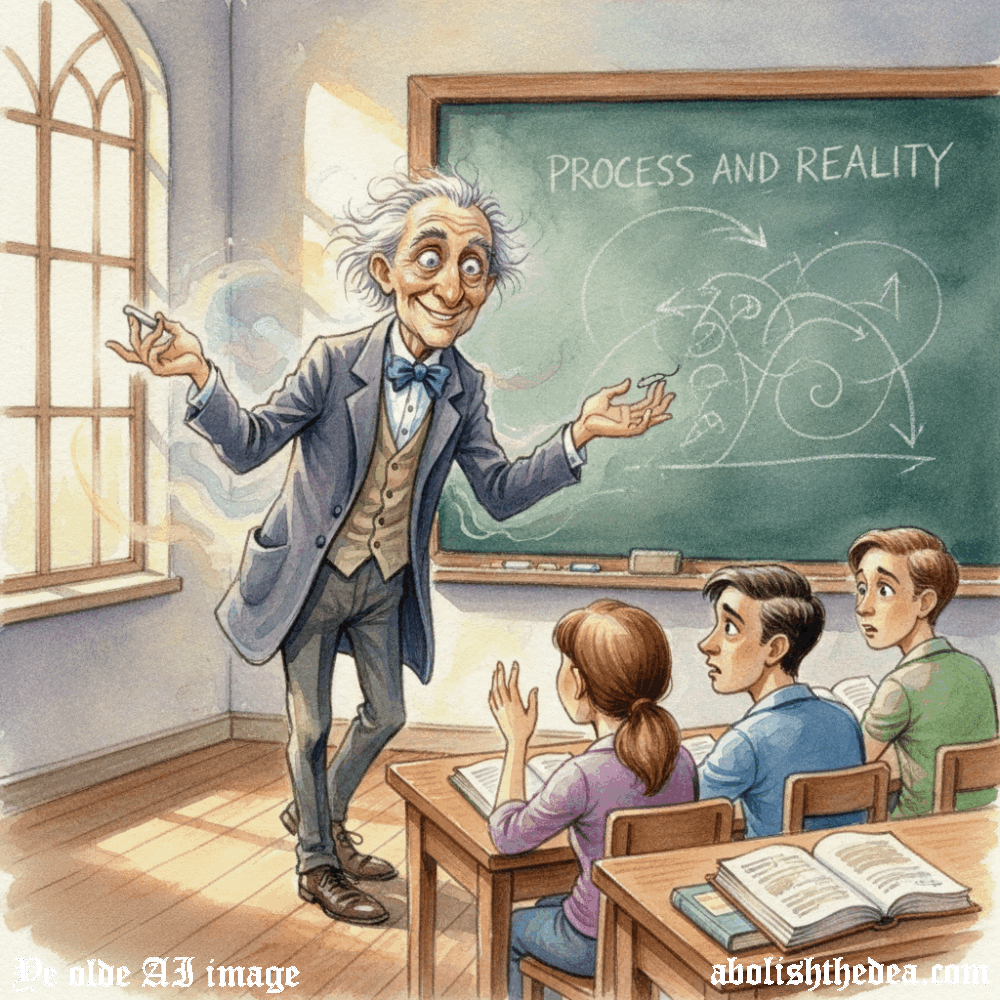
There is a lot to be learned from the fact that Immanuel Kant never mentioned the word "drug" in his Critique of Pure Reason 1. It implies that he felt that the use of psychoactive substances served only to bias the mind in its attempts to make sense of "what's really out there," and, moreover, that this fact would be so obvious to his readers that it could literally go without saying. But in the case of Alfred North Whitehead, there is a lot to be learned from the way that he uses the word "drug" in his published lecture series entitled "Process and Reality 2." For I realized this morning that the English philosopher does indeed employ that term twice in that book, which, by the way, is surely two times more than most modern philosophy professors employ that term when lecturing on Whitehead.

The citations are found, respectively, in sections I and IV of his chapter on "The Extensive Continuum."

There is the partially delusive case when we have been looking in a mirror; in this case, the chair-image we see is not the culmination of the corpuscular society of entities which we call the real chair. Finally, we may have been taking drugs, so that the chair-image we see has no familiar counterpart in any historical route of a corpuscular society. 3


The intellect of Socrates is intermittent: he occasionally sleeps and he can be drugged or stunned. 4


Although Whitehead was not a full-blown rationalist, he was a mathematician interested in meticulous definitions, and we can sense his impatience with substances whose use, if taken seriously, could drastically increase the number of ways in which a human being could be justifiably said to perceive the world. This would increase the complexity of the philosopher's already complex analyses by at least an order of magnitude. As long as he can dismiss the information that we receive/perceive from drug-inspired consciousness as phantasms (i.e., as being ontologically irrelevant), all is well for the system builder; but the moment we agree with William James that there are "many kinds of consciousness" and that they each "may have their field of application," 5 we realize that the system that we were constructing in two dimensions actually has a third dimension of which we had been completely unaware.

And in some ways, William James was obviously right. Whitehead is merely expressing his ignorance of the diverse and manifold effects of psychoactive drugs when he suggests otherwise 6. Although James was working with anaesthetics, chiefly laughing gas, such substances are but a subset of what we classify -- or rather demonize -- today as "drugs." And what forms of consciousness arise from the use of such substances?

A wide variety of drugs may help us to see a chair in a way that has "no known counterpart in any historical route of a corpuscular society," but that does not mean that our use of such substances constitutes a biasing factor in our attempt to see the world "as it really is." The biasing factor is rather the limited nature of our perceptions when we are in what we would call a "sober" state of mind. In the sober state, we think of the chair (on those rare occasions that we think of it at all) as one discrete utilitarian object and nothing more. To a drug user, on the other hand, that chair may become an object of intense interest and may even seem to constitute an aesthetic work of art. But this is not an "illusory" revelation for the user; it is rather just another way of seeing the chair that the drug user had literally never thought of before. A poet is not "wrong" simply because they see beauty in "the culmination of the corpuscular society of entities" that most of us view only from the standpoint of utility. We might just as well say that the sober dullard is "wrong" for seeing the chair as a mere chair.

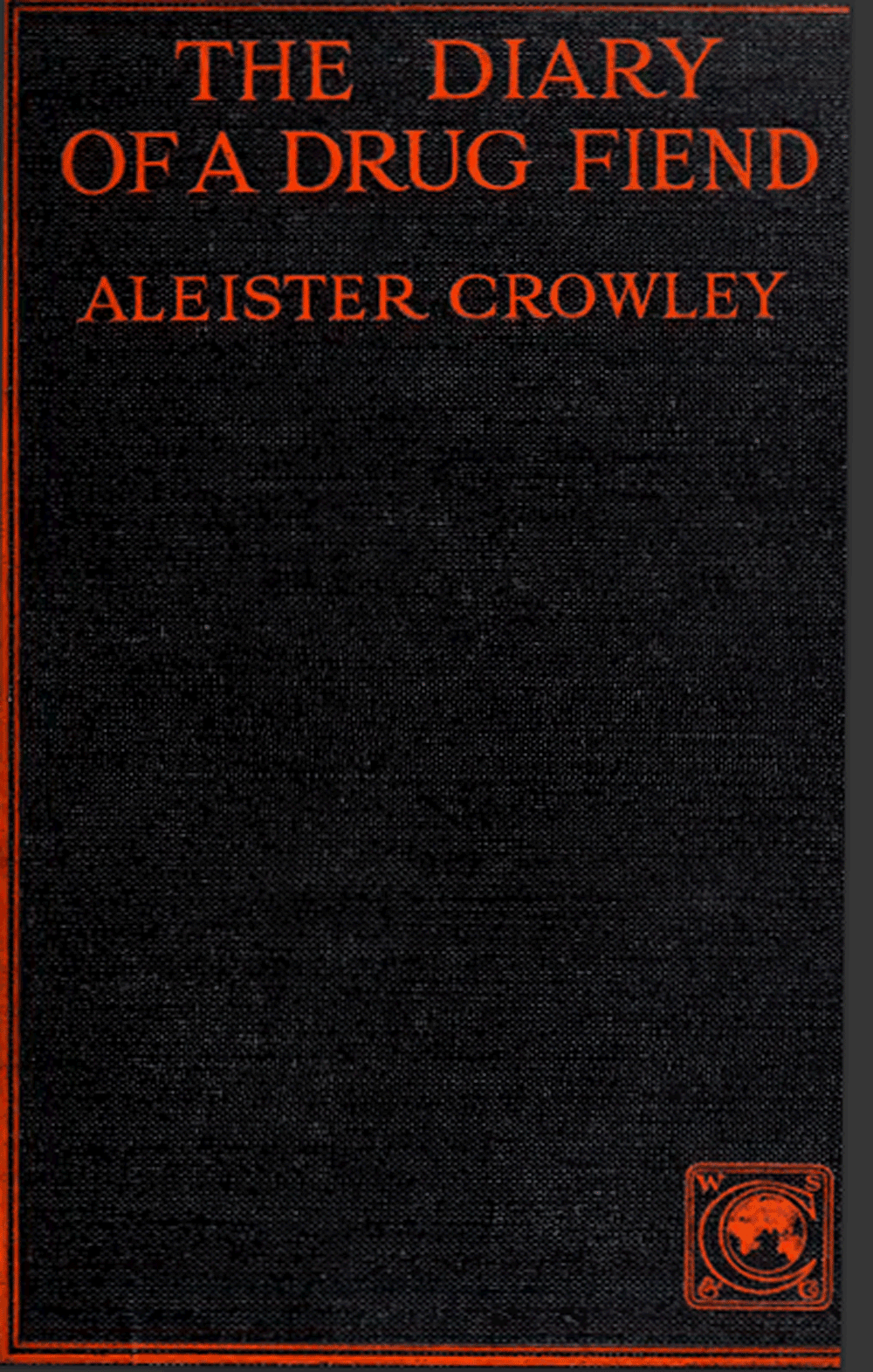
From the standpoint of metaphysics, then, our drug-virgin philosopher seems to be telling us, "Reality is essentially boring; when we see it as otherwise, that's a clear sign that 1) we are either a rare and great poet, or (far more likely) 2) we are 'on drugs' and seeing phantasms." Of course, this dictum presupposes a naive definition of the word "drugs." It's interesting that Whitehead, for all his linguistic sophistication, did not see the problem with using the word in such a catch-all fashion, as if drugs like cocaine and heroin, whose short-term use conduces to intellectual brilliance 7, should be placed in the same category with drugs like alcohol, whose short-term use conduces to brain fog and incapacitation 8. This shows how far the west still was in the late 1920s from grasping the time-honored indigenous idea that psychoactive plants could actually be used for healing, both physically and spiritually, and not just for scrambling the brain and causing addiction. The American ethnobotanist Richard Schultes had not yet traveled to the Amazon, where he was to discover a whole new and highly nuanced way of looking at "drugs," beside which our own kneejerk assumptions about psychoactive substances are revealed for the puerile and superstitious dogma that they are. 9

SPECULATION

I end with a comment that is highly speculative, but whose contemplation might possibly suggest new ways to consider the many philosophical issues that have been suggested above.

I am not a chemist, but it seems to me that, in a certain sense, we are all "on drugs" all the time, insofar as that is what is implied by the term "biochemistry." We use "drugs" to alter our baseline biochemistry in order to produce states of aesthetic understanding and so forth. Given that these visionary states of consciousness are caused by (or at least associated with) specific biochemical states, is it not possible that the visionary William Blakes of the world (the Saint Teresas and the Meister Eckharts) "come about," so to speak, thanks to their innate possession of a poetically conducive biochemistry? Could it be that their unique biochemistries foster a unique consciousness thanks to which they can see the world in ways that the ordinary human being cannot -- that they can see the world from perspectives that the ordinary human being would need to use "drugs" in order to obtain, or even in order to adequately understand? It's a commonplace, after all, that drug users are beggared for words when returning from certain transcendent states. They find that they have to resort to poetry in order to express what they have experienced while "under the influence." When I myself saw a neon-green slide show of pre-Columbian Mesoamerican imagery under the influence of peyote ten years ago at the Church of the Peyote Way in Arizona, I got a sense of what Wordsworth called "something far more deeply interfused," a sense of how the world was somehow a connected place, this despite the fact that science prefers to deal with the world as a mountain of bits and pieces outside of all context. 10

This is interesting, because Whitehead himself writes favorably of Wordsworth, whom he says was "drunk on nature" just as Spinoza is said to have been "drunk on God." Wordsworth's "constant theme," says Whitehead, " is that the important facts of nature elude the scientific method," a statement with which Whitehead clearly agrees 11. We see then that Whitehead was on the right path toward appreciating the testimony of drug users with regard to the insights supplied by altered states. He was on the right path toward seeing that psychoactive drug use has an obvious role in the study of the nature of the world as perceived by human beings. Had he lived during the upcoming age of domestic drug exploration and ethnobotanical progress in the Amazon basin, Whitehead surely would have realized that his wholesale dismissal of drug use as producing states of ontological meaninglessness was unfounded and that such a prejudice on his part only served to shield him from appreciating the full complexity of the task of systemizing human experience and understanding. It also seems to have limited his ability to push back against the Lockean insistence on the existence of secondary qualities, though frankly my understanding of Whitehead on that subject is not at the point where I feel free to speculate in any detail 12.

Yet it's interesting to consider the reservations that Whitehead has about secondary qualities. "If we are to include the secondary qualities in the common world," says the philosopher in Science and the Modern World, "a very drastic reorganisation of our fundamental concepts is necessary. It is an evident fact of experience that our apprehensions of the external world depend absolutely on the occurrences within the human body. By playing appropriate tricks on the body a man can be got to perceive, or not to perceive, almost anything. 13"

I cannot keep myself from answering Whitehead's apparent concerns here as follows (recognizing as I do so that I may be addressing a side of the question that Whitehead did not have in mind when posing it): "Well, maybe that's the way that life really is. Maybe our job as conscious human beings is to "create" the world in which we reside by assuming the best possible attitudes toward the "fundamental" atomic stuff that we used to call the physical world and which we now think of as "mere" or "sheer" potential, in the sense that an electron (which we say is out there in the "real" world) may be said to have a potential location as opposed to an actual one. It follows that if we want to see a well-made chair as a work of art in our living room rather than a forgettable compilation of sticks, we should use our gift of a purpose-driven consciousness to achieve that goal, whether doing so requires years of study, exercise, religious instruction, counseling, meditation and/or the use of a variety of the psychoactive substances that seem to have been sprinkled about us on planet Earth like so many keys to give us access to new forms of consciousness other than the often meager version provided by our default biochemistry. I guess I'm assuming a kind of panpsychism here, having been inspired thereunto by my experience with peyote in the high desert of eastern Arizona.

So much for these highly speculative comments. I hope that, like the metaphysical musings of Dr. Hesselius in the short story "Green Tea," they will "suggest more than they actually say."

CONCLUSION

I have attempted to make it clear how Whitehead's kneejerk dismissal of drug-inspired states has limited his ability to thoroughly sound the question of "what's really out there" and to determine the precise role of perception and consciousness in what we call the real world. But this failure on his part affects more than just the philosophical world. Until we westerners acknowledge the connection between various biochemistries and new world's of consciousness which they incite in the human mind, we will fail to understand the full evil of drug prohibition. If we assume with philosophers like Whitehead that the world as experienced on drugs is simply nonsense, then it may be hard for the average American to become indignant about drug prohibition; but when we understand that drug prohibition keeps us from experiencing whole new worlds of consciousness, each with "its own field of application," we can only see drug prohibition as the worst form of tyranny in the world, one that controls not simply what we can know and therefore think about "the world out there," as did our despots of yore, but how and how much we can think about that world.

The drug prohibitionists insist that we see that living room chair of ours as a compilation of sticks -- just as they insist that we see the most clownish of leaders in Washington D.C. as real bona fide leaders, as cold, hard facts of life, as inevitable and immovable as the Rock of Gibraltar. By prohibiting drug use, governments can destroy our ability to see the great pretention and absurdity of the status quo and so limit our very impulse to fight back against and/or ignore the powers that be. This is no doubt the worst nightmare of the egomaniacal leader, to be considered, not so much as evil, but rather as laughably irrelevant to the daily lives of his subjects. What good is power for the tyrant, after all, if it's not really "felt" by one's people AS power? This is where drug prohibition "comes in." If the tyrant can outlaw all truly effective psychoactive drugs and thereby keep his people unnecessarily depressed and anxious, then he will have an eager audience for the scapegoating and race-baiting that he intends to practice. What delicious irony for the despot that one of his biggest scapegoats of all will be drugs themselves, against which he can successfully encourage his own victims to fight, thereby making them complicit in their own disempowerment.


Notes:

1: The Critique of Pure Reason Kant, Immanuel, Project Gutenberg, 1781 (up)
2: “Process and Reality : Alfred North Whitehead : Free Download, Borrow, and Streaming : Internet Archive.” 2022. Internet Archive. 2022. https://archive.org/details/processreality0000alfr. (up)
3: “Process and Reality : Alfred North Whitehead : Free Download, Borrow, and Streaming : Internet Archive.” 2022. Internet Archive. 2022. https://archive.org/details/processreality0000alfr. (up)
4: “Process and Reality : Alfred North Whitehead : Free Download, Borrow, and Streaming : Internet Archive.” 2022. Internet Archive. 2022. https://archive.org/details/processreality0000alfr. (up)
5: “The Varieties of Religious Experience : William James : Free Download, Borrow, and Streaming : Internet Archive.” 2021. Internet Archive. 2021. https://archive.org/details/the-varieties-of-religious-experience_202109. (up)
6: Forbidden Quotations about the beneficial use of drugs DWP (up)
7: Arthur Crowley. “Full Text of ‘the Diary of a Drug Fiend.’” 1922. Archive.org. 2017. https://archive.org/stream/b29826433/b29826433_djvu.txt. (up)
8: The Mob Museum. n.d. “Alcohol as Medicine and Poison – Prohibition: An Interactive History.” Prohibition.Themobmuseum.Org. Accessed July 14, 2026. https://prohibition.themobmuseum.org/the-history/the-prohibition-underworld/alcohol-as-medicine-and-poison/. (up)
9: Plants of the Gods: Their Sacred, Healing, and Hallucinogenic Powers Schultes, Richard, 1979 (up)
10: How the Drug War Outlaws Criticism of Immanuel Kant DWP (up)
11: “Science and the Modern World : Whitehead, Alfred North, 1861-1947 : Free Download, Borrow, and Streaming : Internet Archive.” 2019. Internet Archive. 2019. https://archive.org/details/sciencemodernwor0000unse. (up)
12: “Process and Reality : Alfred North Whitehead : Free Download, Borrow, and Streaming : Internet Archive.” 2022. Internet Archive. 2022. https://archive.org/details/processreality0000alfr. (up)
13: “Science and the Modern World : Whitehead, Alfred North, 1861-1947 : Free Download, Borrow, and Streaming : Internet Archive.” 2019. Internet Archive. 2019. https://archive.org/details/sciencemodernwor0000unse. (up)


read more essays here


Ten Tweets

against the hateful war on US


I looked up the company: it's all about the damn stock market and money. The FDA outlaws LSD until we remove all the euphoria and the visions. That's ideology, not science. Just relegalize drugs and stop telling me how much ecstasy and insight I can have in my life!!

It's no wonder that folks blame drugs. Carl Hart is the first American scientist to openly say in a published book that even the so-called "hard" drugs can be used wisely. That's info that the drug warriors have always tried to keep from us.

"The Legislature deliberately determines to distrust the very people who are legally responsible for the physical well-being of the nation, and puts them under the thumb of the police, as if they were potential criminals." -- Aleister Crowley on drug laws

Oregon has decided to go back to the braindead plan of treating substance use as a police matter. Might as well arrest people at home since America has already spread their drug-hating Christian Science religion all over the world.

The Petpedia website says that "German Shepherds need to have challenging jobs such as searching for drugs." How about searching for prohibitionists instead?

When Rick Strassman and Michael Pollan call for continued prohibition to protect young people, they ignore the ENORMOUS fact that prohibition has destroyed inner cities around the world. Wake up, guys! Prohibition is evil, not drugs! Ignorance is evil, not education!

No wonder conservatives are terrified of drugs. It is not safety that worries them, else they would demand education. They are terrified of new ways of seeing life. The outlawing of drugs is the outlawing of whole mindsets. It is a meta injustice.

How else will they scare us enough to convince us to give up all our freedoms for the purpose of fighting horrible awful evil DRUGS? DRUGS is the sledgehammer with which they are destroying American democracy.

My impression has been that the use of cocaine over a long time can bring about lasting improvement..." --Sigmund Freud, On Cocaine, 1884

When we outlaw drugs, we are outlawing far more than drugs. We are suppressing freedom of religion and academic research.


Click here to see All Tweets against the hateful War on Us


back navigation arrow


No cookies, no ads.


Unless otherwise indicated, no AI is used in the creation of site content. These essays represent the original ideas of their author and not the ideas that the author SHOULD have based on an algorithmic parsing of existing data. For more on this subject, consider the AI-related viewpoints to which the author subscribes as delineated in the New York Times opinion piece entitled "What 370,000 College Essays Tell Us About A.I.’s Effects on Creativity" by Rebecca Winthrop of the Brookings Institution.

The Partnership for a Death Free America is a proud sponsor of The Drug War Philosopher website @ abolishthedea.com.


Copyright 2026, Brian Ballard Quass Contact: quass@quass.com

tombstone for American Democracy, 1776-2024, RIP (up)