








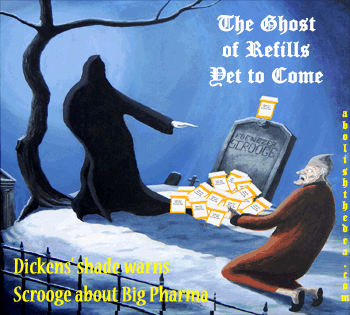
 In the introduction to his exhaustive commentary on The Critique of Pure Reason1, Norman Kemp Smith warns his readers that Kant's definitive viewpoints can only be understood by considering his work as a whole, and that the reader should therefore resist the temptation to consider any of his statements out of context. I feel compelled to extend a similar warning to my readers about my philosophy of drugs. I always do my best to imagine all possible objections to my philosophical positions and to answer them "on the fly," so to speak, in my essays, but I hope that any serious reader will consider my work as a whole before erecting straw men in their mind based on my failure to answer any given potential objection in any given essay. There are so many caveats, explanations, and qualifications that are called for in order for a philosophical maverick to render himself intelligible to a readership that has been indoctrinated in contrary viewpoints since their childhood. One cannot be expected to address them all in every single essay.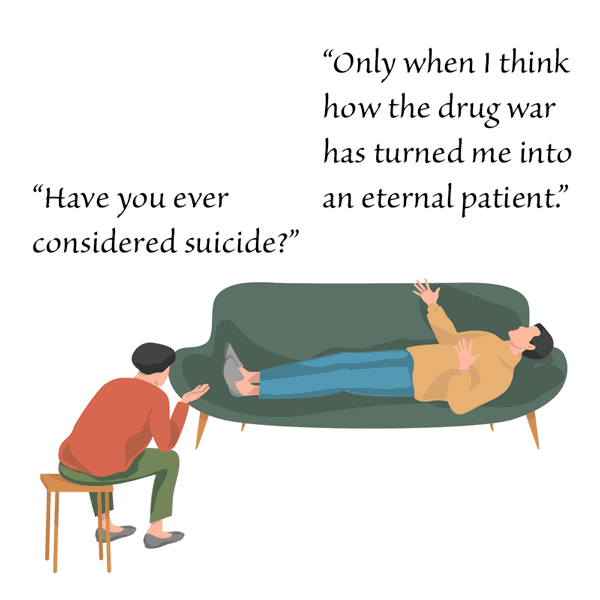
"In the presentation of a novel outlook with wide ramifications, a single line of communications from premises to conclusions is not sufficient for intelligibility. Your audience will construe whatever you say into conformity with their pre-existing outlook." --Alfred North Whitehead, The Concept of Nature2
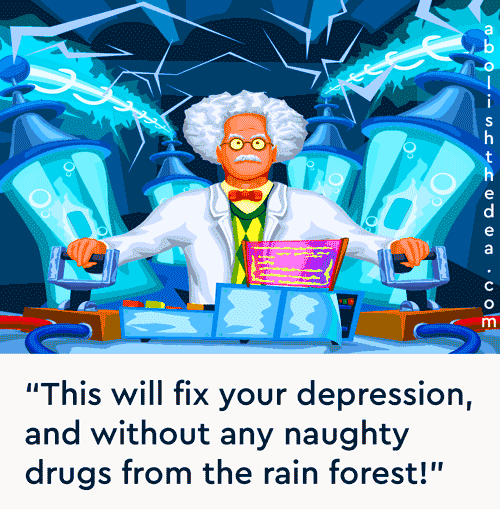
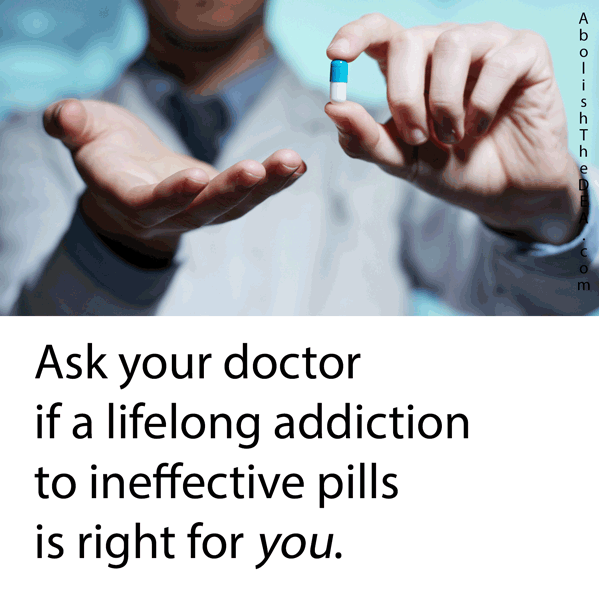
 I hope that this essay has helped to clarify my basic stand on Big Pharma antidepressants: namely, that such drugs are not the problem in and of themselves. That is the Drug Warrior's fallacy, to believe that drugs are a problem rather than the social policies that render their use problematic. The real problem is drug prohibition, which turns those drugs into "the only game in town" when it comes to treating depression.
 Case in point: As a youth, I was "slipped" a psychedelic at a party, thanks to which I suddenly clearly saw all the opportunities that life had to offer -- and I actually began to grieve for the vast swaths of time that I had seemingly wasted in introverted blindness to so many possibilities.
 "The right to chew or smoke a plant that grows wild in nature, such as hemp (marijuana), is anterior to and more basic than the right to vote." --Thomas Szasz, Our Right to Drugs --p xvi13
"Imagine how many people would have benefited during the past half-century had the government respected their autonomy and their right to self-medicate." --Jeffrey A. Singer, Your Body, Your Health Care --p. 9714
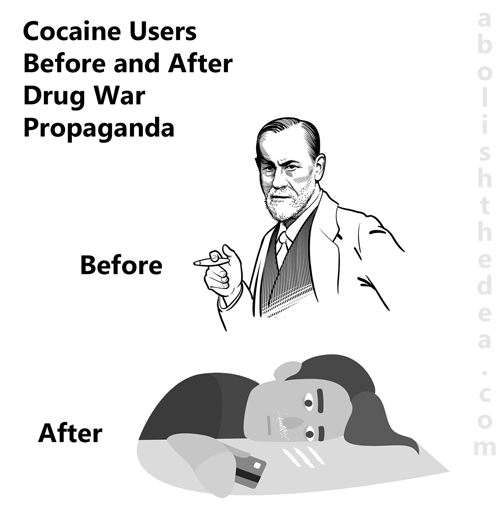 It is amazingly ironic that Sigmund Freud is known today in the west for time-consuming and expensive psychoanalysis. This can only be because academics and the medical community are controlling the narrative. They themselves profit from time-consuming and expensive psychoanalysis, if not as doctors then as researchers and professors. Any knowledgeable depressed person could tell you, however, that Freud's real discovery was that cocaine was a godsend for the depressed. But then the depressed themselves were never asked how they felt about cocaine. Self-interested doctors demonized the drug because they saw it as a threat to their livelihood. And the result has been the infantilization of human beings when it comes to taking care of their own psychological health.
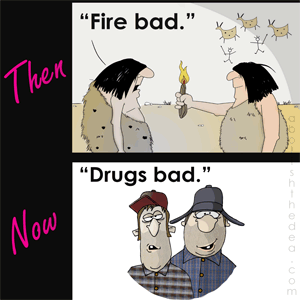
Saying "Fentanyl kills" is philosophically equivalent to saying "Fire bad!" Both statements are attempts to make us fear dangerous substances rather than to learn how to use them as safely as possible for human benefit.
Drug prohibition represents the biggest power grab by government in human history. It is the state control of pain relief and mental states.
A pharmacologically savvy drug dealer would have no problem getting someone off one drug because they would use the common sense practice of fighting drugs with drugs. But materialist doctors would rather that the patient suffer than to use such psychologically obvious methods.
Westerners have "just said no" to pain relief, mood elevation and religious insight.
A generally educated person meets new ideas with curiosity and fascination. An illiberally educated person meets new ideas with fear. --James B. Stockade.
Psst! Drug use has benefits too. Pass it on!
If opium and cocaine were re-legalized, hospital buildings would no longer be the secular cathedrals of our time. Some of that wealth would actually go to healthy people.
AI is inherently plagiaristic technology. It tells us: "Hey, guys, look what I can do!" -- when it should really be saying, "Hey, guys, look how I stole all your data and repackaged it in such a way as to make it appear that I am the genius, not you!"
We're living in a sci-fi dystopia called "Fahrenheit 452", in which the police burn thought-expanding plants instead of thought-expanding books.
The so-called "herbs" that witches used were drugs, in the same way that "meds" are drugs. If academics made that connection, the study of witchcraft would shed a lot of light on the fearmongering of modern prohibitionists.
It is amazingly ironic that Sigmund Freud is known today in the west for time-consuming and expensive psychoanalysis. This can only be because academics and the medical community are controlling the narrative. They themselves profit from time-consuming and expensive psychoanalysis, if not as doctors then as researchers and professors. Any knowledgeable depressed person could tell you, however, that Freud's real discovery was that cocaine was a godsend for the depressed. But then the depressed themselves were never asked how they felt about cocaine. Self-interested doctors demonized the drug because they saw it as a threat to their livelihood. And the result has been the infantilization of human beings when it comes to taking care of their own psychological health.
Saying "Fentanyl kills" is philosophically equivalent to saying "Fire bad!" Both statements are attempts to make us fear dangerous substances rather than to learn how to use them as safely as possible for human benefit.
Drug prohibition represents the biggest power grab by government in human history. It is the state control of pain relief and mental states.
A pharmacologically savvy drug dealer would have no problem getting someone off one drug because they would use the common sense practice of fighting drugs with drugs. But materialist doctors would rather that the patient suffer than to use such psychologically obvious methods.
Westerners have "just said no" to pain relief, mood elevation and religious insight.
A generally educated person meets new ideas with curiosity and fascination. An illiberally educated person meets new ideas with fear. --James B. Stockade.
Psst! Drug use has benefits too. Pass it on!
If opium and cocaine were re-legalized, hospital buildings would no longer be the secular cathedrals of our time. Some of that wealth would actually go to healthy people.
AI is inherently plagiaristic technology. It tells us: "Hey, guys, look what I can do!" -- when it should really be saying, "Hey, guys, look how I stole all your data and repackaged it in such a way as to make it appear that I am the genius, not you!"
We're living in a sci-fi dystopia called "Fahrenheit 452", in which the police burn thought-expanding plants instead of thought-expanding books.
The so-called "herbs" that witches used were drugs, in the same way that "meds" are drugs. If academics made that connection, the study of witchcraft would shed a lot of light on the fearmongering of modern prohibitionists.


 (up)
(up)