








"The psychic effect of cocainum muriaticum in doses of 0.05-0.10 grams consists in a general raising of the spirits and constant euphoria, which differs in no way from the normal euphoria of healthy human beings.... One feels an increase in self-control, and feels revitalised and better able to work...."

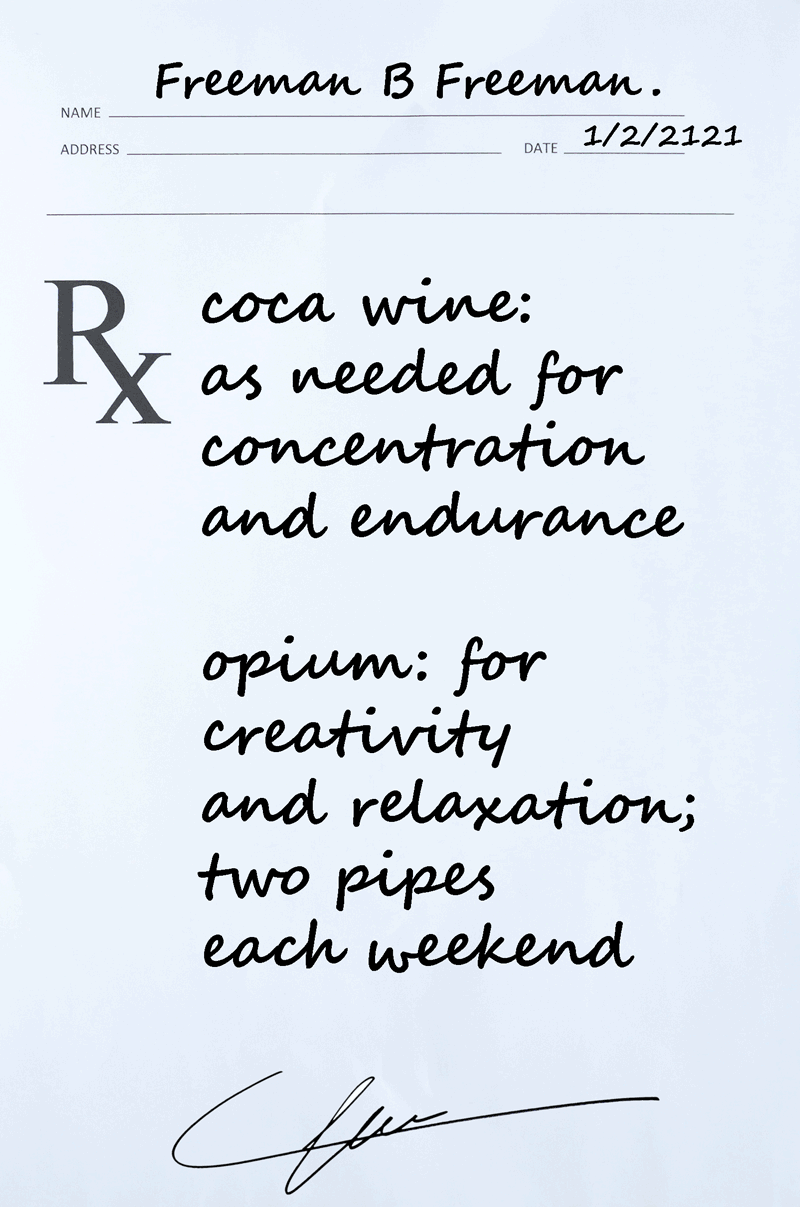 When we judge (or rather demonize) drugs in this way, we are judging far more than drugs. If we say, for instance, that cocaine should be illegal, we are tacitly also pronouncing on the importance of having a focused and cheerful mindset, on the propriety of living life like Sherlock Holmes or Robin Williams. We are saying, in effect, that such ways of "being in the world" are not as important as 100% safety. We are saying, to be specific, that solving my depression is not as important as 100% safety for all parties who are even remotely concerned. This is easy for scientists and moralists to say, because they have no skin in this game. They are like a landlubber calling for the outlawing of boat racing. They therefore feel free to run roughshod over the rights to godsend healthcare for the depressed. Unfortunately, I seem to be the only depressed person in the world who recognizes this fact, however, this failure on the part of the mainstream to honor me as a stakeholder in the drug legislation game. Otherwise, every self-help group for the depressed would be demanding the end of this drug prohibition which refuses to consider the depressed as stakeholders in our government's drug-related policy decisions. And yet almost all such groups have been bamboozled into viewing drugs as a problem, not as an answer.
 "The White Man goes into his church house and talks about Jesus, but the Indian goes into his tipi and talks to Jesus."
 We might paraphrase Parker's observation as follows:
"The westerner goes into their local library and reads self-help books about feeling great; the free individual uses the world's many godsend medicines to actually feel great."
"My impression has been that the use of cocaine over a long time can bring about lasting improvement..." --Sigmund Freud, On Cocaine, 1884

"The White Man goes into his church house and talks about Jesus, but the Indian goes into his tipi and talks to Jesus." 9
"The White Man goes to an expensive psychoanalyst to find out WHY he feels lousy -- the Native American uses Mother Nature's medicines so that he no longer feels lousy."
 Unfortunately, the American chemist seems to have considered the testimony of such users as merely one input in determining what drugs might help the depressed. He felt that any true antidepressant had to be a one-size-fits-all pill that will affect different people in more or less identical ways. This approach was certainly in Shulgin's financial interests given his work for pharmaceutical companies. However, had Shulgin risen above his own self-interest, he would have seen that the testimony of the drug users is EVERYTHING. We need to trust them to tell us what works for THEM -- and in which particular circumstances it works. In other words, we have to embrace all the unique variables of drug use that the Drug Warrior completely ignores! Only in this way can we find out what works for whom and under which circumstances.
 Freud had the right idea: He noticed that cocaine use actually ended depression in his patients. Unfortunately, he was ambitious and was more interested in making a name for himself than in pushing back against the statistically challenged fear mongering of prohibitionists.
Scientists are so used to ignoring "drugs" that they don't even realize they're doing it. Yet almost all books about consciousness and depression (etc.) are nonsense these days because they ignore what drugs could tell us about those topics.
If daily drug use and dependency are okay, then there's no logical or scientific reason why I can't smoke a nightly opium pipe.
If opium and cocaine were legal again in America, the healthcare industry would suddenly have to undergo extensive downsizing, as Americans were once again put in charge of their own health.
Mariani Wine is the real McCoy, with Bolivian coca leaves (tho' not with cocaine, as Wikipedia says). I'll be writing more about my experience with it soon. I was impressed. It's the same drink "on which" HG Wells and Jules Verne wrote their stories.
Someday those books about weird state laws will be full of factoids like: "In Alabama, you could be jailed for 20 years for conspiring to eat a mushroom."
"Everything one does in life, even love, occurs in an express train racing toward death. To smoke opium is to get out of the train while it is still moving. It is to concern oneself with something other than life or death." -Jean Cocteau
Billboards reading "Fentanyl kills" encourage the creation of racist legislation that outlaws all godsend uses of opiates. Kids in hospice in India go without morphine because of America's superstitious fear of opiates.
I'm on SNRIs. But SSRIs and SNRIs are both made with materialist presumptions in mind: that the best way to change people is with a surgical strike at one-size-fits-all chemistry. That's the opposite of the shamanic holism that I favor.
The Drug War is the ultimate example of strategic fearmongering by self-interested politicians.
Chesterton might as well have been speaking about the word 'addiction' when he wrote the following: "It is useless to have exact figures if they are exact figures about an inexact phrase."


 (up)
(up)