




introduction to the Drug War Philosopher website at abolishthedea.com orange rss icon with stylized radio waves orange rss icon with stylized radio waves label reading 'add as a preferred source on Google' bird icon for twitter bird icon for twitter


back navigation arrow forward navigation arrow


One Strike, You're Out

how the western world holds drugs to impossible safety standards

by Brian Ballard Quass, the Drug War Philosopher

August 11, 2025


The western attitude toward drugs has always been based on the absurd notion that a drug should be criminalized if it can be misused, even in theory, by a white young person. This is the faulty racist and xenophobic premise upon which all calls for substance prohibition are always based: the idea that we must legislatively protect our young people from those substances about which we refuse to educate them! But the proponents of this viewpoint are wrong on at least two enormous counts. First, they ignore all the downsides of the prohibition that they are advocating (explicitly or otherwise); and second, they ignore all stakeholders in the drug approval process except for the white young people whom they fear might misuse the drugs under consideration.

PROHIBITION DOWNSIDES

What downsides, you ask? Where do I begin?

Prohibition downsides include the shooting deaths of tens of thousands of minorities in America's inner cities over the last decade alone1, the disappearance of 60,000 in Mexico thanks to the Drug War launched down south in 2006 by Felipe Calderon2, the creation of 'no-go' zones around the world3, the self-censorship of almost everyone in academia4, the self-censorship of books of all kinds, of newspapers and of magazines and of TV shows 5 and movies 6 7 (sometimes with the help of the White House itself8), and the erosion of time-honored freedoms around the world under the pretext of fighting drugs (not to mention the election of Donald Trump -- twice now -- made possible by America's unprecedented mass jailing of minorities9). These downsides make it clear that drug prohibition kills10 far more than it "saves," meanwhile destroying the basic freedoms of democracy in the process. Prohibition merely outsources death and suffering to minorities and the politically disempowered -- and it only "saves" our young people by denying them a vast pharmacopoeia of medicines, rather than by educating them about such potential godsends, some of which have inspired entire religions.


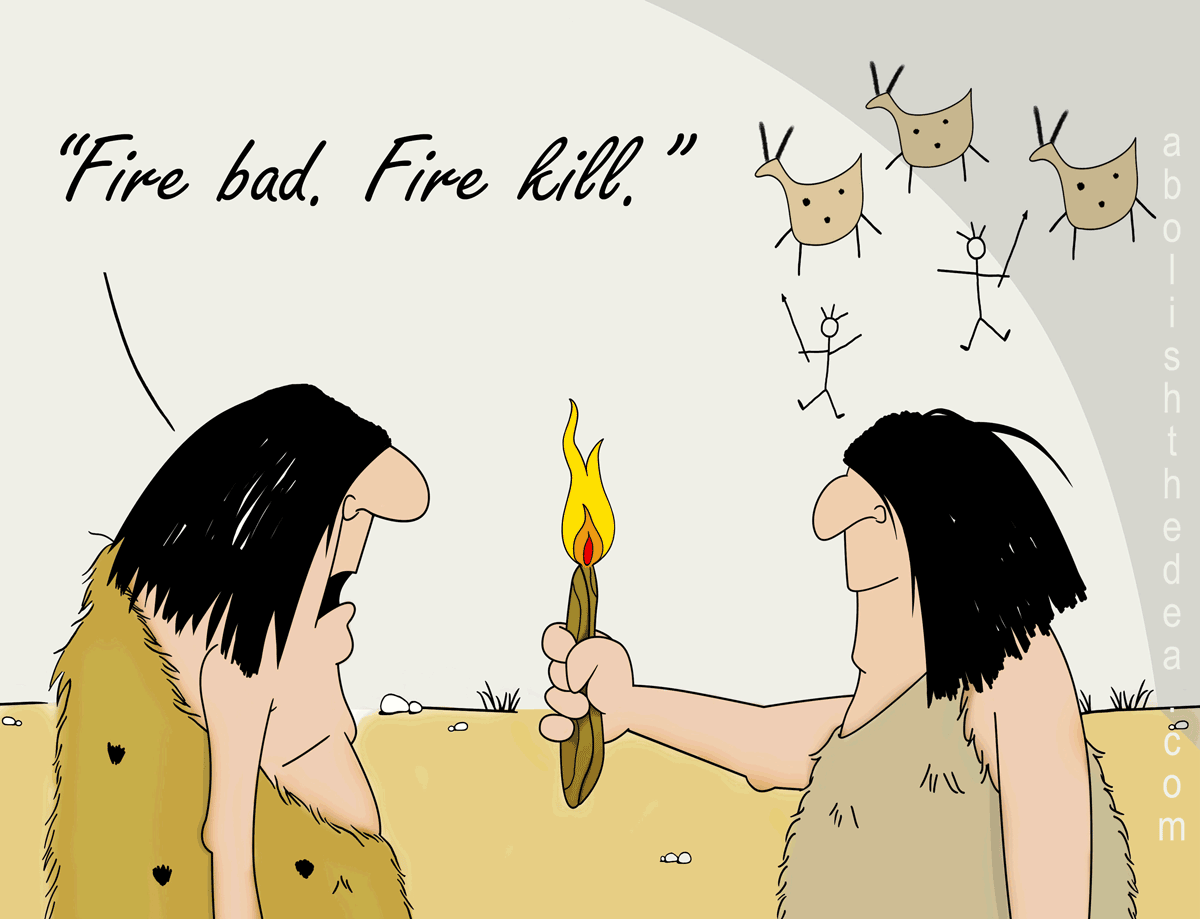
Two cavemen in cave.  Caveman on right, holding burning stick toward second caveman on left. Caveman on left says: 'Fire bad. Fire kill.'
Saying things like 'Fentanyl kills' is philosophically equivalent to saying 'Fire bad'. Both statements would have us fear dangerous substances rather than to learn how to use them wisely for the benefit of human beings.


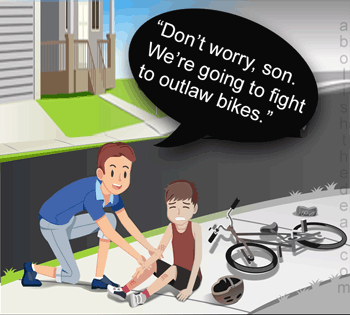
>>>bikes<<11.

Moreover, if such laws prevent Johnny Whitebread from using potential godsend drugs, they only do so by forcing him to grow up in a world in which he has no sovereignty over his own mental and emotional states, no right to take care of his own health, no right to access Mother Nature's vast pharmacopoeia -- and this is a tradeoff that no one should have to make in a free world. In such a world, anyone with psychological issues is forced to become a ward of the healthcare state -- thanks to which (o irony of ironies!) they are likely to be put on Big Pharma dependence-causing drugs for life! (Did I say "drugs"? I meant "meds," of course!) And this is how we "save" Junior from drugs? by making him chemically dependent for life? and then only on the tranquilizing drugs* whose sales boost the bottom line of pharmaceutical companies?

We can clearly see who got the best end of the deal in that arrangement: hint, it was not the so-called "mental patient." Indeed, there would be very few "mental patients" these days if the government would be so magnanimous as to allow Homo sapiens to reach down and use the plant medicines that grow all around them -- but then that is just another of the many downsides of prohibition to which the fearmongering western Drug Warrior is completely blind. Drug prohibition has turned the time-honored expedient of self-medication 12 into the one great unforgivable sin against medical science. As Jeffrey Singer wrote in Your Body, Your Health Care:

"Imagine how many people would have benefited during the past half-century had the government respected their autonomy and their right to self-medicate." 13
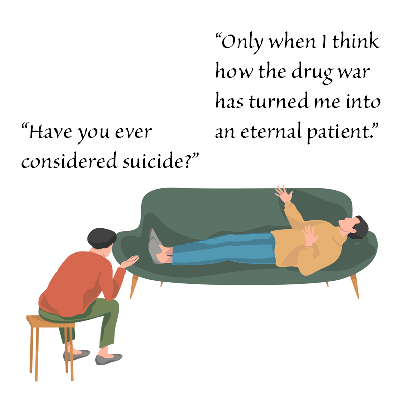

It does not help, of course, that the medical establishment profits handsomely from this disempowerment of healthcare consumers and so has an obvious interest in encouraging prohibitionist attitudes: especially the idea that the hoi polloi are babies when it comes to drugs and must be patronized and prescribed to by their betters in the medical field.

In reality, of course, it was always a category error to place materialist scientists in charge of mind and mood medicine in the first place: that is exactly like placing the passion-scorning Dr. Spock of Star Trek in charge of a course on hugging on the USS Enterprise, an activity which the sullen Vulcan would insist was "highly illogical, Captain." Just so are materialists clueless when it comes to the human psychology of drug use. This is why a materialist scientist like Dr. Robert Glatter has to ask whether laughing gas 14 could help the depressed15. Laughing gas, for God's sake! Everyone knows that laughter is the best medicine -- a truth that the Reader's Digest has been promoting for over a century now -- and yet materialists are behaviorists when it comes to human psychology and so they only believe in evidence that they find under a microscope. The fact that a drug merely "works" from the user's point of view means nothing to the materialist.

INVISIBLE STAKEHOLDERS

>>>suicide<<16 in the Punjab in 1500 BCE. When we outlaw drugs for junior, we also outlaw them for the philosophers who wish to use them in studying the nature of ultimate reality -- a use promoted by William James himself in The Varieties of Religious Experience. When we outlaw drugs for junior, we also outlaw them for those trying to get off antidepressants 17, those for whom a quick and timely pick-me-up from "drugs" could spell the difference between recidivism and remaining off an unwanted Big Pharma drug.

And yet the only stakeholder that the prohibitionist recognizes in the drugs debate are the white young people -- the kids who have trouble with drugs precisely because we have refused to educate them on the subject!

As Szasz wrote in Our Right to Drugs

"The laws that deny healthy people 'recreational' drugs also deny sick people 'therapeutic' drugs."18
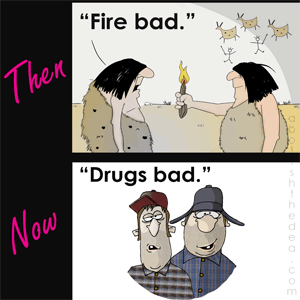

>>>firebad<<19 kills!", failing to realize that such statements are the philosophical equivalent of shouting "Fire bad!" All such statements encourage us to fear dangerous substances rather than to learn how to use them as wisely as possible for the benefit of humanity.
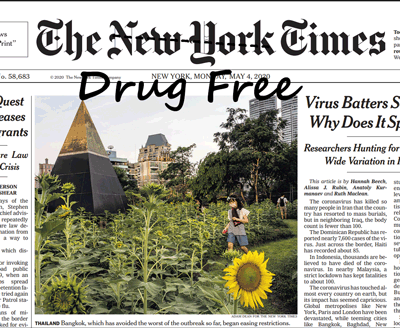
Moreover, it is just plain anti-scientific -- and even anti-human progress -- to outlaw a drug based on the fact that its use may prove problematic for one demographic alone.

ANALYSIS

>>>nyt<<
A good poster child for this lopsided reporting about drugs can be found in the 1972 New York Times article by Henry Lennard entitled Freud's Disaster With Cocaine. Lennard begins this piece of drug-war agitprop as follows:

"Those in the medical profession or the youth culture who do not seriously consider the hidden consequences of drug use may profitably ponder the unfortunate error of that astute observer of human experience, Sigmund Freud. The story of Freud's fascination with cocaine is not unknown but its retelling at this time may be useful."20
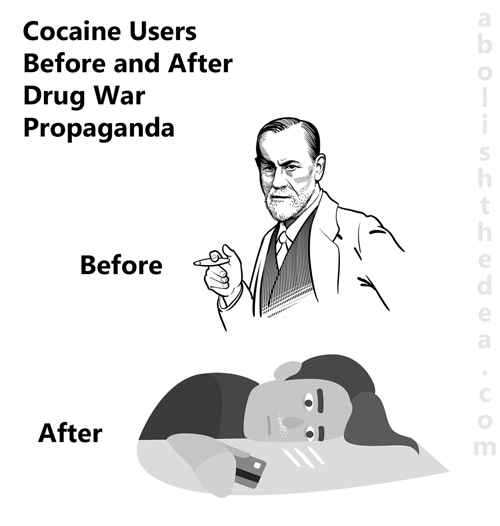

>>>freud<<<

Lennard sets himself up as a moralist here, ready to condescendingly inform us about the supposedly awful truth about cocaine. And yet why does Lennard characterize Freud's work with cocaine as an error in the first place? Answer: for the simple reason that cocaine proved to be addictive for one particular person to whom Freud21 offered the drug. One person.

That's it. That's the evidence that cocaine is bad. And this "one person" was a confirmed morphine 22 addict at that. Cocaine was not even addictive for Freud himself, who yet used the drug liberally whenever he found it useful.

But it is clearly "one strike, you're out" as far as Lennard is concerned when it comes to psychoactive drugs. Instead of seeing the wonderful benefits of cocaine use and pushing for education about safe use so that human beings can profit from the mind-focusing godsend as safely as possible, Lennard implies that the drug itself is beyond the pale simply because it can be misused. By that same logic, we could outlaw literally any drug. The use of both aspirin and Tylenol can lead to death23 and liver damage24 respectively, and yet Lennard would never suggest that it is "one strike, you're out" when evaluating THOSE kinds of drugs. There are thousands who, as we speak, are contemplating suicide because of their problems trying to get off of modern antidepressants (just search the many online forums on this topic), and yet Drug Warriors like Lennard never even notice such downsides to such established drugs, let alone use them as an excuse to put Big Pharma 25 26 out of business by denouncing the dependence-causing nature of the drugs that they create.

This is the hypocritical M.O. of the Drug Warrior: they dismiss every single glaringly obvious benefit of drug use merely by pointing to one single incident of misuse. This is like denouncing alcohol because some people are alcoholics. Of course, the Drug Warrior will blame the existence of "street people" in Oregon on opiates, but there was no opiate crisis in America when opium was legal, it took drug prohibition to accomplish that. How? By refusing to educate as to safe use, refusing to regulate product as to quantity and quality, and refusing to offer a wide variety of medications, thus giving users alternatives to the more addictive nostrums that the drug dealer has been incentivized to provide thanks to drug prohibition.

Poe has written of drugs that can give an educated user a surreal appreciation of Mother Nature27. Alexander Shulgin has written of drugs that inspire compassion in the user28. Mike Jay tells us how the use of certain beta-carbolines can inspire a sort of creativity on demand29. Freud himself told us how cocaine could help him to concentrate and get work done:

"My impression has been that the use of cocaine 30 over a long time can bring about lasting improvement..."31


These are ENORMOUS drug benefits, whether we like to admit that fact or not (and most westerners will, indeed, never admit this apparently highly heretical fact). All such drugs could clearly help prevent suicide by giving the depressed a renewed interest in life. This is psychological common sense. And yet Drug Warriors like Lennard would clearly prefer that you and I commit suicide 32 rather than to use politically demonized substances called "drugs" for the purpose of reigniting our interest in life. Lennard does not realize that we are all on drugs all the time -- it's what we call our biochemistry -- and that the sober state is pathological for many, given the negative voices of the past that can counsel despair.

This is not to say that any given person should use any given drug -- merely that the propriety of drug use must always be determined by circumstances, circumstances of which only the would-be user is intimately aware -- whereas the Drug Warrior childishly tells us that circumstances mean nothing: that drugs can be bad and irredeemable in and of themselves, with no positive uses for anybody, anywhere, ever, at any dose. This is the anti-scientific mindset behind drug prohibition, and it is a shame that there are so few drug pundits who have ever pointed out this absurd philosophical presumption by which such a deadly public policy is always supported.

Lennard never does get around to telling us the story of what Freud himself really thought about cocaine, by the way. The reporter clearly feels that he has done his job merely by reminding us that at least one person in Freud's life could not use cocaine wisely. Case closed. Cocaine is evil, end of story.

And so the self-satisfied Lennard concludes sanctimoniously as follows:

"Everywhere we are promised something for nothing. Yet, the one clear lesson in the history of drug use is that in the giving and taking of drugs, one pays—in the short range or the long, visibly or invisibly—for what one gets."33


Such moralizing belongs in a sermon at a Christian Science venue and not in a "newspaper of record" like the "New York Times."

Does one pay "in the short range or the long" for drinking alcohol? How about for taking their antidepressant "meds"? How about for drinking their daily coffee?

No, this is just meaningless moral blather on Lennard's part. All drugs are unique as are all drug users. It is absurd to talk about drug use "in general."

As for the "history of drug use," does Lennard not realize that the western history of drug use is full of censorship about all positive outcomes of use? We have no unbiased history from which to draw conclusions, let alone "clear lessons." Besides, the word "drugs" covers so many disparate substances that it is absurd to talk about such a history. It is kind of like talking about "the history of appliances and machines." That might be a good topic for a satirical pamphlet, but anyone who has anything serious to say would surely focus on a specific appliance or machine, and not pretend to be giving us "hard and fast truths" that supposedly apply to every member of such an enormously variegated category.

What's going on here, then? How can Lennard maintain that history tells us that drug use is evil?

The answer is obvious. When Lennard talks about "the history of drug use," he actually means "the history of drug abuse" -- which, of course, is the only history that modern Drug Warriors recognize when it comes to drugs.


NOTES: (up)

*I consider modern antidepressants to be tranquilizers -- as opposed to insight-inspiring drugs like phenethylamines, coca, psychedelics, and opium 34 . This is a truth that we all tacitly acknowledge whenever we tell our obnoxious friends and loved ones to "take their meds." We want them to take their meds because we know that it will quiet them down and make them behave more predictably from our own point of view. We know, in short, that the drugs will tranquilize them.

Some readers will no doubt object that antidepressants work according to scientific theory and are therefore somehow preferable to drugs that simply "work" without a "by your leave" from medical science. This is a highly fraught conclusion based on an unspoken metaphysical belief in the ontological truth of materialism 35 as a way -- indeed, as THE way -- of seeing the world. I have discussed the many problems with these materialist assumptions in many other essays. The fact is, however, that even if we believe in the omnipotence of modern science, those antidepressant drugs do NOT work scientifically. Even scientists themselves now acknowledge this inconvenient truth. As Dr. Norm Shpancer reported in Psychology Today in 2022:


"We don't know how antidepressants work."36


...to which I would add, we don't know that antidepressants work at all -- at least if the criteria for their "working" is set by the unique individual user and not by the pharmaceutical companies who created the drugs for a one-size-fits-all market.


Notes:

1: Gun Deaths in Big Cities Big Cities Health (up)
2: Gun Deaths in Big Cities Big Cities Health (up)
3: Rothkerch, Ian. 2002. “‘What Drugs Have Not Destroyed, the War on Them Has.’” Salon. June 29, 2002. https://www.salon.com/2002/06/29/simon_5/. (up)
4: Self-Censorship in the Age of the Drug War DWP (up)
5: The Dead Man DWP (up)
6: Glenn Close but no cigar DWP (up)
7: Running with the torture loving DEA DWP (up)
8: “How the White House and the Media Package Government Propaganda as Entertainment.” 2000. World Socialist Web Site. January 24, 2000. https://www.wsws.org/en/articles/2000/01/drug-j24.html. (up)
9: How the Drug War gave the 2016 election to Donald Trump DWP (up)
10: Prohibition's Death Toll: Alcohol's Deadly Legacy (up)
11: Whiteout: How Racial Capitalism Changed the Color of Opioids in America Hansen, Helena, 2023 (up)
12: Restoring our Right to Self-Medication: how drug warriors work together with the medical establishment to prevent us from taking care of our own health DWP (up)
13: https://www.cato.org/people/jeffrey-singer. 2025. “Your Body, Your Health Care.” Cato Institute. April 8, 2025. https://www.cato.org/books/body-health-care. (up)
14: Forbes Magazine's Laughable Article about Nitrous Oxide DWP (up)
15: Glatter, Robert. 2021. “Can Laughing Gas (Nitrous Oxide) Help People with Treatment-Resistant Depression?” Forbes, June 9, 2021. https://www.forbes.com/sites/robertglatter/2021/06/09/can-laughing-gas-nitrous-oxide-help-people-with-treatmentresistant-depre (up)
16: Blue Tide: The Search for Soma: a philosophical review of the book by Mike Jay DWP (up)
17: Antidepressants and the War on Drugs DWP (up)
18: Szasz, Thomas. 1992. Our Right to Drugs. Praeger. (up)
19: Fentanyl does not steal loved ones: Drug Laws Do DWP (up)
20: Lennard, Henry L. 1972. “Freud’s Disaster with Cocaine.” The New York Times, July 22, 1972, sec. Archives. https://www.nytimes.com/1972/07/22/archives/freuds-disaster-with-cocaine.html. (up)
21: Sigmund Freud's real breakthrough was not psychoanalysis DWP (up)
22: Three takeaway lessons from the use of morphine by William Halsted, co-founder of Johns Hopkins Medical School DWP (up)
23: Daily Aspirin Linked To More Than 3,000 Deaths Per Year, Scientists Warn Huffington Post (up)
24: Everything You Need To Know About Tylenol And Liver Damage HealthMarch (up)
25: Seife, Charles. 2012. “Is Drug Research Trustworthy?” Scientific American 307 (6): 56–63. https://doi.org/10.1038/scientificamerican1212-56. (up)
26: LaMattina, John. n.d. “Why Is Biopharma Paying 75% of the FDA’s Drug Division Budget?” Forbes. https://www.forbes.com/sites/johnlamattina/2022/09/22/why-is-biopharma-paying-75-of-the-fdas-drug-division-budget/. (up)
27: A Tale of the Ragged Mountains Poe, Edgar Allan (up)
28: Shulgin, Alexander T, and Ann Shulgin. 2019. Pihkal : A Chemical Love Story. Berkeley, Ca: Transform Press. (up)
29: “Blue Tide - Mike Jay.” 2025. Mike Jay. May 18, 2025. https://mikejay.net/books/blue-tide/. (up)
30: What the Honey Trick Tells us about Drug Prohibition DWP (up)
31: “Freud on Cocaine : Freud, Sigmund, 1856-1939 : Free Download, Borrow, and Streaming : Internet Archive.” 2023. Internet Archive. 2023. https://archive.org/details/freudoncocaine0000freu/page/n5/mode/2up?view=theater. (up)
32: Why Americans Prefer Suicide to Drug Use DWP (up)
33: Lennard, Henry L. 1972. “Freud’s Disaster with Cocaine.” The New York Times, July 22, 1972, sec. Archives. https://www.nytimes.com/1972/07/22/archives/freuds-disaster-with-cocaine.html. (up)
34: The Truth About Opium by William H. Brereton DWP (up)
35: How materialists lend a veneer of science to the lies of the drug warriors DWP (up)
36: Shpancer, Noam. 2022. “Depression Is Not Caused by Chemical Imbalance in the Brain | Psychology Today.” Www.psychologytoday.com. July 24, 2022. https://www.psychologytoday.com/us/blog/insight-therapy/202207/depression-is-not-caused-chemical-imbalance-in-t (up)


Ten Tweets

against the hateful war on US


I've been told by many that I should have seen "my doctor" before withdrawing from Effexor. But, A) My doctor got me hooked on the junk in the first place, and, B) That doctor completely ignores the OBVIOUS benefits of indigenous meds and focuses only on theoretical downsides.

When we place the FDA in charge of deciding whether a psychoactive drug should be re-legalized or not, we are asking them to decide on things like the relative importance of appreciating a sunset, a task for which the FDA has no expertise whatsoever.

Anytime you hear that a psychoactive drug has not been proven to be effective, it's a lie. People can make such claims only by dogmatically ignoring all the glaringly obvious signs of efficacy.

There are plenty of "prima facie" reasons for believing that we could eliminate most problems with drug and alcohol withdrawal by chemically aided sleep cures combined with using "drugs" to fight "drugs." But drug warriors don't want a fix, they WANT drug use to be a problem.

Michael Pollan is the Leona Helmsley of the Drug War. He uses outlawed drugs freely while failing to support the re-legalization of Mother Nature. Drug laws are apparently for the little people.

Drug warriors have harnessed the perfect storm. Prohibition caters to the interests of law enforcement, psychotherapy, Big Pharma, demagogues, puritans, and materialist scientists, who believe that consciousness is no big "whoop" and that spiritual states are just flukes.

A generally educated person meets new ideas with curiosity and fascination. An illiberally educated person meets new ideas with fear. --James B. Stockade.

Everyone's biggest concern is the economy? Is nobody concerned that Trump has promised to pardon insurrectionists and get revenge on critics? Is no one concerned that Trump taught Americans to doubt democracy by questioning our election fairness before one single vote was cast?

Psychedelic retreats tell us how scientific they are. But science is the problem. Science today insists that we ignore all obvious benefits of drugs.

If I smoke opium nightly, I am a drug scumbag. If I use Big Pharma "meds" every day of my life, I am a good patient.


Click here to see All Tweets against the hateful War on Us


Next essay:
Previous essay:


No cookies, no ads.


Attention, Teachers and Students: Read an essay a day by the Drug War Philosopher and then discuss... while it's still legal to do so!

The Partnership for a Death Free America is a proud sponsor of The Drug War Philosopher website @ abolishthedea.com. Updated daily.

Copyright 2025, Brian Ballard Quass Contact: quass@quass.com

tombstone for American Democracy, 1776-2024, RIP (up)