




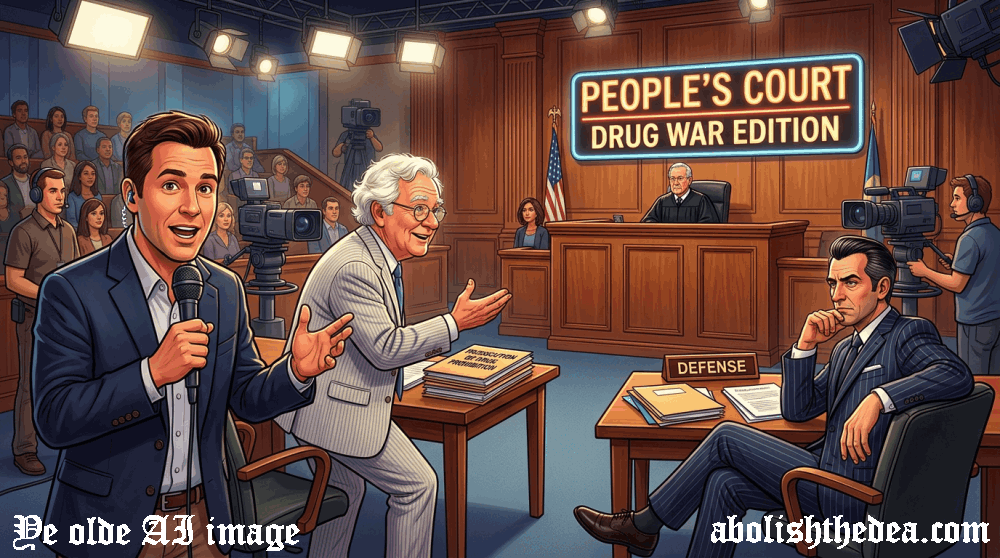
Homepage of the Drug War Philosopher, Brian Quass
blog icon orange rss icon with stylized radio waves bird icon for twitter bird icon for twitter substack icon


back navigation arrow


Common Sense versus Drug Prohibition

Why America's drug policy should be laughed out of court

by Brian Ballard Quass, the Drug War Philosopher (Substack version)

November 15, 2026


EMCEE: Welcome to the People's Court: Drug War Edition. Today, we cover the continuation of the complicated and consequential case of Common Sense v. Drug Prohibition. The judge has opened today's trial and the prosecutor has begun making his case. Let's listen in.

PROSECUTOR: Ladies and gentlemen of the jury, I have already presented countless exhibits and arguments over the past eight years in an effort to demonstrate how drug prohibition is a crime against humanity. I have shown, indeed, how drug prohibition is the perfect crime, insofar as it blinds its very victims to its own culpability in causing the problems that it brings about. Through misdirection, propaganda, and choplogic, it turns good Americans into scapegoats for all of the problems brought about by drug prohibition itself, thereby taking America's "eyes off the prize" when it comes to fixing social problems like poverty and ignorance. But these are arguments that I have made countless times before in this very digital courtroom, and so I will spare the jury further elaboration on these themes. Instead, I would like to draw the jury's attention to a new exhibit that speaks to the cluelessness of Americans when it comes to the subject of drugs. It is a citation from the website of the Cleveland Clinic on the subject of the supposed "illness" of Substance Use Disorder. Your Honor, I move that the following quotation be admitted into evidence.

JUDGE: The exhibit is admitted.

PROSECUTOR: Thank you, Your Honor.

Substance use disorder (SUD) is a problematic pattern of substance use that affects your health and well-being. Some of the most common substances include alcohol, opioids and marijuana. It can range from mild to severe (addiction). SUD is a treatable mental health condition. Help is available when you’re ready. 1


Look at that, ladies and gentlemen of the jury. The definition of the disorder even includes a sales pitch for medical services. We're told that "Help is available when you're ready." And we all know what that means. The help that is available will not be coming from sages or empaths or philosophers or ministers or priests or rabbis or herbal healers or hypnotists -- and least of all will it be coming from people who actually know something about beneficial drug use and best practices. No, SUD is a "mental health condition," if you please, and therefore the field of scientific medicine calls dibs on the disorder. This help that is available is going to come from self-interested parties who are going to tell you that you are the victim of biochemical determinism and that only a long association with doctors and dependence-causing "meds" can henceforth keep you on the straight and narrow. "Free will is an illusion when it comes to drugs," they cry, "Trust us. We've proven it scientifically." And look at that word "problematic." Wee-dogies! That is a red flag if there ever was one. The first question is: "problematic" according to whom? This is a crucial question to ask. It could be argued, after all, that ALL substance use is problematic insofar as it involves the use of an illegal substance. This is, in fact, the way that the DEA would parse the text from the Cleveland Clinic. Or is the substance use problematic for doctors since they lose money whenever a patient self-medicates? Or is the substance use problematic for society because it challenges mainstream assumptions about morality? Or is it problematic for scientists because certain drug effects force them to rethink their ideas about the nature of human consciousness? And look at the latitude behind the word "well-being." Scientists can no doubt comment advisedly on the physical health effects of the use of a given drug when considered in the abstract, but how exactly are they experts on the "well-being" of anybody, let alone a complete stranger. It's almost as if they threw in the word "well-being" here as a lawyer would, to make sure that they were as inclusive as possible. They would much rather drag in customers based on false positives than to inadvertently lose a single customer from a false negative.

Permit me to add one additional comment about the use of the word "problematic" in the above definition of Substance Use Disorder. Let us suppose for the sake of argument that we have determined -- rather than simply assumed -- that substance use is indeed problematic for a given user in a given case. There is an additional relevant question that arises at this point, one that is typically either, 1, ignored by our scientists or, 2, is answered by them in a biased manner, and that is the question of: WHY has use become problematic? Doctors blame the problematical nature of substance use on the user's biochemical propensities and/or on the supposed existence of psychological issues, typically ones which are thought to have had their origin in the user's childhood. It never occurs to these health detectives to consider the role of drug prohibition in rendering substance use problematic. Of course, we all have experienced childhood trauma of some sort, but when doctors like Gabriel Mate trace substance misuse to childhood trauma, they are helping to normalize drug prohibition. How? By refusing to blame it for the problems that it causes. We can never be sure about the etiology of substance use disorder until drugs are legal and we have educated users and allowed for true drug choice. Indeed, we cannot even know the extent to which substance use disorder even exists until we stop spending $51 billion a year to make drug use as dangerous as possible. The creative mind of the doctor can always find a psychological reason why a person might have problems with drug use, but it is presumptuous and pretentious of them to insist on a traumatic origin of a seemingly drug-related problem while ignoring the $51-billion gorilla in the room called drug prohibition. Drug prohibition fails to educate users, it fails to ensure safe supply as to quality, quantity and even identity. The surprising thing is that most people manage to avoid so-called SUD, that most people manage to use drugs wisely and safely, despite the government's attempts to injure drug users. We recall in this connection how the government heartlessly sprayed marijuana plants with paraquat in the 1970s and again in the late 1908s2. This is a drug which, according to AI, can cause kidney failure, heart failure and esophageal scarring. This brings me to one final charge that I would like to level today, not so much against drug prohibition itself, but rather against the bluster and the pretense of medical doctors whenever they assume the title of psychiatrist.

This bluster and pretense is hard for most people to notice today because it has become far more subtle in its manifestations over the last half-century or so, but it remains in effect, as the Gabriel Mates of our time prove with their "just so stories" about human motivation. Such scientists can always find psychological reasons for social problems, following the example of Sigmund Freud in giving free rein to their imaginations. They may not follow Freud in metaphorically superimposing Greek mythology on human behavior, but they can still find plenty of plausible scapegoats for Substance User Disorder other than the gorilla in the room, i.e., drug prohibition and the fact that it causes all of the problems that it purports to solve and then some. And so we have the phenomenon of the psychiatric swagger. We can see this swagger clearly from our perspective as moderns by watching almost any film made in the 1940s or 1950s in which a psychiatrist is part of the cast. Those characters are often such smug and self-satisfied know-it-alls that one wants to walk right up to their LED screen and smack them in the face. They simply ooze omniscience, telling us definitively that A caused B, and what's worse, the characters around them usually take them seriously as they do so. Many films of the mid-20th century portray psychiatrists as all-knowing scientists, including such classics as "The Anatomy of a Murder," "The Caine Mutiny" and "Psycho." Speaking of the Hitchcock title, I just have to ask the jury: don't you LOVE the ending of that movie? The waters parted as the psychiatrist waltzed into the prison to find out in real-time what REALLY motivated Norman Bates to kill Marion Crane. "If anyone gets any answers it'll be the psychiatrist," says the science-loving Detective Arbogast. I like to picture the psychiatrist, Dr. Richman, entering the prison to the sound of "Gaudeamus Igitur" from the Academic Festival Overture of Brahms played by the London Philharmonic. I see him sporting a big black top hat, twirling a cane, and gingerly removing his gloves from his hands one finger at a time as the guards look on in awed silence. Or maybe they whisper to themselves in a Cockney accent as follows: "The guvnor's goin' to interview that bloke what killed the lady at the Bates Hotel!" "Ay," says his colleague. "Now we'll finally know what drove him barmy an' all. Thank God for the medical profession, say I, and its ability to get straight inside people's 'eads like that!"

DEFENSE: Objection, Your Honor, relevance!

PROSECUTOR: The point I am trying to make here, Your Honor, is that Americans have long had an inflated view of what men of science can tell us about human behavior and that we should keep this in mind when scientists from any field purport to tell us what motivates and accounts for such supposed illnesses as Substance Use Disorder, especially when these same scientists absolutely refuse to consider the role of drug prohibition in setting these so-called drug abusers up to fail.

JUDGE: Objection overruled.

PROSECUTOR: I rest my case, Your Honor.

JUDGE: The defense may cross-examine.

DEFENSE: Your Honor, the defense was blindsided by the prosecution's introduction of the quotation from the Cleveland Clinic. We request a postponement of this trial until we have had time to concoct the usual choplogic rebuttals.

JUDGE: Request granted. This case will reconvene next Monday morning at 8:00 a.m. In the meantime, this court is adjourned.

EMCEE: And so ends yet another session in the ongoing case of Common Sense v. Drug Prohibition. Let's get the thoughts of Prosecutor Thomas Ashford Bentley Beaumont III on today's session. Thomas, the defense claims to have been caught off-guard by that seemingly silly statement put out by the Cleveland Clinic on the subject of Substance Abuse Disorder.

PROSECUTOR: Indeed, they did. By the way, I forgot to mention that the quote appeared on the page alongside the words "medically reviewed" with a green check mark.

EMCEE: Aha.

PROSECUTOR: They didn't even give the name of the person who reviewed the blurb. It's like they just showed it to some doctor in the lunchroom and he said, "Looks good to me. I'm in favor of anything we can do to give us scientists a monopoly on treating human behavior. Do you realize how many jobs that can open up for us, how much income that can generate?!"

EMCEE: And let's see if I can catch the defense attorney here. Do you have any comments?

DEFENSE: We were also blindsided by the introduction of the movies that he mentioned: no one on the defense team has seen any of those movies except for "Psycho" -- and I've never even heard of "Gaudeamus Igitamos," or whatever he called it.

PROSECUTOR: Gaudeamus Igitur.

DEFENSE: Whatever. We've got a lot of research to do between now and Monday.

EMCEE: And thus we end another episode of The People's Court: Drug War Edition. Until next week, I'm Curt Chapstik reminding you that when it comes to drug prohibition, if you don't court justice...

AUDIENCE: YOU'RE COURTING DISASTER!

EMCEE: Good night, everybody.


Notes for essay entitled Common Sense versus Drug Prohibition: Why America's drug policy should be laughed out of court:

1: Cleveland Clinic. 2024. “Substance Use Disorder (SUD): Symptoms & Treatment.” Cleveland Clinic. 2024. https://my.clevelandclinic.org/health/diseases/16652-drug-addiction-substance-use-disorder-sud. (up)
2: AP. 1988. “U.S. To Resume Using Paraquat on Marijuana.” The New York Times, July 14, 1988. https://www.nytimes.com/1988/07/14/us/us-to-resume-using-paraquat-on-marijuana.html. (up)


read more essays here


Ten Tweets

against the hateful war on US


Rather than protesting prohibition as a crackdown on academic freedom, today's scientists are collaborating with the drug war by promoting shock therapy and SSRIs, thereby profiting from the monopoly that the drug war gives them in selling mind and mood medicine.

It's almost impossible not to have a problem with drugs in a world in which the government is spending over $50 billion a year to render drug use problematic.

According to Donald Trump's view of life, Jesus Christ was a chump. We should hate our enemies, not love them.

This hysterical reaction to rare negative events actually creates more rare negative events. This is why the DEA publicizes "drug problems," because by making them well known, they make the problems more prevalent and can thereby justify their huge budget.

Capitalism naturally results in disease-mongering by a self-interested medically establishment -- and disease-mongering requires the suppression of medicines that work holistically.

Just think how much money bar owners in the Old West would have saved on restoration expenses if they had served MDMA instead of whiskey.

Just saw a People's magazine article with the headline: "JUSTICE FOR MATTHEW PERRY." If there was true justice, their editorial staff would be in jail for promoting user ignorance and a contaminated drug supply. It's the prohibition, stupid!!!

Prohibitionists have nothing to say about all other dangerous activities: nothing about hunting, free climbing, hang-gliding, sword swallowing, free diving, skateboarding, sky-diving, chug-a-lug competitions, chain-smoking. Their "logic" is incoherent.

What I want to know is, who sold Christopher Reeves that horse that he fell off of? Who was peddling that junk?!

The Drug War treats doctors like potential criminals and it treats the rest of us like children. Prohibition does not end drug risks: it just outsources them to minorities and other vulnerable populations.


Click here to see All Tweets against the hateful War on Us


back navigation arrow
Book Cover

Break the ice with a sledgehammer: place this book on your coffee table.

This book features 150 annotated images, designed to force brainwashed Americans to confront the fact that drug prohibition is wrong. Here is what author Richard Parrish II says of the book's compiler: "The drug prohibition philosopher provides first-hand, principled, persuasive, and insightful arguments against the current drug prohibition regime..."

Purchase Your Copy
Book Cover

Diary of a Drug Fiend

This is the only full-cast recording of Aleister Crowley's 1922 classic paeon to common sense. It is the first book -- and so far almost the only book -- to stake out a philosophy of drug use that is compatible with human freedom, one in which we learn to use drugs as wisely as possible for the benefit of humanity. This recording was produced by the Drug War Philosopher and your purchases help support his effort to push back against the tragically counterproductive policy of drug prohibition, in the name of human freedom and of humanity's right to heal.

Purchase Your Copy


No cookies, no ads paid for by amoral and immoral billionaires (or trillionaires).


Unless otherwise indicated, no AI is used in the creation of site content. These essays represent the original ideas of their author and not the ideas that the author SHOULD have based on an algorithmic parsing of existing data. For more on this subject, consider the AI-related viewpoints to which the author subscribes as delineated in the New York Times opinion piece entitled "What 370,000 College Essays Tell Us About A.I.’s Effects on Creativity" by Rebecca Winthrop of the Brookings Institution.

The Partnership for a Death Free America is a proud sponsor of The Drug War Philosopher website @ abolishthedea.com.


Copyright 2026, Brian Ballard Quass Contact: quass@quass.com

tombstone for American Democracy, 1776-2024, RIP (up)