








 And so anyone today can claim to be an expert on Freud without even knowing about his advocacy of cocaine for the depressed. Those who catch wind of such advocacy are merely informed by their politically correct professors that Freud's interest in cocaine was a mistake. No proof of this fact need be adduced. Such slander will be readily believed by students who have been brainwashed since childhood in the substance demonizing ideology of the War on Drugs. We see then that Freud is considered a hero in academia, not because he found a practical cure for depression, but rather because his theoretical musings about psychoanalysis have provided fodder for endless remunerative academic projects. The depressed may be as gloomy as ever, but the academics have been promoted to the role of experts when it comes to the parsing and mythologizing of the real-world manifestations of our distress.
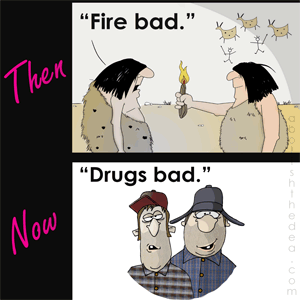 It's as if a tribe of paleolithic cave dwellers were shivering in the cold, racking their brains for ways to keep warm, yet never even thinking about building a fire for that purpose, so thoroughly have they come to believe that fire is bad!
The DEA stomped onto Thomas Jefferson's estate in 1987 and confiscated the founding father's poppy plants in violation of everything he stood for, politically speaking. And the TJ Foundation helped them! They sold out Jefferson.
Americans believe scientists when they say that drugs like MDMA are not proven effective. That's false. They are super effective and obviously so. It's just that science holds entheogenic medicines to the standards of reductive materialism. That's unfair and inappropriate.
Alexander Shulgin is a typical westerner when he speaks about cocaine. He moralizes about the drug, telling us that it does not give him "real" power. But so what? Does coffee give him "real" power? Coke helps some, others not. Stop holding it to this weird metaphysical standard.
I'm going to get on the grade-school circuit, telling kids to say no to horses.
"You think you can handle horses, kids? That's what Christopher Reeves thought. The fact is, NOBODY can handle horses!!!"
Drugs like opium and cocaine should come with the following warning: "Outlawing of this product may result in inner-city gunfire, civil wars overseas, and rigged elections in which drug warriors win office by throwing minorities in jail."
The scheduling system is a huge lie designed to give an aura of "science" to America's colonialist disdain for indigenous medicines, from opium, to coca, to shrooms.
I hope that scientists will eventually find the prohibition gene so that we can eradicate this superstitious way of thinking from humankind.
To treat opioid use disorder, we should re-normalize the peaceable smoking of opium at home as an alternative to drinking alcohol.
We've created a faux psychology to support such science: that psychology says that anything that really WORKS is just a "crutch" -- as if there is, or there even should be, a "CURE" for sadness.
"Now, now, Sherlock, that coca preparation is not helping you a jot. Why can't you get 'high on sunshine,' like good old Watson here?" To which Sherlock replies: "But my good fellow, then I would no longer BE Sherlock Holmes."
It's as if a tribe of paleolithic cave dwellers were shivering in the cold, racking their brains for ways to keep warm, yet never even thinking about building a fire for that purpose, so thoroughly have they come to believe that fire is bad!
The DEA stomped onto Thomas Jefferson's estate in 1987 and confiscated the founding father's poppy plants in violation of everything he stood for, politically speaking. And the TJ Foundation helped them! They sold out Jefferson.
Americans believe scientists when they say that drugs like MDMA are not proven effective. That's false. They are super effective and obviously so. It's just that science holds entheogenic medicines to the standards of reductive materialism. That's unfair and inappropriate.
Alexander Shulgin is a typical westerner when he speaks about cocaine. He moralizes about the drug, telling us that it does not give him "real" power. But so what? Does coffee give him "real" power? Coke helps some, others not. Stop holding it to this weird metaphysical standard.
I'm going to get on the grade-school circuit, telling kids to say no to horses.
"You think you can handle horses, kids? That's what Christopher Reeves thought. The fact is, NOBODY can handle horses!!!"
Drugs like opium and cocaine should come with the following warning: "Outlawing of this product may result in inner-city gunfire, civil wars overseas, and rigged elections in which drug warriors win office by throwing minorities in jail."
The scheduling system is a huge lie designed to give an aura of "science" to America's colonialist disdain for indigenous medicines, from opium, to coca, to shrooms.
I hope that scientists will eventually find the prohibition gene so that we can eradicate this superstitious way of thinking from humankind.
To treat opioid use disorder, we should re-normalize the peaceable smoking of opium at home as an alternative to drinking alcohol.
We've created a faux psychology to support such science: that psychology says that anything that really WORKS is just a "crutch" -- as if there is, or there even should be, a "CURE" for sadness.
"Now, now, Sherlock, that coca preparation is not helping you a jot. Why can't you get 'high on sunshine,' like good old Watson here?" To which Sherlock replies: "But my good fellow, then I would no longer BE Sherlock Holmes."


 (up)
(up)