



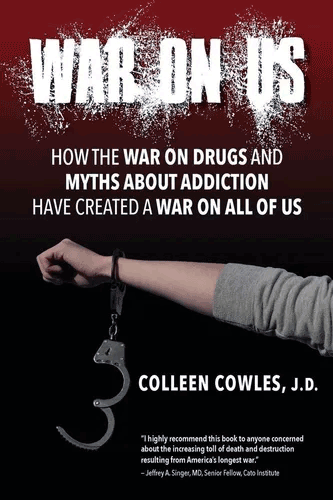
An Open Letter to Colleen Cowles, author of War On Us
by Brian Ballard Quass, the Drug War Philosopher
March 3, 2026
Dear Colleen,
I am enjoying your book1, but I wondered if I might share my ideas on the subject. I am a 67-year-old chronic depressive whose complaints about drug prohibition have been absolutely ignored by everybody -- everybody -- and yet I am just one of millions of such unrecognized victims. We are the chronically depressed who have been "saved" from drugs like cocaine and opium by being shunted off onto under-performing Big Pharma "meds" that are far harder to kick than heroin. Far, far harder. This is why I have a far less forgiving attitude than you seem to have toward the parents, the police, the politicians and the judges who support the demonstrably deadly policy of drug prohibition to this very day.
You ask some rhetorical questions on page 16:
"Can we blame a police officer who harshly arrests someone who looks high when the day before that same officer was rescuing children from a meth house? Can we blame a politician who promotes punitive legislation after being contacted by a grieving mother, asking for harsher sanctions against those who supplied the drugs that took her child's life? Can we blame the judge or prosecutor who has no medical training for mandating drug court for a defendant...?"2
My answer is: YES! YES! YES! We can and we should blame them! Why? Because white American parents are not the only stakeholders in the drugs debate! And these public service employees should KNOW this, even if the grieving mother does not! Whenever you outlaw a substance for recreational use, you outlaw that same substance for therapeutic use. Everyone's worrying about the sensibilities of parents, but American parents are part of the problem -- they are the ones who are working to outsource drug dangers to minorities in inner cities and to foreigners overseas, etc., all so their children can be safe: the same children whom the parents refuse "on principle" to educate about safe drug use. Parents want to scapegoat drugs for the problems of childhood and to hell with the collateral damage: like the millions who go without godsend pain relief and depression relief thanks to drug prohibition!
Take myself, for instance. I desperately needed a drug in my youth that would help me rise above my masochistic depression and perform optimally in life, thereby helping me to make a living -- not eventually but now! Instead, drug prohibition "saved me" from drugs like cocaine (which Freud knew to be a godsend for the depressed3) and shunted me off instead onto under-performing Big Pharma drugs that are far harder to kick than heroin! Far harder. My psychiatrist told me that the Effexor I am on has a 95% recidivism rate 4 for long-term users after three years -- 95% -- a fact that I verified for myself the hard way when I found that getting off the drug scrambled my brain and sent me into the worst depression I had ever experienced in my life. Compare this to Lee Robins' study of heroin5. Of the many American soldiers who used heroin in Vietnam, only 5% needed help getting off the drug when they returned to the States. 5%.
I was thus turned into a patient for life, with all of the demoralizing and expensive baggage that this entails. I am 67 years old, and yet I still have to see a doctor half my age every three months to be able to purchase an expensive medicine that I can never quit without experiencing mental deficits! And yet my disempowerment is completely invisible to all our medical "experts" and ethicists. Today's medical ethicists write about the rights of patients -- but they should be writing about our right NOT TO BE PATIENTS in the first place6!
My experience, combined with the infuriating fact that no one in the medical industry wants to hear about it, gives me a very different angle indeed on drug prohibition and the War on Drugs.
I hope that you will be an exception to the rule and truly listen to what I am saying here.
The New York Times recently reported on the case of a depressed Canadian entertainer named Claire Brosseau who is fighting for her right to assisted suicide78. Please, Colleen, consider what this means in the context of drug prohibition. It means that Claire wants the state to help her to die. And what state is that, Colleen? It is the same state that will not let her use drugs that could make her want to LIVE, drugs that grow unbidden in nature!!!!
And yet the New York Times health reporter, Stephanie Nolen, has ghosted me when I point this out -- as have both of Claire's psychiatrists9! They've ghosted me! They are determined to make Claire's story all about assisted suicide and to completely ignore the role that drug prohibition played in making assisted suicide an issue in the first place. This is why drug prohibition never ends, because no one dares hold it responsible for the problems that it causes, just as enemies of inner-city gun violence refuse to hold drug prohibition responsible for bringing guns to the 'hood in the first place10!
This is why we cannot expect the self-interested medical "experts" to come to the rescue in ending drug prohibition. Like all Americans, they are so bamboozled by a lifetime of drug-demonizing propaganda -- above all in the form of the censorship of all stories of positive drug use -- that they now actually believe that suicide is a viable option for the depressed. Suicide! (Even Jeffrey Singer takes this view, judging by his comments on the case, this despite the fact that he links drug prohibition and healthcare in his book, "Your Body, Your Health Care."11) I am not Einstein, Colleen! Why then am I the only one who sees that this is wrong? Answer: Because Americans have been programmed to believe that death itself is better than drug use -- death itself -- which is a conclusion that would be hard to swallow even for most Christian Scientists!
If I ever committed suicide, Colleen, it would be because drug prohibition has turned me into a childlike patient for life! And if I sound harsh for my disdain for parents, please consider the fact that 49,000 Americans commit suicide every year12 -- and this fact is damning when you consider that we have outlawed all medicines that could make one want to live -- and in a trice! Laughing gas kits should be available for the suicidal as epi pains are made available to those with severe allergies. Instead, the FDA wants to treat laughing gas as a "drug," making it less available than ever, this despite the fact that William James13 told us to use such substances to investigate the nature of reality writ large! This is why I say that I alone seem to appreciate the full evil of drug prohibition -- because as a depressed philosopher, I live the effects of that evil every single day of my life!
I feel that I must be an alien from another planet given that I am the only earthling who has noticed the obvious connection between drug prohibition and assisted suicide. Assisted suicide would not be necessary except for drug prohibition. Anyone who thinks otherwise has a very poor grasp of the state of the art when it comes to pharmacology and ethnobotany. Laughing gas could cheer the depressed up in a trice, as could cocaine, as could a wide variety of phenethylamines, like those synthesized by chemist Alexander Shulgin in the 1990s.14 For many, a nightly opium pipe would do the trick, and that without causing any crippling addiction15 -- at least in a world wherein drug laws are not set up to ensure that users encounter as many problems as possible, up to and including death from contaminated product.
Unfortunately, Claire herself seems to believe that death is preferable to drug use. I wrote her recently to ask her to stop fighting for assisted suicide and to fight instead for her right to heal, for her time-honored human right to use godsend medicines, many of which grow at her feet16. I asked her, in short, to join me in fighting to end drug prohibition on behalf of the unnecessarily depressed of the world. Claire, however, has ignored me. It seems that she too has been programmed to think that death is preferable to drug use. What anti-scientific and anti-health madness!
Speaking of which, if I were a parent, I would reserve my rage for the politicians who are criminally negligent for not grasping the downsides of drug prohibition insofar as it has been in effect for over a century now!
I can demonstrate the difference between our approaches to drug prohibition by asking the following question:
Why are we trying to get people off of heroin in the first place? Why can't they use heroin daily? A co-founder of Johns Hopkins used morphine every day of his life as he worked as a successful and admired surgeon17.
One in four American women take a Big Pharma drug every day of their life and we say that they are good patients for doing so18! Am I the only one in the world who sees the enormous financial self-interest that the medical industry and psychiatrists have in normalizing this unprecedented dystopia of mass chemical dependency?! Moreover, psychological common sense tells us that drugs that inspire can be used intermittently to help one "keep the course" on getting off of an unwanted drug. We do not need medical science to create new drugs to help us -- we need simply to re-legalize all medicines and learn how to use them with psychological common sense in mind, to fight drugs with drugs!
I will end here, since if these ideas do not motivate, then I fear that nothing else that I write will do so either.
But first please allow me to share my own proposal for ending drug prohibition. This is something that you could perhaps help me with, by the way, should you be so inclined.
We need to create a nonprofit called "Depressed Americans for an end to Drug Prohibition." The mere existence of such a group will remind the above-mentioned police, politicians and judges that worried American parents are not the only stakeholders in the drug debate and that outlawing drugs outlaws the right to heal, a right for which we should not need the approval either of the medical industry or the government. Such a group is especially important now that the medical field is working to normalize suicide as an option for the depressed. We need to remind the depressed that there is hope for them, even if the many psychiatrists think otherwise. If we cannot cheer them up, at least we can give them a purpose in life by getting them involved in the fight against the drug prohibition that is denying them their right to heal.
Should any of these ideas resonate with you, please let me know. The very existence of the nonprofit that I advocate above would put Americans on notice that there are far more stakeholders in the drug debate than the children whom we refuse to educate about drugs.
Best Wishes,
Brian
PS Perhaps the best argument against drug prohibition is one that is never made: namely, that entire religions have been inspired by drugs that inspire and elate. It follows that the outlawing of drugs is the outlawing, not simply of a single religion, but of the religious impulse itself. Then, too, there is the simple fact that drug prohibition is the worst oppression that a government can ever place on a people, for it outlaws not only what one can think -- but how and how much one can think and feel. Despots of the past were mere tyros. Today's despots have assumed control of the drugs that can ease pain and end depression, and this is the greatest power grab by government in human history. This is why I feel that almost every book written about drugs understates the problem of drug prohibition. This is to be expected, however, since, as in the case of Claire Brosseau, American pundits refuse to hold drug prohibition responsible for the evils that it causes.
Notes taken while reading 'War on Us'
In reading your book, I would point out that medications ARE drugs and vice versa. The medical industry has an obvious motive in touting its "cures" for addiction. It is common psychological sense that almost any drug could help fight addiction as part of a strategic regimen. We need drug re-legalization, not the intervention of pharmaceutical companies with a handful of silver bullets. Let's remember how Big Pharma has turned 1 in 4 American women into patients for life. The medical industry "cured" my depression by turning me into a patient for life. The last thing I want is their help to get off time-honored medicines like cocaine and opium. Being plant medicines, they are mine by natural right. We cannot have the medical industry pretending that only their drugs are "scientific" and moral.
The "disease" model is rich. First the state outlaws time-honored panaceas that grow around us -- then they tell us that we have a disease if we still want to use those drugs.
The medical "experts" are funny in the way that they find drug use so inexplicable. They must then be puzzled as to why people would want a nice "cold one" after a long day at work or why they would want to visit the local pub. These "experts" have lost all common sense.
Why is it pathological to want to improve mental focus and to see the world with new eyes? I would say that it is pathological to be content with one's own blurry view of the world. It shows a complete disinterest in self-improvement and in gaining a better understanding of one's place in the universe.
Was Benjamin Franklin or Marcus Aurelius pathological because they enjoyed opium? No, this pathologizing of drug use by "experts" has nothing to do with science: it is just using a veneer of science to judge people based on the substances that they use.
We don't need any cures for drug prohibition except to end it and to start placing the blame for social problems on real causes instead of drugs. Human beings have a natural right to take care of their own health and that right cannot be infringed based on a cost/benefit analysis any more than the freedom of speech should be infringed on such a basis. But, of course, drug re-legalization would easily pass any cost/benefit test, assuming that the testers took all factors into account, including above all the cost of NOT re-legalizing drugs.
My approach to withdrawal: incrementally reduce daily doses over 6 months, or even a year, meanwhile using all the legal entheogens and psychedelics that you can find in a way likely to boost your endurance and "sense of purpose" to make withdrawal successful.
To say that psilocybin has not been proven to work is like saying that a hammer has not yet been proven to smash glass. Why not? Because the process has not yet been studied under a microscope.
Psychiatrists never acknowledge the biggest downside to modern antidepressants: the fact that they turn you into a patient for life. That's demoralizing, especially since the best drugs for depression are outlawed by the government.
The Hindu religion was created thanks to the use of a drug that inspired and elated. It is therefore a crime against religious liberty to outlaw substances that inspire and elate.
This is why "rock stars" use drugs: not just for performance anxiety (which, BTW, is a completely UNDERSTANDABLE reason for drug use), but because they want to fully experience the music, even tho' they may be currently short on money and being hassled by creditors, etc.
Scientists are not the experts on psychoactive medicines. The experts are painters and artists and spiritualists -- and anyone else who simply wants to be all they can be in life. Scientists understand nothing of such goals and aspirations.
I never said that getting off SSRIs should be done without supervision. If you're on Twitter for medical advice, you're in the wrong place.
There's more than set and setting: there's fundamental beliefs about the meaning of life and about why mother nature herself is full of psychoactive substances. Tribal peoples associate some drugs with actual sentient entities -- that is far beyond "set and setting."
If NIDA covered all drugs (not just politically ostracized drugs), they'd produce articles like this: "Aspirin continues to kill hundreds." "Penicillin misuse approaching crisis levels." "More bad news about Tylenol and liver damage." "Study revives cancer fears from caffeine."
If media were free in America, you'd see documentaries about people using drugs wisely for a wide variety of praiseworthy purposes.