








 See also Claire Brosseau should be fighting for her right to take care of her own health, not for her right to assisted suicide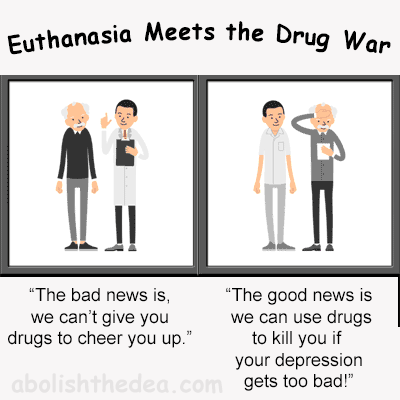
"In Galenic practice the most useful medicine was a theriaca, or antidote, named Electuarium theriacale magnum, a compound composed of several ingredients, among them opium and wine. " --Thomas Szasz, Ceremonial Chemistry: the ritual persecution of drugs, addicts, and pushers29
"More than tranquil, I was completely at peace, in a beautiful, benign, and placid place."31
"A glimpse of what true heaven is supposed to feel like... A true healing potential."32
"This is total energy, and I am aware of my every membrane. This has been a marvelous experience, very beautiful, joyous, and sensuous."33

"The substantial reason for rejecting a philosophical theory is the 'absurdum' to which it reduces us." 39
Good day, Jeff.
I enjoyed your book [i.e. Your Body, Your Health Care40]. You are one of the few authors on the planet who understands that drug prohibition involves the outlawing of our right to take care of our own health!
I feel that I am the living embodiment of that statement, as drug prohibition has "protected me" from opium and cocaine by shunting me off onto a Big Pharma "med" that is far harder to kick than heroin.
I wonder if you are aware of the Claire Brosseau story in the New York Times, in which the Canadian entertainer demands her right to assisted suicide because of her depression! Like so many news stories, this one strikes a very odd note when you consider it in the context of drug prohibition. Claire has a "false consciousness" if ever there was one: she should not be fighting for a new and recherche right to 'assisted suicide'; she should be fighting for the end to drug prohibition, which prevents her from using drugs that could not only let her die peacefully, but, much more importantly, could actually give her a reason to live! (Of course, she knows almost nothing about such drugs because of the censorship of almost all reports of positive drug use in the media.)
I invite you to read my protest letter to Times health reporter Stephanie Nolen, the author of the article in question:
https://abolishthedea.com/no_one_would_need_assisted_suicide_if_we_ended_drug_prohibition
I have also sent this letter to the two psychiatrists involved in the Brosseau case, one of whom is actually fighting for Claire's right to have doctors help her die. Just imagine the irony here: they will probably end up letting Claire use opiates to kill herself, the same opiates that they will not let her use to cheer herself up! This is the weird pass that we have come to thanks to the outlawing of opium in 1914.
Sorry to take your time, but you're about the only person I know who might not ignore my ideas out of hand. I am sure that Stephanie will not respond to my concerns, let alone publish any part of my letter -- at least if past experience is any judge.
Thanks for sharing those links, Jeff.
You make some good points about the need for patient autonomy, with which I completely agree.
But I come at these issues from a very different place, with a sense of urgency as a kind of "patient malgre lui," and so I have a different focus. I ask why many of these people became patients in the first place. The outlawing of just two drugs -- cocaine and opium -- left severe pain, shyness and anxiety (and a host of other conditions, including the common cold itself) untreatable at home. And so the medical field welcomed these people with open arms and created whole new insurance-covered pathologies in the DSM to process and care for them, turning many of them into patients for life with dependence-causing "meds."
Drug prohibition has kept me from using drugs that could work wonders with my attitude toward life -- wonders! -- and I know this from personal experience -- and yet I was forced to become a ward of the healthcare state thanks to drug law, reliant on drugs that were immensely dependence-causing and did not perform any wonders at all. The best that can be said for these "meds" is that they kept me from committing suicide, but I would not have been interested in suicide had I been allowed to use drugs that would have helped me succeed in life at my chosen profession. I am still asked every three months (after 35 years of office visits) if I have considered suicide over the last three months, to which I always want to respond: "Only when I consider the fact that drug prohibition has turned me into a ward of the healthcare state."
Here is where my materialist critics start talking about the need for "real" cures, as if symptomatic help from "drugs" is illegitimate. But this search for "real" cures has led to the greatest mass dependency of all time (tobacco excepted), on antidepressants that were billed as scientific, but which Noam Shpancer at Psychology Today now tells us "work" for completely unknown reasons43. Richard Whitaker even suggests that these drugs cause the chemical imbalances that they were meant to fix44. I don't know if that is true, but it might account for the fact that many of these drugs are so difficult to quit for long-term users.
But thanks again for sharing. I think I am getting a better idea of why I am ignored by most drug-law reformers.
Many reformers seem to think that materialist science has "sorted" depression, as the Brits would say. Carl Hart even starts his book [Drug Use for Grown-Ups45] by saying that the drugs that he uses for recreation should not be used for mental and psychological improvement, and that we should see our doctors for such help, the same doctors who have turned me into a ward of the healthcare state. I find Carl's statement impossible to believe. It runs counter to my personal experience, and even what I might call my psychological common sense. Happiness helps. Looking forward to happiness helps. Relaxation helps. Even if these things cannot be depicted on a bar chart. Even a nightly beer helps one's overall "mental health" if it relaxes one – and if one can look forward to such relaxation, for even the anticipation of upcoming relaxation helps!
Just one more comment if I may and then I'll leave you be. The last thing I want to do is alienate one of the few people in the world who will actually respond to my emails!
I feel that drug prohibition is the 6,000-pound gorilla in the room. It is, I feel, a hugely relevant subject when discussing various social ills, and yet no one mentions it. We are thereby giving Drug Warriors an enormous "Mulligan" for a long list of crimes.
Consider, for instance, the problem with inner-city violence. Guns began flooding America's streets thanks first to liquor prohibition and then to drug prohibition. As Heather Ann Thompson wrote in the Atlantic in 2014:
"Without the War on Drugs, the level of gun violence that plagues so many poor inner-city neighborhoods today simply would not exist." --Heather Ann Thompson, Inner-City Violence in the Age of Mass Incarceration46
And yet almost none of the anti-gun violence groups in inner cities even MENTION drug prohibition. And when I politely suggest that they do so, they ignore my emails.
Then there are the groups that are against suicide. None of them mention the drug prohibition which has outlawed substances that could end suicidal ideation in a trice! They too ignore my emails.
Then there are the groups that are against the use of shock therapy. None of them mention the drug prohibition which keeps patients from using drugs (like cocaine and others) that could make shock therapy unnecessary. They never respond to my emails.
Then there are the groups that are against school shootings. None of them mention drug prohibition which outlaws empathogens like MDMA that could make hotheads actually care about their fellow human beings. They ghost me as well.
Then there are the groups that are against Alzheimer's disease. None of them mention the fact that drug prohibition outlaws drugs that are known to create new neurons in the brain – not to mention drugs that sharply increase cognitive function and so could be godsends for seniors experiencing mental decline. These groups ignore me as well.
Although you do not specifically mention drug prohibition in your articles about assisted suicide, I was happy to see that you called for the right to go outside the healthcare system. And you do NOT ignore me! (Thanks again.)
I don't have any particular horse in the race when it comes to assisted suicide (although I generally favor your views as I understand them) – my focus is on what I take to be the gorilla in the room, the fact that the issue would not even arise had Americans the freedoms that were available to them before 1914.
I can guess why I am being ignored by most activists, however. The mainstream believes that scientists are the experts when it comes to drugs and so we must wait for them to conclude that a given drug is okay to use. This viewpoint is very naïve, however, because the first thing a materialist scientist does in studying a drug is to ignore any and all obvious benefits – benefits that would be apparent to a child – and look under a microscope instead to see if the drug is "really" working according to some biochemical theory. This is why Dr. Robert Glatter wrote a piece in Forbes magazine in 2021 questioning whether laughing gas could help the depressed47. Laughing gas! Even Reader's Digest knows that laughter is the best medicine.
Of course, I understand that people like Deb Roberson (the inspiration behind MAID, or the Medical Assistance in Dying act48) have to deal with the world as it is, not as it should be. She was suffering from an aggressive cancer, after all, and she did not have time to change America's whole mindset about drugs and so end drug prohibition: she simply wanted the right to die peacefully, GIVEN the fact that drug prohibition exists. I understand that. However, if we never even mention the fact that drug prohibition is the original source of our social ills, then we will never end drug prohibition, which is the real problem, let alone hold it responsible for the endless list of social problems that it causes. We will be like the miser who "fixes" the holes in his walls by hanging pictures over them... at least until the wall finally collapses from excessive perforation.
Finally, regarding the justification for the re-legalization of drugs – especially Mother Nature's medicines – I prefer to make the positive argument that these are basic rights (the right to take care of one's health and the Lockean right to the use of 'the land and all that lies therein') and therefore need not be justified on the basis of a harm/benefit analysis, any more than the freedom of speech should be justified on such a basis. It is the unprecedented policy of wholesale drug prohibition that should be subjected to a harm/benefit analysis, and such an analysis would, conducted fairly, end drug prohibition at once, seeing as it has destroyed inner cities around the globe and turned millions of the depressed into patients for life.
Again, sincere thanks for discussing these issues with me and I hope that my vehemence on these topics has not caused me to "come across" as rude or disrespectful. If so, my apologies!
PS Here's another concern that I have with the harm/benefit approach to drug re-legalization: it is never done fairly. A true harm/benefit analysis of drug use would consider such things like the harm of NOT re-legalizing a drug. What happens if we do NOT re-legalize a drug that inspires compassion, given that we live in a world on the brink of nuclear destruction? What happens if we do NOT re-legalize a drug that could cheer up the suicidally depressed in a trice? But then the depressed (like pain patients) are not considered to be stakeholders in the debate about drug re-legalization because politicians can trust them to suffer in bamboozled silence behind closed doors.
And the list of such questions is limited only by the imagination. This is why GK Chesterton claimed in connection with liquor prohibition that a bureaucrat would have to become God in order to determine what is healthy for a given person49. There is, after all, such a dizzying array of seemingly limitless variables involved in deciding if the use of a specific substance is "healthy" for a given person in a given situation. This is why Drug Warriors ignore details and teach us instead to associate drugs with hated demographics: like opium with the Chinese, hemp (er, I mean "marijuana") with Hispanics, cocaine with Blacks, and psychedelics with "hippies" and other damned "peace lovers." We are taught not to associate drug use with a real-life unique individual but rather with a fashionable category of scapegoat.
Hence the following quote from Thomas Szasz:
"If we argue from principle, then it is moot whether drug prohibition works, because it is problematic what should count as its 'working.' The very existence of such a mass movement of scapegoating-- uniting a diverse people in a common hatred-- may be regarded as evidence that, simply put, it is working." --Thomas Szasz, Our Right to Drugs --p. 11050
"The whole drift of my education goes to persuade me that the world of our present consciousness is only one out of many worlds of consciousness that exist, and that those other worlds must contain experiences which have a meaning for our life also." --William James 57 58
"'Dangerous drugs,' addicts, and pushers are the scapegoats of our modern, secular, therapeutically imbued societies; ...the ritual persecution of these pharmacological and human agents must be seen against the historical backdrop of the ritual persecution of other scapegoats, such as witches, Jews, and madmen. " 63
Your indoctrination in Drug War ideology may have begun in grade school, but it did not end there. Your university professors continued that indoctrination by refusing to teach you any inconvenient truths about the substances that we have been taught to hate. Take your knowledge of Sigmund Freud66 67. You have been taught by your professors to think only of "psychoanalysis" when it comes to Freud, but in a free world, we would be thinking instead about the power of cocaine to end depression. This was Freud's real breakthrough, his acknowledgment that a drug that inspires and elates can be used as an antidepressant. We do not hear about this breakthrough because the powers-that-be have decided FOR us long ago that this belief was a mistake on Freud's part and so future generations need not even know about it.
And so anyone today can claim to be an expert on Freud without even knowing about his advocacy of cocaine for the depressed. Those who catch wind of such advocacy are merely informed by their politically correct professors that Freud's interest in cocaine was a mistake. No proof of this fact need be adduced. Such slander will be readily believed by students who have been brainwashed since childhood in the substance demonizing ideology of the War on Drugs. We see then that Freud is considered a hero in academia, not because he found a practical cure for depression, but rather because his theoretical musings about psychoanalysis have provided fodder for endless remunerative academic projects. The depressed may be as gloomy as ever, but the academics have been promoted to the role of experts when it comes to the parsing and mythologizing of the real-world manifestations of our distress.
And who were the authorities who originally decided FOR us that cocaine use for depression was a non-starter?
Hint: They were not the depressed themselves, whose opinions about cocaine were never even consulted -- not then, not now. (In the materialist west, doctors are the experts on how we feel about the world -- not ourselves.)
No, these "authorities" were the self-interested psychiatrists, psychologists and medical doctors who had a vested interest in demonizing a drug whose use could put them out of business68! If cocaine remained legal, anyone could treat their own depression symptomatically and the mental health field would be devastated -- just as the physical health field would be devastated were opium to be re-legalized for the intermittent treatment of physical pain and discomfort. And what would happen to all the academics who wrote so many impressive (if unreadable) papers on the subject of Oedipus complexes and latent fears of castration? They could no longer create the illusion of profundity through the employment of pedantic circumlocutions and the amassing of superfluous footnotes. And what about the doctors who counseled so many patients for depression? They could no longer entice the public into paying for a lifetime of talk therapy based merely on the possibility of an eventual "breakthrough" of some kind, the precise nature and value of which can never be guaranteed in advance.
This is why the original critics of cocaine use were doctors -- and why they never even bothered to acknowledge the glaringly obvious benefits of the drug for the large majority of users. Cocaine was an existential threat to these professionals. The drug had to be demonized at all costs. And so they wrote hatchet jobs for the press, in which neither they nor their publishers pointed out their obvious conflict of interest in so doing.
A good poster child for this lopsided reporting about drugs is Social Psychologist Henry Lennard, author of a 1972 New York Times article entitled Freud's Disaster With Cocaine69. The op-ed piece contains the kind of argumentation that could only impress a child -- or else an adult who has been brainwashed since grade school in the substance-demonizing ideology of the Drug War. For one searches the article in vain for proof that Freud's interest in cocaine was a mistake, let alone a disaster. Lennard merely cites the fact that a patient of Freud's (one who was already addicted to morphine 70 ) used the drug irresponsibly and became psychologically dependent upon it.
That's it, that's the proof that Freud's advocacy of cocaine was a "disaster."
Now, I ask the reader, have you ever offered a drink to someone who eventually became an alcoholic? If so, did you commit a big mistake -- a disaster, even -- or did you merely provide a potentially beneficial substance to someone who turned out to be incapable of using it wisely, like the vast majority of OTHER drinkers?
And yet the intoxiphobic Lennard perversely tortures this one incident in Freud's life into a supposedly "knock-down" argument, not just against the use of cocaine 71 , but against drug use in general for the treatment of conditions like depression. Not only should we not use cocaine, but we should apparently not use psilocybin, nor opium , nor phenethylamines, nor beta-carbolines, nor even laughing gas -- no, not even if we're desperately depressed like some relatives of mine, on the verge of suicide, and visiting the ER at 3 in the morning in the naive hope of getting some unequivocal relief. As someone who is intimately acquainted with the downsides of neurotic sobriety, I find this drug-hating attitude of Lennard's to be condescending and naive in the extreme. Did Lennard not understand that in some people, the so-called "sober" state is counterproductive, that it works against our interests in life, and that it promotes personal failure through the subtle transmission of defeatist thoughts to the brain? It matters not whether such thoughts are a product of upbringing, genetics, or biochemistry, or -- which is much more likely -- a hopelessly entangled admixture of all three factors. The point is that there exist drugs like cocaine that can clearly help the afflicted to transcend such nefarious and ever-present influences, in light of which fact, Lennard is cruel to support drug prohibition. Cruel! Such a stance on his part amounts to his saying: "I can get along just fine without drugs, thank you very much. Everyone else should be able to do so as well."
But this is mere know-nothing solipsism . There is, in fact, no logical reason for Lennard's belief. It is rather a conclusion based (consciously or otherwise) on the drug-hating ideology of Mary Baker Eddy. And it is an anti-indigenous viewpoint into the bargain. Had Lennard been conversant in the field of ethnobotany72, he would have known that all indigenous societies have used drugs for the benefit of humanity. Being surrounded by untrammeled nature, they were well aware of the psychoactive potential of their environment and were determined to exploit it for the use of their people. Only in the long-since bulldozed world of the west do we deem such interest in psychoactive medicines to be pathological and even criminal. And so we pass laws that help to normalize the imperial intolerance of the Francisco Pizarros of the world with respect to native medicine, thereby giving the lie to our politically correct protestations against the colonialist practice of interfering in the affairs of sovereign countries.
To grasp the cock-sure absurdity of Lennard's views, I like to imagine the psychologist standing in the Andean jungle, surrounded on every side by the psychoactive medicines of Mother Nature, chastising the Inca for their time-honored use of the coca leaf and Sapo frog venom and San Pedro cactus and ayahuasca, etc. "Now, I can set each of you up for a $200 visit to a psychotherapist," says Lennard. "He will help you understand why you have this pathological desire for drugs. I'm guessing here that it has something to do with your relationship with your mothers, but don't quote me on that. Let's see now, the first opening I see here is for next Friday at 10 a.m."
This would be funny, were it not for the fact that Lennard's naive views of human psychology (not to mention sociology) still reign in academia. Hence the postulate of this essay: namely, that censorship about drugs reigns supreme, not just in grade school but in university as well.
"Drug education... is the name we give to the state-sponsored effort to inflame people's hatred and intolerance of other people's drug habits, which is as indecent as it would be to inflame people's hatred and intolerance of other people's religious habits and call it 'religion education.'" p. 90 --Thomas Szasz, Our Right to Drugs 73
"The substantial reason for rejecting a philosophical theory is the 'absurdum' to which it reduces us." -- Concept of Nature74
"No one who has not lived for years in a totalitarian land can possibly conceive how difficult it is to escape the dread consequences of a regime's calculated and incessant propaganda." -- 75
"The laws that deny healthy people 'recreational' drugs also deny sick people 'therapeutic' drugs." 77
"No; if I mistake
In those foundations which I build upon,
The centre is not big enough to bear
A school-boy's top."
My impression has been that the use of cocaine over a long time can bring about lasting improvement..." --Sigmund Freud, On Cocaine, 1884
The addiction gene should be called the prohibition gene: it renders one vulnerable to prohibition lies and limitations: like the lack of safe supply, the lack of choices, and the lack of information. We should pathologize the prohibitionists, not their victims.
It's always wrong to demonize drugs in the abstract. That's anti-scientific. It begs so many questions and leaves suffering pain patients (and others) high and dry. No substance is bad in and of itself.
Drug warriors are too selfish and short-sighted to fight real problems, so they blame everything on drugs.
I have yet to find one psychiatrist who acknowledges the demoralizing power of being turned into a patient for life. They never list that as a potential downside of antidepressant use.
Wonder how America got to the point where we let the Executive Branch arrest judges? Look no further than the Drug War, which, since the 1970s, has demonized Constitutional protections as impediments to justice.
Doc to Franklin: "I'm sorry, Ben, but I see no benefits of opium use under my microscope. The idea that you are living a fulfilled life is clearly a mistake on your part. If you want to be scientific, stop using opium and be scientifically depressed like the rest of us."
"The Harrison [Narcotics] Act made the drug peddler, and the drug peddler makes drug addicts.” --Robert A. Schless, 1925.
That's why we damage the brains of the depressed with shock therapy rather than let them use coca or opium. That's why many regions allow folks to kill themselves but not to take drugs that would make them want to live. The Drug War is a perversion of social priorities.
The so-called opiate crisis is really a drug prohibition crisis.

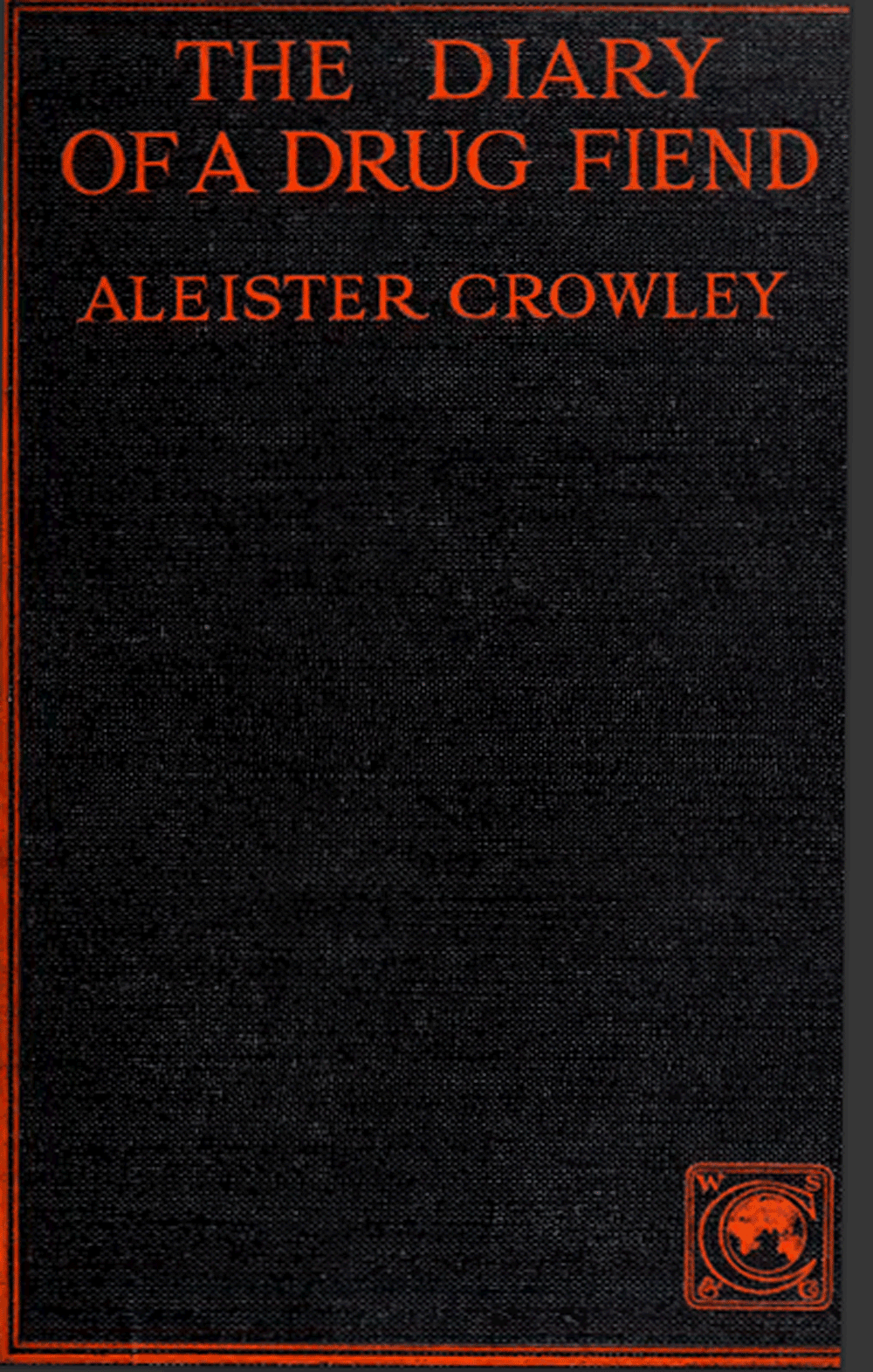

 (up)
(up)