




no access Drug War 101: What's drugs got to do with it?
Homepage of the Drug War Philosopher, Brian Quass
blog icon orange rss icon with stylized radio waves bird icon for twitter bird icon for twitter substack icon


back navigation arrow forward navigation arrow


Drug War 101: What's drugs got to do with it?

Students and teachers: read this essay and discuss... while it's still legal to do so

by Brian Ballard Quass, the Drug War Philosopher

January 4, 2026


Good morning, class.

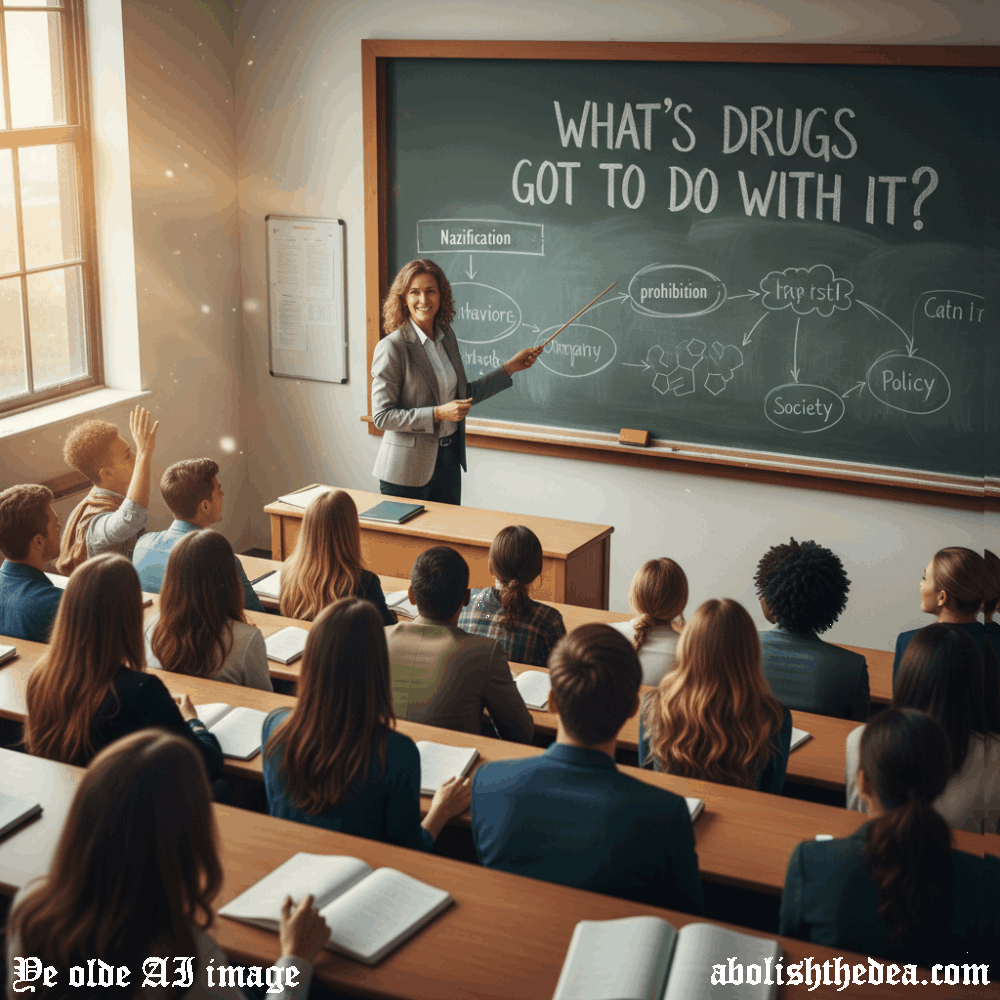
Today's lecture is entitled, "What's Drugs Got to Do With It?"

I just have a couple of items of housekeeping to take care of before we get started. First, let me remind you that this is not a class in politics, okay? We are not going to be discussing the latest in world events. Just so that's clear. We are NOT going to be discussing, for instance, the fact that America has, once again, played the "drug" card in Latin America and "justified" an invasion of a sovereign country in the name of fighting against a plant medicine that we had no right to outlaw in the first place, a plant alkaloid that Sigmund Freud himself considered to be a virtual cure for depression. We are not going to talk about that today. Nor are we going to discuss the disingenuous nature of that justification, insofar as we all know that the regime in Washington D.C. took out Maduro for two reasons and two reasons only: first, because he was an unapologetic socialist and second because he refused to treat our would-be monarch as a king.

This class is about drugs, after all, not about politics! I mean, what's drugs got to do with it, right?

[dramatic pause]

Psych! I am being ironic, of course. American drug policies and American drug attitudes have everything to do with current events!

But hold that thought. There is one more item of housekeeping that I forgot. As you know, all teachers here at Drug War U. receive regular drug tests, just to make sure that we're good patriotic citizens, and I just want you to know that I passed my latest drug test with flying colors. I kid you not. In fact, the lab guy actually congratulated me on using the best possible drugs for the best possible reasons and in the wisest possible ways.

Now, then, where were we? Oh, yes:

Psych! I am being ironic, people! American drug policies and American drug attitudes have everything to do with current events! They have everything to do with daily life. The troubling thing is that so few people realize this fact.

Take the shootings in inner cities, well over 67,000 in the last ten years1. As Ann Heather Thompson wrote in the Atlantic in 2014:

"Without the War on Drugs, the level of gun violence that plagues so many poor inner-city neighborhoods today simply would not exist." 2
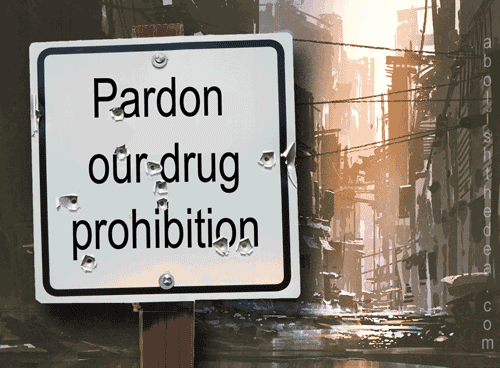

A city sign with bullet holes requests "Pardon our drug prohibition."
Drug prohibition has destroyed minority communities around the world by introducing guns and violence to poor neighborhoods.


And yet the many organizations that fight to end gun violence never talk about drug prohibition, let alone push for an end to that disastrous policy. They are so bamboozled by drug-hating propaganda and censorship that they refuse to connect the dots between prohibition and violence, even though we all know that liquor prohibition created the Mafia as we know it today! There was no machine-gun fire in city streets until liquor prohibition came along3. And yet these organizations refuse to name the obvious villain and instead speculate vaguely about a need for better education and more job opportunities and better healthcare. These are all important things, of course, but let's get our priorities straight.

I've written to several such organizations on this topic and of course they have all ignored me. It is truly considered impolite to bring up the subject of drugs these days. The Philadelphia Citizen is one such organization4. They say their goal is to end gun violence in the City of Brotherly Love, and yet their website never even mentions the subject of drug prohibition, the policy that brought guns to the 'hood in the first place! After they ghosted me, I found an article in The Trace5 concerning their group, so I wrote to the reporter, one Mensah Dean, to suggest that both he and the Citizen start considering the role of drug prohibition in causing gun violence. Alas, he ghosted me as well.

I knew I was in trouble when I received an automated response from The Trace admonishing me that the organization's reporters simply did not have time to answer every email. Apparently they have more important things to do than confront the root cause of gun violence -- which truly makes you wonder, what sort of cosmic issues are they grappling with at The Trace that learning about the root cause of gun violence in inner cities is not at the very top of their to-do list! The mind boggles.

Americans have compartmentalized that subject and placed it aside: they do not wish to be reminded of it. I guess they feel that life is difficult enough without having to factor drug-related home truths into our world view. And the news media that covers gun violence is just as bamboozled. Reporters treat gun violence as more or less inexplicable. They make valiant attempts to link it to various social problems, like a lack of education and a lack of job opportunities and inadequate healthcare -- even to global warming. And yet the obvious villain is invisible to them. Indeed, Lisa Ling produced an entire documentary about gun violence in Chicago in which she never even mentioned drug prohibition6.

We have seen so far that Americans fail (or rather refuse) to connect the dots between drug prohibition and two things: our invasion of Latin American countries and the gunfire in city streets. But the list goes on. Americans also refuse to draw the disturbing connection between drug prohibition and electroshock therapy7.


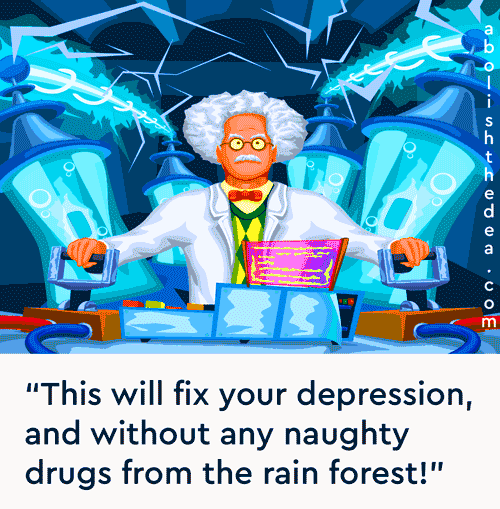
Cartoon features mad doctor throwing switches at console panel as sparks fly from the complicated machinery behind him.  Doctor tells off-screen patient: 'This will fix your depression, and without any naughty drugs from the rain forest!'
Drug prohibition literally fries the brain. The FDA encourages brain-damaging shock therapy for the severely depressed while our government refuses to let us use godsend medicines that could cheer us up in a trice, and without brain damage!


Let's stop for a moment and think what the ongoing promotion of electroshock therapy by the medical community means in the age of wholesale drug prohibition: it means that we actually prefer that the severely depressed undergo brain-damaging shock therapy than to use naturally occurring plant medicine, to say nothing of godsend synthetics. Sure, the doctors have to abide by drug law like everyone else, but they should be screaming about the fact that drug law is forcing them to fry their patients' brains. But they're not doing that. Instead, they are promoting electroshock therapy as a valuable treatment in and of itself, which is actually unconscionable. We outlaw everything that could cheer the depressed up "in a trice," thereby tacitly concluding that suicide and/or brain damage is preferable to "drug" use. I don't know about you guys, but I would personally prefer that a child of mine use cocaine advisedly than to commit suicide or receive "therapeutic" brain damage -- but then maybe that's just me. God only knows in the age of a pyrrhic Drug War like ours in which all basic social values are inverted.

Drug prohibition is also directly related to the massive problem with dementia in the elderly.

Americans wring their hands about dementia these days in the same way that they wring their hands about inner-city gun violence: in total ignoration of the role that drug prohibition plays in making the problem worse, if not causing it in the first place. They do not notice how drug prohibition has outlawed our best hope in fighting conditions like Alzheimer's Disease.

Drug prohibition outlaws drugs that grow new neurons in the brain8! New neurons! You would have to be pretty bamboozled to miss the connection between Alzheimer's and that fact, but, alas, Americans are actually just that bamboozled. Nor is it just psychedelics that could help. Cocaine and amphetamines improve our ability to think straight -- and again, you'd have to be pretty bamboozled by drug propaganda to miss this connection as well -- and yet Americans are, indeed, just that bamboozled.

And the list goes on. Let's talk about school shootings and drugs. The use of Ecstasy in the 1990s brought totally unprecedented peace, love and understanding to the dance floors of England, which you might think was a good thing for a world on the brink of nuclear destruction thanks to the hatred of Homo sapiens for "the other."9 Consider the following reminiscences from DJs of the time as quoted in the documentary "United Nation" by concert promoter Terry Stone:
10

"It was the first time that black-and-white people had integrated on a level... and everybody was one." -- DJ Ray Keith.

"It was black and white, Asian, Chinese, all up in one building," -- MC GQ.

"Everyone's loving each other, man, they're not hating." - DJ Mampi Swift.


Now, one would have to be very bamboozled indeed not to see the connection between the drug Ecstasy and a potential treatment for gun-wielding hotheads. But Americans are, indeed, just that bamboozled. No one stops to think that a drug that inspires compassion could actually be used in therapy to keep hotheads from shooting up grade schools! They may not turn a would-be shooter into Saint Francis of Assisi, but then they don't have to: they merely need to render him or her just compassionate enough so that they no longer have a yen to murder people wholesale, and that is setting a very low bar indeed for success.

I should add that Ecstasy is just one of a potentially endless list of empathogenic drugs that help inspire concern for others. Consider the following user reports for the phenethylamines synthesized by American chemist Alexander Shulgin in the 1990s11:


The feeling was one of great camaraderie, and it was very easy to talk to people.


I am experiencing more deeply than ever before the importance of acknowledging and deeply honoring each human being.


This feels marvelous, and a whole new way to be much more relaxed, accepting, being in the moment. No more axes to grind.

Again, you would have to be very bamboozled not to see the relevance of these user reports to our attempts to end mass shootings by hotheads... and yet, again, Americans, are, indeed, just that bamboozled when it comes to drugs. The groups that wring their hands about school shootings seem to prefer a drug-free maniac to a peaceable drug user.

What's drugs got to do with it, then? Everything.

[bell rings]

Homework assignment, people!

Explain what drugs have to do with the social issue of your choice and how our Drug War prejudices keep most people from recognizing these connections.

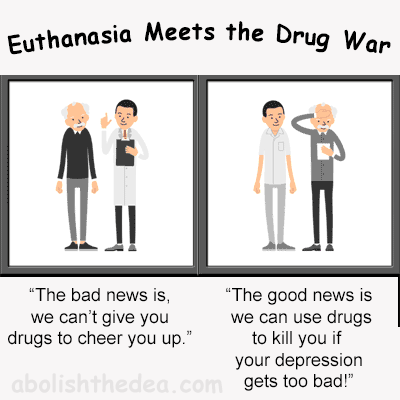
Hint: What about euthanasia? People are insisting on the right to die -- but shouldn't they first be insisting on our right to live fully! [March 2026 UPDATE: See my many essays about the strange case of the depressed Canadian entertainer Claire Brosseau, who would apparently rather kill herself than use drugs that could cheer her up in a trice.12]


Cartoon titled Euthanasia Meets the Drug War. Doctor talks to patient: The bad news is we can't give you drugs for your depression. The good news is, we can kill you if your depression gets too bad.
Americans have been taught to superstitiously believe that drugs are bad. Drugs are not bad or good. They are inanimate objects. Their widespread misuse tells us something about society, not about drugs.


By the way, I actually wrote an essay on these topics back in February of this year. It seems to me that I called it, uh... oh, yes: What's Drugs Got to Do With It? The importance of psychoactive substances in modern philosophy. And no, Coleton, nothing from that essay will be on the test! I just thought you might want to read it, that's all. Jeez! [sigh] There's one in every class!

AFTERWORD

Speaking of Venezuela, I'm reminded of a recent news story about how the U.S. military helped Nobel Prize winner Maria Corina Machado escape the country a couple of weeks ago. They did so by boat, which is not surprising, you might say, since the government had the land routes all monitored and blocked. Yes, but what KIND of boat did they use to escape? According to one of the rescuers involved, they did not dare use a speed boat because the U.S. military has a habit of shooting at such boats under the assumption that they are carrying cocaine.

Just think about that for a minute. The U.S. military shoots at speed boats under the assumption that they are carrying cocaine.

This shows how far America is willing to depart from its foundational principles thanks to drug demonization and drug prohibition, to the point that we will gladly put the innocent in harm's way in order to fight the boogieman called drugs. Even if all of the speed boats in the world were carrying cocaine, what gives the U.S. military the right to be judge, jury and executioner for those smuggling the drug? Since when has law enforcement in America adopted the motto of "by any means necessary"? (Since drug prohibition, of course.)

Our government would have us believe that drug use turns us into scumbags, and they do everything they can to turn that prediction into a self-fulfilling prophecy. But it is drug prohibition which is really turning Americans into scumbags -- by Nazifying their language and convincing them that they have a moral duty to kill Christian Science heretics without a trial!

It will be said that the government only behaves in this lawless fashion when dealing with foreigners, as if that would be some kind of excuse. That would only make the crime worse, however, insofar as it would add imperialism and xenophobia to the military's rap sheet of human rights violations.

This piratical behavior by the U.S. military when it comes to drugs has been going on for well over half a century now, and it does not just affect foreigners, either. When my brother was a teenager in the 1970s, he took a catboat on a solo voyage down the Inland Waterway from our home in Virginia to the Carolinas. During the excursion, he was approached by a U.S. Coast Guard ship, whose crew had apparently pegged him as a potential drug courier. They boarded his small boat and poked around but could find nothing to confiscate. So they returned to their ship, neither apologizing nor wishing my brother a good day. This alone qualifies as Gestapo-like behavior in my book, but the true affront to democratic norms was yet to come. The captain of the Coast Guard boat floored his engines when departing, nearly capsizing my brother's sailboat.

This is just another example of how the ignorant fanaticism behind drug prohibition has Nazified daily life and destroyed American freedoms.


Key Takeaways:


Notes:

1: Gun Deaths in Big Cities Big Cities Health (up)
2: Heather Ann Thompson. 2014. The Atlantic. The Atlantic. October 30, 2014. https://www.theatlantic.com/national/archive/2014/10/inner-city-violence-in-the-age-of-mass-incarceration/382154/. (up)
3: Prohibition's Death Toll: Alcohol's Deadly Legacy (up)
4: Dean, Mensah M. 2025. “The End of Progress on Philly Gun Violence?” The Philadelphia Citizen. July 9, 2025. https://thephiladelphiacitizen.org/gun-violence-summer-2025/. (up)
5: Breaking the Curse of Gun Violence Dean, Mensah M., The Trace, Philadelphia, 2024 (up)
6: Open Letter to Lisa Ling DWP (up)
7: Electroshock Therapy and the Drug War DWP (up)
8: Richard Louis Miller. 2017. Psychedelic Medicine : The Healing Powers of LSD, MDMA, Psilocybin, and Ayahuasca. Rochester, Vermont: Park Street Press. (up)
9: How the Drug War killed Leah Betts DWP (up)
10: United Nation: Three Decades of Drum & Bass Stone, Terry, 2020 (up)
11: Shulgin, Alexander T, and Ann Shulgin. 2019. Pihkal : A Chemical Love Story. Berkeley, Ca: Transform Press. (up)
12: No one would need assisted suicide if we ended drug prohibition: what Claire Brosseau's case tells us about the warped mindset of the west when it comes to drugs DWP (up)


read more essays here


Ten Tweets

against the hateful war on US


The FDA approves of shock therapy and the psychiatric pill mill, but they cannot see the benefits in MDMA, a drug that brought peace, love and understanding to the dance floor in 1990s Britain.

Health is not a quality, it's a balance. To decide drug legality based on 'health' grounds thus opens a Pandora's box of different points of view.

Harm Reduction is not enough. We need Benefit Production as well. The autistic should be able to use compassion-enhancing drugs; dementia patients should be able to use drugs that speed up and sharpen mental processes.

Drug war pundits need to stop using the word "snorts" when it comes to cocaine. We "take" our "meds," and yet we "snort" cocaine, just like a pig. That is NOT neutral language, folks!

In "How to Change Your Mind," Michael Pollan says psychedelic legalization would endanger young people. What? Prohibition forces users to decide for themselves which mushrooms are toxic, or to risk buying contaminated product. And that's safe, Michael?

If I have no right to mother nature's bounty, then I surely have no right to manmade guns. If hysterical fearmongering justifies the eradication of the Fourth Amendment, then the Second Amendment should go as well.

To say that psilocybin has not been proven to work is like saying that a hammer has not yet been proven to smash glass. Why not? Because the process has not yet been studied under a microscope.

People are talking about re-scheduling psilocybin, but they miss the point. We need to DE-schedule everything. It's anti-scientific to conclude in advance that any drug has no uses -- and it's a lie too, of course. End drug scheduling altogether! It's childish and wrong.

It wasn't until western prudery and racism came along that we started to judge people by the substances that they chose to ingest, rather than by their actual behavior in the world.

New article in Scientific American: "New hope for pain relief," that ignores the fact that we have outlawed the time-honored panacea. Scientists want a drug that won't run the risk of inspiring us.


Click here to see All Tweets against the hateful War on Us


back navigation arrow forward navigation arrow
Book Cover

Break the ice with a sledgehammer: place this book on your coffee table.

This book features 150 annotated images, designed to force brainwashed Americans to confront the fact that drug prohibition is wrong. Here is what author Richard Parrish II says of the book's compiler: "The drug prohibition philosopher provides first-hand, principled, persuasive, and insightful arguments against the current drug prohibition regime..."

Purchase Your Copy
Book Cover

Drama lovers: collect full-cast recordings of classic plays

In my spare time, when I am not shaming drug warriors for their heartless drug policies, I create full-cast recordings of classic plays using the latest in synthetic voices licensed by the Natural Reader company. Snag your copy of my production of Volpone, by Ben Jonson... and follow me on Payhip for more where that came from, including classics like The Post Office, The Double Dealer and The Inspector General. -- Yours in all-too-justified outrage, the Drug War Philosopher @ abolishthedea.com.

Purchase Your Copy


No cookies, no ads paid for by amoral and immoral billionaires (or trillionaires).


Unless otherwise indicated, no AI is used in the creation of site content. These essays represent the original ideas of their author and not the ideas that the author SHOULD have based on an algorithmic parsing of existing data. For more on this subject, consider the AI-related viewpoints to which the author subscribes as delineated in the New York Times opinion piece entitled "What 370,000 College Essays Tell Us About A.I.’s Effects on Creativity" by Rebecca Winthrop of the Brookings Institution.

The Partnership for a Death Free America is a proud sponsor of The Drug War Philosopher website @ abolishthedea.com.


Copyright 2026, Brian Ballard Quass Contact: quass@quass.com

tombstone for American Democracy, 1776-2024, RIP (up)