








"We are free, when our acts proceed from our entire personality, when they express it, when they exhibit that indefinable resemblance to it which we find occasionally between the artist and his work."
"In the meantime the morphine had its customary effect- that of enduing all the external world with an intensity of interest. In the quivering of a leaf- in the hue of a blade of grass- in the shape of a trefoil- in the humming of a bee- in the gleaming of a dew-drop- in the breathing of the wind- in the faint odors that came from the forest- there came a whole universe of suggestion- a gay and motley train of rhapsodical and immethodical thought.8"
"In the presentation of a novel outlook with wide ramifications, a single line of communications from premises to conclusions is not sufficient for intelligibility. Your audience will construe whatever you say into conformity with their pre-existing outlook." --Alfred North Whitehead, from The Concept of Nature, 27
"We are free, when our acts proceed from our entire personality, when they express it, when they exhibit that indefinable resemblance to it which we find occasionally between the artist and his work." 32
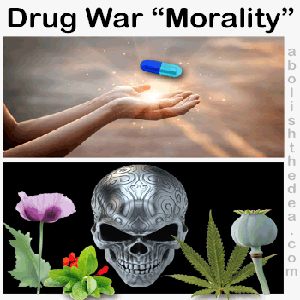
It's always wrong to demonize drugs in the abstract. That's anti-scientific. It begs so many questions and leaves suffering pain patients (and others) high and dry. No substance is bad in and of itself.
Scientists are making entire livings from trying to figure out what's best for ME as a chronic depressive. They owe their jobs to drug prohibition.
There are hundreds of things that we should outlaw before drugs (like horseback riding) if, as claimed, we are targeting dangerous activities. Besides, drugs are only dangerous BECAUSE of prohibition, which compromises product purity and refuses to teach safe use.
Irony of ironies, that the indignant 19th-century hatred of liquor should ultimately result in the outlawing of virtually every mind-affecting substance on the planet EXCEPT for liquor.
The American Philosophy Association should make itself useful and release a statement saying that the drug war is based on fallacious reasoning, namely, the idea that substances can be bad in themselves, without regard for why, when, where and/or how they are used.
Oregon's drug policy is incoherent and cruel. The rich and healthy spend $4,000 a week on psilocybin. The poor and chemically dependent are thrown in jail, unless they're on SSRIs, in which case they're congratulated for "taking their meds."
If we let "science" decide about drugs, i.e. base freedom on health concerns, then tea can be as easily outlawed as beer. The fact that horses are not illegal shows that prohibition is not about health. It's about the power to outlaw certain "ways of being in the world."
In the board game "Sky Team," you collect "coffees" to improve your flying skills. Funny how the use of any other brain-focusing "drug" in real life is considered to be an obvious sign of impairment.
All sites about drugs are propaganda in the age of the Drug War, just as all talk about Jewish criminals was propaganda during WWII. Drugs can have downsides and Jews may be criminals, but to focus only on those facts in a time of war turns everything you say into propaganda.
Even when laudanum was legal in the UK, pharmacists were serving as moral adjudicators, deciding for whom they should fill such prescriptions. That's not a pharmacist's role. We need an ABC-like set-up in which the cashier does not pry into my motives for buying a substance.


 (up)
(up)