



Homepage of the Drug War Philosopher, Brian Quass
blog icon orange rss icon with stylized radio waves bird icon for twitter bird icon for twitter substack icon


back navigation arrow forward navigation arrow


On Szasz, Whitehead, Dualism and Beneficial Drug Use

a companion piece to the essay entitled 'Why universities should offer degrees in Beneficial Drug Use'

by Brian Ballard Quass, the Drug War Philosopher

July 11, 2026


In the afterword to my recent essay entitled Why universities should offer degrees in Beneficial Drug Use (or view on Substack), I was on the verge of broaching an important philosophical topic. I hesitated to continue writing, however, for at least two reasons: first, I did not want to turn the essay into a book (for which, indeed, there would have been plenty of material available), but I also did not want to try the patience of those readers who are not particularly interested in philosophical matters (though one wonders why such readers are visiting my Substack in the first place). And so I have created this entirely separate document for the philosophically minded, where I can write without fear of alienating the utilitarian-oriented reader. That said, I don't mean to give the impression that what I have to say here is of no real-world importance.

I am referring to some recent invalid yet very thought-provoking criticism that I have read about Thomas Szasz's insistence that "mental illness" is a metaphor. It has been alleged that Szasz is tacitly positing a kind of outdated dualism, according to which the body and the mind are completely separate entities, a viewpoint that these critics rightfully point out has long since been discredited. But when I read this criticism, I thought to myself, "This is another case of the pot calling the kettle black." The whole premise of the behaviorist and reductionist mindset that reigns today in the sciences is that drug efficacy must be established by citing quantifiable changes in physical matter and that user reports of drug benefits is irrelevant and even a potential biasing factor for tough-love scientists. This explains why scientists to this very day refuse to say that laughing gas (or opium or cocaine or phenethylamines, etc.) could help the depressed. The efficacy of such drugs, from their point of view, remains to be established by controlled experiments in which scientists can monitor, not how the user feels as expressed in their own words, but rather how their serotonin levels and dopamine levels are moving about during use to see if they are doing so in a way that flatters current theories about the biochemical way to "fix" depression. Anyone could cheer up the depressed in a free world: our biochemical determinists want to "REALLY" cheer us up -- which essentially means they want to cheer us up in such a way that doctors and scientists are not left out of the loop in the highly remunerating business of "treating" the human condition known as depression.

If such philosophical scruples do not convince the reader of the folly of placing biochemical determinists in charge of opining on the utility of mind and mood medicine, then they might want to consider financial motives. Literally billions of dollars ride on this question. In a free world in which human beings took care of their own behavioral health, most of Thomas Szasz's critics would be out of a job, and this is something that we must keep in mind whenever they publish their impressively annotated papers behind academic paywalls, thus giving those papers an air of authority and inevitability that is denied to the op-ed pieces of the victims of their materialistic biases, assuming that any modern platform will even publish the latter's criticism in the first place. I have found that they generally do not. In fact, Mad in America will not publish my own views on this subject, even though they claim to be the champions of the rights of the med-dependent "patient." MIA is just one of many organizations that purport to speak for the med-dependent depressed, but which lack all relevance in my view since they refuse to directly challenge the policy of drug prohibition which rendered me med-dependent in the first place. They refuse, above all, to acknowledge the most obvious of facts: that depression would not even be a "thing" in America if drugs were legal again and our society were determined to promote their wise and safe use to achieve various desirable outcomes for specific individuals with specific needs, goals, and risk tolerances.

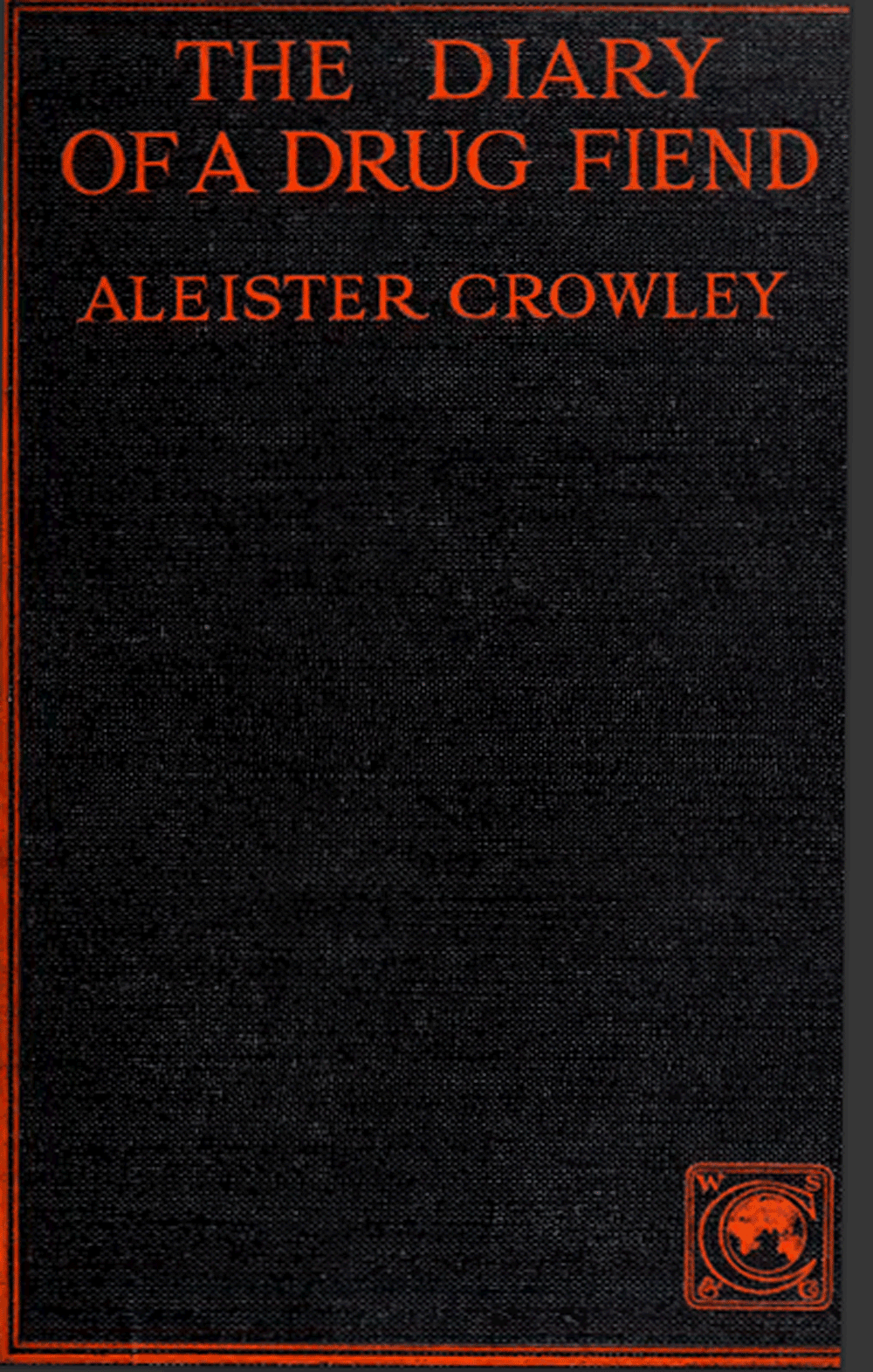
As Aleister Crowley wrote of his first use of cocaine:

The depression lifted from my mind like the sun coming out of the clouds. 1
Aleister Crowley -- The Diary of a Drug Fiend

We can talk for days about ways to limit misuse of such drugs, but until groups like MIA see the glaringly obvious connection between such quotations and my disempowered status as a med-dependent depressed "patient," then they have nothing to teach me.

A close look at the MIA Substack shows that they hold the same materialist viewpoint that I have criticized above. One can tell merely by reading the title of their articles, such as 'The Hype for Psychedelic Drugs Relies on Unblinding', written in April 2026 by Robert Whitaker's scientific partner, Peter Simons. 2 (See my response to that paper: Blinded by the Scientific Light 3). Simons accuses the psychedelic researchers of hype -- failing to realize that the drug approval process is political in the age of drug prohibition. If psychedelic researchers are guilty of cheerleading, then materialist scientists are equally guilty of jeerleading. (See my comments on this subject in What Rick Strassman Got Wrong 4 .) Simons' very title assumes a very debatable point: namely, that scientists should have veto power over forms of healing that have been used by indigenous cultures for millennia! The only useful thing that scientists can tell us about such substances are the dangers of use in the abstract, outside of all particular contexts. That's it. They have no more business telling us whether psychedelics "really" work for us than they have telling us whether "religion" really works for us or "prayer" or "positive thinking." They should go back to their labs and start studying the inanimate objects for which they have apparently mistaken us.

Szasz's critics imply that non-dualism means that psychological problems can indeed be treated as physical problems. And yet behavioral problems have never been treated as physical problems in the past. Before we start declaring the need to start doing so, we have to first give human beings (once again) their right to treat those problems the way that they have always treated problems like depression in the past, namely, in a symptomatic manner. Just as modern beer drinkers "treat" their angst at the end of the workday with "a cold one," adult human beings should be allowed (once again) to use the drugs of their choice to facilitate or promote the mental states that they find useful given their unique circumstances in life, whether they've just come home from a busy workday or from a grueling session of radiation therapy for colon cancer. The alternative, as Thomas Szasz pointed out, is a "system of chemical statism" in which psychiatrists become double agents, "helping politicians to impose their will on the people by defining self-medication as a disease, and helping the people to bear their privations by supplying them with drugs," 5 not the drugs of their choice, of course, but rather the drugs that are chosen for them based on the prudish prejudices of politicians and the metaphysical biases of scientists.

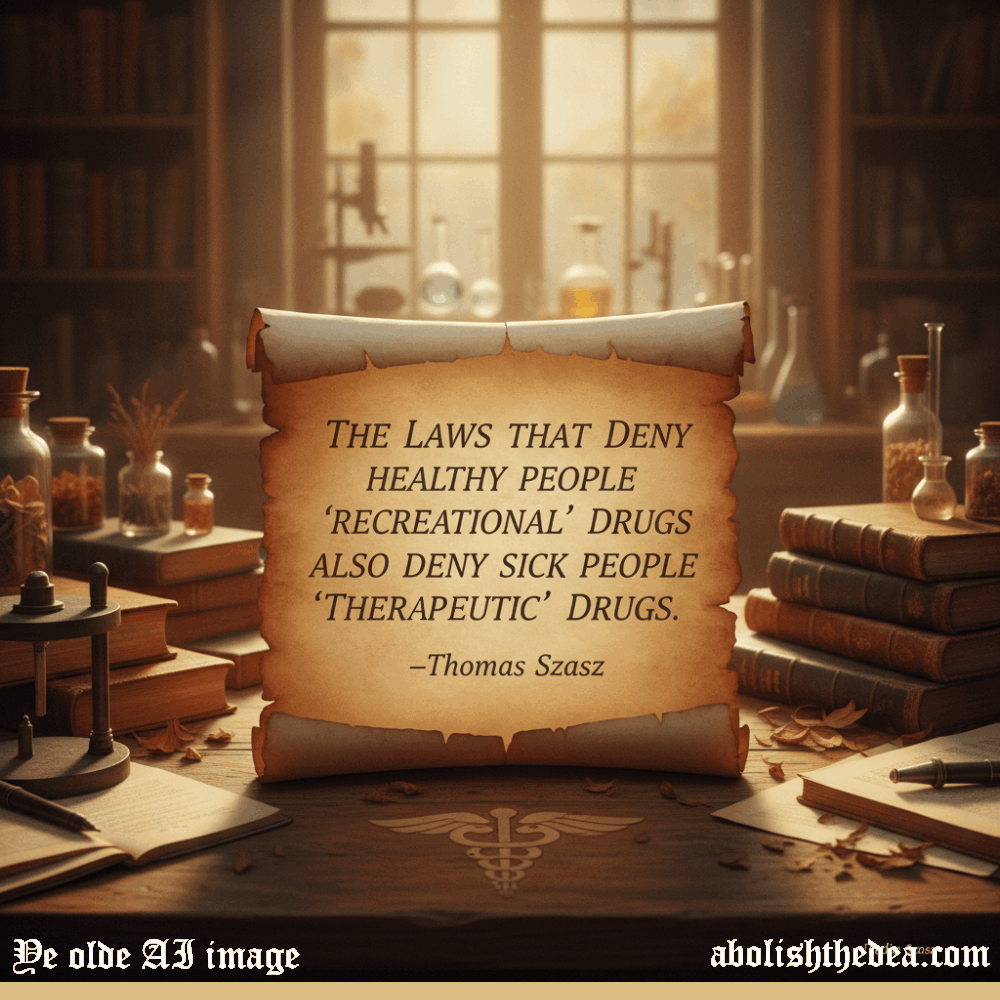
The interesting question on the subject of dualism is: how many physical diseases will disappear or become much more amenable to treatment once we begin -- for the first time in human history -- to sound the depths of the mind's ability to affect the body in beneficial ways? Notice that phrase: "for the first time in human history." For humanity has never stopped everything it was doing and asked from a humanistic rather than a political point of view: "What can these substances -- and derivatives thereof -- do for human beings in various circumstances given the various expectations of users and their various needs and goals and risk tolerances, etc. etc. etc.?" Although the secret has so far been kept under wraps by our drug-bashing media, the use of demonized substances can produce truly miraculous benefits and outcomes. This is something that anyone who studies drug user reports will discover. (For a quick sampler of such benefits, see Forbidden Quotations about the beneficial use of drugs 6.) The fact that Americans are so ignorant about the amazing potential for drugs is proof of my thesis, that we need to start studying and teaching beneficial drug use to adults in our schools and universities. To repeat the conclusion of my original essay: the mere existence in our universities of Departments for the Study of Beneficial Drug Use would make it impossible for Drug Warriors to pretend that poor defenseless white suburban children are the only stakeholders in the debate over drug prohibition. In such a world, the truth of the following statement by Thomas Szasz would be clear to everybody:

The laws that deny healthy people 'recreational' drugs also deny sick people 'therapeutic' drugs. 7
Thomas Szasz -- Our Right to Drugs


Notes for essay entitled On Szasz, Whitehead, Dualism and Beneficial Drug Use: a companion piece to the essay entitled 'Why universities should offer degrees in Beneficial Drug Use':

1: Arthur Crowley. “Full Text of ‘the Diary of a Drug Fiend.’” 1922. Archive.org. 2017. https://archive.org/stream/b29826433/b29826433_djvu.txt. (up)
2: Simons, Peter. 2026. “The Hype for Psychedelic Drugs Relies on Unblinding.” Substack.com. Mad in America. March 27, 2026. https://substack.com/home/post/p-192311543?. (up)
3: Blinded by the Scientific Light DWP (up)
4: What Rick Strassman Got Wrong DWP (up)
5: Szasz, Thomas. 1992. Our Right to Drugs. Praeger. (up)
6: Forbidden Quotations about the beneficial use of drugs DWP (up)
7: Szasz, Thomas. 1992. Our Right to Drugs. Praeger. (up)


read more essays here


Ten Tweets

against the hateful war on US


AI is inherently plagiaristic technology. It tells us: "Hey, guys, look what I can do!" -- when it should really be saying, "Hey, guys, look how I stole all your data and repackaged it in such a way as to make it appear that I am the genius, not you!"

Had we really wanted to "help" users, we would have used the endless godsends of Mother Nature and related synthetics to provide spirit-lifting alternatives to problem use. But no one wanted to treat users as normal humans. They wanted to pathologize and moralize their use.

The drug war controls the very way that we are allowed to see the world. The Drug War is thus a meta-injustice, not just a handful of bad legal statutes.

By reading "Drug Warriors and Their Prey," I begin to understand why I encounter a wall of silence when I write to authors and professors on the subject of "drugs." The mere fact that the drug war inspires such self-censorship should be grounds for its immediate termination.

Only a pathological puritan would say that there's no place in the world for substances that lift your mood, give you endurance, and make you get along with your fellow human being. Drugs may not be everything, but it's masochistic madness to claim that they are nothing at all.

It is folly to put bureaucrats in charge of second-guessing drug prescriptions: what such bureaucrats are really doing is second-guessing the various philosophies of life which are presupposed by the way we use psychoactive drugs.

I'm grateful to the folks who are coming out of the woodwork at the last minute to deface their own properties with "Trump 2024" signs. Now I'll know who to thank should Trump get elected and sell us out to Putin.

No wonder conservatives are terrified of drugs. It is not safety that worries them, else they would demand education. They are terrified of new ways of seeing life. The outlawing of drugs is the outlawing of whole mindsets. It is a meta injustice.

Freud's real discovery was that drugs like cocaine could make psychiatry UNNECESSARY for the vast majority of people. The medical establishment hated the idea -- so they judged the drug based on its worst possible use!

In his book "Salvia Divinorum: The Sage of the Seers," Ross Heaven explains how "salvinorin A" is the strongest hallucinogen in the world and could treat Alzheimer's, AIDS, and various addictions. But America would prefer to demonize and outlaw the drug.


Click here to see All Tweets against the hateful War on Us


back navigation arrow forward navigation arrow
Book Cover

Break the ice with a sledgehammer: place this book on your coffee table.

This book features 150 annotated images, designed to force brainwashed Americans to confront the fact that drug prohibition is wrong. Here is what author Richard Parrish II says of the book's compiler: "The drug prohibition philosopher provides first-hand, principled, persuasive, and insightful arguments against the current drug prohibition regime..."

Purchase Your Copy
Book Cover

Diary of a Drug Fiend

This is the only full-cast recording of Aleister Crowley's 1922 classic paeon to common sense. It is the first book -- and so far almost the only book -- to stake out a philosophy of drug use that is compatible with human freedom, one in which we learn to use drugs as wisely as possible for the benefit of humanity. This recording was produced by the Drug War Philosopher and your purchases help support his effort to push back against the tragically counterproductive policy of drug prohibition, in the name of human freedom and of humanity's right to heal.

Purchase Your Copy


No cookies, no ads paid for by amoral and immoral billionaires (or trillionaires).


Unless otherwise indicated, no AI is used in the creation of site content. These essays represent the original ideas of their author and not the ideas that the author SHOULD have based on an algorithmic parsing of existing data. For more on this subject, consider the AI-related viewpoints to which the author subscribes as delineated in the New York Times opinion piece entitled "What 370,000 College Essays Tell Us About A.I.’s Effects on Creativity" by Rebecca Winthrop of the Brookings Institution.

The Partnership for a Death Free America is a proud sponsor of The Drug War Philosopher website @ abolishthedea.com.


Copyright 2026, Brian Ballard Quass Contact: quass@quass.com

tombstone for American Democracy, 1776-2024, RIP (up)