








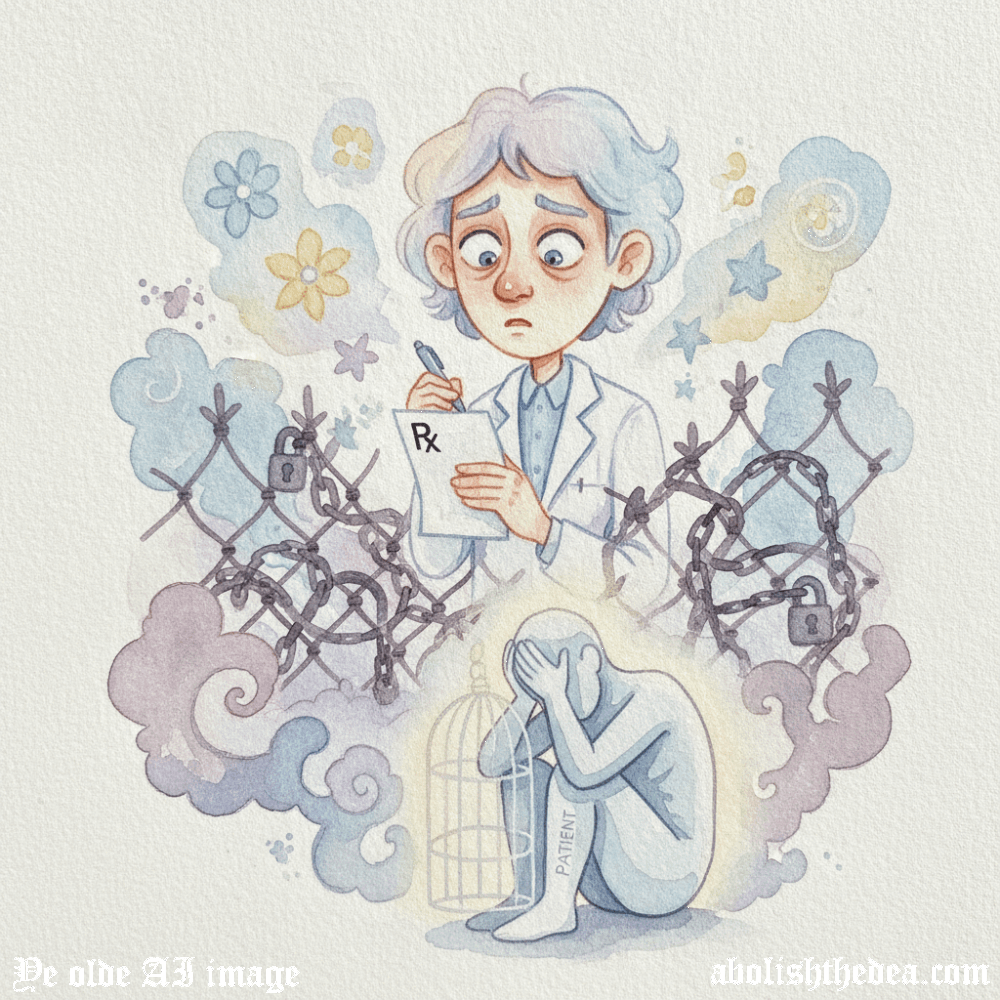
 I have just read your highly informative article entitled "Who Decided You Need a Prescription?" 1 I now have a much better idea of how our various drug prohibitions came about and the role that the use of opium in the Philippines played in this history. Thanks. While reading the post, a number of corollary considerations came to mind that I wanted to share with you.
NIDA is just a propaganda arm of the U.S. government -- and will remain so until it recognizes the glaringly obvious benefits of drugs -- as well as the glaringly obvious downsides of prohibition. We need a National Institute on Drug Use, not a National Institute on Drug Abuse.
My consciousness, my choice.
Prohibition never ended. Busybody Americans just gave alcohol a big Mulligan for killing 178,000 a year in America alone and then began fighting to outlaw everything else.
As such, "we" are important. The sun is just a chaos of particles that "we" have selected out of the rest of the raw data and declared "This we shall call the sun!" "We" make this universe. Consciousness is fundamental.
The media called out Trump for fearmongering about immigrants, but the media engages in fearmongering when it comes to drugs. The latest TV plot line: "white teenage girl forced to use fentanyl!" America loves to feel morally superior about "drugs."
The DEA stomped onto Thomas Jefferson's estate in 1987 and confiscated the founding father's poppy plants in violation of everything he stood for, politically speaking. And the TJ Foundation helped them! They sold out Jefferson.
There was no opioid crisis when Americans were free to smoke opium nightly in their homes. Now scientists around the country are making money hand over fist by "solving" the problem in a politically correct way, without even mentioning the drug prohibition that caused it.
To say that psilocybin has not been proven to work is like saying that a hammer has not yet been proven to smash glass. Why not? Because the process has not yet been studied under a microscope.
The WHO says that depression will be the number-one cause of disability by 2030. What they don't say is that this is only because drug prohibition has outlawed all obvious treatments for depression.
Philip Jenkins reports that Rophynol had positive uses for treating mental disorders until the media called it the "date rape drug." We thus punished those who were benefitting from the drug, tho' the biggest drug culprit in date rape is alcohol. Oprah spread the fear virally.
I have just read your highly informative article entitled "Who Decided You Need a Prescription?" 1 I now have a much better idea of how our various drug prohibitions came about and the role that the use of opium in the Philippines played in this history. Thanks. While reading the post, a number of corollary considerations came to mind that I wanted to share with you.
NIDA is just a propaganda arm of the U.S. government -- and will remain so until it recognizes the glaringly obvious benefits of drugs -- as well as the glaringly obvious downsides of prohibition. We need a National Institute on Drug Use, not a National Institute on Drug Abuse.
My consciousness, my choice.
Prohibition never ended. Busybody Americans just gave alcohol a big Mulligan for killing 178,000 a year in America alone and then began fighting to outlaw everything else.
As such, "we" are important. The sun is just a chaos of particles that "we" have selected out of the rest of the raw data and declared "This we shall call the sun!" "We" make this universe. Consciousness is fundamental.
The media called out Trump for fearmongering about immigrants, but the media engages in fearmongering when it comes to drugs. The latest TV plot line: "white teenage girl forced to use fentanyl!" America loves to feel morally superior about "drugs."
The DEA stomped onto Thomas Jefferson's estate in 1987 and confiscated the founding father's poppy plants in violation of everything he stood for, politically speaking. And the TJ Foundation helped them! They sold out Jefferson.
There was no opioid crisis when Americans were free to smoke opium nightly in their homes. Now scientists around the country are making money hand over fist by "solving" the problem in a politically correct way, without even mentioning the drug prohibition that caused it.
To say that psilocybin has not been proven to work is like saying that a hammer has not yet been proven to smash glass. Why not? Because the process has not yet been studied under a microscope.
The WHO says that depression will be the number-one cause of disability by 2030. What they don't say is that this is only because drug prohibition has outlawed all obvious treatments for depression.
Philip Jenkins reports that Rophynol had positive uses for treating mental disorders until the media called it the "date rape drug." We thus punished those who were benefitting from the drug, tho' the biggest drug culprit in date rape is alcohol. Oprah spread the fear virally.


 (up)
(up)