








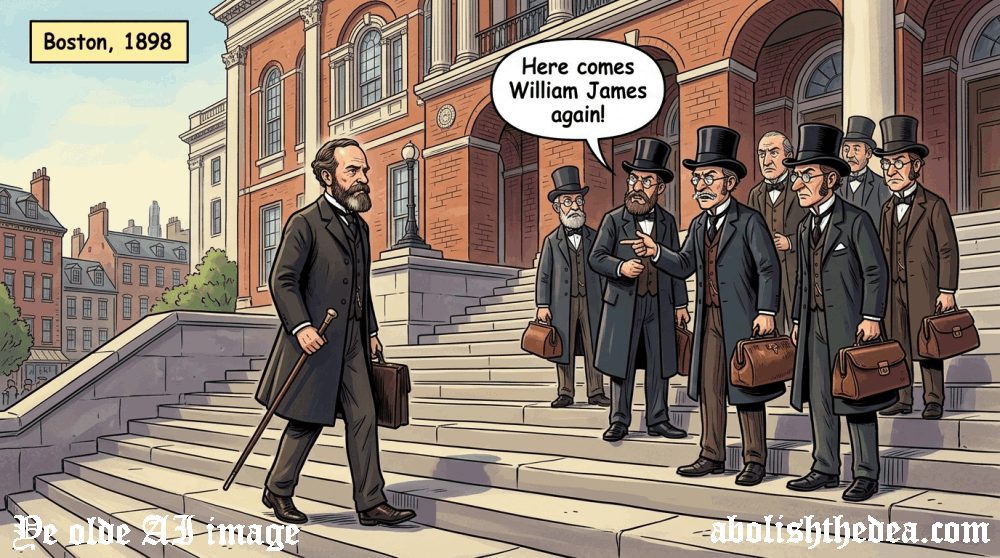
 In the second volume of his collected letters1, we learn that William James was a foe of the medical licensing legislation that was being considered by the state of Massachusetts in the late 19th century. In particular, he was against an 1898 bill for medical licensing. This is a crucial fact for anyone interested in the development of drug law and drug attitudes in the United States. James’ reason for protesting, as I hope to show in an upcoming essay, was this: that medical licensing would involve a war on “quacks” and that such a war would ultimately serve to medicalize spiritual states. I was hoping to write an essay on this subject today; however, I have found this to be a difficult subject to research. There is not much information available on this topic online. Most of what exists has been placed behind expensive academic firewalls — which brings up another problem with America today besides drug prohibition, namely, the fact that the knowledge acquired at our tax-supported universities is now being sold back to the taxpayers at extortionate prices. But it’s just as well in a way: the relevant titles that exist on Google Scholar regarding William James and medical licensing suggest that the denizens of today's Ivory Tower think that James was "beyond the pale" on this topic. One of the typical materialist papers that is being held for ransom is titled “William James, Warts and All,” the implication of that being that James’ foray into medical politics was an embarrassment to his otherwise devoted fan base. This academic pushback suggests to me, however, that these latter-day scholars do not understand what James was protesting or why.
Self-medication is not a dirty word. It has always been a fundamental right to take care of one's own health -- until the medical establishment demonized the practice for obvious financial reasons.
The Drug War treats doctors like potential criminals and it treats the rest of us like children. Prohibition does not end drug risks: it just outsources them to minorities and other vulnerable populations.
Jim Hogshire described sleep cures that make physical withdrawal from opium close to pain-free. As for "psychological addiction," there are hundreds of elating drugs that could be used to keep the ex-user's mind from morbidly focusing on a drug whose use has become problematic for them.
Healthline posted an article in 2021 about the benefits of getting off of antidepressants. They did not even mention the biggest benefit: NO LONGER BEING AN ETERNAL PATIENT -- no longer being a child in the eyes of an all-knowing healthcare system.
Folks like Sabet accuse folks like myself of ignoring the "facts." No, it is Sabet who is ignoring the facts -- facts about dangerous horses and free climbing. He's also ignoring all the downsides of prohibition, whose laws lead to the election of tyrants.
We won't know how hard it is to get off drugs until we legalize all drugs that could help with the change. With knowledge and safety, there will be less unwanted use. And unwanted use can be combatted creatively with a wide variety of drugs.
If any master's candidates are looking for a thesis topic, consider the following: "The Drug War versus Religion: how the policy of substance prohibition outlaws the attainment of spiritual states described by William James in 'The Varieties of Religious Experience.'"
The Thomas Jefferson Foundation is a drug war collaborator. They helped the DEA confiscate Thomas Jefferson's poppy plants in 1987.
It's disgusting that folks like Paul Stamets need a DEA license to work with mushrooms.
The existence of a handful of bad outcomes of drug use does not justify substance prohibition... any more than the existence of drunkards justifies a call for liquor prohibition.


 (up)