How Madison Avenue helps to normalize the incoherent policy of substance prohibition
by Brian Ballard Quass, the Drug War Philosopher
November 23, 2025
After studying the Drug War from a philosophical perspective for the last eight years, I have learned about far more than drugs. I have learned how our inhumane drug attitudes are symptoms of a larger problem in America: namely, our country's uncritical acceptance of omnipresent propaganda in the form of commercial advertisements, and most notably in the form of television advertisements, including those streaming ads that we penny-pinching viewers must sit through in order to watch our favorite shows "on the cheap." In researching this topic, I was surprised to find that few philosophers are raising any red flags about capitalism's reliance on such propaganda. To be sure, there are books that expose the manipulative practices of advertisers (see, for instance, "Brandwashed" by Martin Lindstrom 1) but these books never seem to question the practice of propagandistic advertising itself; the authors' goal in such books is merely to give their readers a privileged heads-up on how they personally can avoid getting snookered by the implicit lies and misdirection of modern advertising.
This blithe acceptance of unfettered brainwashing in capitalistic society takes on ominous overtones when one considers the striking similarities between Drug Warriors and modern-day advertisers. Both of these modern "types" have the same M.O.: their goal is not to educate the public about anything, but rather to make the public FEEL a certain way about things -- such as cars, nasal spray, running shoes, and, of course, drugs. I sensed this problem long before I had formulated it clearly in my mind. This explains why I began walking into an adjoining room in my parents' house twenty years ago whenever commercials appeared on television -- always at a decibel level that had been purposefully raised by the broadcasters in order to insist on the viewer's attention. Though I enjoyed watching shows with my ailing mother, I found something sinister in this attempt to control my economic activity -- and indeed my very view of life -- through the creation of Pavlovian associations in my mind -- as for instance those Coca-Cola ads that taught me to think of "apple trees and honey bees and snow-white turtle doves" whenever I saw a bottle of Coke.
Speaking of the Coca-Cola company, did you know that it is the only entity in America that has the legal right to import coca leaves into the United States2? What ironic hypocrisy! If anyone should have such a right, it is the depressed person for whom the wise use of coca could be a blessing. And yet the government cares more about the rights of modern corporations to earn the maximum possible profits than they do about the rights of living and breathing human beings to take care of their own health. For this reason alone, I attempt to avoid Coke products whenever possible. And yet I cannot escape from the multi-billion-dollar company's attempts to brainwash me into associating their product with all things bright and beautiful. The Coca-Cola company seems to have bought up at least 50% of the ad space on my streaming channel of choice, Canel+, where I would otherwise say that I enjoy watching Spanish-dubbed films to increase my knowledge of that language.
The richer that the Coca-Cola company becomes, the more money they can spend on hiring America's best and brightest to create ever-slicker advertisements. Indeed, one wonders if the Coca-Cola company is not the monopoly par excellence in today's world, a juggernaut that can never fail insofar as it can and will always buy the best talent when it comes to influencing the subconscious minds of American consumers. As I am writing this in November, I am currently witnessing the company's perennial slick attempt to render its product evocative of the Christmas spirit and of Christmas tradition and of the joy in a child's eyes on Christmas morning. Like most Americans, I used to take such television commercials as a normal and harmless part of American life, until my study of Drug War injustice apprised me of two inconvenient truths:
First, that the Drug War, just like advertising, was one big branding operation designed to make me hate drugs; and second, that modern advertisers are helping to normalize that anti-drug sentiment by refusing to send any messages in their advertisements -- explicit or otherwise -- that might seem to violate drug-war orthodoxy. The advertisers may program us into thinking that Jim Beam bourbon3 is the ideal drink for white American young people to carry around in public by the bottleful, but they will never so much as hint that there are any benefits whatsoever to using drugs like opium and cocaine, drugs which have inspired entire religions and whose free use could end so much suffering in a trice, and without a "by your leave" from the expensive and time-consuming medical industry.
I hope the reader sees the problem here. Advertisers are helping to indoctrinate Americans in the incoherent policy of drug prohibition -- which tells us that time-honored panaceas are evil while yet praising the effects of a drug that kills 178,000 a year in America alone4. Worse yet, they are not achieving this goal by logical argumentation -- which, of course, would be impossible at any rate -- but they are rather brainwashing us (i.e., teaching us subconsciously) to "feel" a certain way about the world: a way in which we embrace the Drug Warrior's childishly bifurcated view of psychoactive substances on purely emotional grounds, without posing any inconvenient questions about the rationale behind it.
QUESTIONS
My goal in this essay is modest. I merely wish to ask a few questions that most Americans -- including myself -- have never contemplated before.
1) Is television advertising -- at least insofar as it relies on creating Pavlovian associations in the subconscious mind -- compatible with freedom of thought in a free society?
2) In a world of unjust social policies, does not television advertising serve to normalize injustice by its uncritical depiction of the status quo?
This is why I like to say that Drug Warriors should quit while they are ahead. Any philosophical parsing of Drug War lies and misdirection inevitably leads to questions about American society itself. The fact that American citizens can be so thoroughly hoodwinked by Drug War lies reflects badly on our whole way of life and raises questions about practices that we have hitherto taken for granted as harmless and natural. The critical thinker will eventually ask blasphemous questions such as: "Is capitalism really the best way of life given that it accommodates itself so easily to the destruction of the Bill of Rights in the name of the unprecedented outlawing of godsend medicines?" Drug warriors are therefore inviting the eventual rejection of American capitalism itself by persisting in the demonstrably inhumane practice of drug prohibition. That said, I would gladly stand down if our government would merely re-establish our right to the use of the plants and fungi that grow at our very feet. I would have no problem with television commercials in a world in which I could transcend their attempts to brainwash me with the strategic use of psychoactive medicines.
AFTERWORD
There were no television commercials in 5th century BCE, and yet Socrates has something to tell us about the issues raised above. He feared that poetry was problematic because it persuaded us to believe things by appealing to our feelings rather than to our rational minds. Poetry was therefore subject to abuse: it could be used to make us believe in lies. And so he says in "Plato's Republic":
""We know that poetry is not truth, and that a man should be careful how he introduces her to that state or constitution which he himself is; for there is a mighty issue at stake—no less than the good or evil of a human soul."" -- 5
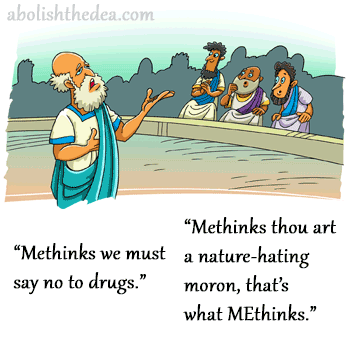
Television advertisements are clearly a kind of poetry in this Platonic sense: they employ artifice to make us feel things to be true that could very well be false. We should therefore not view the potential harm from modern advertising as a merely modern concern, but rather approach the problem as a potential evil about which Socrates himself was aware.
Only a pathological puritan would say that there's no place in the world for substances that lift your mood, give you endurance, and make you get along with your fellow human being. Drugs may not be everything, but it's masochistic madness to claim that they are nothing at all.
There would be almost no relapses for those trying to get off drugs if all drugs were legal. Then we could use a vast variety of drugs to get us through those few hours of late-night angst that are the bane of the recidivist.
Americans are starting to think that psychedelics may be an exception to the rule that drugs are evil -- but drugs have never been evil. The evil resides in how we think, talk and legislate about drugs.
My depression would disappear overnight if religiously intolerant America would just allow me to live as freely as Benjamin Franklin.
The U.S. Congress considered the following to be a scientific fact back in 1924:
"A person taking narcotics regularly impedes evolutionary progress and tends to degenerate backwards toward the brute." -- Richmond Hobson
So he writes about the mindset of the deeply depressed, reifying the condition as if it were some great "type" inevitably to be encountered in humanity. No. It's the "type" to be found in a post-Christian society that has turned up its scientific nose at psychoactive medicine.
Drug Prohibition is a crime against humanity. It outlaws our right to take care of our own health.
If we can go overseas to burn poppy plants, then Islamic countries should be free to come to the United States to burn our grape vines.
The press once again hauls out the easy answer. Reiner's son was using drugs! Aha! Of course, that explains EVERYTHING! [sigh]
Americans believe scientists when they say that drugs like MDMA are not proven effective. That's false. They are super effective and obviously so. It's just that science holds entheogenic medicines to the standards of reductive materialism. That's unfair and inappropriate.
Unless otherwise indicated, no AI is used in the creation of site content. These essays represent the original ideas of their author and not the ideas that the author SHOULD have based on an algorithmic parsing of existing data. For more on this subject, consider the AI-related viewpoints to which the author subscribes as delineated in the New York Times opinion piece entitled "What 370,000 College Essays Tell Us About A.I.’s Effects on Creativity" by Rebecca Winthrop of the Brookings Institution.