







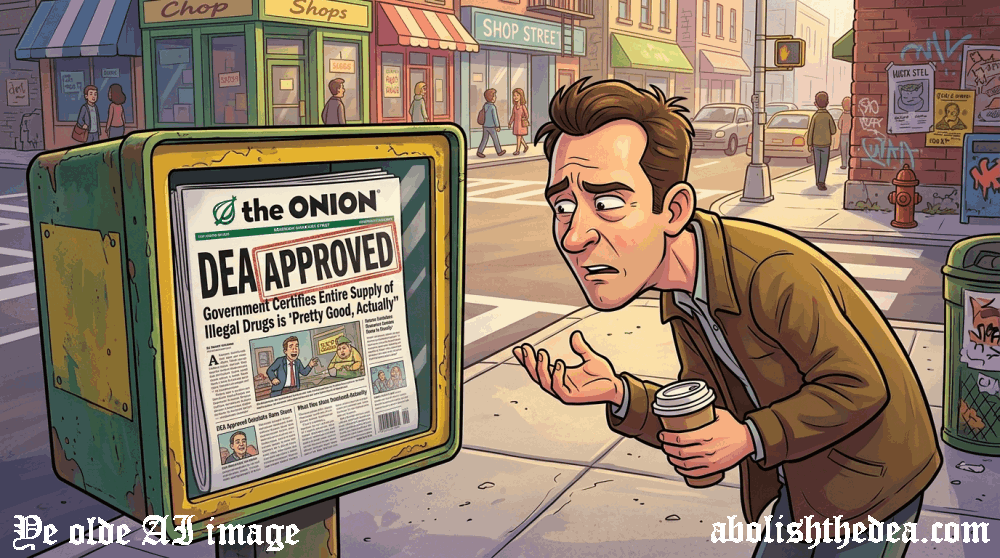
 If you want evidence of America's bamboozlement about drugs, consider the fact that even the famously irreverent Onion will not dare to suggest that drugs like cocaine and opium have positive uses. In the 2001 book "Dispatched from the Tenth Circle," the word "drugs" is typically used as a synonym for marijuana1. There is no attempt to suggest that all substances have potential positive uses for somebody, at some dose, in some circumstance. The untenable premises of drug prohibition are never questioned. And we've seen this reticence before on the part of satirists. It is the same "kid gloves" that the producers of Clerks II later brought to the subject of drug testing in 2006, when they mocked their characters' attitudes toward drug testing, but not the unconstitutionally invasive protocol of drug testing itself. Even our "bravest" social critics get weak knees when it comes to satirizing drug prohibition, and so we have a dearth of pushback on the comic front (a fact which, I feel, justifies my occasional forays into comedy on this website). I will attempt to remedy this shortcoming today for The Onion by suggesting a variety of satirical headlines and stories that should appear in their newspaper whenever they finally acquire a backbone on this topic. My goal here is not to submit these particular headlines and stories of mine for publication -- I'm sure that the staff can write funnier copy than I can. My goal is simply to suggest a whole class of satirical stories that The Onion should start writing at long last if they wish to change minds about drug prohibition -- rather than to continue simply titillating stoners by participating in the implicitly racist practice of normalizing the use of one single solitary psychoactive substance alone -- namely, the go-to drug of white American young people called marijuana.
Late last night, a SWAT team slammed and banged their way into the house of a local interior designer, Armand Redclear Hughes, where they discovered a cabinet-sized stash of mind-enhancing medicines which sources say could have kept their owner out of behavioral health clinics for an entire lifetime if only they were used wisely. Hughes was not available for comment, as he was recovering from repeated kicks to his head and groin, but prosecutors say he will have a lot to answer for should he ever come out of his coma. "People like Hughes have this crazy notion that they can take care of their own health as they see fit," says DA Hughes Jay Hardiman. "The County begs to differ. It's my job to make examples of such low-lives. I'm working with the county fair to place this clown in a dunking booth draped with a big flashy banner reading: 'I tried to take care of my own health. Punish me!"
Electrician Richard Huzz Blaine of San Diego, California, got a new lease on life yesterday after inhaling nitrous oxide. "The experience left me with the firm belief," said Richard, "that there is more to life than we can understand from our standpoint here-below, and that suicide is a silly copout. The experience convinced me that life has meaning, somehow, someway, and that we should study these mystic experiences, not shrink from them in timidity and pessimism." When asked to elaborate on that statement, Blaine referred this reporter to the following quotation from William James as being representative of his, Blaine's, new outlook on life.
A team of psychiatric scientists at the New Orleans School of Medicine published a paper today in the incredibly respectable Journal of Human Behavior in which they reminded the depressed that the mood elevation that they claim to feel after using psychoactive substances like phenethylamines, tryptamines, laughing gas, cocaine and opium is imaginary. "They can tell me that they are happy till they are blue in the face," says leading researcher Pam Bitkins Raythorn III, "but our monitoring of their brain chemistry tells another story." Raythorn reminds drug users that there are specific biochemical pathways that psychoactive substances must employ in order to qualify as antidepressants and that she has yet to find so much as one outlawed substance that has been shown to jump through the required hoops."
Ever since workplace drug testing was first instigated by Ronald Reagan in the 1980s, the enemies of the policy have been suspected of having something to hide. Anyone who refuses to take a drug test has been assumed to be a user who simply does not want to be caught but who seeks to disguise their motive for refusal with high and mighty talk about human rights and the sovereignty of the body, etc. etc. But a scientist at the University of Omaha has recently hypothesized the existence of another far more sinister motive behind the refusal to take a drug test, especially a test that searches, not just for present impairment, but also for mere traces of any psychoactive substances in the urine whatsoever, the finding of which could result in termination of employment for the urinator in question. "It may actually be," says Stanford ethnobotanist Ruth Packard Stansen, "that many of these dissenters are actually motivated by first principles that they trace back to the US Constitution, in which case the threat that they pose to society is obvious." Some scientists disagree. Epidemiologist Mark Hewitt DeClancey, also of Stanford, says Stansen is overreacting. "The battle for drug testing was won back in the '80s when community groups around the country met in school gymnasiums and town halls to say in effect, 'Our digestive systems are open for government inspection and Constitutional principles be damned! Just tell us where and when to urinate, and we will come across with the goods. We have nothing to hide!'" DeClancey admitted however under cross-examination by this reporter that an occasional thinker with an open mind could theoretically arise and push back against the whole idea of drug testing. "But that naysayer," quoth he, "would be ignored today exactly like Dr. Miles J. Bennell was ignored in the 1950s version of 'The Invasion of the Body Snatchers' -- the original one with the tragic ending, I mean, not the one with the happy ending that the studio imposed on the film at the last minute for fear of bumming everybody out."
In a rare show of vocational unanimity, thirty of America's top medical ethicists published a paper today in the journal Science insisting that it is more ethical for the severely depressed to be killed by the state than for them to make their peace with depression with the help of outlawed substances. Despite the seemingly controversial nature of the proclamation, Heather Dan Speers, spokesperson for Medical Ethicists Who Hate Drugs Just As Much As You Do, says that the paper is really "just the codification of the de facto status quo when it comes to assisted suicide for the depressed. Take the current case of the depressed Claire Brosseau, for instance: I think I speak for ethicists everywhere when I say that we would rather see her die with the help of the state than to see her using drugs. I've already purchased a ticket for the execution, assuming that Brosseau wins her right to die. I want to be there to praise her for putting death ahead of drug use. That's so amazingly patriotic of her. Any of us can say no to drugs, but it takes a real angel to place even death itself ahead of drugs. If there was a Church of Drug Hating, she would become the first saint."
Police have taken a local woman in for questioning after an anonymous source accused her of supporting the racist and destructive policy of drug prohibition. Police believe the suspect, whose name is being held pending charges, has been active for years as part of a ring of op-ed letter writers who constantly hold drug use to safety standards that they would never apply to any other risky activity on earth: not to mountain climbing, not to skateboarding, and definitely not to beer drinking or driving automobiles. "Their MO is always the same," says Police Chief Kim Fensterbaron. "They feel that they have to find just one person who was negatively affected by drug use and they think that they've got a knock-down argument against drug re-legalization. Or else they'll point to supposed problems with drugs that were actually caused by drug prohibition itself, with its refusal to educate and to regulate product as to quality, quantity, dose and even identity." Police urge the community to call the tip hotline if they spy anyone spouting Drug Warrior claptrap or having truck with terrorist organizations such as DARE and the Partnership for a Drug Free America. "Such groups," according to Chief Fensterbaron, "have supported policies that have destroyed inner cities around the globe and indoctrinated children in the drug-hating religion of Christian Science."
Today's Washington Post reports that "opioid pills shipped" DROPPED 45% between 2011 and 2019..... while fatal overdoses ROSE TO RECORD LEVELS! Prohibition is PUBLIC ENEMY NUMBER ONE.
We've all been taught since grade school that human beings cannot use psychoactive medicines wisely. That is a defeatest lie. It's criminal to keep substances illegal that can awaken the mind and remind us of our full potential in life.
I knew all along that Measure 110 in Oregon was going to be blamed for the problems that the drug war causes. Drug warriors never take responsibility, despite all the blood that they have on their hands.
What bothers me about AI is that everyone's so excited to see what computers can do, while no one's excited to see what the human mind can do, since we refuse to improve it with mind-enhancing drugs.
The so-called opiate crisis is really a drug prohibition crisis.
This is why it's wrong to dismiss drugs as "good" or "bad." There are endless potential positive uses to psychoactive drugs. That's all that we should ask of them.
It's disgusting that folks like Paul Stamets need a DEA license to work with mushrooms.
This is why "rock stars" use drugs: not just for performance anxiety (which, BTW, is a completely UNDERSTANDABLE reason for drug use), but because they want to fully experience the music, even tho' they may be currently short on money and being hassled by creditors, etc.
Mad in America publishes stories of folks who are disillusioned with antidepressants, but they won't publish mine, because I find mushrooms useful. They only want stories about cold turkey and jogging, or nutrition, or meditation.
If media were free in America, you'd see documentaries about people using drugs wisely for a wide variety of praiseworthy purposes.


 (up)