I invite you to read more of my essays to understand my position. I think everyone must remember in discussing this matter that the media has refused to show us any positive drug use — and, in fact, it is almost illegal to talk about beneficial drug use. Also, westerners know almost nothing about drugs except that they are supposed to fear them. Those who actually study the reality will find that there are endless possibilities of drugs. You are correct that you won’t find any of these “approved” by science, but science cannot even figure out if laughing gas could help the depressed, something that even a child would know
17.
Why not? Because they have a materialist view of cures — they refuse to consider simple psychology and instead insist that efficacy be established by looking under a microscope. The point is not that cocaine or any specific phenethylamine or tryptamine or even laughing gas would work for everybody. The point is that we should find out for whom they do work and in what way — and then publicize those results as “best practices.” We should spend some of the $50 billion that we spend on arresting people
18 on educating them about safe drug use and best practices. We should find those categories of people that may overdo on drugs like cocaine and suggest other medicines for them that could help them without encouraging their addictive tendencies. The alternative is to keep arresting people and busting heads. By keeping cocaine illegal, we are causing a civil war in Mexico that has killed hundreds of thousands of people and disappeared over 60,000
19 and destroyed the rule of law in Latin America, while turning inner cities into war zones
20.
We must look at the long run. How is the west going to deal with the fact that the world is full of psychoactive medicines and will have more of them almost every day? How are we going to deal with this fact in 20 years, in 50 years, in 5,000 years? Do we do it till the crack of doom by scaring people, breaking down doors, censorship, and denying jobs to those who use substances of which beer-belly politicians disapprove? Do we spread our prohibition ideology to the universe? Do we impose our Christian Science Sharia on the first inhabitable planet that we come across in a neighboring galaxy? Or do we do it by admitting that no drugs are good or bad and that the only evil is unwanted dependency — and that this can only be ended by giving people information about best practices as well as customized suggestions for getting the results that they wish from the drug use that makes sense for them, to the extent, of course, that any drug use does "make sense" for them, at least as they define that term.
But America won’t go there. Why not? Because the entire mental health system DEPENDS on unwanted dependency on Big Pharma drugs, some of which (as I know) are harder to kick than heroin
21 22. I believe that antidepressants are more dangerous than cocaine. Cocaine can be “beat” for those who misuse it — antidepressants cannot. Also, as a depressed patient, I respectfully protest the implicit belief of the Drug Warriors that the only stakeholders in this debate are worried parents. Why should I have to go without a godsend for depression recommended by Sigmund Freud himself because a minority cannot use it wisely?
Alcohol kills 178,000 a year and the city gutters are full of abusers of the drug, but alcohol is legal because people realize that it has good effects for many
23. Yet no one asked the depressed what they thought about cocaine, an alkaloid from the divine plant of the Inca. But the worst thing is, the Drug War is imperialistic. I cannot even move to a country that does not demonize drugs because America has blackmailed the entire world into taking a jaundiced view of Mother Nature’s medicines.
And now this demonization has a body count. Depressed Canadian Claire Brosseau is asking for the right to commit suicide with the help of the state
24. I say that it is evil not to allow her to use drugs like cocaine and phenethylamines. And anyone who thinks that this can only lead to addiction, with all due respect, is not familiar with the state of the art in pharmacology and ethnobotany. In any case, addiction is actually better than death, something that Drug Warriors do not understand.
Scientists are part of the problem.
They see no benefits in drugs because they judge drugs by molecules, not by psychological common sense. The problem is that Americans refuse to consider the depressed to be stakeholders. While everyone’s worrying about the young person on TV who is featured in a documentary about drug abuse, no one is worried about the MILLIONS of depressed that suffer in silence behind closed doors because self-interested doctors demonized the drug for obvious financial reasons. My point is this: drugs are not — and have never been — the problem.
Social policy is the problem. When we teach fear and arrest users and censor drug news to feature only death and destruction, that is not a free society. If my policy should make me responsible for those young people whom we see on TV misusing a drug like cocaine, then the Drug Warrior should take responsibility, for their part, for the millions who suffer in silence behind closed doors from an unnecessary depression.
They should take responsibility for the end of the rule of law in Latin America and for the hundreds of thousands that have been killed in Mexico and for the fact that Mexican officials have been corrupted by cartels
25. They should take responsibility for the murder on the high seas in which the Trump regime is engaging in order to fight an insane war against the medical bounty of a plant that the Inca considered to be divine. Finally, they must take responsibility for the end of democracy in America, since Trump only won because of the outlawing of cocaine, which helps throw 1.4 million Americans in prison every year
26, removing them from the voting rolls and thus throwing elections to tyrants. But thank you for your feedback.
I encourage you to consider the possibility that you have been lied to all your life about drugs and that you might feel very differently in a world in which the media actually covered beneficial drug practices. This, by the way, is just the tip of the iceberg for why we need to re-legalize Mother Nature. We cannot have a democracy without it. The proof is extant.
Drug prohibition is a corrosive lye when it comes to American freedoms. It destroys every democratic freedom that it comes in contact with, as our corrupt right-wing judges tell us that the Constitution itself no longer applies in cases involving drugs.
AFTERWORD
Again, I greatly appreciate all feedback. That said, however, it is depressing when I learn through such comments that intelligent people can’t see what to me are the obvious psychological benefits to the use of the kinds of substances that have inspired entire religions. It reminds me of how far Americans have to go before they will find a drug policy that is consistent with human freedom and democracy. The first step is education. Americans have to be directed toward, and urged to read, those few books that educate about drugs rather than inspiring fear.
/newpics/778.png
Unfortunately, these books are rare in the west, and even some of the best are filled with western biases that would have been unintelligible to indigenous people. So no wonder people are bamboozled. Just go into a library and ask the librarian where to find a section on beneficial drug use. She will suddenly turn into a robot and declaim as follows, in a robotic voice, no less:
What could you possibly mean, human? Everybody knows that there is no such thing as beneficial drug use. Beep. No such thing. Beep. No such thing. Beep.
I need to be patient, reminding myself how thoroughly the knowledge in question has been suppressed in the west. But I sometimes feel like a Shakespearean expert who receives emails from students saying that they hear that Shakespeare is boring and that, as far as they can see, this seems to be the case. I feel like saying: “Well, let’s not start a discussion yet about the supposed soporific aspect of Shakespeare’s oeuvre, not before we’ve all first at least read his works and maybe attended a class or two on the subject. Otherwise, we will just be discussing how we “feel” about the subject. I apparently feel differently than you do, but that tells us nothing about the price of tea in China.
My concern is this: that if the concerned individual simply responds to the effect that “I think you’re wrong,” we end up arguing like two kids, shouting first “Is too!” and then “Is not!” We both must be aware of the same background history before we can meaningfully debate a topic.
Notes for essay entitled To the Unconvinced: an open letter to those who have yet to see the benefits of common-sense drug use:
1:
The Truth About Opium by William H. Brereton DWP
(up)2:
“Confessions of an English Opium-Eater.” 2019. Gutenberg.org. 2019. https://www.gutenberg.org/files/2040/2040-h/2040-h.htm. (up)3:
A Philosophical Review of "The Varieties of Religious Experience"-- How William James failed to connect the dots DWP
(up)4:
“The Varieties of Religious Experience : William James : Free Download, Borrow, and Streaming : Internet Archive.” 2021. Internet Archive. 2021. https://archive.org/details/the-varieties-of-religious-experience_202109. (up)5:
“Soma: The Nectar of the Gods.” n.d. History of Ayurveda. https://www.historyofayurveda.org/library/soma. (up)6:
“The Project Gutenberg EBook of Coca and Its Therapeutic Application, by Angelo Mariani.” 2026. Gutenberg.org. 2026. https://www.gutenberg.org/files/48328/48328-h/48328-h.htm. (up)7:
Szasz, Thomas. 1992. Our Right to Drugs. Praeger. (up)8:
Shulgin, Alexander T, and Ann Shulgin. 2019. Pihkal : A Chemical Love Story. Berkeley, Ca: Transform Press. (up)9:
“Erowid Online Books : ‘TIHKAL’ - The Continuation’ by Alexander and Ann Shulgin.” 2015. Erowid.Org. https://www.erowid.org/library/books_online/tihkal/tihkal.shtml. (up)10:
Plants of the Gods: Their Sacred, Healing, and Hallucinogenic Powers Schultes, Richard, 1979
(up)11:
Madder in America DWP
(up)12:
Richard Louis Miller. 2017. Psychedelic Medicine : The Healing Powers of LSD, MDMA, Psilocybin, and Ayahuasca. Rochester, Vermont: Park Street Press. (up)13:
Heroin versus Antidepressants DWP
(up)14:
Miller, Richard L. 1996. Drug Warriors and Their Prey. Praeger. https://www.goodreads.com/book/show/594749.Drug_Warriors_and_Their_Prey. (up)15:
Arthur Crowley. “Full Text of ‘the Diary of a Drug Fiend.’” 1922. Archive.org. 2017. https://archive.org/stream/b29826433/b29826433_djvu.txt. (up)16:
Forbidden Quotations about the beneficial use of drugs DWP
(up)17:
Glatter, Robert. 2021. “Can Laughing Gas (Nitrous Oxide) Help People with Treatment-Resistant Depression?” Forbes, June 9, 2021. https://www.forbes.com/sites/robertglatter/2021/06/09/can-laughing-gas-nitrous-oxide-help-people-with-treatmentresistant-depre (up)18:
“War on Us – the War on Drugs Is a War on All of Us.” 2019. Waronus.com. 2019. http://waronus.com/. (up)19:
Mexico's war on drugs: More than 60,000 people 'disappeared' 2020
(up)20:
ThriftBooks. 2026. “Drug War Capitalism.” ThriftBooks. 2026. https://www.thriftbooks.com/w/drug-war-capitalism/9217021/?resultid=e8667266-257a-41bf-83e3-78200e3527f3#edition=8539401&idiq=10283063. (up)21:
Hall, Wayne, and Megan Weier. 2016. “Lee Robins’ Studies of Heroin Use among US Vietnam Veterans.” Addiction 112 (1): 176–80. https://doi.org/10.1111/add.13584. (up)22:
Heroin versus Antidepressants DWP
(up)23:
CDC. 2024. “Facts About U.S. Deaths from Excessive Alcohol Use.” Alcohol Use. July 8, 2024. https://www.cdc.gov/alcohol/facts-stats/?CDC_AAref_Val=https://www.cdc.gov/alcohol/features/excessive-alcohol-deaths.html. (up)24:
Nolen, Stephanie, and Chloë Ellingson. 2025. “Claire Brosseau Wants to Die. Will Canada Let Her?” The New York Times, December 29, 2025. https://www.nytimes.com/2025/12/29/health/assisted-death-mental-illness-canada.html. (up)25:
Miller, Richard L. 1996. Drug Warriors and Their Prey. Praeger. https://www.goodreads.com/book/show/594749.Drug_Warriors_and_Their_Prey. (up)26:
“War on Us – the War on Drugs Is a War on All of Us.” 2019. Waronus.com. 2019. http://waronus.com/. (up)
read more essays here
Ten Tweets
against the hateful war on US

The Drug War brought guns to the "hoods," thereby incentivizing violence in the name of enormous profits. Any site featuring victims of gun violence should therefore be rebranded as a site featuring victims of the drug war.
Folks point to the seemingly endless drugs that can be synthesized today and say it's a reason for prohibition. To the contrary, it's the reason why prohibition is madness. It results in an endless game of militaristic whack-a-mole at the expense of democratic freedoms.
"In consciousness dwells the wondrous, with it man attains the realm beyond the material, and the peyote tells us where to find it." --Antonin Arnaud
If politicians wanted to outlaw coffee, a bunch of Kevin Sabets would come forward and start writing books designed to scare us off the drink by cherry-picking negative facts from scientific studies.
SSRIs are created based on the materialist notion that cures should be found under a microscope. That's why science is so slow in acknowledging the benefit of plant medicines. Anyone who chooses SSRIs over drugs like San Pedro cactus is simply uninformed.
There would be little or no profiling of blacks if the Drug War did not exist.
Health is not a quality, it's a balance. To decide drug legality based on 'health' grounds thus opens a Pandora's box of different points of view.
Someday, the First Lady or Man will tell kids to "just say no to prohibition." Kids who refuse will be required to watch hours' worth of films depicting gun violence, banned religions, civil wars, and adults committing suicide for want of medicine that grows at their very feet.
Classic prohibitionist gaslighting, telling me that "drugs" is a neutral term. What planet are they living on?
According to Donald Trump's view of life, Jesus Christ was a chump. We should hate our enemies, not love them.
Click here to see All Tweets against the hateful War on Us


Break the ice with a sledgehammer: place this book on your coffee table.
This book features 150 annotated images, designed to force brainwashed Americans to confront the fact that drug prohibition is wrong. Here is what author Richard Parrish II says of the book's compiler: "The drug prohibition philosopher provides first-hand, principled, persuasive, and insightful arguments against the current drug prohibition regime..."
Purchase Your Copy
Diary of a Drug Fiend
This is the only full-cast recording of Aleister Crowley's 1922 classic paeon to common sense. It is the first book -- and so far almost the only book -- to stake out a philosophy of drug use that is compatible with human freedom, one in which we learn to use drugs as wisely as possible for the benefit of humanity. This recording was produced by the Drug War Philosopher and your purchases help support his effort to push back against the tragically counterproductive policy of drug prohibition, in the name of human freedom and of humanity's right to heal.
Purchase Your Copy
No cookies, no ads paid for by amoral and immoral billionaires (or trillionaires).

Unless otherwise indicated, no AI is used in the creation of site content. These essays represent the original ideas of their author and not the ideas that the author SHOULD have based on an algorithmic parsing of existing data. For more on this subject, consider the AI-related viewpoints to which the author subscribes as delineated in the New York Times opinion piece entitled
"What 370,000 College Essays Tell Us About A.I.’s Effects on Creativity" by Rebecca Winthrop of the Brookings Institution.
Copyright 2026, Brian Ballard Quass
Contact: quass@quass.com
 (up)
(up)







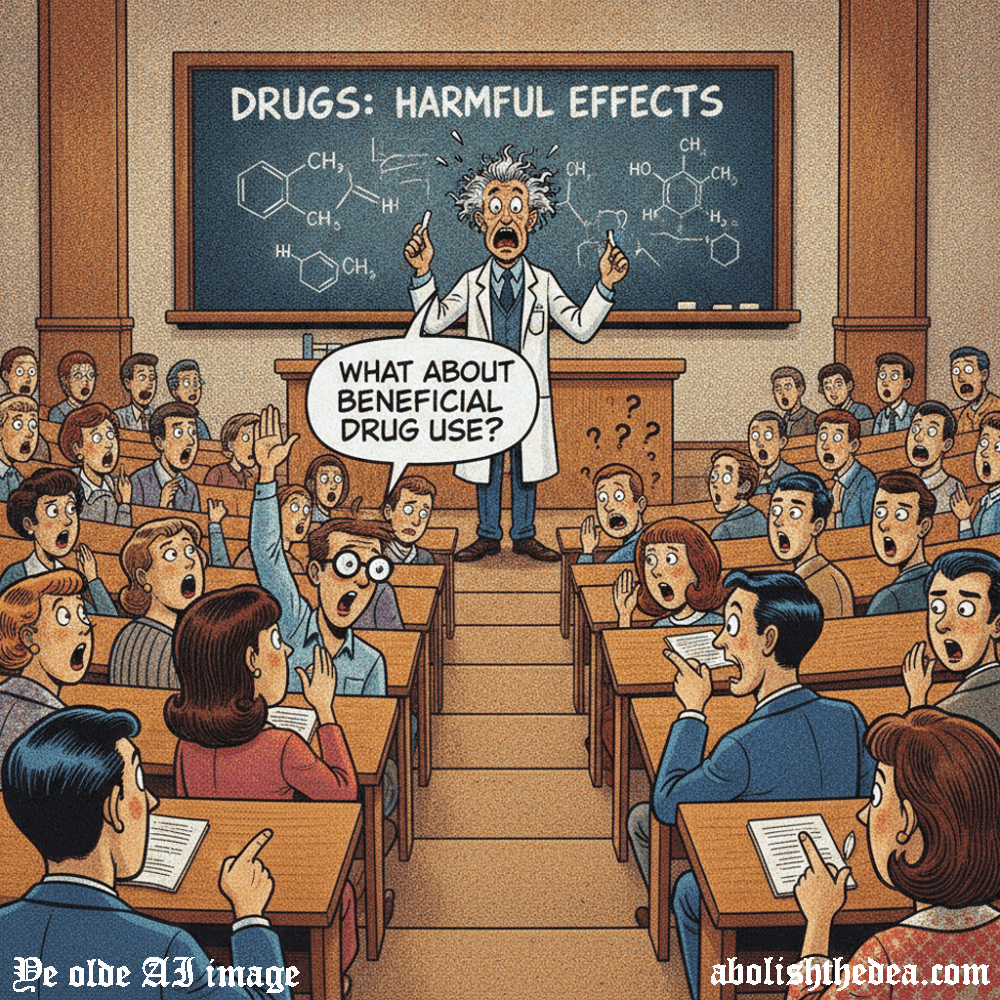 This morning, I received a comment from a subscriber whom I'll refer to here as LB. I am sure that LB speaks for many westerners when he questions the wisdom of using “drugs” for emotional benefit. I wrote a quick response which I have pasted below, but first I wanted to observe that our modern “scientific” approach to drugs does not consider common sense. I can tell you right now that my depression would be over this minute if I could, say, smoke an opium pipe once a week to fully enjoy an opera on television1 2, and then use laughing gas once a week to continue the studies that William James himself recommended for philosophers in order to understand the nature of perception, the mind, the brain and human consciousness3 4.