








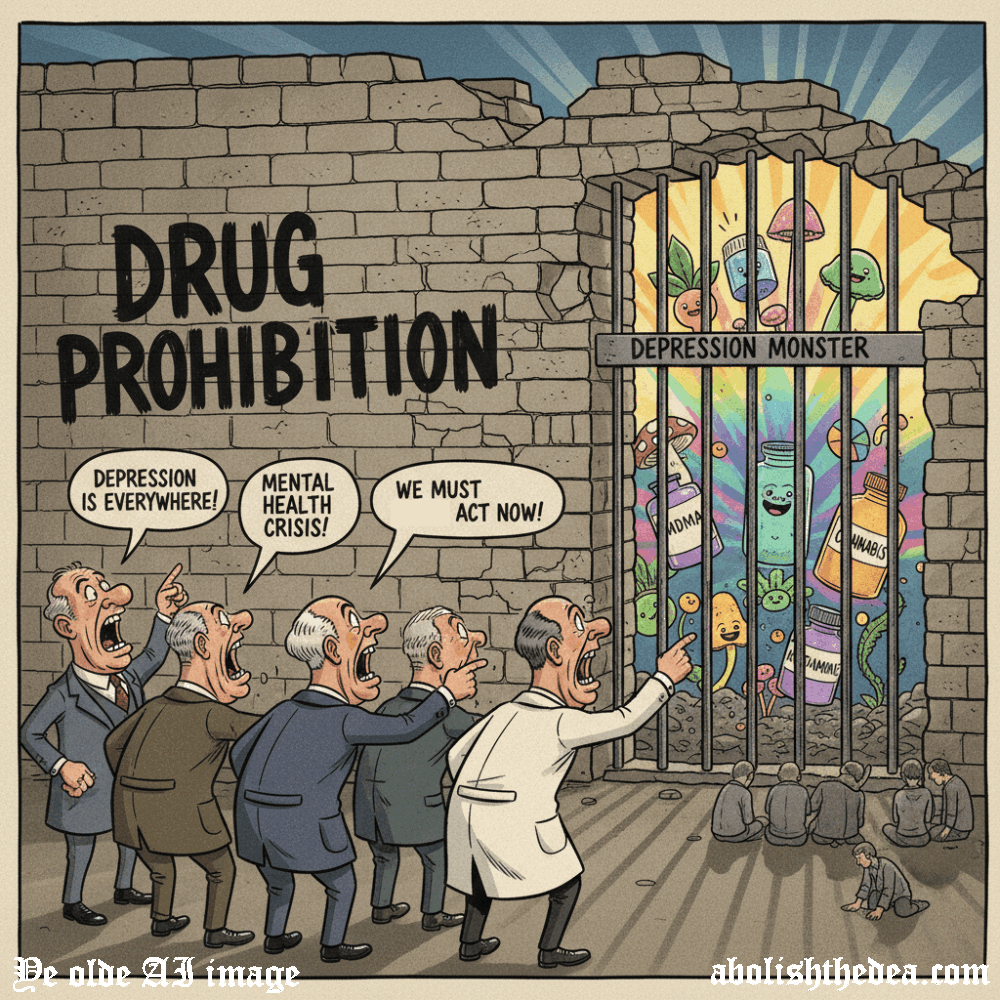
 If I had a little more guts and a lot more money, I would have named my Substack "Madder in America," to succinctly express my frustration with organizations like "Mad in America" 1 which purport to speak for me as a depressed patient. The "Mad in America" website and organization, for those who may not know, was created by reporter Robert Whitaker, author of the eponymous 2010 bestseller, "to serve as a catalyst for rethinking psychiatric care in the United States (and abroad)." Or so says the non-profit's mission statement. A close look at their website, however, reveals that Robert and his group of "experts" on my depression actually have definite limits to the kinds of rethinking that they are prepared to catalyze. A more honest mission statement would read: "to serve as a catalyst for rethinking psychiatric care in the United States (and abroad) in ways that do not question the status quo according to which all uplifting drugs have been outlawed and self-interested academics and doctors have been dubbed the experts on the minds and moods of strangers."
The Drug War is one big entrapment scheme for poor minorities. Prohibition creates an economy that hugely incentivizes drug dealing, and when the poor fall for the bait, the prohibitionists rush in to arrest them and remove them from the voting rolls.
Why does no one talk about empathogens for preventing atrocities? Because they'd rather hate drugs than use them for the benefit of humanity. They don't want to solve problems, they prefer hatred.
Harm Reduction is not enough. We need Benefit Production as well. The autistic should be able to use compassion-enhancing drugs; dementia patients should be able to use drugs that speed up and sharpen mental processes.
John Halpern wrote a book about opium, subtitled "the ancient flower that poisoned our world." What nonsense! Bad laws and ignorance poison our world, NOT FLOWERS!
If the depressed patient laughs, that means nothing. Materialists have to see results under a microscopic or they will never sign off on a therapy.
His answer to political opposition is: "Lock them up!" That's Nazi speak, not American democracy.
Many articles in science mags need this disclaimer: "Author has declined to consider the insights gained from drug-induced states on this topic out of fealty to Christian Science orthodoxy." They don't do this because they know readers already assume that drugs will be ignored.
Rick Strassman reportedly stopped his DMT trials because some folks had bad experiences at high doses. That is like giving up on aspirin because high doses of NSAIDs can kill.
The DEA has done everything it can to keep Americans clueless about opium and poppies. The agency is a disgrace to a country that claims to value knowledge and freedom of information.
No substance is bad in and of itself. Fentanyl has positive uses, at specific doses, for specific people, in specific situations. But the drug war votes substance up or down. That is hugely anti-scientific and it blocks human progress.
If I had a little more guts and a lot more money, I would have named my Substack "Madder in America," to succinctly express my frustration with organizations like "Mad in America" 1 which purport to speak for me as a depressed patient. The "Mad in America" website and organization, for those who may not know, was created by reporter Robert Whitaker, author of the eponymous 2010 bestseller, "to serve as a catalyst for rethinking psychiatric care in the United States (and abroad)." Or so says the non-profit's mission statement. A close look at their website, however, reveals that Robert and his group of "experts" on my depression actually have definite limits to the kinds of rethinking that they are prepared to catalyze. A more honest mission statement would read: "to serve as a catalyst for rethinking psychiatric care in the United States (and abroad) in ways that do not question the status quo according to which all uplifting drugs have been outlawed and self-interested academics and doctors have been dubbed the experts on the minds and moods of strangers."
The Drug War is one big entrapment scheme for poor minorities. Prohibition creates an economy that hugely incentivizes drug dealing, and when the poor fall for the bait, the prohibitionists rush in to arrest them and remove them from the voting rolls.
Why does no one talk about empathogens for preventing atrocities? Because they'd rather hate drugs than use them for the benefit of humanity. They don't want to solve problems, they prefer hatred.
Harm Reduction is not enough. We need Benefit Production as well. The autistic should be able to use compassion-enhancing drugs; dementia patients should be able to use drugs that speed up and sharpen mental processes.
John Halpern wrote a book about opium, subtitled "the ancient flower that poisoned our world." What nonsense! Bad laws and ignorance poison our world, NOT FLOWERS!
If the depressed patient laughs, that means nothing. Materialists have to see results under a microscopic or they will never sign off on a therapy.
His answer to political opposition is: "Lock them up!" That's Nazi speak, not American democracy.
Many articles in science mags need this disclaimer: "Author has declined to consider the insights gained from drug-induced states on this topic out of fealty to Christian Science orthodoxy." They don't do this because they know readers already assume that drugs will be ignored.
Rick Strassman reportedly stopped his DMT trials because some folks had bad experiences at high doses. That is like giving up on aspirin because high doses of NSAIDs can kill.
The DEA has done everything it can to keep Americans clueless about opium and poppies. The agency is a disgrace to a country that claims to value knowledge and freedom of information.
No substance is bad in and of itself. Fentanyl has positive uses, at specific doses, for specific people, in specific situations. But the drug war votes substance up or down. That is hugely anti-scientific and it blocks human progress.


 (up)
(up)