A remedial course on drug benefits for medical ethicists and healthcare majors
by Brian Ballard Quass, the Drug War Philosopher
April 28, 2026
Every time I read about drug benefits, I am stunned anew at the world in which we live today: a world in which our experts on healthcare and ethics profess to see no connection between the subject of assisted suicide for the depressed and the fact that our society has outlawed all substances that inspire and elate. And so now the state that refuses to let you use drugs to cheer yourself up will help you use drugs to kill yourself. How can our best and brightest tell me that they see no irony here?! I have written many "experts" on this subject and I have been ghosted by most. But the worst cases are when they actually answer me, because the few who do so are gaslighting me, even if they do not realize it themselves.
The only way that our "experts" can honestly disagree with me on this subject is if they really do not believe that there are indeed drugs out there that have the potential of which I speak, the potential to inspire and elate. But it never occurred to me that folks with master's degrees could be both that unworldly and that uninformed. It never occurred to me that they could be so totally uneducated when it comes to pharmacology, ethnobotany, "drug literature," the history of drug use, and just plain common sense. Even a five-year-old child can see how laughing gas could have beneficial uses for the suicidal! Why are our experts so dense on these topics?
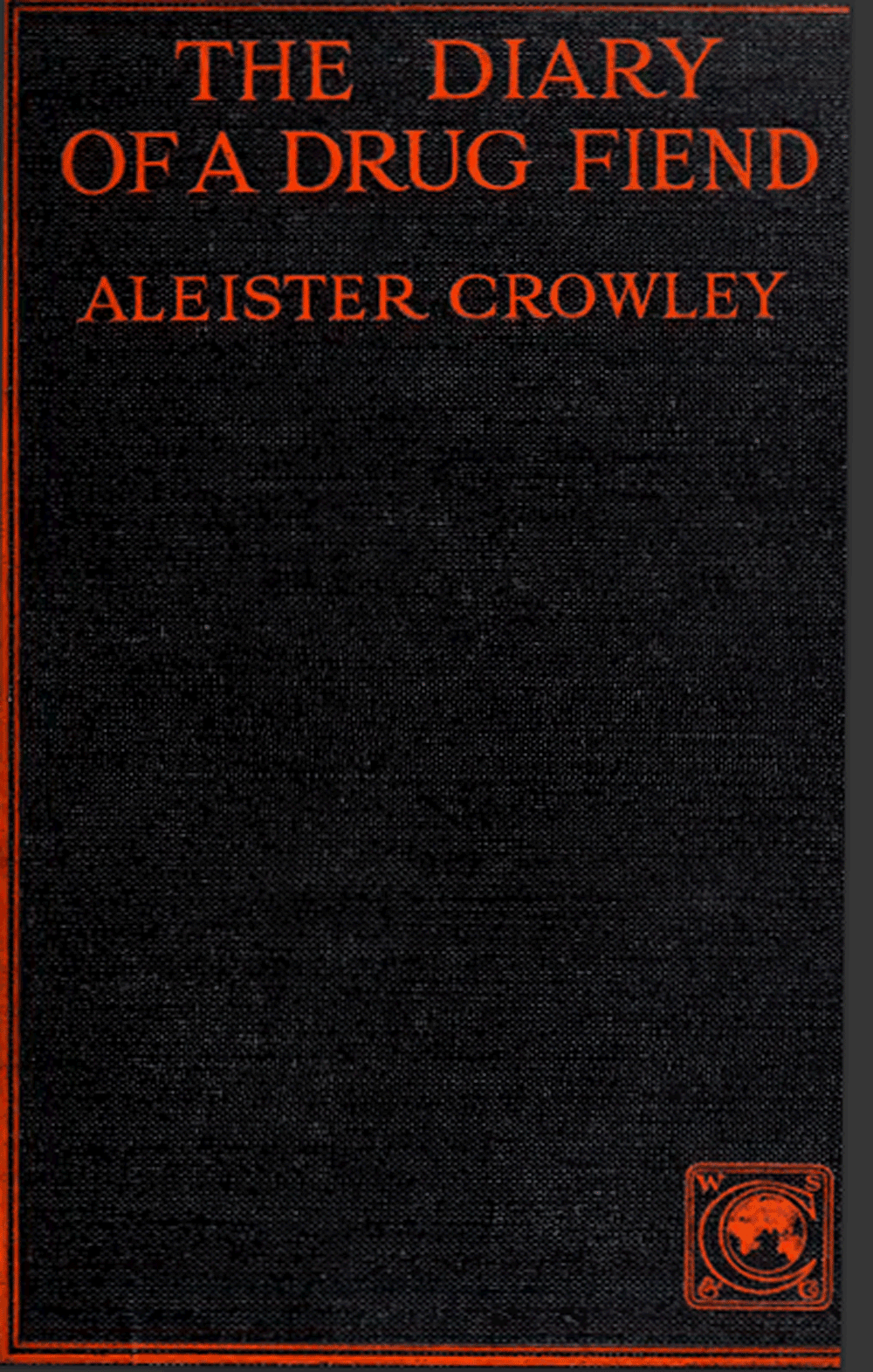
Sensing a need for remedial education here, I have taken the liberty of providing a few relevant quotes from Aleister Crowley below about the potential benefits of cocaine, the drug that our experts love to hate. Each snippet is followed by an annotation by yours truly serving to underscore and expand upon the take-away message to be gleaned by the conscientious reader. By the time our experts get through reading these, they should be smarter than a five-year-old child -- and if not, I'll give them a free lollipop as a consolation prize.
Quotes from Aleister Crowley
“The depression lifted from my mind like the sun coming out of the clouds.“
This is what the depressed World War I vet discovered after his first use of cocaine in "Diary of a Drug Fiend." And yet America's "experts" on ethics and health are discussing assisted suicide for the depressed without mentioning the fact that such drugs exist. It's insanity with a body count! See my multiple essays on this topic, starting with How organizations like Mad in America normalize drug prohibition.
“I recollected every detail with the most minute exactitude. But the most vexatious and humiliating items meant nothing to me anymore. I took the same pleasure in recalling them as one has reading a melancholy tale.”
If a Martian came to our planet and learned everything about us but our drug prejudices, they would read such a line about the use of cocaine and they would scream aloud that we must find ways to use it for our trauma victims! Then an embarrassed diplomat would have to take Zoltan aside and explain to him how we as a society believed that drugs were the devil himself and that human beings were far too childlike to ever learn how to use drugs wisely for human benefit.
“People think that talking is a sign of thinking. It isn't, for the most part ; on the contrary, it's a mechanical dodge of the body to relieve oneself of the strain of thinking, just as exercising the muscles helps the body to become temporarily unconscious of its weight, its pain, its weariness, and the foreknowledge of its doom.”
Crowley here cuts to the heart of the real psychology that behaviorists are dogmatically obliged to ignore. He sees the downsides of excessive rationality, a pathological aspect of thought that he tells us Shakespeare clearly understood given his numerous paeons to "blessed sleep" -- a time when all the words-words-words are silenced. All of us understand this insofar as we see the benefits of having a "cold one" at the end of the day. Yet psychiatrists and counselors are dogma-bound to consider drug use as inexplicable, as a cry for help, apparently having learned nothing from the popularity of alcohol in the western world. No one will dare say that the drinking habit was adopted in the west because beer was considered to be a great new taste sensation.
“While eating and breathing and going about are permitted, we shall never be a really righteous race.”
Here we see Crowley (in the persona of Peter Pendragon) mocking the thoroughly regulated society that he saw coalescing around him after his return from the tropospheric battlefield of World War I.
“We were driving in the chariot of the Sun through the circus of the Universe.”
This is a snippet from Peter Pendragon's extravagant coke-fueled inner dialogue as he was flying 'Unlimited Lou' to Paris in his seaplane -- or at least attempting to do so. I include this quotation to make a point: namely, that the benefits you can accrue from psychoactive drugs will be dependent upon a wide variety of factors, but especially upon your education level and the power of your imagination. In the words of the advertisers, the chariot and the circus are "not included," or at best they are "sold separately." If you want cocaine -- or any drug, for that matter -- to send you to fantastic places, it definitely helps to have an education and an imagination so that you can give the drug "something to work with," so to speak. The effect of psychoactive drug use is a joint effort. This is what REALLY distinguishes a drug from a "med," the fact that beneficial drug use is the result of a partnership, whereas the results of a so-called "med" are supposed to be the same whether that drug is consumed by Shakespeare or the village idiot.
“Happiness lies within one’s self, and the way to dig it out is cocaine. But don't you go and forget what I hope you won’t mind my calling ordinary prudence. Use a little common sense, use precaution, exercise good judgment.”
And yet Americans say, by their actions and inaction, that it is actually better to commit suicide than to use cocaine. This is surely the most anti-health society in the history of the world -- the first society to deny human beings their right to take care of their own health, to deny them their right to happiness and pain relief, the first society to deny them a host of drugs that inspire and elate -- a society that insists, moreover, that they are suffering from an actual disease if they cannot content themselves with this impoverished status quo brought about by the unprecedented policy of wholesale drug prohibition.
"The majority of people seem to stumble through this world without any conception of the possibilities of enjoyment. It is, of course, a matter of temperament. But even the few who can appreciate the language of Shelley, Keats and Swinburne, look on those conceptions as Utopian. Most people acquiesce in the idea that the giddy exaltation of Prometheus Unbound, for example, is an imaginary feeling. I suppose, in fact, that one wouldn’t get much result by giving heroin and cocaine, however cunningly mixed, to the average man. You can’t get out of a thing what isn’t there. " --Arthur Crowley, The Diary of a Drug Fiend1
Key Takeaways:
Laughing gas can have beneficial uses for the depressed.
Cocaine has obvious uses for the depressed.
Behaviorists ignore the downsides of thought and hence naively assume that users are pathological.
Scientists pathologize the understandable desire for the human mind to take breaks from ratiocination.
Notes for essay entitled What they didn't teach you in school: A remedial course on drug benefits for medical ethicists and healthcare majors:
Conservatives say they're against Big Government -- but they let bureaucrats decide what medicines they can use.
Question: Why do doctors judge cocaine by its worst possible use? Answer: Follow the money.
The search for SSRIs has always been based on a flawed materialist premise that human consciousness is nothing but a mix of brain chemicals and so depression can be treated medically like any other physical condition.
The Hindu religion was created thanks to the use of a drug that inspired and elated. It is therefore a crime against religious liberty to outlaw substances that inspire and elate.
Outlawing substances like laughing gas and MDMA makes no more sense than outlawing fire.
The MindMed company (makers of LSD Lite) tell us that euphoria and visions are "adverse effects": that's not science, that's an arid materialist philosophy that does not believe in spiritual transcendence.
The real value of Erowid is as a research tool for a profession that does not even exist yet: the profession of what I call the pharmacologically savvy empath: a compassionate life counselor with a wide knowledge of how drugs can (and have) been used by actual people.
Don't the Oregon prohibitionists realize that all the thousands of deaths from opiates is so much blood on their hands?
The Shipiba have learned to heal human beings physically, psychologically and spiritually with what they call "onanyati," plant allies and guides, such as Bobinsana, which "envelops seekers in a cocoon of love." You know: what the DEA would call "junk."
As such, "we" are important. The sun is just a chaos of particles that "we" have selected out of the rest of the raw data and declared "This we shall call the sun!" "We" make this universe. Consciousness is fundamental.
Break the ice with a sledgehammer: place this book on your coffee table.
This book features 150 annotated images, designed to force brainwashed Americans to confront the fact that drug prohibition is wrong. Here is what author Richard Parrish II says of the book's compiler: "The drug prohibition philosopher provides first-hand, principled, persuasive, and insightful arguments against the current drug prohibition regime..."
This is the only full-cast recording of Aleister Crowley's 1922 classic paeon to common sense. It is the first book -- and so far almost the only book -- to stake out a philosophy of drug use that is compatible with human freedom, one in which we learn to use drugs as wisely as possible for the benefit of humanity. This recording was produced by the Drug War Philosopher and your purchases help support his effort to push back against the tragically counterproductive policy of drug prohibition, in the name of human freedom and of humanity's right to heal.
No cookies, no ads paid for by amoral and immoral billionaires (or trillionaires).
Unless otherwise indicated, no AI is used in the creation of site content. These essays represent the original ideas of their author and not the ideas that the author SHOULD have based on an algorithmic parsing of existing data. For more on this subject, consider the AI-related viewpoints to which the author subscribes as delineated in the New York Times opinion piece entitled "What 370,000 College Essays Tell Us About A.I.’s Effects on Creativity" by Rebecca Winthrop of the Brookings Institution.









 Every time I read about drug benefits, I am stunned anew at the world in which we live today: a world in which our experts on healthcare and ethics profess to see no connection between the subject of assisted suicide for the depressed and the fact that our society has outlawed all substances that inspire and elate. And so now the state that refuses to let you use drugs to cheer yourself up will help you use drugs to kill yourself. How can our best and brightest tell me that they see no irony here?! I have written many "experts" on this subject and I have been ghosted by most. But the worst cases are when they actually answer me, because the few who do so are gaslighting me, even if they do not realize it themselves.


 (up)
(up)