








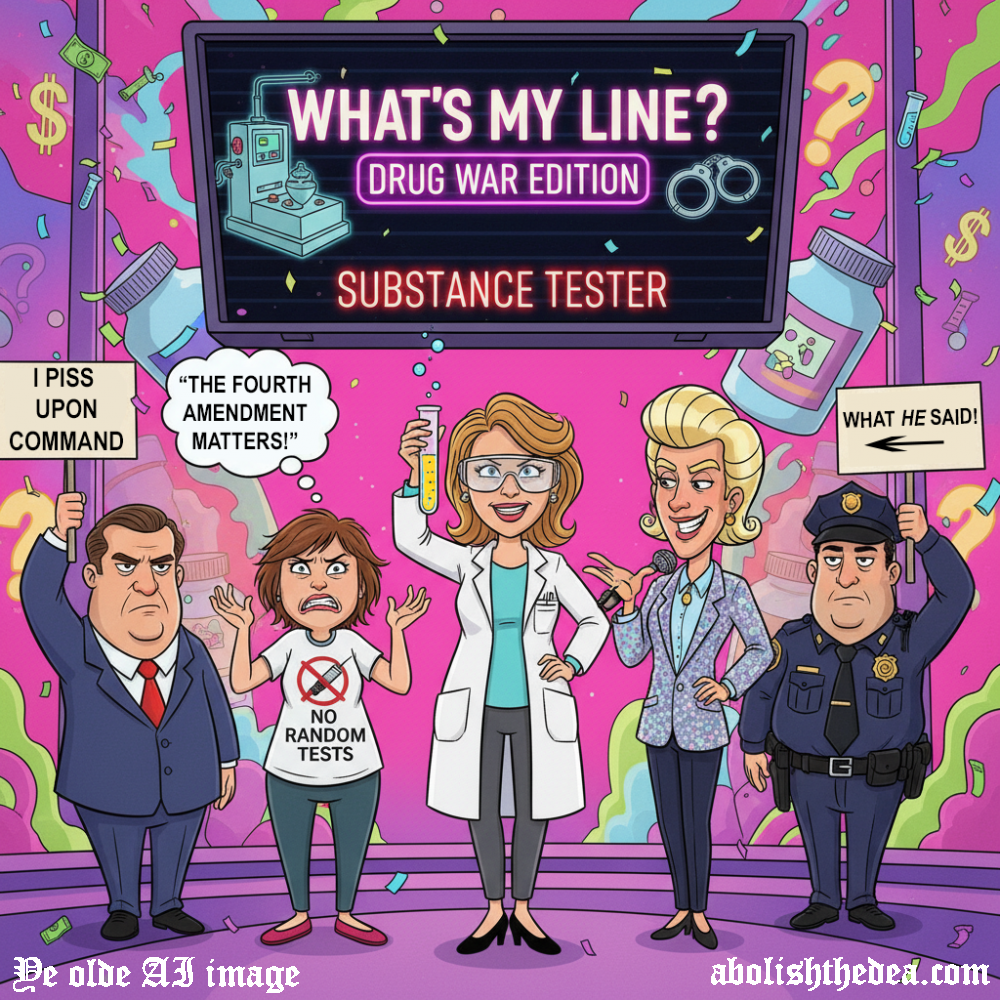
 HOST: Welcome to What's My Line?! Today's guest is someone in the biomedical field. Someone in the biomedical field. Our contestants' duty is to identify the job that he holds. Okay, guys? Let's start with the star of Celebrity Lawn Darts, Talon West. Talon, your first question, please?
Scientists hold holistically working drugs to reductionist standards, thereby practicing a sort of pharmacological colonialsm.
If the depressed patient laughs, that means nothing. Materialists have to see results under a microscopic or they will never sign off on a therapy.
The Thomas Jefferson Foundation is a drug war collaborator. They helped the DEA confiscate Thomas Jefferson's poppy plants in 1987.
The drug war is a meta-injustice. It does not just limit what you're allowed to think, it limits how and how much you are allowed to think.
There's more than set and setting: there's fundamental beliefs about the meaning of life and about why mother nature herself is full of psychoactive substances. Tribal peoples associate some drugs with actual sentient entities -- that is far beyond "set and setting."
If they're going to throw doctors in jail for prescribing too much pain medication, they should also throw them in jail for prescribing too LITTLE.
Being less than a month away from an election that, in my view, could end American democracy, I don't like to credit Musk for much. But I absolutely love it every time he does or says something that pushes back against the drug-war narrative.
Imagine if we held sports to the same safety standard as drugs. There would be no sports at all. And yet even free climbing is legal. Why? Because with sports, we recognize the benefits and not just the downsides.
I'm told that science is completely unbiased today. I guess I'll have to go back and reassess my doubts about Santa Claus and the Tooth Fairy.
I've always wondered why we don't just let heroin users be -- or better yet, re-legalize drugs and give them choices. Why are they punished for using heroin daily while we praise 1 in 4 women for taking an even more dependence-causing drug every day of their life?
HOST: Welcome to What's My Line?! Today's guest is someone in the biomedical field. Someone in the biomedical field. Our contestants' duty is to identify the job that he holds. Okay, guys? Let's start with the star of Celebrity Lawn Darts, Talon West. Talon, your first question, please?
Scientists hold holistically working drugs to reductionist standards, thereby practicing a sort of pharmacological colonialsm.
If the depressed patient laughs, that means nothing. Materialists have to see results under a microscopic or they will never sign off on a therapy.
The Thomas Jefferson Foundation is a drug war collaborator. They helped the DEA confiscate Thomas Jefferson's poppy plants in 1987.
The drug war is a meta-injustice. It does not just limit what you're allowed to think, it limits how and how much you are allowed to think.
There's more than set and setting: there's fundamental beliefs about the meaning of life and about why mother nature herself is full of psychoactive substances. Tribal peoples associate some drugs with actual sentient entities -- that is far beyond "set and setting."
If they're going to throw doctors in jail for prescribing too much pain medication, they should also throw them in jail for prescribing too LITTLE.
Being less than a month away from an election that, in my view, could end American democracy, I don't like to credit Musk for much. But I absolutely love it every time he does or says something that pushes back against the drug-war narrative.
Imagine if we held sports to the same safety standard as drugs. There would be no sports at all. And yet even free climbing is legal. Why? Because with sports, we recognize the benefits and not just the downsides.
I'm told that science is completely unbiased today. I guess I'll have to go back and reassess my doubts about Santa Claus and the Tooth Fairy.
I've always wondered why we don't just let heroin users be -- or better yet, re-legalize drugs and give them choices. Why are they punished for using heroin daily while we praise 1 in 4 women for taking an even more dependence-causing drug every day of their life?


 (up)
(up)