And we wonder why scientists today can see no benefits in the use of laughing gas by the depressed. Robots cannot enjoy laughing gas!
Fortunately for us, a seemingly representative portion of James's testimony on this subject has been preserved on page 7 of the March 7, 1898 edition of the Boston Evening Transcript.
ANNOTATIONS
on the testimony of William James at the Massachusetts State House on March 2, 1898, in opposition to a bill that would give a monopoly to physicians and surgeons in the field of healthcare.
WILLIAM JAMES: I come to protest against the bill simply as a citizen who cares for sound laws and for the advance of medical knowledge. Were medicine a finished science, with all practitioners in agreement about methods of treatment, a bill to make it penal to treat a patient without having passed an examination would be unobjectionable. But the present condition of medical knowledge is widely different from such a state. Both as to principle and as to practice our knowledge is deplorably imperfect.
Like Nagel, James is telling scientists to "get over themselves," to stop assuming that they have figured everything out, and to remain open to all possibilities.
WILLIAM JAMES: The whole face of medicine changes unexpectedly from one generation to another in consequence of widening experience, and as we look back with a mixture of amusement and horror at the practice of our grandfathers, so we cannot be sure how large a portion of our present practice will awaken similar feelings in our posterity.
If James only knew what little right we moderns would have to crow about our healing profession just over a century later. Imagine that he was beamed to 2026 America and discovered that we were treating depression by damaging brains with shock therapy and by performing lobotomies. We can hear James now: "But you have discovered and synthesized all sorts of medicines that could end depression in a trice! Why is depression still the leading cause of workplace disability according to your World Health Organization?
11" To which the triumphant physician responds: "Oh, those drugs that you mention have not yet been shown to work to the satisfaction of we scientists, James. But don't worry: if someone gets too depressed, they will soon have the right to state-assisted suicide, that's just how scientific we've become in the last century." "What?!" screams James. "You would help kill these people without letting them use inspirational medicines, the kind that have inspired the creation of entire religions, as the Soma juice inspired the creation of the Vedic faith?!" To which the scientist responds, unmoved: "You forget, Dear James, that these, ahem, 'miracle' drugs of which you speak have never been proven to work -- and, indeed, they never will be proven to work as long as physicians like myself have a mortgage payment to make! As for killing them, we're doing nothing of the kind. We're giving them euthanaaaasia... Doesn't that sound so much better than "killing them"? Now then, let me take you to the wards. I'll show you how peaceful the depressed become after a nice dose of shock therapy. I'm thinking of damaging my brain myself: they say that it does wonders for the attitude." James once described Schopenhauer as the only philosophical pessimist of note
12, but I dare say that the New England psychologist would assume that label for himself, if only by way of protest, were he to travel forward and see how resistant the scientific world of the 21st century has become to open-mindedness, common sense and even to the dictates of simple humanity.
Just wait till James finds out that merely TALKING about mind cures in our time zone is forbidden insofar as it is said to constitute the cardinal sin of giving medical advice without a license. "Verily," says James, "the medical field has taken the monopoly that they were given in the late 19th century and run with it faster and further than I myself could have possibly imagined! Not only have they maintained their hubristic claims to be the sole authority with respect to health care, but they have turned even indirect challenges to their hegemony into medical sins, including the apparently mortal sin of self-medicating, i.e., taking care of one's health while leaving the medical field out of the loop. Indeed, they have so normalized this fetish for all-powerful science," continues James in somber soliloquy, "that the medical industry of the 21st century has been able to turn 1 in 4 American women into patients for life with dependence-causing 'meds'
13 and nobody even notices the fact, let alone recognizes it for what it is, namely, the greatest mass pharmacological dystopia of modern times! Why, blast me!" James continues as he stumbles, dazed, through the breezy atrium of the 1.5 billion-dollar John Edward Porter Neuroscience Research Center in Bethesda, Maryland. "It looks like mind cures have been completely priced out of the market here. Everyone's looking for biochemical breakthroughs so that they can find a politically correct way to help the depressed without yet condescending to let them use the plant medicine that grows at their very feet!" Nor is James reassured when he reflects that he was virtually the only academic of note to push back against the triumphalist scientistic narrative of 1898, a mindset that marginalized every way of looking at human behavior except for the dry and scientific way.
WILLIAM JAMES: Do you feel called on, do you dare, to thrust the coarse machinery of criminal law into these vital mysteries, into these personal relations of doctor and patient, into these infinitely subtle operations of nature, and enact that a whole department of medical investigation (for such it is), together with the special conditions of freedom under which it flourishes must cease to be? I venture to say that you dare not, gentlemen. You dare not convert the laws of this Commonwealth into obstacles for the acquisition of truth.
Alas, they did indeed dare to do so, Will. This is apparently what happens when philosophy encounters the economic interests of the privileged class in America. Philosophy, common sense and even simple humanity come in second place to expediency and a big paycheck for monopolists. And who can blame them? Just imagine the issue from the point of view of a physician, after all: the passage of the bill in 1898 would result in the arrest of any of their competition in the mind-cure movement. Their arrest! Imagine if you worked in a field in which your competition was arrested by the police as a matter of course, merely for BEING your competition. Speaking of which, you've heard of truth in advertising; well, I think we need truth in arresting as well. The police who enforce drug laws should be required to identify themselves as Monopoly Enforcers for the Medical Industry. We might even start referring to them as MEMI when they arrest us in that capacity. Whenever a drug suspect is nabbed, they could say to themselves, "Okay, I get it. The fact that you're hassling me like this at least makes some small semblance of sense now!" There would no longer be this huge disconnect between the crime -- possessing a damn mushroom -- and the punishment -- being forced to languish for 25 years in a federal penitentiary. If we're not going to end drug prohibition, we can at least switch to this new far more interesting form of injustice. I can hear the Monopoly Enforcers now: "You're under arrest for trying to improve your life while leaving the Medical Industry out of the loop." Maybe we could even save money on prisons by allowing drug suspects to clear all charges against themselves merely by contributing, say, $1,000 to the retirement funds of the board-certified doctor of their choice, since it's obviously all about money here. "Okay," says the suspect, "I'll take the payment option, boss. I see you've got a list of area doctors there. If you've got old lady McGillicutty on that list, pencil her in for at least 500 of the thousand that I'll be paying you off with. She's been our family doctor for, like, forever."
WILLIAM JAMES: Above all things, Mr. Chairman, let us not be infected with the Gallic spirit of regulation and “reglementation” for their own abstract sakes. Let us not grow hysterical about lawmaking. Let us not fall in love with enactments and penalties because they are so logical, and sound so pretty, and look so nice on paper. Let us cultivate the robust old Saxon spirit of insensibility and tolerance, toughening ourselves manfully to the sight of much that we abhor, and of still more that we can only imperfectly understand.
Of course, as moderns, we all know how THAT story ended. The committee members basically said to themselves: "Hmm. Enactments and penalties. I like the sound of that, James." If the reader doubts the penchant for such "enactments and penalties" on the part of Massachusetts legislators, they have only to wade through the 36,641 documents that appear when one searches for those terms on the website for the State Library of Massachusetts Digital Collections.
14
WILLIAM JAMES: The flood of quackery and medical ignorance about us is sickening to think of. One’s first impulse is to get up and scream, saying, “Why is there not a law to stop it?” One’s heart bleeds, one’s fingers itch, at the persistent impunity. But so it is with the vileness of our newspapers, with their medical advertisements and other filth; so it is with the rottenness of most of our public life. Yet laws cannot reach such symptoms.
Here William James is pointing out a truth that Drug Warriors do not understand: that the perceived omnipresence of drug-related problems in a society is the canary in the mine. It is a symptom that something is wrong with a society -- and to interpret it instead as a sign that drugs are bad -- or in this case that mind-oriented cures are useless -- is the ultimate form of pathological denial. It is like telling the Peruvian Indians, "We cannot use the coca leaf wisely; therefore, neither can you, notwithstanding your centuries-long history of doing so." It's like an alcoholic grabbing the glass of a casual drinker and saying, "Are you crazy? Do you want to end up a drunkard like myself?" James also broaches the role of the press as being "part of the problem." One hates to agree with James on this topic at this particular stage of American history. One hates to criticize the press in an age when the regime in Washington, D.C. is referring to journalists as "the enemy of the people," but James does have a point. The press is far from guiltless on this topic. In James's day, the press was uncritically promoting anything that might remotely work for mental conditions, including what today we would refer to derisively as "drugs." In our day, they are guilty of a completely different drug-related sin: the sin of pretending that drugs can have no benefits for anybody, anywhere, ever. In fact, we only hear about drugs when the press finds a way to link a substance to a crime or a death
15 16 17. I'm sure the Times reporters are monitoring police radio while they're boozing it up at the local bar, waiting to hear about a death that might be in any way linked to a despised psychoactive substance. Their mouths start watering, as they think of the Pulitzer Prize-winning story they could write about another life senselessly ruined by those damned awful never-to-be-sufficiently-decried drugs, damn them! "Something must be done!" they cry to themselves, as they slam their empty shot glass down on the counter and call for another.
NOTE: I was having my hair cut yesterday at a local salon when the crusty old man in the chair next to me started talking about the evils of Fentanyl. "You hear about it every time you turn on the television," he lamented as he rose from his chair after a lengthy chitchat with his stylist on the subject of raising kids. And I'm thinking to myself: "Yes, you hear about the evils of Fentanyl every day -- just as you NEVER hear about the latest booze-related deaths or the latest gun-related deaths. And even when you do, the crusty old men of the world never think of the evils of booze or guns -- they think instead about the evils of people. Why do we have these different reactions to different menaces? It's because Americans are superstitious when it comes to drugs. They believe that drugs are evil in the same way that their forebears once believed that lightning was evil."
WILLIAM JAMES: The Commonwealth of Massachusetts is not a medical body, has no right to a medical opinion and should not dare to take sides in a medical controversy. In the particular business of mental healing there can be no doubt that if the proposed law were really enforced, it would stamp out and arrest the acquisition of that whole branch of medical experiences.
Legislation has indeed arrested the acquisition of knowledge about whole branches of study -- to the point that we now literally arrest those who seek such knowledge, say, by studying the effects of time-honored plant medicines in bringing about states of bliss or in promoting compassion or cognitive improvement, etc. But there's still a problem for modern scientists here. Sometimes even THEY can't help but see some benefits in a drug that is used holistically in the real world. But does this encourage them to renounce their passion-free monopoly on mind and mood medicine and allow other forms of healing to flourish on an equal and equally well-funded basis? Of course not. The scientists engage in cultural appropriation, instead. They whitewash the psychedelic experience of the Mazatec people until curandero Maria Sabina wouldn't recognize it. Consider the following caricature of the scientific study of psychedelic mushrooms for the truth that it contains in spite of its obvious exaggerations of the case: A troupe of scientists break up a native-led mushroom ceremony in San Jose del Pacifico, as the lead investigator bellows: "That's all well and good, I'm sure, but the reality police have arrived, thank you very much. Only we scientists can tell you what's REALLY going on here, so please be so good as to curb your enthusiasm, folks." Of course, most scientists recognize the hubris of such an approach, so what do they do? They paint the white walls of their clinic in the color of the rainforest and tell us: "See? We scientists can be just as hip as any on-site curandero in the Amazon Rainforest. But mark our words: we aren't letting ourselves go too much, either, emotionally speaking, and what's more, we are taking important-looking quantitative notes every step of the way and we are publishing more impressive articles on the subject behind academic paywalls than you can shake an ancestral rattle at!"
The scientists attempt to study these substances without bias, failing to realize that their determination to be unbiased is, in fact, the biggest bias of all given the holistic provenance of the effects that are produced by the substances in question.
Of course, having scientists study shrooms is better than nothing from the standpoint of someone like myself who is still waiting for the renewal of his right to access Mother Nature, and I hate to sound ungrateful. Yes, I'm glad that a mushroom is finally getting closer to becoming "legal" again -- isn't our government so damn magnanimous just to even THINK of such a possibility?! -- but my point here is that scientists have no right to be the one's bringing about or justifying this new legality. It is a category error to think so. The experts for such drugs are those who have used such substances historically and are aware of best practices; the experts are empaths; the experts are curanderos and counselors and preachers and the user's best friend. The experts are not scientists who pride themselves on being passion-free and disinterested in the "whys" of the matter. Such drugs have always been thought to work holistically, and that is an M.O. which modern scientists are ill-equipped to accommodate or understand. The experts are what James would have called "mind curers." But you see what is happening here: because science has been granted the monopoly on all mind cures thanks to laws such as the 1898 bill in Massachusetts, the mushroom must now justify itself on science's terms, never mind what the aboriginal mindset has to say about it. In other words, psychedelics have essentially been kidnapped, taken from their ideological rainforest and forced to justify their existence among scientists, strangers from the imperial class who pride themselves on their refusal to be "taken in" by mere feelings -- failing to realize that expectations and feelings play a crucial role in creating the realities that we inhabit, a fact that James has often highlighted in his philosophy. The scientists attempt to study these substances without bias, failing to realize that their determination to be unbiased is, in fact, the biggest bias of all given the holistic provenance of the effects that are produced by the substances in question.
The fact is that we don't need scientists to "prove" to us that psychedelics "work," or that any other psychoactive drug works, for that matter. To ask them to tell us that is just inviting them to gaslight us. But that's the absurd situation that we are in today -- passion-free reductionist scientists are considered to be the "experts" when it comes to psychoactive medicines -- precisely because of the monopoly that physicians were granted by legislators thanks to the latter's total indifference to the philosophical arguments of William James and likeminded academics (of which there appear to have been depressingly few, at least among the purportedly educated class of his time). The category error here is funny, if one stops to think about it. I can picture the lab coats now, "busting in" on a Quechuan ayahuasca ceremony among the rocky ridges towering above Cusco, Peru, the former capital of the Incan empire: "All right, that's enough singing," cries the Anglo-Saxon biochemist as he blunders into camp. "It's very impressive, of course, and our ethnobotanists will no doubt have plenty of questions for you guys on that score. But be advised: the experts have arrived as far as this ayahuasca business is concerned. We're going to figure out for sure what all this mumbo jumbo is REALLY about, thank you very much. Speaking of which, Harry, tell me when the electroencephalograms have arrived from Lima. I want to wire the indigenous cabezas of these tribal chieftains to the hilt. To the HILT, do you hear? I only hope that you've brought enough wires. Remember, Laura, we're going to need plenty of pictures, too. We need to show the funders back home that we are being thoroughly scientific up here in this civilization backwater."








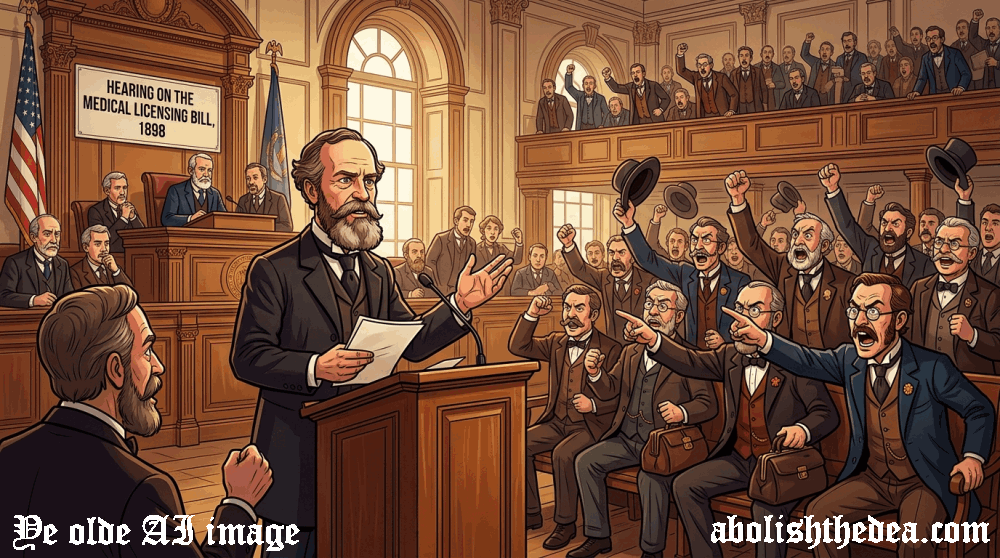 On March 2, 1898, William James testified at the Massachusetts State House against a bill that would give physicians a monopoly on healing "any physical or mental ailment."1 In doing so, he made the kind of common sense arguments which, had they only been heeded, would have kept the Commonwealth of Massachusetts, and eventually our entire country, from pursuing the unprecedented and ultimately disastrous policy of wholesale drug prohibition. James argued against the bill by claiming that it was presumptuous to place medical doctors in charge of all matters of public health, for the simple reason that so much is still unknown about the true causes and treatments of human indispositions -- and the fact that doctors themselves disagree about the proper remedies for many health-related concerns. "Our State needs the assistance of every type of mind," James testified, "academic or non-academic, of which she possesses specimens... Each is necessarily partly perceptive and partly blind." The healing profession, James believed, should be open to well-meaning experimentation and not limited to the physical protocols proffered by physicians. But the medical community was not convinced. They dismissed all enemies of the bill as quacks and charlatans. James, in his turn, reminded the legislators that the medical industry had self-interested motives for such characterizations. He also reminded the legislators that they should not be taking sides in an ongoing medical debate over the proper approach to healing, especially given the fact that there were intelligent and well-intentioned people on all sides of that question. James might have added that the legislators should not be taking sides in a metaphysical debate either, since the monopoly that they were preparing to grant to physicians depended for its justification on a reductionist philosophy of mind, the idea that spirit, mentation and attitude, whether of the healer or of the patient, were irrelevant to the healing art. Indeed, the legislators would be indirectly deciding on religious matters were they to pass the bill of 1898, insofar as James said of the mind-curing community that "Their movement is a religious or quasi-religious movement."

 (up)
(up)