The New York Times gives drug prohibition another mulligan
a review of 'A Teen Autopsy Marks the Arrival of a Deadly Drug in San Francisco' by Heather Knight
by Brian Ballard Quass, the Drug War Philosopher
September 15, 2026
The New York Times is at it again, supporting drug prohibition by turning one single solitary death into a cause célèbre for "more of the same" when it comes to drug policy: more crackdowns, more arrests and more drug laws. In her September 14th article entitled "A Teen Autopsy Marks the Arrival of a Deadly Drug in San Francisco,"1 reporter Heather Knight pulls out all the usual stops. She turns the death of 16-year-old Dante Lacourte into the usual morality tale, with the usual props and characters: the rebellious kid who refused to listen to his better angels, the lousy rotten drugs that he consumed, and the evil drug dealers who deserve everything we can give them and more. Not one single line is devoted to the real villains of the piece: the drug prohibitionists who outlawed the relatively harmless practice of smoking opium in order to spite the Chinese, thereby incentivizing the creation and sale of evermore powerful opiates, each of them more powerful than the former by an order of magnitude. And yet what did we expect? We outlawed a substance that has been considered a panacea since the time of Galen,2 and now we're surprised that a hopped-up version of the drug is being sold on the street? It is little short of criminal for the Times to continue reporting these stories without even mentioning drug prohibition. Heather might at least have asked for a soundbite from Colleen Cowles, author of "War on Us."3 As Cowles reminded us in her data-filled 2025 book, the Fentanyl crisis was "a direct result of drug prohibition, which incentivizes drug dealers to concentrate substances for easier smuggling." Just so, the newly dubbed cychlorphine crisis. The only real crisis here is the drug prohibition crisis.
Heather's article is a perfect example of the prohibitionist strategy elucidated by Philip Jenkins in "Synthetic Panics."4 A local drug-related tragedy is publicized nationwide in the form of a heart-tugging documentary or news story, thereby increasing use of the drug in question, thereby leading to an increase in the DEA's already astronomical budget and the creation of new laws that infringe on what's left of the Bill of Rights.
Let's consider a few sentences from this New York Times hatchet job to see what's going on here. I use the term "hatchet job" advisedly here, by the way. By the term "hatchet job," I mean "an article that was meant not simply to inform its reader, but to give the reader a certain feeling about the events conveyed." Heather does not simply want her readers to know what happened to Dante, she wants them to draw a certain moral from that story based on her own highly debatable interpretation of the facts of the case. She apparently even wants her story to be read as a call to action, though she herself seems unclear as to precisely what that action should be, and in this she is but mirroring the self-inflicted bafflement of Americans in general when it comes to drugs.
[Cychlorphine] is one of an array of new, deadly drugs upending the illicit drug market and confounding cities that are only now beginning to get a handle on Fentanyl.
Heather tells us here that opiates are deadly. That is philosophically equivalent to telling us that cars are deadly. Yes, indeed, cars can be deadly, but only in a society that does not prioritize education and wise use. The vodka that I have in my cupboard would be deadly for me if I went downstairs right now and swallowed the whole bottle "at one go," but then so what? And what about these cities that we're told are getting a handle on Fentanyl? How could they possibly be "getting a handle" on Fentanyl when they are completely ignoring the reason why Fentanyl is popular in the first place?!
[Cychlorphine] has shown up in Europe and the East Coast over the past couple of years, its presence spreading like tentacles.
Is Heather channeling Lovecraft here? One reads this simile and thinks of the admonition of Sergeant Friday of Dragnet: "Just the facts, ma'am. Just the facts." I wonder if Heather would refer to the distribution of the dependence-causing Big Pharma "med" called Effexor as being facilitated by tentacles? Clearly, she is employing this sinister simile merely to help the reader to feel a certain way about the subject matter that she is covering: namely, drug-hating outrage.
'Such drugs were not approved for medical use because they were deemed too strong and dangerous. The recipe for making them, though, was published in journals and is now available in the dark corners of the internet,' said Keith Humphreys, a Stanford psychiatry professor who served as a senior drug policy adviser in the Obama administration.
Obama wanted to follow the science when it comes to drug policy. He failed to realize that science is political in the age of drug prohibition. This is clear from the fact that America has a National Institute on Drug Abuse rather than a National Institute on Drug Use. And another thing: since when are scientists qua scientists specialists on human motivation and the culturally influenced decision making of individuals? Since when are they the experts on knowing what goes on in my mind and whether my mental conditions warrant psychochemical intervention? Why don't we follow common sense instead? Common sense tells us that when we outlaw naturally occurring godsends, determined users will set themselves up as amateur chemists. And what about those "dark corners of the Internet" that Humphreys refers to? They could just as easily be referred to as those "free corners of the Internet," those locations where America's oligarchy has not yet managed to control the narrative and to block inconvenient truths with the help of Christian Science algorithms.
Marco Lacourte, the younger twin by one minute, said he has avoided drugs and said in an interview that he had grown increasingly worried about his brother. He said he had talked to him, telling Dante, 'You know it could get you killed.'
The category of psychoactive drugs contains all sorts of substances with all sorts of risk profiles and potential benefits. These drugs come from all sorts of sources, including fungi, plants, animals, laboratories and human beings themselves. To say that one has avoided drugs is kind of like saying that one has avoided animals. In a sane world, we would ask them to be more specific. Do you avoid coffee? Do you avoid alcohol? Do you avoid Big Pharma "meds"? This vague use of language on the part of drug haters exists because drug propaganda has taught us to lump all psychoactive substances into the same category -- albeit with hypocritical exceptions such as the ones just mentioned above. The real message of Dante's story is that opiate use has been rendered highly dangerous thanks to drug prohibition; and yet the takeaway message for most Americans is that "drugs are bad." It is as if Dante had been killed by a wildebeest and his brother subsequently testified that, for his part, he had always avoided animals. Only in the case of animals would we see this as a strange boast on Marco's part; we are unfazed by his use of the same logic when he applies it to drugs.
In the next quotation, Heather reinforces the "just say no" subtext of her article, this time in a caption for a photograph of Marco appearing near the end of the article.
Marco Lacourte, Dante’s twin brother, said he had urged Dante to stop using drugs and warned that they could kill him.
Our journalist wants to leave no doubt that Marco is the good guy that was doing all he could to keep Dante on the straight and narrow. Like all Drug Warriors, she wants to turn the story of the west's massively bungled confrontation with psychoactive medicines into a morality tale about temptation and forbidden fruit. This is the approach that so offended me as a depressed teenager, when all the "experts" completely ignored all the substances that I knew worked -- notwithstanding their risks -- and wanted me to practice meditation and affirmations and getting to bed early and attending "group"... and finally popping "meds" like they were going out of style. Like Dante, I wanted something that really worked and that worked now, not something that would eventually work for me someday, maybe. I wanted to be able to return to the work that I had loved -- not simply to make my slow and reluctant peace with the loss of that work. But in the words of the prescient Rimbaud, "Science is too slow for us," at least when it comes to everything that matters in life. Behavioral health "experts" will never understand that "safety first" is the motto of a hypochondriac, and that for the rest of us, safety comes in a decided second place to self-actualization. As the opium-loving Avicenna said: “I prefer a short life with width to a narrow one with length.”5
Which brings me to the comments of one of Dante's friends, 19-year-old Leo Wingate, who, in my opinion, is the only real "expert" that Heather quoted in the piece:
Mr. Wingate said that Dante had used drugs to cope with school pressures, anxiety and depression, and that Dante frequented the Tenderloin neighborhood, where dealers were always changing and their wares could not be trusted. Dante would take pills even if he thought they could be laced with 'fetty,' Mr. Wingate said, using the slang term for Fentanyl.
And now comes the quotation that really resonated with me as someone who was in Leo's position 50 years ago:
'He was just a kid trying to feel better,' Mr. Wingate said.
As was I. And the American healthcare system let us both down. Like Dante, I knew from personal experience that there were substances "out there" that could really work for me, that could help me to succeed in my chosen profession and so create a virtuous circle of real-life success, thereby building a positive sense of self that could endure long after the use of any given drug had been renounced. Unfortunately, the mainstream was determined to keep me from using any obviously effective substances whatsoever. The assumption seemed to be that any drug that can be used addictively will be used addictively. Apparently, it never occurred to drug scientists, either then or now, that a variety of such apparently effective substances could be used strategically in such a way that no one substance would "get the chance" to become addictive, especially if the mechanisms of action differed from drug to drug. This possibility may have been less obvious to the drug scientists "in my day," when the known number of such drugs was limited, but today things have changed. We now know, thanks to ethnobotanical studies and the laboratory work of Alexander Shulgin,6 that there are a potentially endless number of drugs that can inspire and elate, many of which, as Aldous Huxley noted in "The Human Situation," are inherently non-addictive.7
Even if this were not the case, the idea that the human will is powerless against drugs has to be reassessed, nay, it has to be vehemently rejected by those of us who believe in free will. We need to consider the vested interest of those who have been making that claim since the early 1900s: namely, the psychiatrists and rehab coaches who stand to gain clients for life from that assumption. When they tell us that "Once an addict, always an addict," they are really saying, "Once my client, always my client."
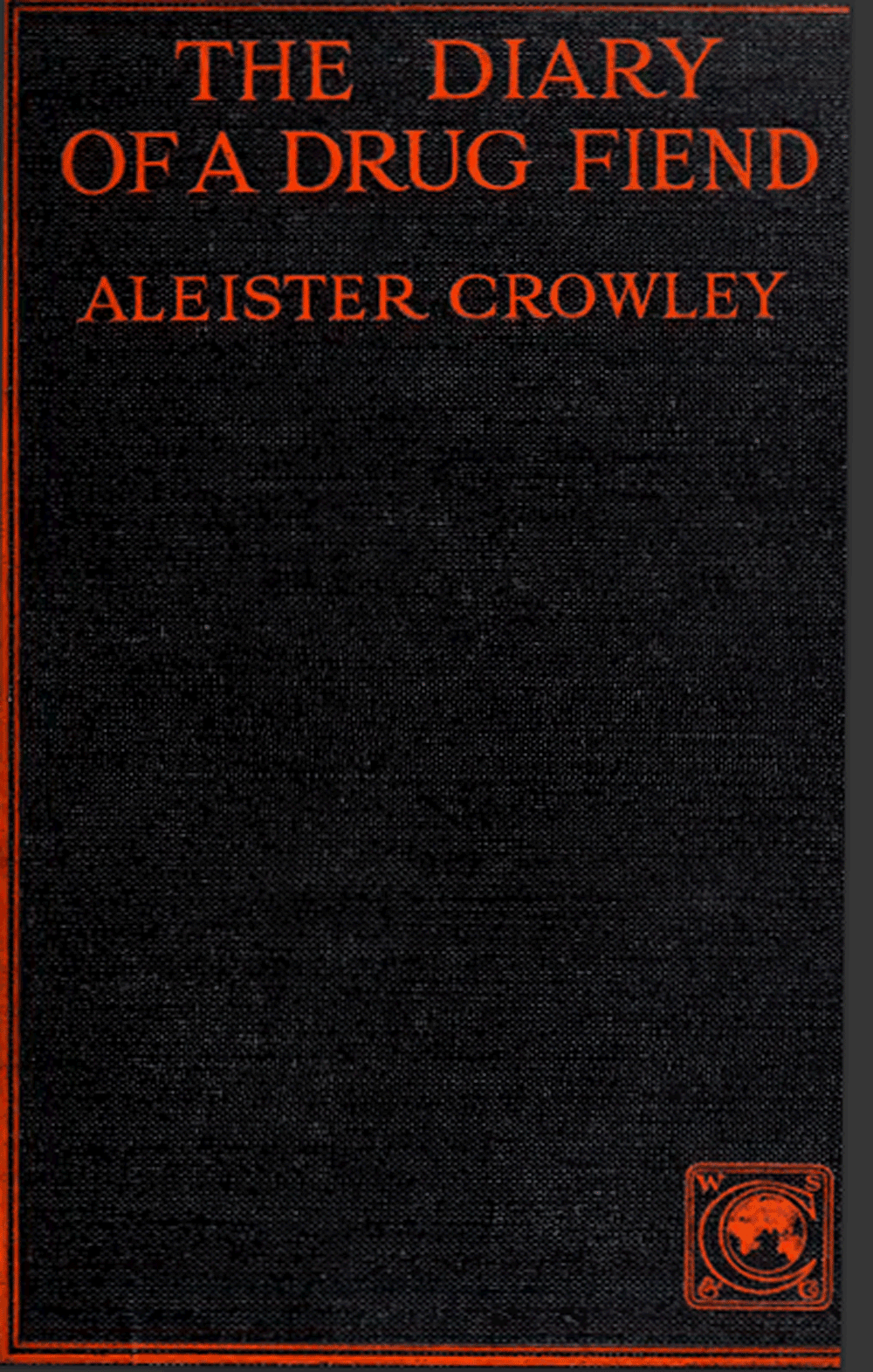
As the rehab coach King Lamus told his pupils in "The Diary of a drug fiend by Aleister Crowley":
You have got to learn to make use of drugs as your ancestors learnt to make use of lightning. You have got to stop at the word of command, and go on at the word of command according to circumstances. 8
Aleister Crowley, The Diary of a Drug Fiend
Note that King Lamus is not trying to get his charges to forswear drugs. He is trying to get them to use them wisely. There is a world of difference. Drug-hating Americans will never allow themselves to read an essay of this kind in its entirety, but if they did, they would say, "Brian and Dante both would have been fine if we could have just gotten them to say no to drugs!" And that is plain nonsense. Sobriety can be deadly. It can be counterproductive. The Scott Borchetta's of the world, who always seem to be firing on all cylinders, psychologically speaking, will have to trust me on this one, but it is true. Most of the 47,000 Americans who commit suicide every year could have passed a drug test prior to doing so. Merely getting us to renounce drugs is not just a useless approach; it is immoral: it is an attempt to take advantage of our distress by converting us into a kind of secular Christian Scientist, one who believes that drug use is unnecessary and that all we really need is to get out in nature and get "high on sunshine" and lark about with our friends, etc. Of course, there is nothing wrong with such advice in and of itself: indeed, that is why drugs that work can be so beneficial, because they finally make us WANT to do such things. But to give such advice to a deeply depressed person is like telling a wealth seeker to go out and get himself a million bucks.
One final word on addiction: If by "addiction" we mean the daily use of a drug, then we have no leg to stand on in demanding that drug users forbear, not when 1 in 4 American women take a dependence-causing psychiatric drug every day of their life.9
Now let's look at the backstory that Heather provides for the Lacourte family tragedy.
The double-whammy of the pandemic and Fentanyl jolted the city six years ago. Drug dealing occurred in plain sight, and people were frequently seen in the Tenderloin bent over at the waist, a common symptom of using Fentanyl. Residents were frustrated, recalling the city’s progressive district attorney in 2022 and ousting the mayor in 2024.
This is so typical. Drug warriors are infuriated by seeing maladaptive drug use in public. They don't want to be reminded of the downsides of their own social policies, not just the downsides of drug prohibition but the downsides of redlining and homelessness as well. They want all that unnecessarily dangerous drug use that they have caused with their social policies to remain where they think that it belongs, in crack houses on the edge of town, or better yet, on the other side of the rails. If thousands of opiate users are dying indoors, that's not a problem for them, but if so much as one opiate user is dying in plain view, then these fine upstanding citizens are up in arms: the leaders in City Hall will have to be replaced with a new mayor and a hardnosed D.A. who will start an immediate crackdown on those eyesore drug users and start it now! This goes "double" when the citizens in question live in some of the richest communities in the United States. How dare they be exposed to the problems that they themselves have caused with their antipathy to honest education and to conventional freedoms like the free access to Mother Nature. One can hear the denizens of Nob Hill now: "By Jove, I say, we didn't move to one of the richest neighborhoods in the world only to have to drive by drug-using scumbags on our way to church!"
This is why it is so hard to make drug decriminalization stick in America. The arrests that police were making under the drug-prohibition regime were serving a purpose, after all: they were helping to hide a real social problem. With decriminalization, the arrests are no longer being made and suddenly the social problem is clear for everyone to see. The result is inevitable: rich, conservative Drug Warriors now become deeply offended in a way that can only be experienced by those who are secretly conscious of their own complicity in the dysfunctional status quo. They are in the same position, morally speaking, as the philandering male who has just been identified as the father of a child born out of wedlock. They rage in proportion as they recognize themselves to be guilty.
Finally, let's investigate the conclusion of Heather's article:
Ms. Lacourte regularly visits the cemetery in Mill Valley, Calif., where Dante’s ashes are buried under an oak tree.
She got rid of much of the furniture in the bedroom where Dante died. But she kept the neon sign reading “Open” that hung above his bed.
Every morning, she turns it on, and she can see the glowing light from other parts of the apartment. Every night, she turns it off.
With each flick of the switch, she said, she thinks of Dante.
This would be a very touching conclusion to a short story. But in an ostensibly factual report, these lines are out of place, especially in the context of what went before. Heather Knight is basically telling the reader: "I don't know what we should do precisely, reader, but by golly we need to be cracking down on somebody, but good!" And no wonder she's confused: she has failed to even mention the prime suspects in the case: America's racist and xenophobic drug prohibitionists.
Dante's mother is equally purblind, though, of course, we can and must forgive her for that fault. She's under no professional obligation to be objective and consider all possible angles to this tragedy. She does not work for a newspaper whose uncritical articles on these subjects can do so much to harden the hearts of Americans toward the very people whom the Drug War was designed to scapegoat. Heather tells us that, "She was glad that the police had removed people suspected of drug dealing from the streets, but she was doubtful that she would ever know exactly who sold the fatal pill to her son, who manufactured it or how it ended up in San Francisco."
I can answer the last part of that question myself. How did the pill end up in San Francisco? It ended up in San Francisco because of drug prohibition, which outlawed a godsend natural medicine, thereby incentivizing the sale of a far more dangerous substance that was unregulated as to quantity, quality, dosage, or even identity. In other words, the pill ended up in San Francisco because of drug prohibition. Drug prohibition is the problem, not drugs. Until Americans recognize this fact, frustrated short story writers like Heather Knight will hold veto power over the re-legalization of Mother Nature's bounty. All they will have to do to stop Americans from leaving the pharmacological stone age is to find one single white American young person who has been affected negatively by such time-honored freedom and then write a heartbreaking story about them, being sure to include baby pictures, maternal lamentations, and extravagant speculations about what could have been, biographically speaking.
Notes for essay entitled The New York Times gives drug prohibition another mulligan: a review of 'A Teen Autopsy Marks the Arrival of a Deadly Drug in San Francisco' by Heather Knight:
Our government treats drugs like uranium and spends hundreds of billions of dollars trying to scare us about them.
Our tolerance for freedom wanes in proportion as we consider "drugs" to be demonic. This is the dark side behind the new ostensibly comic genre about Cocaine Bears and such. It shows that Americans are superstitious about drugs in a way that Neanderthals would have understood.
Americans HATE big government -- and yet they have no problem with government using drug prohibition to control their pain relief and how and how much they can think and feel in this life.
"Abuse" is a funny term because it implies that there's a right way to use "drugs," which is something that the drug warriors deny. To the contrary, they make the anti-scientific claim that "drugs" are not good for anybody for any reason at any dose.
Someday the world will realize that Freud's real achievement was his discovery of the depression-busting power of cocaine.
People talk about how dangerous Jamaica is -- but no one reminds us that it is all due to America's Drug War. Yes, cannabis and psilocybin are legal there, but plenty of drugs are not, and even if they were, their illegality elsewhere would lead to fierce dealer rivalry.
The FDA uses reductive materialism to justify and normalize the views of Cortes and Pizarro with respect to entheogenic medicine.
DEA Stormtroopers should be held responsible for destroying American Democracy. Abolish the American Gestapo.
All drugs have potential positive uses for somebody, at some dose, in some circumstance, alone or in combination. To decide in advance that a drug is completely useless is an offense to reason and to human liberty.
Healthline posted an article in 2021 about the benefits of getting off of antidepressants. They did not even mention the biggest benefit: NO LONGER BEING AN ETERNAL PATIENT -- no longer being a child in the eyes of an all-knowing healthcare system.
Break the ice with a sledgehammer: place this book on your coffee table.
This book features 150 annotated images, designed to force brainwashed Americans to confront the fact that drug prohibition is wrong. Here is what author Richard Parrish II says of the book's compiler: "The drug prohibition philosopher provides first-hand, principled, persuasive, and insightful arguments against the current drug prohibition regime..."
This is the only full-cast recording of Aleister Crowley's 1922 classic paeon to common sense. It is the first book -- and so far almost the only book -- to stake out a philosophy of drug use that is compatible with human freedom, one in which we learn to use drugs as wisely as possible for the benefit of humanity. This recording was produced by the Drug War Philosopher and your purchases help support his effort to push back against the tragically counterproductive policy of drug prohibition, in the name of human freedom and of humanity's right to heal.
No cookies, no ads paid for by amoral and immoral billionaires (or trillionaires).
Unless otherwise indicated, no AI is used in the creation of site content. These essays represent the original ideas of their author and not the ideas that the author SHOULD have based on an algorithmic parsing of existing data. For more on this subject, consider the AI-related viewpoints to which the author subscribes as delineated in the New York Times opinion piece entitled "What 370,000 College Essays Tell Us About A.I.’s Effects on Creativity" by Rebecca Winthrop of the Brookings Institution.








 The New York Times is at it again, supporting drug prohibition by turning one single solitary death into a cause célèbre for "more of the same" when it comes to drug policy: more crackdowns, more arrests and more drug laws. In her September 14th article entitled "A Teen Autopsy Marks the Arrival of a Deadly Drug in San Francisco,"1 reporter Heather Knight pulls out all the usual stops. She turns the death of 16-year-old Dante Lacourte into the usual morality tale, with the usual props and characters: the rebellious kid who refused to listen to his better angels, the lousy rotten drugs that he consumed, and the evil drug dealers who deserve everything we can give them and more. Not one single line is devoted to the real villains of the piece: the drug prohibitionists who outlawed the relatively harmless practice of smoking opium in order to spite the Chinese, thereby incentivizing the creation and sale of evermore powerful opiates, each of them more powerful than the former by an order of magnitude. And yet what did we expect? We outlawed a substance that has been considered a panacea since the time of Galen,2 and now we're surprised that a hopped-up version of the drug is being sold on the street? It is little short of criminal for the Times to continue reporting these stories without even mentioning drug prohibition. Heather might at least have asked for a soundbite from Colleen Cowles, author of "War on Us."3 As Cowles reminded us in her data-filled 2025 book, the Fentanyl crisis was "a direct result of drug prohibition, which incentivizes drug dealers to concentrate substances for easier smuggling." Just so, the newly dubbed cychlorphine crisis. The only real crisis here is the drug prohibition crisis.

 (up)
(up)