For years now, I have been holding the medical field responsible for their self-interested demonization of near-panaceas like opium, coca, and cocaine. I have been pointing out what no one else seems to have noticed: that doctors are interested parties on the subject of drug benefits, that they have a vested interest in depriving the world of medicines that would make the doctor's job irrelevant, at least when it comes to so-called behavioral health. And yet I have so far failed to explicitly make a point of which Ivan Illich reminded me last night as I was re-reading his seminal "Medical Nemesis" of 1975: 1 namely, that the medical field's demonization of godsend medicines and their ongoing medicalization of human behavior is just part of a larger effort on their part to make doctors indispensable in the daily lives of human beings.
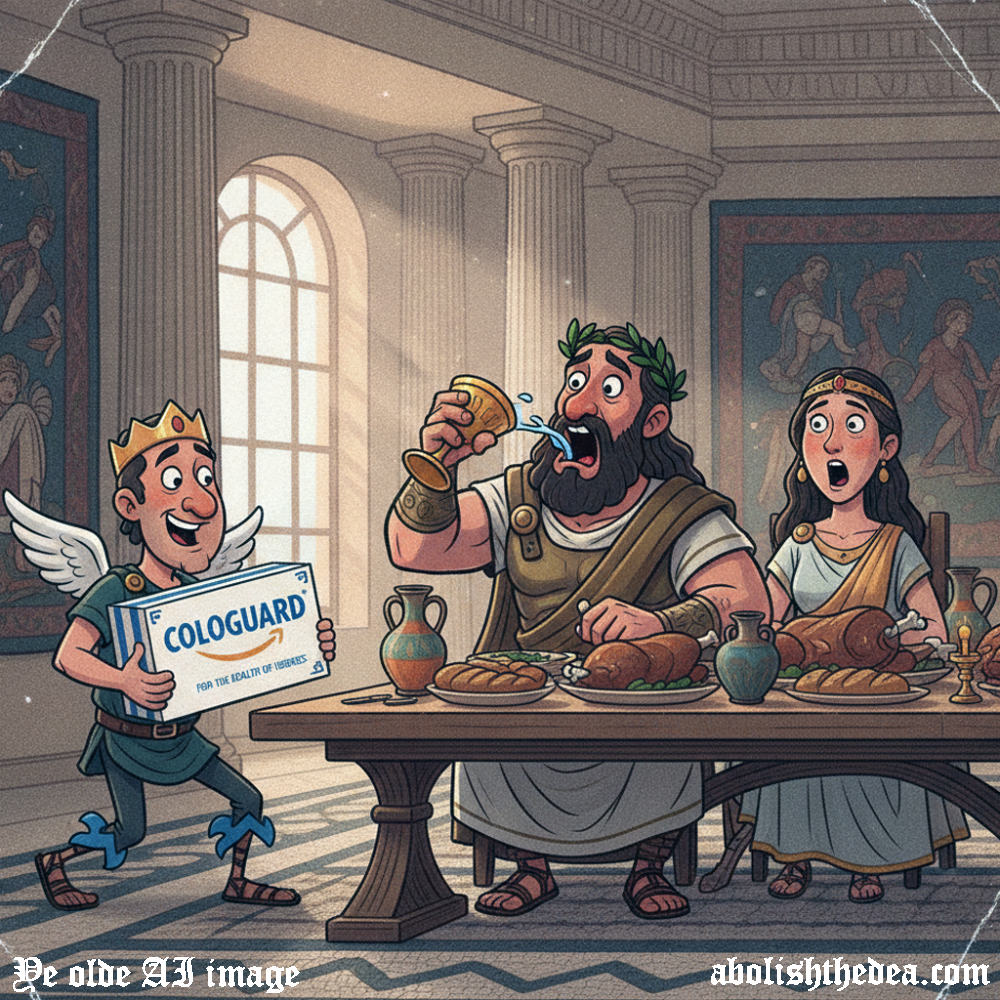
As Illich reminds us, the ceremonies of birth and death used to be intensely familial matters to which the bereaved attached diverse meanings based on prevailing social norms and religious beliefs. Such events took place at home. Now, mothers give birth in nonsectarian hospitals, surrounded by medical personnel, and are then shipped off with a calendar full of regularly scheduled doctor appointments set to coincide with the supposed milestones of childhood. Like Google, the medical field is trying to become indispensable to humanity in every way possible. They want to guide us through every stage of life. This is why, when I became eligible for Social Security last year, my healthcare provider attempted to sign me up for regular screenings throughout the rest of my life, as if I were a Ford Bronco being scheduled for routine maintenance. The assumption seemed to be that I wanted to live forever and that I valued longevity over every other goal in life. Imagine if Homer's Odysseus had lived during our medicalized age: he either 1) would never have left Ithaca, or 2) he would have held up these "longevity-boosters" to scorn in defense of human freedom and the spirit of bold adventure. One can see the hero now, feasting in the halls of King Alcinous, as a lackey approaches with a blue-and-white Cologuard box, saying, "By your leave, honored stranger, this package hath been forwarded thee from Ithaca."
This is why doctors write so unrealistically about drug use, insisting that there is no good reason for using cocaine and opium and phenethylamines, etc. (though, of course, it is somehow our duty as conscientious citizens to take our "meds"). They cannot see any benefits to unbridled psychological freedom. Their ideal health-conscious citizen is a hypochondriacal homebody. The heroes of the world just don't know what's good for them.
For the doctor to be in charge of our lives, we must be efficient rather than merely human, we must be predictable. Hence the need for the bottle-feeding of infants. Breast-feeding is all well and good, of course, but it is just a trifle "unseemly" from a logical scientist's point of view, just a little too "touchy-feely," you understand. The champions of medicalization cannot see how the feeding of a baby could be -- or should be -- anything more than a utilitarian transaction. ("The kid should be happy, he's been fed, hasn't he?!")
This indifference to what really counts in life (the "touchy-feely" quality of life) is astonishing enough when considering the move from breast-feeding to bottles in the mid-20th century, but this tone-deafness has its modern-day equivalent in the mainstream reaction to assisted suicide for the depressed. Our medical ethicists today see no connection between that subject and the drug prohibition which outlaws substances that inspire and elate. It is as if they were saying: "There is no logical reason why the depressed should require drugs, any more than a baby should require an actual mother's breast in order to feed." To which we respond, "No, there may be no logical reasons for either of those things, but then so much the worse for logic."
This was Dostoevsky's complaint in "Notes from Underground," a complaint against the scientistic tendency to treat human beings as predictable widgets, while ignoring all that makes them unique and unpredictable.
And how do these wiseacres know that man wants a normal, a virtuous choice? What has made them conceive that man must want a rationally advantageous choice? What man wants is simply independent choice, whatever that independence may cost and wherever it may lead. And choice, of course, the devil only knows what choice. 2
Notes from Underground
At the risk of digressing, I cannot help but see a connection here with the institutionalization of my elderly mother six years ago now. I fought this institutionalization all the way, insisting that I could care for my mother with the help of nurses, etc. I will spare the reader the details of the sibling squabbles that ensued. Suffice it to say that I was voted down, 3-1. The point here is that the chief argument against my viewpoint was that I was being hopelessly old-fashioned, that only a facility staffed by medical personnel could meet the needs of my mother as her mental faculties slowly but surely declined thanks to dementia. In other words, the reasoning was identical to that of the bottle pushers above: babies need nourishment, it matters not how they get it; the elderly need to be cared for, it matters not who gives them that care, whether it's their own flesh and blood or a college student studying at a local university to become an RN. Of course, my siblings were right, in a way. I would have encountered difficulties in caring for my mother at home; but I would argue that most of those problems would be the result of the fact that the country in which I live makes no provision for such healthcare while providing financial incentives for institutionalization. And yet "homes" for senior citizens are virtually unknown in Panama, for the simple reason that the population is not yet sufficiently scientific to appreciate the "need" for such places. They still have the counterrevolutionary idea that family matters, yes, even more than jobs and money.
I hope I have made it clear that the medical field's naive attitude about drug use is symptomatic of a larger problem: namely, the desire to make doctors indispensable to all aspects of modern life. To accomplish this goal, the champions of medicalization must de-emphasize those aspects of human life in which scientists are not and, indeed, cannot be the experts (like everything that matters most to us as human beings) and regard us instead as predictable widgets that can be reliably placed into abstract risk categories based, not on ourselves as individuals, but on the various classes to which we are deemed to belong.
I will leave it to Ivan Illich himself to sum up this latter point as follows:
By turning from art to science, the body of physicians has lost the traits of a guild of craftsmen applying rules established to guide the masters of a practical art for the benefit of actual sick persons. It has become an orthodox apparatus of bureaucratic administrators who apply scientific principles and methods to whole categories of medical cases. In other words, the clinic has turned into a laboratory. By claiming predictable outcomes without considering the human performance of the healing person and his integration in his own social group, the modern physician has assumed the traditional posture of the quack. 3
Ivan Illich -- Medical nemesis : the expropriation of health
And I am living the downsides of this dystopia in 2026, over 50 years since the publication of "Medical Nemesis." Having been turned into a ward of the healthcare state by dependence-causing "meds," I have to see a doctor one-third my age every three months of my life to verify that I am taking those "meds" correctly. In a sane world, this would constitute a flagrant violation of my right to be treated like an adult. In the age of medicalization, this is considered first-rate therapy. My very doctors see no problem with this status quo whatsoever. They aren't embarrassed about it in the least, nor would they ever think of apologizing to me. And why should they? This status quo leaves everybody enriched, after all -- doctors, researchers, ethicists, nurses, receptionists... everybody except for the patients, of course, but you can't please everybody.
But Americans were being disempowered by medicalization before I took my very first pill. As Illich wrote a full half-century ago:
The patient is reduced to an object —his body— being repaired; he is no longer a subject being helped to heal. If he is allowed to participate in the repair process, he acts as the lowest apprentice in a hierarchy of repairmen. Often he is not even trusted to take a pill without the supervision of a nurse. 4
Ivan Illich -- Medical nemesis : the expropriation of health
The UK just legalized assisted dying. This means that you can use drugs to kill a person, but you still can't use drugs to make that person want to live.
I'd like to become a guinea pig for researchers to test the ability of psychoactive drugs to make aging as psychologically healthy as possible. If such drugs cannot completely ward off decrepitude, they can surely make it more palatable. The catch? Researchers have to be free.
Videos about science and psilocybin are funny. They show nerds trying to catch up with common sense.
As great as it is, "Synthetic Panics" by Philip Jenkins was only tolerated by academia because it did not mention drugs in the title and it contains no explicit opinions about drugs. As a result, many drug law reformers still don't know the book exists.
One merely has to look at any issue of Psychology Today to see articles in which the author reckons without the Drug War, in which they pretend that banned substances do not exist and so fail to incorporate any topic-related insights that might otherwise come from user reports.
We need a few brave folk to "act up" by shouting "It's the drug war!" whenever folks are discussing Mexican violence or inner city shootings. The media treat both topics as if the violence is inexplicable! We can't learn from mistakes if we're in denial.
Even when laudanum was legal in the UK, pharmacists were serving as moral adjudicators, deciding for whom they should fill such prescriptions. That's not a pharmacist's role. We need an ABC-like set-up in which the cashier does not pry into my motives for buying a substance.
Drug prohibition is a crime against humanity.
There are plenty of "prima facie" reasons for believing that we could eliminate most problems with drug and alcohol withdrawal by chemically aided sleep cures combined with using "drugs" to fight "drugs." But drug warriors don't want a fix, they WANT drug use to be a problem.
Cocaine is not evil. Opium is not evil. Drug prohibition is evil.
Unless otherwise indicated, no AI is used in the creation of site content. These essays represent the original ideas of their author and not the ideas that the author SHOULD have based on an algorithmic parsing of existing data. For more on this subject, consider the AI-related viewpoints to which the author subscribes as delineated in the New York Times opinion piece entitled "What 370,000 College Essays Tell Us About A.I.’s Effects on Creativity" by Rebecca Winthrop of the Brookings Institution.








 For years now, I have been holding the medical field responsible for their self-interested demonization of near-panaceas like opium, coca, and cocaine. I have been pointing out what no one else seems to have noticed: that doctors are interested parties on the subject of drug benefits, that they have a vested interest in depriving the world of medicines that would make the doctor's job irrelevant, at least when it comes to so-called behavioral health. And yet I have so far failed to explicitly make a point of which Ivan Illich reminded me last night as I was re-reading his seminal "Medical Nemesis" of 1975: 1 namely, that the medical field's demonization of godsend medicines and their ongoing medicalization of human behavior is just part of a larger effort on their part to make doctors indispensable in the daily lives of human beings.
 (up)
(up)