time again for the Drug War Philosopher to take Substackers to task for their propaganda-inspired misconceptions about psychoactive substances
by Brian Ballard Quass, the Drug War Philosopher (Substack version)
July 29, 2026
It's another Note Wednesday, that time of the week when I take a deep breath and look unflinchingly at the irritating notes in my Substack feed. It's a kind of competition in which the contestants try to gall me as much as possible with their harebrained defense of an unconscionable status quo. And with that criterion in mind, the winner is... Envelope, please... Well, what do you know? Our winner turns out to be a remorse-ridden ex-Libertarian, who tells us that he has grown up now to see how desperately human beings need to be protected from big evil drugs by all the laws that we can think of, and then some. Congratulations go out to a certain MDB for trying my patience with his politically subservient choplogic. He really has irritated me more than any other posters this week. Well done! I invite the audience to read his actual quote below, along with my actual rejoinder. I think you'll find that his viewpoint is even less excusable than I have given it credit for.
MDB did bring up a point that I've made before, however: namely, that Libertarians tend to support drug re-legalization for the wrong reason: the idea that Americans should be free to go "to hell in their own way." This is not my justification for drug re-legalization at all, nor was it the justification put forth by Thomas Szasz, wherefore I am placed on the defensive whenever a critic refers to either Szasz or myself as a Libertarian. By giving us that label, the critic seems to be implying that our ideas can be safely put to one side since they are fringe beliefs based on the mean-spirited idea that drug users should be allowed to injure themselves to their heart's content. This is such a distortion of our viewpoints that one does not know where to start in debunking it. Yet how can we think of outlawing a field of study in which we westerners have scarcely begun to take part? We have scarcely begun to study the prima facie benefits of psychoactive medicines for humankind on the philosophical, religious, and therapeutic front. I therefore reject the idea that we must ignore this entire aspect of life on planet Earth altogether in order to shield our young people from dangers inherent in the human condition, inherent in a world full of psychoactive medicines, dangers about which we refuse "on principle" to even teach them.
See? I'm getting in a huff already just writing about these things.
Incidentally, the notes to which I'm responding below are a subset of those that have been brought to my attention by Substack algorithms, though I'm not sure if the algorithm writer was hoping to edify me or gall me with such a list. There are occasional flashes of sanity in the feed posts, and yet I almost never see notes that combine the subject of drug prohibition with the subject of healthcare in an instructive way. The note of James Zech below comes closer than any so far in the Substack universe to being an exception to this rule. In talking about the failure to use psychedelics in hospice, he observes that: "Modern medicine will spend millions helping someone live another six weeks. Helping them die with less fear, however, remains controversial." Yet he still seems to be unaware of the larger issue that his own example demonstrates: namely, that Americans would rather that human beings die than to use substances that could make them wish to live -- or that could help them die peaceably in the case of hospice care.
Speaking of Libertarianism: I recently gave a short talk via video chat to some postgrad students at SUNY, after which the professor in charge asked me to confirm what he apparently had already taken for granted, namely, that I was "of course" a Libertarian. This was frustrating because as I saw it, nothing that I had said during my 30-minute spiel could have justified that conclusion. His working assumption therefore seemed to be that only a Libertarian would desire that America return to a world in which Mother Nature was legal again. I was quick to undeceive him on this point, being careful to conceal my consternation as best I could at having been labeled in this way. I was tempted to say, "Sorry, but you'll have to search for a better reason than that to write me off prematurely," but the last thing I wanted to do was to alienate one of the rare academics who thinks that my viewpoints deserve an airing in the Ivory Tower. True, the location was not exactly Carnegie Hall, but as my French teacher used to say, petit a petit, l'oiseau fait son nid.
Let me add, for the record, that this ascription of heartlessness that MDB gives to Libertarians is not necessarily justified. My correspondence with the Cato Institute's Jeffrey Singer suggests otherwise. Nor am I trying to imply that Thomas Szasz himself was not a Libertarian. I merely believe that his position on drug re-legalization can be supported without resorting to Libertarian arguments, and especially without reference to any cost-benefit analysis regarding potential harm to others. Such arguments are not only unnecessary in establishing our right to Mother Nature's bounty, but they are impossible, insofar as many of the benefits of drug use are intangible, such as the power to appreciate a sunset or the ability to understand a complicated tome whose meaning has so far escaped one. A bean counter cannot provide numbers for such drug benefits without imposing their own view about what matters in life and what life is all about, which, of course, is the whole reason why drug criminalization was wrong in the first place: because when we outlaw psychoactive drugs, we outlaw different ways of seeing the world, the values of which, even in theory, can never be objectively determined and will vary from person to person and from incident to incident. Yet that doesn't stop Americans from trying. Drug prohibition has spawned a cottage industry of indoctrinated Americans who consider themselves to be experts on the subject of what their neighbors should and should not be able to profit from in a psychoactive world.
SUBSTACK NOTES
FROM: The Age of Authenticity
What’s something society rewards that you secretly think makes people less alive?
RESPONSE: The use of antidepressants
FROM: The Bipolar Bro
Antipsychiatry is too simple.
RESPONSE: Psychiatry is too simple: it offers one-size-fits-all cures for the downsides of the human condition, with dependence-causing pills that have turned me into a ward of the healthcare state.
FROM: Based Psychiatrist
Patients are told antidepressants aren’t addictive, then warned to never to stop abruptly, then their withdrawal is interpret [sic] as proof they need the drug forever.
RESPONSE: Right. Dependency is portrayed as the worst thing in the world when the drug is opium, a time-honored panacea, but when dependency develops for antidepressants, psychiatrists flip the script and tell us that this dependency shows us that the meds are needed.
FROM: James Zech
The case for psychedelics in palliative care, in a nutshell: Modern medicine will spend millions helping someone live another six weeks. Helping them die with less fear, however, remains controversial
RESPONSE: The problem is larger than hospice care, James. Depressed Canadian Claire Brosseau is demanding her right to state-assisted suicide. And I am the only pundit who sees the obvious connection with drug prohibition. I am the only one who finds it bizarre that the state can use drugs to kill Claire but it will not let Claire use drugs that might make her wish to live. This is a case not just for the use of psychedelics, but for the end of drug prohibition itself.
FROM: Jason Chen
What's the weirdest belief you've ever encountered?
RESPONSE: That time-honored drugs have no beneficial uses whatsoever.
FROM: MDB
Many moons ago I advocated for the legalization of drugs and gambling. Not because I think either is a good idea, but because I didn’t want the State to throw people in jail when they chose to harm themselves. Oh, how I underestimated the number of people willing to harm themselves and the collateral damage that would follow.
RESPONSE: The harm is coming from drug prohibition. Drug prohibition resulted in 80,000 TOTALLY UNNECESSARY DEATHS in 2024 in America alone because the drug supply was not regulated as to quantity, dosage and even identity. Your Drug War has ended the rule of law in Latin Americe and caused hundreds of thousands of deaths in civil wars. Meanwhile, your drug prohibition throws 1.4 million Americans into jail every year, so many that trials are now a thing of the past in America. Everything is handled by plea deals, where DA's threaten suspects with long prison terms unless they give up their right to a jury of their peers. Meanwhile, your drug prohibition has shunted me off onto “meds” that are far harder to kick than heroin and which have turned me into a ward of the healthcare state who has to see a doctor one-third his age every three months to qualify for a refill on an expensive and under-performing “med.” You should regret your prohibitionist tendencies that have turned inner cities into death zones around the world by incentivizing violence. What did you THINK was going to happen when you outlawed substances that have been considered panaceas since the time of Galen?!!
FROM: Autism Love and Science
“Question the science, scientifically.” We need more of that in the field of autism.
RESPONSE: We also should ask, When is the scientific method inappropriate? It is a category error to place scientists in charge of mind and mood medicine. The proof is extant in the fact that scientists claim to see no benefits in drugs that have been considered panaceas by past generations. Scientists are not the experts in such things: the most they can tell us is about abstract risks of use. The experts are thinkers, empaths, and drug users with experience. Speaking of autism, we outlaw all empathogens. Americans prefer drug-bashing to helping people. We will use drugs to kill a person with assisted suicide but we won’t let them use drugs that would help make them wish to live.
FROM: Andrew M. Weisse
Spend a day watching someone who proudly says they "don't do drugs." You'll find them glued to their phone, compulsively scrolling social media, popping Zyn, drinking coffee, eating shitty food & ending the night with wine or watching porn (or both). Humans don't avoid addictions, we rank them. Some are socially acceptable, others are condemned.
RESPONSE: Saying one “doesn’t do drugs,” is ridiculous. It’s like saying, “I don’t go to exotic places.” The response is, "So what?" or "Tootie-frootie for you!" The propriety of drug use is all about the DETAILS. The use of drugs like opium and coca and hemp (marijuana) have inspired entire religions. Opiates and cocaine can give one extraordinary mental focus — at least if one is smart enough to begin with. To say that there is no use for such things is mere Christian Science. It’s also xenophobia since indigenous people do not think they should feel guilty about using Mother Nature’s psychoactive bounty. William James’s philosophy was changed forever by his use of nitrous oxide. And our attempt to outlaw these desired substances has destroyed American democracy, ended the trial system and forced suspects to give up their rights in order to make plea deals. That’s the only way our courts can deal with the 1.4 million young people that are arrested annually for possessing the kinds of substances that past cultures considered to be godsends. I don’t drink beer myself, but I see no cause to brag about that fact much less to outlaw beer — even for the drug prohibitionists, who, in some ways, would probably deserve it.
The fact that drugs have positive uses for human beings is a psychological corollary of Husserl's phenomenology and Whitehead's philosophy of organism.
Prohibitionists have nothing to say about all other dangerous activities: nothing about hunting, free climbing, hang-gliding, sword swallowing, free diving, skateboarding, sky-diving, chug-a-lug competitions, chain-smoking. Their "logic" is incoherent.
Prohibitionists will me that we're all children when it comes to drugs, and can never -- but never -- use them wisely. That's like saying that we could never ride horses wisely. Or mountain climb. Or skateboard.
Almost all of today's magazine articles about human psychology should come with the following disclaimer:
"This article was written from the standpoint of Drug War ideology, which holds that outlawed substances can have no beneficial uses whatsoever."
Drug prohibition is the biggest tyranny imaginable. It is the government control of pain relief. It is government telling us how and how much we are allowed to think and feel in this life.
For those who want to understand what's going on with the drug war from a philosophical point of view, I recommend chapter six of "Eugenics and Other Evils" by GK Chesterton.
What bothers me about AI is that everyone's so excited to see what computers can do, while no one's excited to see what the human mind can do, since we refuse to improve it with mind-enhancing drugs.
AI is inherently plagiaristic technology. It tells us: "Hey, guys, look what I can do!" -- when it should really be saying, "Hey, guys, look how I stole all your data and repackaged it in such a way as to make it appear that I am the genius, not you!"
Clearly a millennia's worth of positive use of coca by the Peruvian Indians means nothing to the FDA. Proof must show up under a microscope.
It's interesting that Jamaicans call the police 'Babylon,' given that Babylon denotes a society seeking materialist pleasures. Drug use is about transcending the material world and seeking spiritual states: states that the materialist derides as meaningless.
Break the ice with a sledgehammer: place this book on your coffee table.
This book features 150 annotated images, designed to force brainwashed Americans to confront the fact that drug prohibition is wrong. Here is what author Richard Parrish II says of the book's compiler: "The drug prohibition philosopher provides first-hand, principled, persuasive, and insightful arguments against the current drug prohibition regime..."
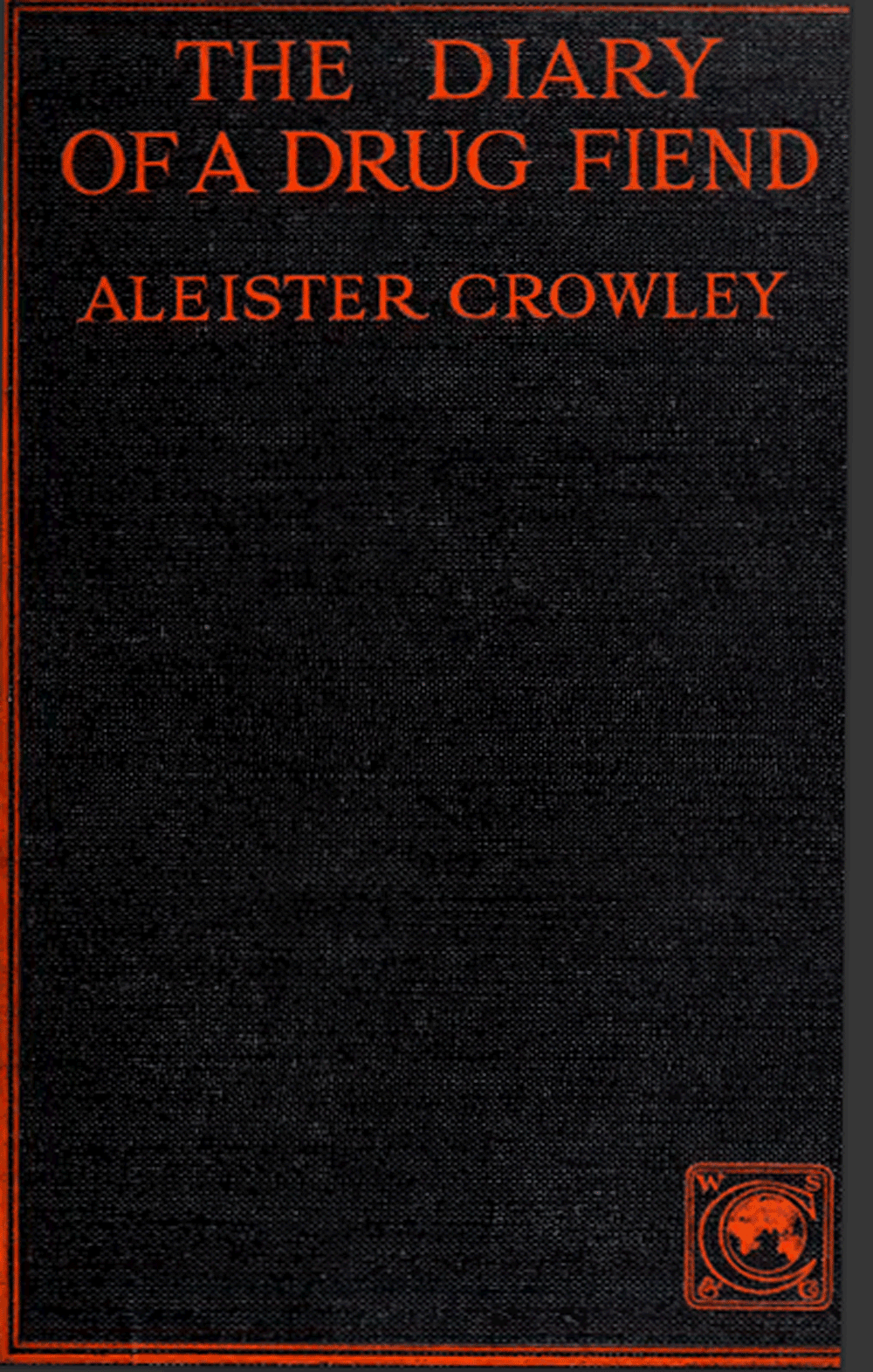
This is the only full-cast recording of Aleister Crowley's 1922 classic paeon to common sense. It is the first book -- and so far almost the only book -- to stake out a philosophy of drug use that is compatible with human freedom, one in which we learn to use drugs as wisely as possible for the benefit of humanity. This recording was produced by the Drug War Philosopher and your purchases help support his effort to push back against the tragically counterproductive policy of drug prohibition, in the name of human freedom and of humanity's right to heal.
No cookies, no ads paid for by amoral and immoral billionaires (or trillionaires).
Unless otherwise indicated, no AI is used in the creation of site content. These essays represent the original ideas of their author and not the ideas that the author SHOULD have based on an algorithmic parsing of existing data. For more on this subject, consider the AI-related viewpoints to which the author subscribes as delineated in the New York Times opinion piece entitled "What 370,000 College Essays Tell Us About A.I.’s Effects on Creativity" by Rebecca Winthrop of the Brookings Institution.









 It's another Note Wednesday, that time of the week when I take a deep breath and look unflinchingly at the irritating notes in my Substack feed. It's a kind of competition in which the contestants try to gall me as much as possible with their harebrained defense of an unconscionable status quo. And with that criterion in mind, the winner is... Envelope, please... Well, what do you know? Our winner turns out to be a remorse-ridden ex-Libertarian, who tells us that he has grown up now to see how desperately human beings need to be protected from big evil drugs by all the laws that we can think of, and then some. Congratulations go out to a certain MDB for trying my patience with his politically subservient choplogic. He really has irritated me more than any other posters this week. Well done! I invite the audience to read his actual quote below, along with my actual rejoinder. I think you'll find that his viewpoint is even less excusable than I have given it credit for.

 (up)
(up)