




Homepage of the Drug War Philosopher, Brian Quass
blog icon orange rss icon with stylized radio waves bird icon for twitter bird icon for twitter substack icon


back navigation arrow


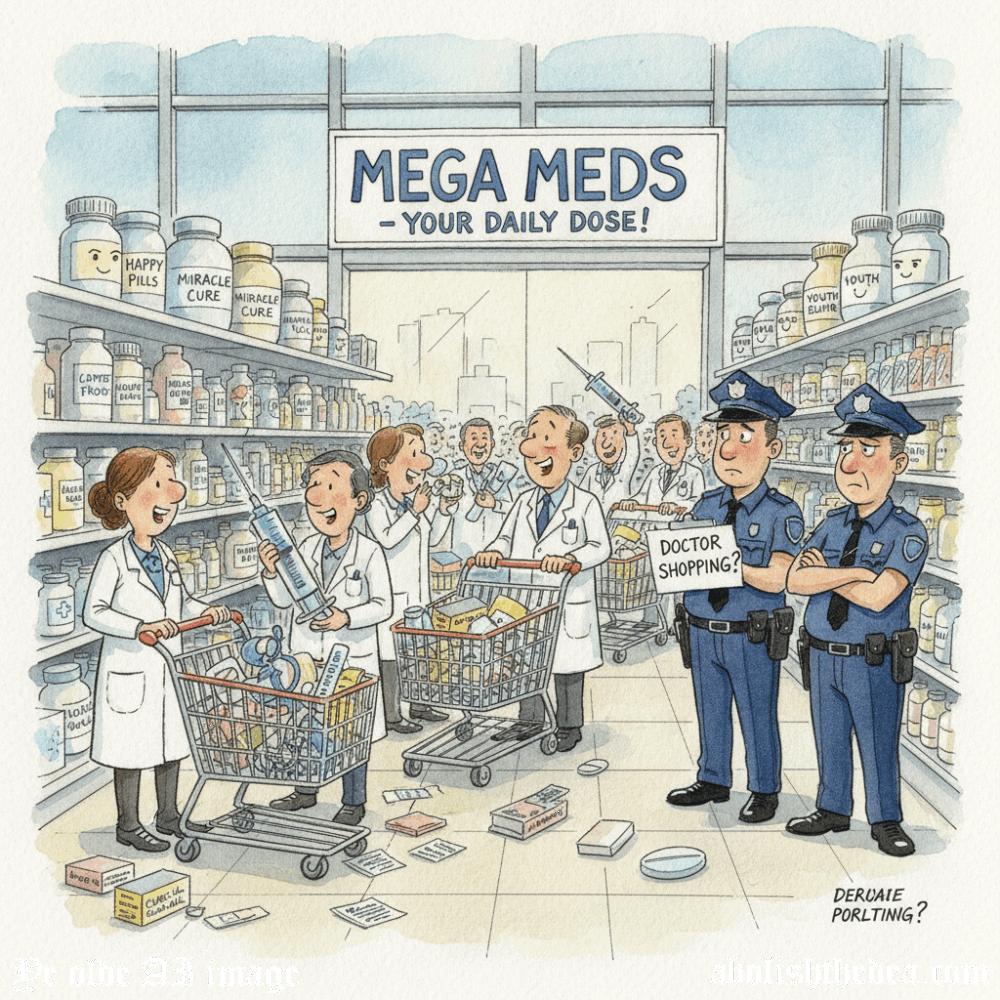
Doctor Shopping in the age of drug prohibition

when practicing due diligence can be a crime

by Brian Ballard Quass, the Drug War Philosopher

August 24, 2026


In his information-rich Substack post entitled "The Watchers,"1 Richard Henry Parrish II tells us how Prescription Drug Monitoring Programs (PDMPs) are being used by law enforcement "to investigate not just large-scale drug diversion operations but individual patients suspected of doctor shopping, prescribers suspected of inappropriate prescribing, and in some cases general criminal investigations where prescription records might provide incidental evidence." As a 67-year-old med-dependent patient with a philosophical turn of mind, I was shocked to read one of the items on this list in particular: namely, doctor shopping. I realized in reading this how America's confusion about drugs is more than just a philosophical problem for me, that it could even end up throwing me in jail. I do not even have to use an illegal substance, or even attempt to use one, in order to be targeted for investigation. I merely have to launch a concerted attempt to find a doctor whose prescription policies coincide with my own -- at least to the small extent that such overlap is possible in the age of drug prohibition. I consider it my medical duty to go doctor shopping, after all. One need not shop until they drop, of course, but I figure that I owe it to myself to find a doctor who shares my views about life and hence is likely to give me the drugs that I feel I need as a patient, rather than the drugs that the DEA thinks that I should need based on a statistical analysis of patients in general. No one would think of calling such a practice a crime unless they assumed that doctors are -- or should be -- automatons who are doing the bidding of the state. The crime in that case would apparently consist in my attempt to find a doctor who would think for him or herself and prescribe in defiance of the statistical norms that the DEA has decided should be good enough for Americans.

Doctor shopping is a very strange kind of crime, indeed, one worthy of a science-fiction story: a crime in which you are arrested for your insistence on having a doctor who shares your point of view about what matters in life, what freedom means, and the role that government should play in the medical field. Of course, one can imagine people taking advantage of this freedom in order to obtain an opioid for reasons that are not technically considered medical, but it still seems strange that the long-established best practices for shopping in general -- i.e., comparing offers from as many sources as possible -- should be considered to be a crime when it comes to health care. Even if I'm going after a refill for a prescription that I require because of a habit, it is not clear why that activity should be punished while we yet praise the millions of med-dependent patients in America for taking their drugs of choice every day of their life. One might say that doctor hopping is unequivocally wrong in the case of a patient who is "turning around" and selling the "meds" that they receive from various doctors, but I hate to be too hard on a crime that is created out of whole cloth by a drug policy that is purposefully created to turn Americans into criminals. Besides, the real crime there is not so much doctor hopping as it is selling a controlled substance on the street.

Even if the monitoring reveals the existence of a troubled person with a habit, and even if we assume that the monitoring is only done by health departments, the monitoring is still problematic in the age of drug prohibition. In such an age, the monitoring will result in an effort by the medical field to get the user thus identified off of ALL drugs (except maybe dependence-causing meds), and this is an ideological protocol, not a scientific one. True, the user may be placed on a government-approved (or at least a government-tolerated) opiate replacement, but this is ironic and bizarre, given the fact that the more addictive opiates became popular after the government's outlawing of the much less addictive habit of opium smoking. I hate to sign off on these replacement drugs for opiates because it is really odd to turn these habitues into wards of the healthcare state, given that the government should have left people alone to smoke opium peaceably at home in the first place. It seems crazy that the government is now requiring them to become "patients" for life and, in a way, customers of the government, in order to be able to experience the benefits of opiates. It's as if the government was saying, "We didn't so much mind you using opium as we minded you being free to do what you want. Now that we're in charge, we're perfectly fine with you using more potent stuff than the original product -- as long as you use it on OUR terms -- while staying off said original product, of course." The use of drugs that block opioid receptors is science-fiction, too, in a way. Rather than letting people use wisely, we change them so they physically cannot benefit from opiates. Apparently, no one is interested in setting these people up with an opium pipe and teaching them how to use wisely. The feeling is that they will be fine once they stop using, but they were using because they did not feel fine. They wanted opiate relief.

Let me attempt to illustrate the problems here more concretely with a story from my own life as a med-dependent chronic depressive, a story that I have thrown into the public domain in order to speak on behalf of the many millions in my position who are never considered to be stakeholders when it comes to drug policy. Until a year ago, I was traveling once a year to a Sentara behavioral health clinic 45 miles away in order to get a refill on an underperforming and expensive "med" which I have found harder to kick than heroin. I did not realize what a good thing I had back then. I have since found that most doctors require tri-monthly visits for those who are receiving so-called maintenance prescriptions. I am still not sure how this previous doctor of mine managed to give me an entire year's worth of freedom at a time from the clinic, for the length of our ten-year relationship. Why, I was almost forgetting that I was a patient! But you know what they say about "all good things." Last year, I found that my psychiatrist was no longer employed at the facility -- a fact that I found suspicious since I had recently complained to Sentara about the dependence-causing nature of the Effexor that I have been on for 30 years now. My suspicion was aroused by the fact that it was this latest doctor of mine who had informed me of an NIH study of Effexor that bothered me in the first place. He told me that the drug essentially had a 95% recidivism rate after three years for long-term users who attempt to get off it. I figured he had been sacked for washing psychiatry's dirty laundry in public.

But now for the relevant part of this history. Having arrived at the clinic and found my customary doctor missing, I was introduced to his replacement, a Pakistani-American who appeared to be at least 30 years younger than yours truly. He was the kind of psychiatrist whom I remembered from my youth. He had the full three-piece suit, dress shoes, the fulsome smile, the works. I felt like I had been transported back in time, to a time of bell-bottom pants and stack shoes. I thought to myself, "Don't judge, Brian, just see what happens in this upcoming office visit. This does look very bad indeed, but you've still got to give this guy a hearing. He may not be quite as 'by the book' as he appears to be after all."

So thinking, I followed my new psychiatrist into a small room, a sort of glorified cubicle, where he sat down behind a desk on a chair that I noticed was fancier and more highly elevated than was mine, as if the very feng shui of the place was designed to remind me of who was in charge here. He then proceeded to tell me how he looked forward to getting to know me and how I needed to schedule an hour-long session as soon as possible so that he could do just that. This should have bothered me in real-time -- I wanted less office visits, not more -- but I had entered the room determined to keep an open mind. Besides, I was not ready to get into a long discussion that could easily turn into an argument given the self-interested nature of the assumptions that he was apparently making about my medical needs. I recognized moreover that an honest discussion with this man was likely to result in an explosion, an explosion of the pent-up frustrations with the healthcare field that had been building up in me over the past four decades, and I did not feel ready to cross that Rubicon, at least not on this particular day. So he talked and smiled, and I listened while doing my best to smile as well, albeit noncommittally, as who should say: "I hear you, Doc, and I promise to take all this information onboard, although I make no promises about the kind of verdict that I will ultimately reach with respect to these self-satisfied adumbrations of yours."

We eventually parted like brothers -- brothers who had just been reunited after years of separation -- although he was clearly the brother who had "made good" in life while I was the reprobate who could be tolerated and humored only as long as he professed to know his place in the family. But it's all good, I thought to myself. I was only there to listen today. Even as I drove home, I was instructing myself to withhold judgment and let the good doctor's message sink in slowly and surely, lest I place an unnecessarily harsh and hasty construction on everything that he had just told me. Only after I got home and collapsed on the couch did I allow myself to analyze the outcome of that meeting freely and without regard for etiquette. That was when I suddenly realized that everything he had said to me was grade-A nonsense. Why did I need to travel another 90-miles for a $200 one-hour appointment in order to get to know somebody whose only job is to write me a refill every three months of my life? In fact, why do I have to get to know him at all? A capuchin monkey could do his job for the price of a banana! I say "every three months," by the way, because the Herr Doctor made it clear to me in our first session that he was going to play me by the book, that I would be expected to see him every three months of my life no matter how egregiously my previous doctor may have been playing fast and loose with the rules when it came to the refill of maintenance prescriptions.

Now consider that backstory in connection with the idea of drug shopping. It turns out that if I try too diligently to avoid doctors of this kind, I could be added to a watch list and even arrested!

Spoiler alert: I did finally find a half-decent doctor whom I can now see online and who will cost me a fraction of the money I was spending on Sigmund Freud down in Harrisonburg, Virginia. Of course this new doctor will still be asking me the usual humiliating questions, like, "Have you contemplated suicide lately?" and "Have you been hearing voices?", but at least I can now be humiliated in the comfort of my own home without having to travel 90 miles for the privilege. That's the good news. The bad news is that it took me as many as a dozen telephone calls and/or online queries before I found a doctor whom I felt was going to treat me like a human being, at least to the extent that such a thing is permissible by law nowadays. Had my doctor shopping set off an algorithmic alarm in some office building in, say, Omaha, Nebraska? Was some flunky in the Cornhusker State second guessing the propriety of my doctor vetting activity from a Christian Science point of view? "Well, would you look at this?" says Anomaly Specialist First Class Joe Buttinski, "This guy has queried at least ten doctors about their refill policies. He's obviously after some 'goodies'. And this is the same med-dependent clown who has been seeing a doctor once a year for the last ten years when he should have been seeing a doctor every three months instead. I don't know what our Investigations Department is up to. I told them last year that they should be investigating this guy. Well, all I can say is, don't blame ME if this guy manages to forget that he is even a patient; don't blame me if he starts to think that he really truly does live in 'the land of the free.'"

AFTERWORD

I have had many psychiatrists in my life, almost all of whom did nothing but sign prescriptions for me -- after I had signed a form saying that I was not yet ready to commit suicide, of course. "No," I always felt like writing on the multiple choice form that they provided me. "I'm still determined to 'soldier on', as it were, despite the fact that you guys in the medical field have turned me into a child for life and a ward of the healthcare state. Nice try, but you're not gonna get rid of me THAT easily, no matter how much demoralizing rigamarole you put me through." But there is one final anecdote that is germane to this topic, one that shows how my disempowerment has acquired an almost religious status in the pharmacological field. The reader will remember how that recent doctor of mine only required me to visit him once a year for a prescription refill? Well, I actually had one other doctor who cut me that same kind of slack in the past. He once wrote a prescription for me which supplied me with a an entire year of an antidepressant. Just one single prescription. And I can still remember the look on the pharmacist's face when he read that script. He was disgusted. He obviously felt that it was my medical duty to see a doctor every three months of my life to get my prescription refills, and he had nothing but scorn for a doctor who would help me to forego that requirement. When he finally gave me the "meds," he did so as if he were an elderly Christian clerk at a convenience store handing an 18-year-old male a package of pornographic magazines. Who would have thought that the Durham-Humphrey Act of 1951 would ultimately lead to a world in which the exercise of even a small degree of healthcare freedom was considered to be immoral?

But then our professionals in the medical field hate nothing so much as our failure to take them seriously. They've had this chip on their shoulder since Moliere's time. The following quote from "The Imaginary Invalid" demonstrates what I mean. The hypochondriac's brother has just told his sibling to stop taking his doctor-prescribed enemas and to start thinking for himself for a change. When the on-site physician, Dr. Purgon, learns that there is such rebellion afoot, he accuses his hypochondriacal patient of treachery:

"I have just heard nice news downstairs! You laugh at my enemas, and refuse to take the remedy which I ordered. Unheard of! What an unprecedented revolt of patient against doctor!"


Notes for essay entitled Doctor Shopping in the age of drug prohibition: when practicing due diligence can be a crime:

1: Parrish, Richard Henry II. 2026. “The Watchers: How the System That Claims to Protect Sara Is Recording Her Every Move.” Substack.Com. Richard Henry Parrish II. March 27, 2026. https://richardhenryparrish2.substack.com/p/the-watchers-how-the-system-that?u (up)


read more essays here


Ten Tweets

against the hateful war on US


Researchers say that the New York Times has been flooding the world with Drug War agitprop.

Freud found that cocaine CURED most people's depression and he "got off it" without trouble.

The drug war tells us that certain drugs have no potential uses and then turns that into a self-fulfilling prophecy by outlawing these drugs. This is insanely anti-scientific and anti-progress. We should never give up on looking for positive uses for ANY substance.

This just in on the drug scene: A new New York Times report shows that America has been flooding the world with antidepressants, alcohol and cigarettes!

According to Donald Trump's view of life, Jesus Christ was a chump. We should hate our enemies, not love them.

Drug-designing chemists have no expertise in deciding what constitutes a cure for depression. As Schopenhauer wrote: "The mere study of chemistry qualifies a man to become an apothecary, but not a philosopher."

The FDA is not qualified to tell us whether holistic medicines work. They hold such drugs to materialist standards and that's pharmacological colonialism.

Kids should be taught in grade school that prohibition is wrong.

The addiction gene should be called the prohibition gene: it renders one vulnerable to prohibition lies and limitations: like the lack of safe supply, the lack of choices, and the lack of information. We should pathologize the prohibitionists, not their victims.

It's amazing. Drug law is outlawing science -- and yet so few complain. Drug law tells us what mushrooms we can collect, for God's sake. Is that not straight-up insane? Or are Americans so used to being treated as children that they accept this corrupt status quo?


Click here to see All Tweets against the hateful War on Us


back navigation arrow
Book Cover

Break the ice with a sledgehammer: place this book on your coffee table.

This book features 150 annotated images, designed to force brainwashed Americans to confront the fact that drug prohibition is wrong. Here is what author Richard Parrish II says of the book's compiler: "The drug prohibition philosopher provides first-hand, principled, persuasive, and insightful arguments against the current drug prohibition regime..."

Purchase Your Copy
Book Cover

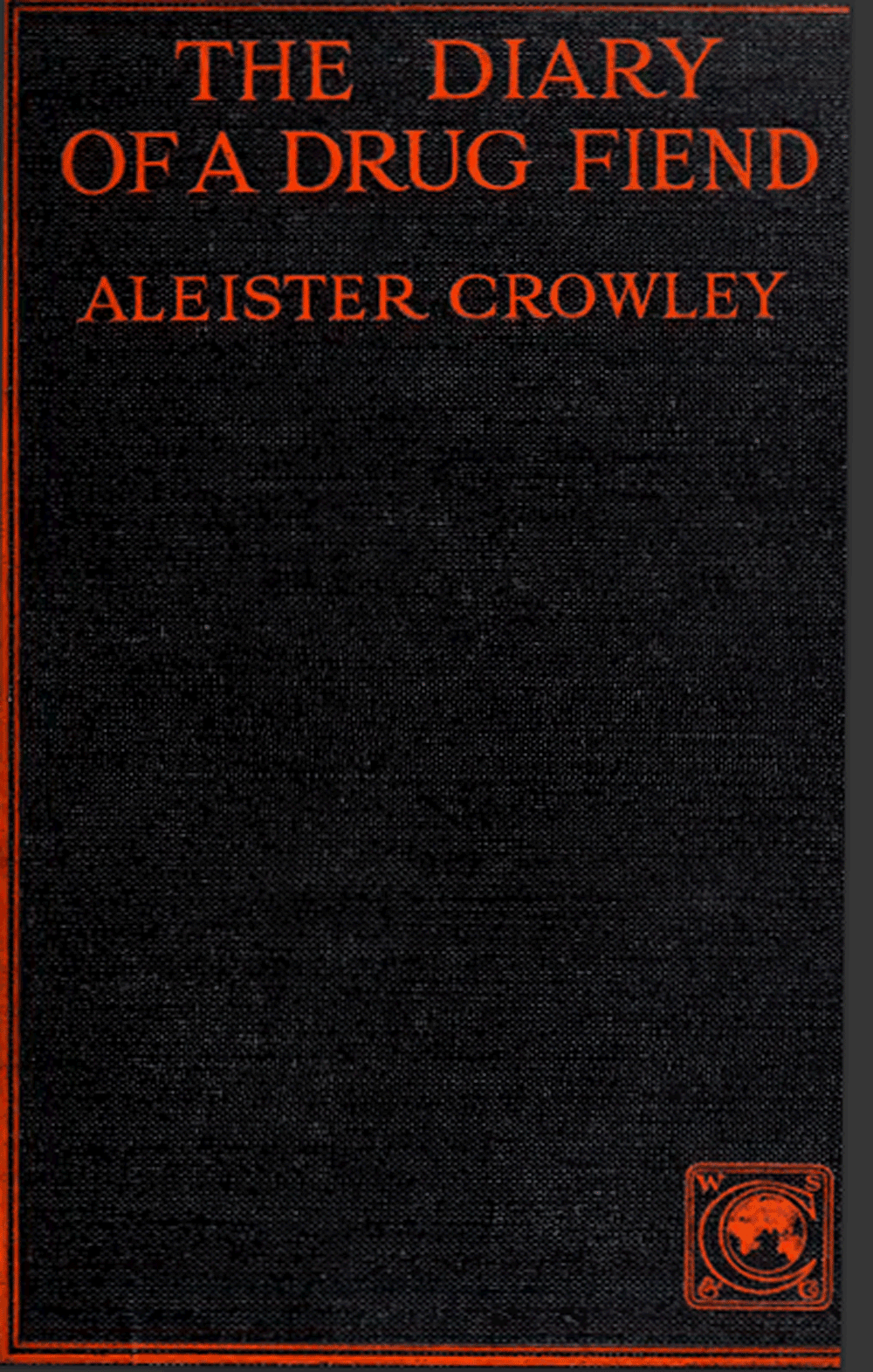
Diary of a Drug Fiend

This is the only full-cast recording of Aleister Crowley's 1922 classic paeon to common sense. It is the first book -- and so far almost the only book -- to stake out a philosophy of drug use that is compatible with human freedom, one in which we learn to use drugs as wisely as possible for the benefit of humanity. This recording was produced by the Drug War Philosopher and your purchases help support his effort to push back against the tragically counterproductive policy of drug prohibition, in the name of human freedom and of humanity's right to heal.

Purchase Your Copy


No cookies, no ads paid for by amoral and immoral billionaires (or trillionaires).


Unless otherwise indicated, no AI is used in the creation of site content. These essays represent the original ideas of their author and not the ideas that the author SHOULD have based on an algorithmic parsing of existing data. For more on this subject, consider the AI-related viewpoints to which the author subscribes as delineated in the New York Times opinion piece entitled "What 370,000 College Essays Tell Us About A.I.’s Effects on Creativity" by Rebecca Winthrop of the Brookings Institution.

The Partnership for a Death Free America is a proud sponsor of The Drug War Philosopher website @ abolishthedea.com.


Copyright 2026, Brian Ballard Quass Contact: quass@quass.com

tombstone for American Democracy, 1776-2024, RIP (up)