




Homepage of the Drug War Philosopher, Brian Quass
blog icon orange rss icon with stylized radio waves bird icon for twitter bird icon for twitter substack icon


back navigation arrow forward navigation arrow


Michel Foucault on Drugs

what the French intellectual said -- and what he SHOULD have said

by Brian Ballard Quass, the Drug War Philosopher

October 20, 2026


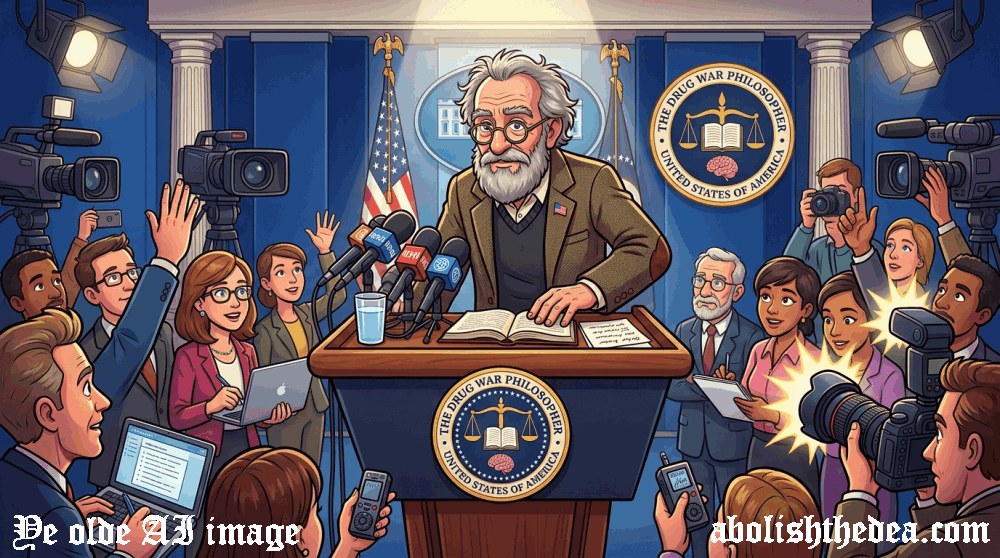
NARRATOR: Ladies and gentlemen, the Drug War Philosopher of the United States of America.

DWP: Thank you, friends. I'll make a brief statement and then I'll open up the floor to questions.

As you may know, I have begun studying the works of Michel Foucault with a view toward seeing what light the French philosopher might shed on drug attitudes, drug prohibition and the way that society punishes drug users today -- by which I mean anyone who dares to emulate the behavior of Benjamin Franklin and Thomas Jefferson in accessing Mother Nature's medicines without permission of the government and its powerful handmaiden in the psychoactive realm, the medical industry. The text with which I am launching this investigation is the Essential Works of Foucault 1954-1984 1 edited by Paul Rabinow, which, amazingly enough, is actually available in the public domain, where it appears to contain almost everything that Foucault ever wrote that was not published in a book. Let me warn you, however, that I have only so far read to page 76 of this rather substantial tome. I have arrived at the section wherein Michel is linking the origins of American "asylums" to the power dynamics that created various implementations of the idea of justice in western society, of which he has given a fascinating and thus far plausible account in the preceding pages. I will attempt only to make comments here today that I feel can be deduced or inferred conclusively from this sample material, meanwhile being sure to qualify any of my conclusions that might possibly be gainsaid by future reading.

I have called this press conference today for selfish reasons, so that you reporters can, as it were, drag my acquired insights out of me with your questions without my having to organize those insights into the time-honored essay format. Before you get to work on this extraction process, however, I have just one overall comment to make about Foucault and drugs, something that I can say decisively about his philosophy without having yet read past page 76 of the book in question: namely, the fact that Michel Foucault joins almost every other famous philosopher and author in the 20th century in completely ignoring the topic of drug prohibition, failing to realize the massive ramifications of that policy. I've searched the entire book, and there are no references to drugs whatsoever: none. This, I would suggest to you, is a massive oversight on the part of any philosopher, "however they have writ the style of gods, and made a push at chance and sufferance.2"

Think about it. The United States has outlawed all substances that used to make the citizenry independent of the medical system -- first and foremost, opium, which has been considered a panacea since the time of Galen -- and the rest of the non-indigenous world was eager to follow suit, often out-Heroding Herod when it came to the oppressive policies that they put in place in order to accomplish this disempowerment. In Singapore, you can be executed for selling plant medicine3. As I have tried to explain in my hundreds of essays over the last eight years, this criminalization has had endless downsides, including inner-city violence, the outlawing of academic freedom, the inability to symptomatically treat depression, the inability to symptomatically treat anxiety, the inability to symptomatically treat cognitive decline, the inability to create new religions based on substance-aided inspiration, and more generally, the inability of individuals to be sovereign over their own minds and moods, over how they think and feel about life. The outlawing of opium not only stopped us from treating common ailments, but it also gave the government a role in deciding whether we had a right to end our life early due to intense suffering -- say, for instance, with what Poe would call "an immoderate dose of morphine."

Just a few years ago, the moderator of the philosophy forum for philosopher Bernard Kastrup told me that drug prohibition had nothing to do with philosophy and that I should be discussing that subject in some niche forum. This is a typical viewpoint in modern academia: drug prohibition is considered to be a niche topic. Nobody bothers to connect the dots between drug prohibition and the problems that it causes. We have all seen promotional material from community organizations that are protesting gun violence in inner cities; but you will notice that none of these organizations are calling for an end to the drug prohibition that brought guns to the streets in the first place. We have all seen passionate appeals to spend money to end school shootings, yet none of these appeals call for an end to drug prohibition, even though that policy outlaws so-called empathogenic drugs whose therapeutic use could keep haters from wanting to shoot up schools in the first place. I myself have seen appeals from groups seeking to end the use of shock therapy on the depressed, and yet these groups refuse to condemn the drug prohibition that outlaws all substances whose wise use could make shock therapy unnecessary -- assuming that it is ever necessary in the first place.

I say nothing here about the kind of hands-on work performed by William James with psychoactive substances, which has been outlawed by drug prohibition. That fact alone should have convinced intellectuals like Foucault to protest drug prohibition as the outlawing of academic freedom.

In other words, there is a real epidemic of blindness here, and unfortunately Foucault himself fell prey to it.

Yes, your question?

REPORTER: What was Foucault's understanding of the origin of justice and how does it connect with the subject of drug prohibition?

Oh, dear. You're going to put me through my paces, aren't you? Foucault, as I understand him, rejects the idea that "justice" is some kind of inborn or transcendent condition a la Socrates but is rather a label that we attach, as it were, a posteriori to a series of established procedures that serve, at least generally speaking, to produce outcomes that are desired by the powers-that-be. What is understood as "justice" in any generation is actually the result of a procedural system created by those who hold knowledge-backed power. But I fear that I've headed out on a conjectural limb that is liable to crack at any moment. Let me put it this way. I think Foucault would say of various forms of justice what he says about political relations on page 17 of this book, namely, that they "have been established and deeply implanted in our culture, giving rise to a series of phenomena that can be explained only if they are related not to economic structures, to the economic relations of production, but to the power relations that permeate the whole fabric of our existence."

Fair enough?

REPORTER: And what's the connection here with drug prohibition?

Well, it's clear that drug prohibition is not about saving anybody given the fact that the policy has caused hundreds of thousands of needless deaths (in Mexico alone in the 21st century) and the fact that the powers-that-be have no worries about the most deadly drug of all, namely alcohol, and that we are happy to leave guns as available as possible notwithstanding mass shooting incidents, accidental deaths with guns and suicides. We have to ask therefore, cui bono? Who is benefiting from drug prohibition? And this is a question that an analysis a la Michel Foucault could help us to answer.

REPORTER: I see.

And let me start answering my own question as to who is benefitting from drug prohibition. The beneficiaries include, first and foremost, the medical industry, followed by law enforcement, the corrections industry, the rehab industry, the psychiatric industry, etc. Speaking of law enforcement, historian Richard Miller writes the following in Drug Warriors and their Prey:

The income that police receive through forfeiture is staggering. When drugs were found in raids of fraternity houses in Charlottesville, Virginia, police seized all the houses.4


Speaking of which, Foucault writes the following about what he calls the "diabolical" invention of the punishment of confiscation that developed in the early Middle Ages:

The guilty party was required not just to compensate for the offense he had committed against another individual but also to compensate for the offense he had committed against the sovereign, the state, the law. In this way there appeared, along with the mechanism of fines, the great mechanism of confiscations. These confiscations of property were one of the chief means for the great emerging monarchies to enrich and enlarge their holdings. The Western monarchies were founded on the appropriation of the judicial system, which enabled them to apply these mechanisms of confiscation. That is the political background of this transformation. 5


Before I take another question, I should clarify a statement that I made above. I said that drug prohibition is not designed to save anybody, but that is not entirely correct. It is generally designed to "save" white American young people from THEMSELVES at the cost of outsourcing drug dangers to other demographics, as for instance when we try to "save" white American junior by outlawing cocaine, only to bring about the disappearance of 60,000 young people in Mexico as drug cartels flourish thanks to that prohibition6.

Next question.

REPORTER: What else does Foucault say that might help us to end drug prohibition?

As the editors point out, Foucault thinks of liberalism as "the equivalent of a Kantian critique." It essentially educates the government by showing it "the intrinsic limits to its power to know" -- its power to know, for instance, which plant medicines can be helpful to a specific individual and which cannot. Liberals would explain to government why they cannot possibly make such decisions wisely. Unfortunately, most liberals -- and perhaps all neo-liberals -- in the United States remain committed to drug prohibition of some kind, so we have to question why liberalism is not functioning as advertised in this case. I would say that it's because intellectuals are lazy when it comes to the subject of drugs: on this one topic, they accept whatever the media tells them when they should know better. They should know that the media (in cahoots with government and the White House in particular7 8) is censoring all talk of beneficial drug use and spreading an anti-drug message in sitcoms and movies. This propaganda is omnipresent. I still remember Tom Brokaw as anchor on NBC News, urging me as a young person to say no to drugs. He actually told me (and millions of other young people) that this was a war and that we were all soldiers. Incidentally, I cannot find this quotation online, but it definitely transpired; I guess that's the kind of epigram that Brokaw fans are not interested in uploading for public consumption. They'd rather remember old Tom as an inoffensive baseball enthusiast.

The amazing thing is that almost all intellectuals took this drug propaganda at face value, as who should say, "Yes, it is a war, Tom, and by golly, those drugs are damn evil and should be fought against, tooth and nail. Gee golly, but you are so right!" I would suggest that philosophical societies do some research and then expel all members who were found to have passively accepted the party line on drugs in the Reagan '80s. The only problem is that such a punishment protocol would deplete their ranks, since almost no one who called themselves a philosopher at the time was pushing back against the pablum being served up by our Christian Science media. Be careful, though: if you use this strategy, your ranks may be decimated. You may have to admit gadflies like myself as members to your clubs without having the luxury of saying to yourself: "Oh, we have plenty of philosophers who are going to toe the party line about drugs, why should we let the Drug War Philosopher join in any of our reindeer games? He'll only be a party pooper!"

Just one more question?

REPORTER: Why do you even bother considering that all the powers-that-be ignore you?

It's funny that you should ask. I write for the purpose of producing "work," which Michel Foucault wonderfully defines as follows:

That which is susceptible of introducing a significant difference in the field of knowledge, at the cost of a certain difficulty for the author and the reader, with, however, the eventual recompense of a certain pleasure, that is to say of access to another figure of truth.9


REPORTERS: Mr. Philosopher! Mr. Philosopher!

DWP: Sorry, no further questions.


Notes for essay entitled Michel Foucault on Drugs: what the French intellectual said -- and what he SHOULD have said:

1: Foucalt. 2000. Essential Works of Foucalt. https://archive.org/details/essential-works-of-foucalt. (up)
2: “Much Ado About Nothing, Act V, Scene 1 :|: Open Source Shakespeare.” 2026. Opensourceshakespeare.Org. 2026. https://www.opensourceshakespeare.org/views/plays/play_view.php?WorkID=muchado&Act=5&Scene=1&Scope=scene. (up)
3: Ng, Kelly. 2025. “Singapore Executes Three Men for Drug Offences Over Two Days,” December 1, 2025. https://www.bbc.com/news/articles/c8dymv623q0o. (up)
4: Miller, Richard L. 1996. Drug Warriors and Their Prey. Praeger. https://www.goodreads.com/book/show/594749.Drug_Warriors_and_Their_Prey. (up)
5: Foucalt. 2000. Essential Works of Foucalt. https://archive.org/details/essential-works-of-foucalt. (up)
6: Mexico's war on drugs: More than 60,000 people 'disappeared' 2020 (up)
7: Carter, Marc Lacey with Bill. 2000. “Networks Let White House Drug Office Check Scripts / If Slant Deemed Right, Broadcasters Benefit.” Sfgate. January 14, 2000. https://www.sfgate.com/politics/article/Networks-Let-White-House-Drug-Office-Check-2784143.ph (up)
8: “How the White House and the Media Package Government Propaganda as Entertainment.” 2000. World Socialist Web Site. January 24, 2000. https://www.wsws.org/en/articles/2000/01/drug-j24.html. (up)
9: Foucalt. 2000. Essential Works of Foucalt. https://archive.org/details/essential-works-of-foucalt. (up)


read more essays here


Ten Tweets

against the hateful war on US


After over a hundred years of prohibition, America has developed a kind of faux science in which despised substances are completely ignored. This is why Sci Am is making a new argument for shock therapy in 2023, because they ignore all the stuff that OBVIOUSLY cheers one up.

Americans were always free to take care of their own health -- until drug warriors handed doctors a monopoly on providing mind and mood medicine.

If Fentanyl kills, then alcohol slaughters. Drug prohibition is the real killer.

MDMA legalization has suffered a setback by the FDA. These are the people who think Electro Shock Therapy is not used often enough! What sick priorities.

The U.S. government created violence out of whole cloth in America's inner cities with drug prohibition -- and now it is using that violence as an excuse to kick the people that they themselves have knocked down.

Mayo Clinic is peddling junk. They are still promoting Venlafaxine, a drug that is harder to kick than heroin.

Most enemies of inner-city gun violence refuse to protest against the drug prohibition which caused the violence in the first place.

Drug warriors are too selfish and short-sighted to fight real problems, so they blame everything on drugs.

"Abuse" is a funny term because it implies that there's a right way to use "drugs," which is something that the drug warriors deny. To the contrary, they make the anti-scientific claim that "drugs" are not good for anybody for any reason at any dose.

Musk and co. want to make us more robot-like with AI, when they should be trying to make us more human-like with sacred medicine. Only humans can gain creativity from plant medicine. All AI can do is harvest the knowledge that eventually results from that creativity.


Click here to see All Tweets against the hateful War on Us


back navigation arrow forward navigation arrow
Book Cover

Break the ice with a sledgehammer: place this book on your coffee table.

This book features 150 annotated images, designed to force brainwashed Americans to confront the fact that drug prohibition is wrong. Here is what author Richard Parrish II says of the book's compiler: "The drug prohibition philosopher provides first-hand, principled, persuasive, and insightful arguments against the current drug prohibition regime..."

Purchase Your Copy
Book Cover

Diary of a Drug Fiend

This is the only full-cast recording of Aleister Crowley's 1922 classic paeon to common sense. It is the first book -- and so far almost the only book -- to stake out a philosophy of drug use that is compatible with human freedom, one in which we learn to use drugs as wisely as possible for the benefit of humanity. This recording was produced by the Drug War Philosopher and your purchases help support his effort to push back against the tragically counterproductive policy of drug prohibition, in the name of human freedom and of humanity's right to heal.

Purchase Your Copy


No cookies, no ads paid for by amoral and immoral billionaires (or trillionaires).


Unless otherwise indicated, no AI is used in the creation of site content. These essays represent the original ideas of their author and not the ideas that the author SHOULD have based on an algorithmic parsing of existing data. For more on this subject, consider the AI-related viewpoints to which the author subscribes as delineated in the New York Times opinion piece entitled "What 370,000 College Essays Tell Us About A.I.’s Effects on Creativity" by Rebecca Winthrop of the Brookings Institution.

The Partnership for a Death Free America is a proud sponsor of The Drug War Philosopher website @ abolishthedea.com.


Copyright 2026, Brian Ballard Quass Contact: quass@quass.com

tombstone for American Democracy, 1776-2024, RIP (up)