




Homepage of the Drug War Philosopher, Brian Quass
blog icon orange rss icon with stylized radio waves bird icon for twitter bird icon for twitter substack icon


back navigation arrow


TEDxx Talk

Drug Prohibition and Healthcare Disempowerment

by Brian Ballard Quass, the Drug War Philosopher

September 24, 2026


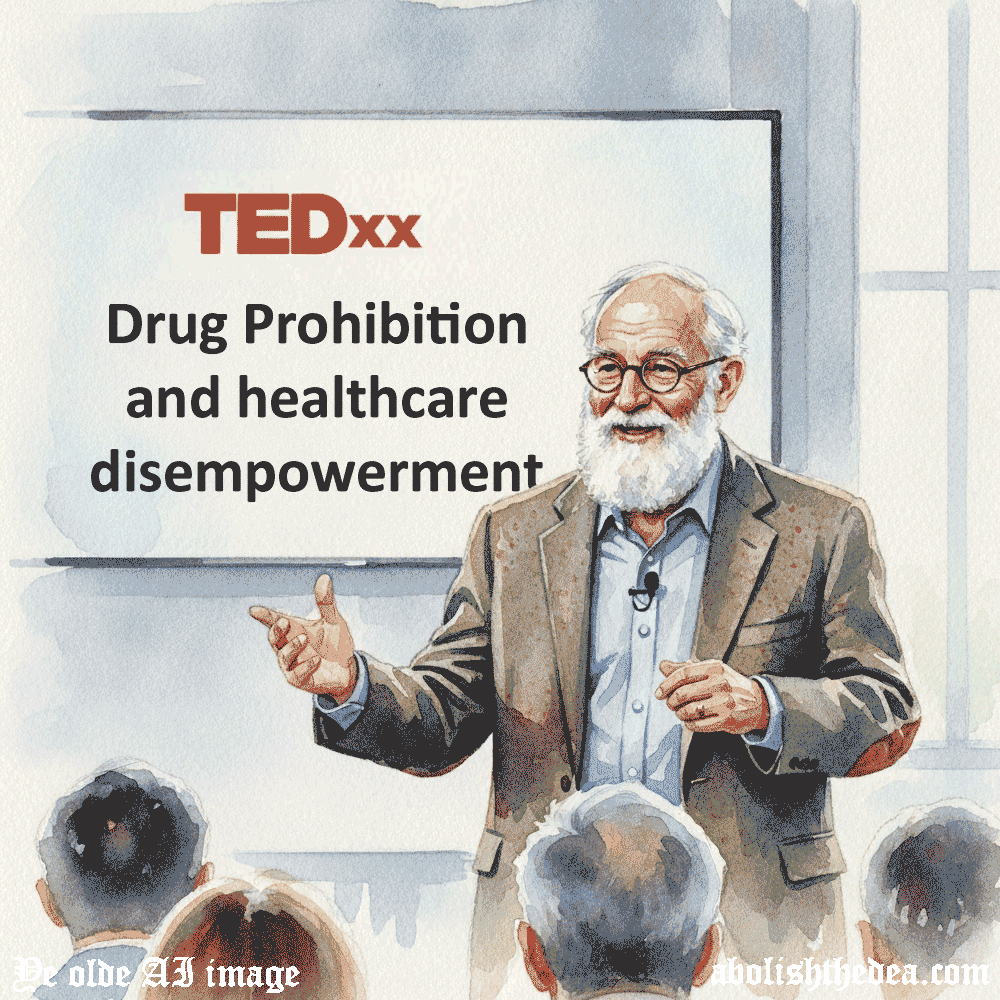
EMCEE: Welcome to the first in a series of TEDxx Talks. That's TED with two x's, folks. Like the TED Talks and the TEDx talks, the TEDxx Talks will seek to, and I quote, "discover and spread ideas that spark conversation, deepen understanding, and drive meaningful change." We will "inform and educate global audiences in an accessible way." And we will "bring together people from different backgrounds and disciplines to exchange and share ideas."1 Fair enough?

Of course, this takes money. Like the better-known TED Talks and TEDx Talks, the TEDxx Talks owes its existence to philanthropy. We all know how TED Talks is funded by billionaires through initiatives like the Audacious Project. Well, TEDxx Talks relies on money, too. We are funded by a donor whom I'm told has literally thousands and thousands of dollars in his bank account: some say as many as $20,000, but I suppose I shouldn't be telling tales out of school. Suffice it to say that the numbers involved here boggle the mind of us mere mortals. I just want to impress upon you the fact that the ideas we will be presenting are championed by deep pockets, and so it's not just anybody and their brother who is invited to stand up here against this minimalist backdrop of ours and hold forth. One really has to have something to say. Speaking of which...

Our first speaker needs no introduction. Many of you know him as the first philosopher to point out that state-assisted suicide for the depressed is nothing less than murder in an age when the state outlaws all substances that could make a depressed person wish to live.2

[cricket chirps]

I said, many of you know him as the first philosopher to point out that state-assisted suicide for the depressed is nothing less than murder in an age when the state outlaws all substances that could make a depressed person wish to live.

[applause]

That's more like it.

Others of you may know him as the first philosopher to point out that drug prohibition is responsible for the psychiatric pill mill thanks to which 1 in 4 American women now take a drug every day of their life.3

[applause]

Still others will know him as the first med-dependent patient to point out the direct connection between drug prohibition and healthcare disempowerment and the fact that drug prohibition has turned the depressed into wards of the healthcare state. 4

Anybody?

Remember? He pointed out that he has to see a doctor one-third his age every three months of his life in order to qualify for a refill on an expensive, underperforming and dependence-causing "med" that is harder to kick than heroin?

[applause]

Yes, indeed. How could we possibly forget THAT humiliating status quo? He's been turned into a child for life, after all.

A few of you may even know him as the first philosopher to draw a connection between the so-called bifurcation theory of nature of which Alfred North Whitehead spoke and the complete loss of common sense in the field of psychology when it comes to drug benefits. 5

[cricket chirps]

Really? No philosophers in the house?

[clapping]

Thank you to the young lady in row four!

But, of course, most of us know him as a presumptuous nobody who has to write imaginary scenarios like these in order to keep himself sane in an age in which drug superstitions have rendered the mainstream impervious to his every argument, be it never so logical.

[thunderous applause]

Let's hear it, please, friends, for the Drug War Philosopher from AbolishTheDEA.com!

[applause]

DWP: Thank you, Don Pardo, thank you, friends.

Well, since you all know me so well, I will begin with a bombshell revelation that I haven't even told my dog yet. I was actually fired by my own psychiatrist last year. I kid you not. I was "let go," so to speak, by my doctor shortly after I had finished with my year-long attempt to get off of the dependence-causing drug called Effexor, which I had found far harder to kick than heroin. The doc had not been happy with that attempt to begin with: he thought that Effexor was wonderful stuff and basically said that I was on my own in my attempts to get off it. I tried to pick his brain on the subject of drug compounding, since Pfizer does not create small doses for tapering purposes, but he seemed to know less on that subject than I did.

I won't give you the details of the year-long withdrawal process. I won't tell you how everything went fine until the last month when I suddenly was hit by a depression far worse than anything I had ever suffered in my life. I won't tell you about how I sat at the top of my staircase at 2 in the morning and realized I had two choices, that of suicide and that of going back to a lifetime of Effexor use. Such detail would be highly out of place in a generally upbeat narration of this kind. Suffice it to say, instead, that the withdrawal process failed. That's all you need to know. The important bit is the decision that I made AFTER this failure. I decided to 'make my peace' with my dependence and to get on with life at the customary dosage, not because I thought it was fair, but simply because I did not want to devote the last decade or two of my life to a painful psychopharmacological struggle that would render me unable to even lodge a coherent protest against drug prohibition. I say this because one of the results of that attempted withdrawal was incapacitating brain fog.

By the way, the emcee missed one of my accomplishments, if I do say so myself. You may ALSO know me as the first philosopher to point out the links between Thomas Szasz's ideas on psychiatry and his ideas on drugs. I find that most fans of Szasz focus on only one of those two aspects of his work, whereas the power of Szaszian analysis, in my view, comes from the combining of those two topics. Szasz was interested in patient disempowerment, after all, and what could be more disempowering than drug prohibition, which outlaws all symptomatic behavioral medicine and places all sufferers on "meds" that they have to take for life, thereby turning them into eternal patients. Yes, indeed. It's not just the mental patients who are hospitalized against their will who are disempowered. It's the entire population of the west when it comes to behavioral healthcare.6

But where was I? Oh, yes, I was fired by my own psychiatrist.

It was funny, because the bombshell came in response to a message post of mine that I thought would have sat well with the doc. I told him that I had decided, for utilitarian reasons, to go back to "business as usual" when it came to Effexor. I had decided to "get back on the drug." Isn't that what he had wanted all along, for me to stay on Effexor? Unfortunately, I did include some requests that I now see in retrospect must have infuriated the man, given his insistence on "playing by the book" when it comes to psychiatric protocol. I pointed out that I lived 45 miles away and that office visits for refills would ideally be kept to a minimum and perhaps even handled via computer. I pointed out how my previous Sentara doc had let me go for almost an entire year without office visits. I pointed out how I had been visiting doctors for 45 years now and that they might now suppose me to be responsible enough to "take my meds" without constant oversight.

So I clicked the "submit" button, meanwhile patting myself on the back with my free hand for standing up for my interests at long last when it comes to refill protocol.

Little did I foresee the rebuff that I was to receive in 24 hours when I re-entered the Sentara message app in order to read the good doctor's reply.

"I'm sorry that this is not the response you were expecting," quoth he, "but I have decided to terminate our relationship." Then he said something about me questioning his integrity?

"Questioning his Integrity?", I thought to myself What? Who? When? Why?

Well, he was right about one thing, this was certainly not the response that I had been expecting. I had just been through a week of hell with Effexor. I was expecting something more along the lines of: "Well, you gave it a yeoman's try, Brian. It's good that you can view the matter practically and not suffer unnecessarily, whatever your philosophical or political viewpoint may be." In short, I was expecting him to say, "Welcome back, Prodigal Son. Welcome back into the psychiatric fold!"

And so I racked my brains. What had I said to offend this guy, other than to express my contrary opinions about Effexor?

Then I remembered. I had phoned the Sentara Healthcare Hotline several months ago to complain about delays in filling a prescription. Okay, I thought to myself, enough said. I am just another whistleblower to be fooled into thinking that his complaints were being treated confidentially. The only surprising thing here is that I had never been fired by a psychiatrist before. The one thing that they all had in common over the last half century was their ineptitude in filling my prescriptions. I wish I had a bitcoin for every time I showed up at a pharmacy over the last 50 years, only to have the pharmacist tell me that the doctor had not yet "called in" my prescription.

Well, there's nothing like blatant unfairness to ignite the dormant volcano of one's writing skills. You could have fried an egg on the prose that I vouchsafed the good doctor by way of response. I wish I had preserved a copy. As I recall, it was just three terse sentences that said it all, as far as I was concerned, so much so that I did not even feel an urge to add any indignant follow-ups, as is sometimes the case when one gets into a flame war with a hater. I felt that, whatever he might write going forward, I could just point at my original response and say, "What I said!" Besides, I wasn't going to stick around and wait for a response in any case. He may have fired me, but I had fired him as well, as far as I was concerned. "You can't fire me," I thought to myself, "I quit!"

Of course, this doctrinaire psychiatrist of mine was really doing me a favor. He was forcing me to do something that I should have done years ago: get off my duff and find a psychiatrist who would meet with me remotely, via video chat.

The search for such a doctor was revealing in itself. I found that most remote doctors insisted on trimonthly visits, despite my 40-year history of taking Effexor. Indeed, they came close to saying that anything else would be illegal. I finally found one doctor who would see me every six months. Unfortunately, she switched provider networks after our first remote visit, so now I'm back with a doctor who is an exponent of the trimonthly school of prescription refills. To be fair to this latter doc, however, she was quite generous in our most recent virtual office visit: she told me that she was going to let me go four whole months this time before the next office visit, apparently so that I could enjoy the Christmas holidays without having to worry about doctor appointments. Four whole months! She must really trust me. That's one whole extra month without monitoring. God knows what I might do! Can I even trust MYSELF with such freedom? I must really strive hard to remain responsible and avoid any temptation to start abusing the drug or selling it on the street. "Psst, hey, you. Are youse looking for a drug that will only mildly improve your mood while turning you into a ward of the healthcare state?" If I tried to sell Effexor on the street, I would become the world's first drug dealer to have a losing business model. I can hear me now: "I can't figure out why nobody's buying my dope, the doctors themselves say that Effexor is a miracle drug!"

I'm finding it very hard to take my new psychiatrist seriously, by the way. I am just seeing her for a refill on a prescription that I have been taking for over 30 years, and yet she actually asks me questions like: "Have you been hearing voices lately?" Have I been hearing voices? I consider that question to be a non-sequitur under the circumstances. My utility company might as well ask me if I have been hearing voices after I pay my electric bill. Have I been hearing voices? I always want to respond as follows: "No. Have YOU?" And it's not like she's asking me a "pro forma" question, either. She asks in such a way as to suggest that there is a high probability that I might answer "yes." And then there's the obligatory question about "offing" myself, that I've been asked every three months for decades now: "Have you considered suicide?" -- to which I always want to respond: "Only when I think how drug prohibition has turned me into an eternal child and a ward of the healthcare state." Or better yet: "Check my track record, lady. Have I ever committed suicide in the past?"

Oh, I see that my time is up.

I'd like to thank the people at TEDxx for giving me the chance to speak up about the anti-patient status quo. Remember, however, I am not just advocating for patient rights, here; I am advocating for the rights of chronic depressives like myself not to be patients in the first place.

I can see, however, that some of you out there are still having trouble placing me. Let's see, how can I prod that grey matter of yours? Oh, I know. You might remember me as the only guy in the world (ethicists included) who is saying that depressed Canadian Clare Brosseau does not need a newfangled right to state-assisted suicide no matter what she says, that what she simply needs is the restoration of her time-honored right to use the godsend medicines of Mother Nature that grow at her very feet.7

Still nothing, huh? Well, you might also recognize me as the guy whose ideas about the rights of med-dependent patients are censored by Mad in America, which refuses to recognize the outlawing of Mother Nature as the outlawing of my right to heal but which instead pretends that scientists are the experts in how I should be allowed to think and feel in this life. 8

No? Still nothing? That's funny. Well, keep thinking about it. I'm sure you'll remember me eventually. Between the emcee and myself, we've certainly given you plenty of contexts in which to do just that.

EMCEE: Let's hear it for today's first TEDxx speaker, the Drug War Philosopher from AbolishTheDEA.com.


Notes for essay entitled TEDxx Talk: Drug Prohibition and Healthcare Disempowerment:

1: “TED Talks.” 2019. Www.Ted.Com. 2019. https://www.ted.com/about/programs-initiatives/ted-talks. (up)
2: Half-Off on State Assisted Suicide DWP (up)
3: Thomas Szasz, Drug Prohibition, and the Psychiatric Pill Mill DWP (up)
4: How drug prohibition damaged my uncle's brain and turned me into a ward of the healthcare state DWP (up)
5: Whitehead and Psychedelics DWP (up)
6: On Szasz, Whitehead, Dualism and Beneficial Drug Use DWP (up)
7: Open Letter to Claire Brosseau DWP (up)
8: Madder in America DWP (up)


read more essays here


Ten Tweets

against the hateful war on US


If we encourage folks to use antidepressants daily, there is nothing wrong with them using heroin daily. A founder of Johns Hopkins used morphine daily and he not only survived, but he thrived.

It's funny to hear fans of sacred plants indignantly insisting that their meds are not "drugs." They're right in a way, but actually NO substances are "drugs." Calling substances "drugs" is like referring to striking workers as "scabs." It's biased terminology.

Drug War propaganda is all about convincing us that we will never be able to use drugs wisely. But the drug warriors are not taking any chances: they're doing all they can to make that a self-fulfilling prophecy.

People magazine should be fighting for justice on behalf of the thousands of American young people who are dying on the streets because of the drug war.

Even when laudanum was legal in the UK, pharmacists were serving as moral adjudicators, deciding for whom they should fill such prescriptions. That's not a pharmacist's role. We need an ABC-like set-up in which the cashier does not pry into my motives for buying a substance.

The goal of rehab should not be to get people off of all drugs, it should be to teach them to be in control of their drug use and to use drugs wisely for beneficial purposes.

After over a hundred years of prohibition, America has developed a kind of faux science in which despised substances are completely ignored. This is why Sci Am is making a new argument for shock therapy in 2023, because they ignore all the stuff that OBVIOUSLY cheers one up.

Trump's lies about America's voting process are typical NAZI and DRUG WAR strategy: raise mendacious doubts about whatever you want to destroy and keep repeating them. It's what Joseph Goebbels called "The Big Lie."

In a sane world, we would learn to strategically fight drugs with drugs.

We won't know how hard it is to get off drugs until we legalize all drugs that could help with the change. With knowledge and safety, there will be less unwanted use. And unwanted use can be combatted creatively with a wide variety of drugs.


Click here to see All Tweets against the hateful War on Us


back navigation arrow
Book Cover

Break the ice with a sledgehammer: place this book on your coffee table.

This book features 150 annotated images, designed to force brainwashed Americans to confront the fact that drug prohibition is wrong. Here is what author Richard Parrish II says of the book's compiler: "The drug prohibition philosopher provides first-hand, principled, persuasive, and insightful arguments against the current drug prohibition regime..."

Purchase Your Copy
Book Cover

Diary of a Drug Fiend

This is the only full-cast recording of Aleister Crowley's 1922 classic paeon to common sense. It is the first book -- and so far almost the only book -- to stake out a philosophy of drug use that is compatible with human freedom, one in which we learn to use drugs as wisely as possible for the benefit of humanity. This recording was produced by the Drug War Philosopher and your purchases help support his effort to push back against the tragically counterproductive policy of drug prohibition, in the name of human freedom and of humanity's right to heal.

Purchase Your Copy


No cookies, no ads paid for by amoral and immoral billionaires (or trillionaires).


Unless otherwise indicated, no AI is used in the creation of site content. These essays represent the original ideas of their author and not the ideas that the author SHOULD have based on an algorithmic parsing of existing data. For more on this subject, consider the AI-related viewpoints to which the author subscribes as delineated in the New York Times opinion piece entitled "What 370,000 College Essays Tell Us About A.I.’s Effects on Creativity" by Rebecca Winthrop of the Brookings Institution.

The Partnership for a Death Free America is a proud sponsor of The Drug War Philosopher website @ abolishthedea.com.


Copyright 2026, Brian Ballard Quass Contact: quass@quass.com

tombstone for American Democracy, 1776-2024, RIP (up)