A review of The Case Against Reality, the 2020 book by psychologist Donald Hoffman
by Brian Ballard Quass, the Drug War Philosopher
September 22, 2026
INTRODUCTION
Seven years ago, I was invited to leave the Bernardo Kastrup1 philosophy forum because of my posts about human consciousness. I felt that a discussion of drug effects was crucial to an understanding of human consciousness, but the moderator begged to differ. He politely told me to "beat it," admonishing me that the discussion of drugs belonged in a niche forum devoted specifically to that topic, not in the lofty precincts of a high-minded philosophical forum. Humph! This astonished me because William James knew better, although he employed the word "anesthetics" in place of "drugs" given his own substance usage pattern. 2 James had discovered whole new worlds of consciousness with the help of the psychoactive substance known as nitrous oxide. He insisted that philosophers needed to study such realms in order to understand the nature of reality. It follows that philosophers need to use psychoactive substances. How is that not relevant to the study of consciousness? But I could take a hint. I knew when I was not wanted. So I scuttled off to do my own thing in my own way.
After a brief but irritating attempt to post my seemingly heretical viewpoint on Reddit, I got tired of the juvenile feedback and the way that hair-trigger bots seemed to be censoring me whenever I attempted to speak positively about drug use. So I finally decided to create my own website and write essays on drug-related topics under the moniker of The Drug War Philosopher. In performing research for that purpose, it soon became apparent to me that the extraordinary effects of various psychoactive substances on human mood and mentation had crucial relevance to the philosophical discussion of such topics as perception and consciousness, so much so that they call into question the veracity of much generally accepted dogma on those topics. Take the ideas of Immanuel Kant, for instance.34 The "Sage of Konigsberg" presupposed the existence of one single kind of consciousness, namely the rational consciousness of a "sober" westerner, given how westerner's define the word "sobriety." Once we admit James' view that this is just one form of consciousness that Kant is presupposing here or, in other words, once we acknowledge the results of substance use, we have to question the supposed universal applicability of Kantian categories when it comes to human understanding.
THE BOOK
I mention this backstory by way of introducing the reader to a book that was frequently mentioned approvingly in the Kastrup forum: "The Case Against Reality" by Donald Hoffman, published in 2020.5 As a fan of the study of consciousness, I felt duty bound to read this book at some point, but I had put off doing so for over six years because my general impression based on forum content was that Hoffman was starting with some dubious assumptions. I felt that Hoffman was missing something. I felt that he might even have an axe of some kind to grind. And as much as I hate to say that I told myself so, I was right. Not once -- not once -- does Hoffman refer to what drug effects might have to tell us about human perception and consciousness. No wonder the group moderator did not believe that drug effects were relevant to the discussion of human consciousness: the great Donald Hoffman himself had ignored the subject of drugs altogether in his new book. Not only does Hoffman ignore the work of William James with laughing gas but he ignores the modern phenomenon of the DMT experience as well. Both would seem ("prima facie") to have something to tell us about human consciousness. If Hoffman thinks otherwise, he should at least tell us why, rather than simply ignoring the subject altogether. One has to ask, what is going on here? Is Hoffman forcing his philosophy to fit into a mold that will be acceptable to drug prohibitionists, or is he simply shielding his drug-neutral philosophy from criticism by playing it safe and pretending, like most mainstream professionals these days, that drugs do not exist -- except as evil things that those people "do" whom we have been taught to hate?
Does Hoffman not keep up on modern trends? Since well before his book's publication date, thousands of online psychonauts have been reporting bizarre experiences under the influence of the naturally occurring substance known as DMT. 6789 They were seeing multi-colored worlds with fractal-like backgrounds, pulsating geometries populated with sentient beings. Stranger still, these entities seemed to belong to specific types of creatures that turn out to be common to most DMT experiences, creatures that can be identified, not just by their appearance but by their perceived intentions toward the tripper as well, as for instance the generally friendly "machine elves" of which Terence McKenna spoke1011, those self-transforming and often prankish entities that welcome the user to the DMT experience and guide them on their journey. Such experiences suggest a whole world full of intriguing questions about the nature of human consciousness, if not about consciousness writ large. Hoffman is welcome, of course, to say otherwise; he is free to tell us that there is no "there there" when it comes to so-called "altered states," that both William James and these trippers are irrelevant to the discussion of consciousness, but he should at least tell us why he is a non believer. Instead, he just ignores the topic altogether. Nor is it just the subject of drugs that Hoffman ignores in this book. He never mentions the philosophers that one might have thought to be central to a discussion of consciousness, including Whitehead12 and Bergson13. But then Hoffman considers "Darwin's idea" to be a "universal solvent," so we're apparently meant to assume that there is nothing left of any of our holistic philosophers these days except for the burnt and tattered remnants of the clothes that they were wearing when they last pontificated on the subject of human freedom and self-transcendence.
I have one additional scruple about Hoffman's book. The author never considers how the starting assumptions of a reductive materialist might sound to the hundreds of millions of aboriginal people in the world. The so-called "Astonishing Hypothesis" of Francis Crick that Hoffman keeps touting throughout the book would surely sound odd to them, if not positively offensive. Indeed, the passion-scorning presumption of that credo is deeply offensive to westerners themselves when considered against the backdrop of Nazi atrocities. To be fair, Hoffman does point out that there is more to life than species fitness, but all of this "more" is composed of actions that are performed in the interest of that fitness: as such, these actions can be either good or bad from the standpoint of conventional morality.
Now that I've told you what Hoffman does not talk about in his book, let me tell you what he does talk about. Hoffman believes that we are all conscious agents who do not see reality as it is but rather what natural selection "wants" us to see. And what does natural selection want us to see? It wants us to see the world in a way that will help us to procreate and to keep the species going. Natural selection generates our consciousness accordingly. This is Hoffman's Interface Theory of Perception, ITP, the idea that the world we see consists of icons designed to help us stay fit in order to procreate. Like computer icons, the things in the world are symbols for some unknown reality beneath, just as a computer icon is not the data itself but rather the symbol for the data. And so Hoffman tells us that "Fitness Beats Truth," FTB. The truth is hidden from us but the road to fitness, so to speak, is marked out for us by our perceptions. It is natural selection that somehow supplies us with the perceptions that we need to survive for the purposes of procreating. And so instead of seeing what's "really" out there, we see what will help us to leave behind healthy offspring. Of course, this desire to leave behind healthy offspring must be expressed very indirectly indeed in the actions of an elderly man or a woman who is beyond her child-bearing years, but Hoffman has no doubt that it does operate at all times, no matter how indirectly, to guide us toward the most species-friendly actions.
THIS IS NOT YOUR GRANDMOTHER'S DARWINISM
Notice that this is more than the typical Darwinian credo at work here, it is a truly metaphysical Darwinism, it is Darwinism uber alles. The following three citations demonstrate how Hoffman assigns primordial importance to natural selection in creating our perceptions of the world.
Our perceptions of space-time, and objects were shaped by natural selection not to be veridical, not to reveal or reconstruct objective reality but to let us live long enough to raise offspring.
Outlook on space-time and objects flows from the idea that our perceptions have evolved to encode fitness payoffs and to guide adaptive behavior.
Space-time is not an objective reality independent of any observer it is an interface shaped by natural selection to convey messages about fitness.
As Hoffman himself admits, this is a minority viewpoint. Most people believe that we see "what's out there." When we ask them why, they may even invoke evolutionary theory to justify their belief; they may tell us that natural selection has an interest in showing us "what's really there" so that we can survive and procreate. And this is ironic because Hoffman invokes natural selection too, and yet he draws an opposite conclusion after looking at the same set of facts. And herein lies the problem -- or rather yet another problem -- with Hoffman's ideas on consciousness. They rely for their justification on a series of demonstrably subjective judgments about the "facts on the ground." Hoffman attempts to explain the limits and limitations of human perception with an appeal to the omnipresent and universal action of natural selection. He therefore must give us what biologist Michael Behe14 called a series of "just-so" stories about why animals and human beings act the way that they do: why giraffes have long necks, why teenagers like the smell of pizza, why lemons taste sour, etc. He must show us how not only the actions of sentient beings but their very morphologies have, as their ultimate goal, the survival of the species. Now, I am not a creationist. I am not, nor have I ever been, a member of a fundamentalist church; but I have always been bothered by the ease with which Darwinists come up with explanations for animal morphology in order to show a connection with natural selection. If a creature has a red body, we're told it's to ward off danger by using a garish color; if they don't have a red body, we're told it's to ward off danger by becoming inconspicuous. Insofar as natural selection relies on such "proofs," it is incapable of falsification.
HERETICS BEWARE
This is why I really feared reading Hoffman's book. I sensed that Hoffman had wrapped himself up in the flag of evolution, and so anyone who dares attack him will be considered to be a pseudoscientist. Take the researcher Michael Behe whom I mentioned above. Thanks to his involvement with the Intelligent Design theory, he is libeled on Wikipedia to this very day as a "pseudoscientist," by those white western males who think that the purpose of an online encyclopedia is to impose their metaphysical view of the world on readers. They know that they are thereby pleasing their hero, Richard Dawkins15, who is constantly telling them in so many books that they should be as mean-spirited as possible when it comes to Darwinian heretics. But even the atheist philosopher Thomas Nagel saw through this full-court press of intolerance in the scientific field when he wrote as follows in his tellingly titled 2010 book, "Mind and Cosmos: why the materialist neo-Darwinian conception of nature is almost certainly false":
"Even if one is not drawn to the alternative of an explanation by the actions of a designer, the problems that these iconoclasts pose for the orthodox scientific consensus should be taken seriously. They do not deserve the scorn with which they are commonly met. It is manifestly unfair."16
I hope that this citation from one of America's best-known modern philosophers will indemnify me from all charges of creationism in this essay.17 It is clear enough that creatures adapt to their environment, after all. But Hoffman is saying far more; he is saying that this adaptation for the purposes of species propagation is the be-all and end-all of existence, that it determines the nature of our perceptive abilities and hence of our consciousness itself. And that's it, according to Hoffman, that's what life is all about. "Life solved," says Hoffman. "Next!" In fact, Hoffman is so indifferent to all other considerations that he agrees with the so-called "Astonishing Hypothesis" of Francis Crick, the poster child for the reductionist philosophy of "nothing but-ism," when he tells us that...
THE ASTONISHINGLY SIMPLISTIC HYPOTHESIS
You, your joys and your sorrows, your memories and your ambitions, your sense of personal identity and free will, are in fact no more than the behavior of a vast assembly of nerve cells and their associated molecules. You're nothing but a pack of neurons.
As Carl Sagan reminds us, "Extraordinary claims require extraordinary proof."18 Of course, Carl said that with the understanding that his motto would oblige us to rule out spiritual ideas and teleology, or purpose, in life at every scientific turn, but that motto cuts both ways. No claim could be more extraordinary than that human beings are "nothing but" a pack of neurons. That claim is as extraordinary as it gets when considered in light of human history with all its intensely felt meaning. Indeed, the extraordinary nature of Crick's claim is noted in the very title that Crick gives to the belief; he himself calls it an "astonishing" hypothesis, and "astonishing" is nothing but a synonym for the word "extraordinary." Yet Hoffman gives us extraordinarily poor proof of Crick's hypothesis insofar as he completely ignores what drug-aided experiences can tell us on the subject. Since Hoffman does not explain this omission, we can only assume that he "rules out" experiential epistemology a priori. He rules out what Henri Bergson called intuition. To Hoffman, we learn truths by rationality and analysis using the imperfect human-created tool called language, not by experience.
The irony is that if both Hoffman and Crick are right, then there is no reason to believe what either of them say: they are simply saying what they have to say in a world whose only "truth" is that which accords with adaptation for the ultimate purpose of keeping a species alive. Hoffman wants to privilege rationality while undercutting its pedigree, while denying that rationality has any raison d'etre. He seems to think that we can, as it were, "factor out" our evolutionary biases and in so doing we will uncover deeper truths beyond them, but then how can there be any deeper truths if we are all just a pack of neurons? Because Hoffman ignores both experiential epistemology and intuitive knowledge, he has nothing left in his bag of tricks once he has explained away perception as a tool of natural selection.
WAKE UP!!!
Let me pause here to wake up any nodding reader to remind them that this topic is hugely relevant to everyday life! There is a clear connection here between Hoffman's indifference to drug effects and the fact that I have gone a lifetime now without godsend medicines that grow at my very feet.
Just as Hoffman can see no connection between drug user reports and human consciousness, our drug researchers can see no connection between drug user reports and psychological healing. They cannot see how cocaine, or laughing gas, or opium, or phenethylamines, or tryptamines, etc., could have any positive uses, even when they hear the users insisting otherwise, even when they hear the users insisting that they are happy for the first time in their life or are able to feel comfortable in their own skins. "So what?" says the materialist. "We need to view the matter objectively, not based on your subjective feelings!" The key point is this, that Hoffman and drug researchers both ignore drug user reports for the same reason: they both believe that truth comes only from rational analysis and that scientists who rely on the impressions of drug users are New Age charlatans. Science, they say, must decide what works for people via rational analysis, just as science must decide about the nature of the cosmos via rational analysis; scientists are the experts on such metaphysics, not passionate human beings. In a recent Vice story about a DMT trial at Johns Hopkins, 58% of DMT users experienced a spiritual awakening19, but Hoffman does not want to hear such testimony, any more than drug researchers want to hear the testimony of an erstwhile atheist who acquired a belief in higher powers after using the substance. That is just a subjective opinion, after all, and so has no place in "science" as Hoffman defines the term.
THE SYSTEM IS RIGGED
This brings us to a truth that is unrecognized by today's scientists: the fact that the scientific method, by definition, presupposes the falsity of holism. The supposedly "scientific" approach to studying holism would be for us to study it after taking it apart, which is a self-defeating protocol. And our reductive materialists have another way of ignoring holism. They insist that truth must be capable of being formulated in human words and numbers. But may we not ask, why? What if the truth about life ends up being experiential by nature and incapable of being captured in our necessarily imperfect and prejudicial human languages, mathematics included? Isn't science a search for the truth about the world? Or is it just a search for truths that are simple enough to be mirrored accurately in our clumsy and necessarily imperfect human languages? Our materialists have written the ground rules for modern science in such a way as to debar the opposition from participating. They have done this by defining the word "proof" in a way that assumes the validity of materialism. They have assumed, in short, that the truth must be capable of being formulated in human words; no experiential truths allowed.
MORE ASTONISHMENT
Another word about the "Astonishing Hypothesis."
This is the credo of materialist curmudgeons everywhere. Of course, everyone's entitled to their own opinion, but this statement declares by fiat what should be established (if possible) by experiential investigation a la William James: that life is meaningless and the sooner we get used to it, the better. It tells us that we are just the sum of our inherently meaningless parts. To me, this is an offensively premature conclusion when considered in the light of human history of just the last one hundred years alone. And a word about Francis Crick. Hoffman suggests that his discovery of DNA somehow proved Darwinian theory to be true. That is not so. To understand this, we simply have to ask the following question: Why did Francis Crick propose the theory of "panspermia" in 1970, the idea that life came to earth from outer space? Answer: Because it just did not seem probable to Crick that the random genetic changes required by Darwinian evolution could, as it were, stumble into creating DNA, a coding system that is so eerily reminiscent of human programming code. As Bill Gates himself remarked in The Road Ahead: "Human DNA is like a computer program, but far, far more advanced than any software ever created." 2021 This is why Francis Crick, the man whom the Atlantic dubbed "The Twentieth-Century Darwin," felt compelled to direct our gaze skyward for the origins of life in his 1972 paper entitled "Directed Panspermia," thereby admitting that, as far as he was concerned, evolution was simply "not up to the task" of creating DNA, at least not on this planet. Instead, Crick speculates hopefully that:
There may be other types of planet on which the origin of life ab initio is greatly more probable than on our own. 22
Directed Panspermia
But then why should we even take Crick seriously? If his astonishing hypothesis is true, then he himself is just a pack of neurons. What could he know?
One final point before I respond to some actual quotations from Hoffman in "A Case Against Reality." Hoffman adopts Hume's position that there is no rational connection between cause and effect.23 He seems unaware of the way that Whitehead solved this problem, or at least helped to clarify it. Whitehead's insight was that it is presumptuous of us to look for "a" single cause for an effect in the first place. There is no single cause. The cause of an event is basically nothing less than the history of the universe up to the point that the effect obtains; the effect is not caused by what went before so much as it was immanent in what went before. This is just another way of saying that life must be considered holistically, which is, as shown above, the one way that today's scientists refuse to see the world.
Having thus stipulated my chief philosophical scruples with Donald Hoffman's book, I will now provide responses to specific potentially problematic statements that it contains. I have attempted to present these quotations in the order in which they appeared in the book.
A-PARSING WE WILL GO
"I don't try to solve the mystery of consciousness, but I do try in the coming chapters to dethrone a belief that hinders a solution. "
High marks for Donald on this comment. I agree with him in this, that our current view of perception is naive, to put it mildly. More power to Donald in dethroning the belief that we see what is "really there." I was astonished when Donald reported that most vision scientists actually believe that what we see is basically "what's out there," the so-called veridical view of the matter. Psychological studies, optical illusions and, yes, drug experiences suggest quite otherwise. As does classic literature. As the protagonist complains in Le Horla by Guy de Maupassant:
"How deep it is, this mystery of the Invisible! We cannot fathom it with our miserable senses, with our eyes that perceive neither the too small, nor the too great, nor the too near, nor the too distant, nor the inhabitants of a star, nor the inhabitants of a drop of water ... with our ears that deceive us... with our smell, feebler than a dog’s ... with our taste, that can only just detect the age of a wine. If only we had other organs to work other miracles on our behalf, what things we could discover round us!" 24
Guy de Maupassant -- The Horla
To which I would add: we do not need other organs, Guy: we can use psychoactive substances, as user reports amply demonstrate. But Hoffman says absolutely nothing about drug-aided experiences. Hoffman elaborates on this general topic, however, as follows.
Physics reveals that we often fail to notice what is too fast or slow, too big or small, or simply outside the band of electromagnetic waves that we can see. ITP is saying something much deeper. It says that even though we can, with the help of technology, observe all these new things, we are no closer to seeing reality as it is. We are just exploring more of our interface, more of what happens within the confines of space and time.
To which I would add, we do not need technology, Donald: we can use psychoactive substances.
Elon Musk wants to solve mental health problems by planting technology in our brains, but it would be both absurd and bizarre to go down that path while refusing to see what the psychoactive substances of Mother Nature can do for those with psychological issues.25 It says volumes about the scientistic American mindset that we would be comfortable with implants created by trillionaire techies but fear and tremble before plants provided by nature itself. By the way, this is not some drug-addled hippie speaking, Don, I am merely channeling William James, who told us that we must learn from the worlds of consciousness that are opened to us by the use of psychoactive substances. Unfortunately, James' use of nitrous oxide is politically incorrect in the age of drug prohibition. His alma mater, Harvard University, does not even mention the anesthetic in their online bio of the man, even though he credits it with changing his whole philosophy of life.26 But then they are not alone in their rewriting of James' legacy. The lengthy article on James in the Stanford Encyclopedia of Philosophy says nothing about James' use of laughing gas27 At least this bothers one philosopher in this world, videlicet myself. I have attempted over the last seven years to arouse indignation on James' behalf in my fellow philosophers, but have been ignored, even by those organizations that purport to be honoring James' legacy. When I was reminded of this injustice during the creation of this essay, I felt obliged to write a protest letter to the editors at the Stanford Encyclopedia of Philosophy. I have copied that letter in the afterword section of this essay.
"ITP says that a taste is illusory if it prompts behaviors that are unadaptive."
Hoffman seems to be saying that if a sensation is wrong for practical purposes, then it is illusory. But "illusory" is an ontological epithet. If our fitness-aiding "interface" tells us nothing about the world "as it really is," how can it tell us something about the world "as it really is not"? Is he saying a la Percy Shelley that: "Species reproduction is truth, and truth is species reproduction; that is all ye know on earth, and all ye need to know"?
“Science can also mystify the mundane. It can plunge us, without warning, down a rabbit hole of the curious and curiouser. ” 28
How's that for spin? Science, at least as understood by Hoffman, is all about saying "nothing to see here" when it comes to the wonders of the universe. We're just a pack of neurons, remember? No wonder Donald Hoffman is completely ignorant about drugs: he is dogmatically obliged to see the world as being a utilitarian outfit interested in nothing but procreation.
“Four percent of humans are synesthetes who live in perceptual worlds quite foreign to the rest of us.”
Close to 100% of human beings can experience synesthesia with the help of psychoactive medicine. Hoffman's fascination with synesthetes in this book underscores the arbitrary nature of his decision to ignore drug-aided states. As Edgar Allan Poe wrote of a substance-facilitated experience in the Democratic Review of 1844:
“The orange ray of the spectrum and the buzz of the gnat affect me with nearly similar sensations. In hearing the gnat, I perceive the color. In perceiving the color, I seem to hear the gnat.” -Democratic Review 1844 29
Edgar Allan Poe -- Exploring Drug-Induced Synesthesia
As we discussed earlier, that some mishap, millions of years ago, handicapped all vertebrates with an eye of stupid design. Our photoreceptors hide behind curtains of neurons and black vessels that block and scatter light.
The word "stupid" in this quotation startled me. I said to myself, "Where did that outburst come from, Donald?" This was the first and last time in the book where Hoffman seemed to be second-guessing evolution. It shows the hubristic nature of materialist scientists who think they understand it all. To call a design stupid (yes, even Donald calls it a "design") is to claim to know the entire context in which the design element exists, which in this case is the total organism and all its complicated machinery. Neo-Darwinists used to criticize the design of the eye because it seemed to be turning visual data upside down, but we have since learned that this is not really what's going on. The explanation of what is actually happening is a complicated story that is beyond the scope of this essay. The point here is that this did not turn out to be a design flaw after all; it was just a way of working with visual data that human beings did not understand at first. 30
My guess is that Donald calls the eye design "stupid" in order to remind us that evolution works by random mutations and so cannot be expected to do things efficiently, like a rational scientist. And yet it is not clear how this viewpoint squares with the fact that natural selection by random mutation is also credited with giving us DNA, a coding program that has eerie similarities to human programming code. Which is it, Don? Is natural selection a genius or a moron?
With an ant, our icon reveals so little that even [Jane] Goodall could not, we suspect, probe its conscious world. With a bacterium, the poverty of our icon makes us suspect that there is, in fact, no such conscious world. With rocks, molecules, atoms, and quarks, our suspicion turns to near certainty.
Indeed, we should not be in a hurry to deny consciousness to anyone or anything given our limited and limiting senses. Tragic cases of locked-in syndrome have shown that human beings can be conscious even though they evince literally no sign of consciousness to onlookers. For more on this topic, see "Out of Our Heads" by Alva Noë. 31
To do Hoffman credit, he concludes this book with becoming modesty, theorizing that we are all what he calls "conscious agents," with that consciousness being created by perceptions that are dedicated to keeping our species alive.
So, with this proviso, I offer a bold thesis: the conscious agent thesis. Every aspect of consciousness can be modeled by conscious agents. The definition of conscious agent is precise, and this thesis is bold. Not because I know it is right, but because I want to discover where precisely it may be wrong, and if possible, to repair the defect.
Hopefully, I have made my position clear enough by now that the reader can successfully predict my response to that latter quotation. Here is my response so that you can check your answer at home: My response is that Hoffman's conclusions about consciousness are being drawn with an apparently willful disregard for what psychoactive substances can tell us about the nature of consciousness. The fact that he does not feel obliged to explain this disregard on his part is depressing. It suggests that not just Hoffman, but the mainstream "philosophers of consciousness" as well are rejecting the counsel of William James when it comes to the subject of consciousness, his insistence that we must study what today we might refer to as "altered states." The only question is, are they doing this in order to flatter America's superstitious mindset about drugs, the idea that drugs can have no beneficial uses whatsoever, or have they themselves come to believe that superstition thanks to Drug War propaganda and the media's ruthless suppression of all talk of beneficial drug use?
SHE SAID, SHE SAID
Let me end with one final quotation that actually has nothing to do with drugs.
Each scientist argues for her idea and against contradictory ideas of other scientists."
There were at least eight times in this book when Hoffman referred to a "person in general" with a pronoun, and every single time that pronoun was feminine. Every single time. Now, I am all in favor of inclusivity, but I see this as pronoun chauvinism, or at best a kind of pronomial affirmative action. Having grown up in the '70s when the pronoun revolution took place, I was told that the reason for change was that women could not identify with a masculine pronoun as meaning "one." I can understand that, that's all well and good. But I do not understand why I am now expected to identify with a feminine pronoun as meaning "one." Is this some kind of payback or something, Donald?
But then I suppose that the editors at Penguin Press were getting bored. They wanted to do more than just check for comma splices and insert missing punctuation. And what better way to get involved than to insert a stealth commentary on gender into the book by ensuring that it employed only feminine pronouns. Okay, fine, I think to myself. But in that case, the editors who made those changes should be billed as co-authors on the title page, not editors.
LETTER TO THE STANFORD ENCYCLOPEDIA OF PHILOSOPHY
Good day.
Your article on William James is highly informative. I have just one bone to pick. It is clear that, like it or not, James' experience under the influence of laughing gas was crucial to his mature philosophy. As James reported in 'The Varieties of Religious Experience':
"Some years ago I myself made some observations on this aspect of nitrous oxide intoxication, and reported them in print. One conclusion was forced upon my mind at that time, and my impression of its truth has ever since remained unshaken. It is that our normal waking consciousness, rational consciousness as we call it, is but one special type of consciousness, whilst all about it, parted from it by the filmiest of screens, there lie potential forms of consciousness entirely different."
This is crucial biographical information. William James used nitrous oxide for the purpose of metaphysical exploration, and yet your biography says nothing about this. I fear that this is a political omission in the age of drug prohibition, one that serves to normalize drug prohibition by helping to preserve the American view that psychoactive substances (except for "meds") can have no positive uses for anybody, anywhere, ever. This is a particularly troubling omission given the fact that James encouraged his followers to join him in studying these states produced by anesthetics. If this is provocative advice in the age of drug prohibition, so be it. We should not edit past lives in order to conform to modern sensibilities.
Personally, I believe that institutions like Stanford should be protesting drug prohibition in the name of academic freedom. But if that is not possible thanks to political reasons, then surely Stanford could at least insert a sentence or two in James' biography pointing out how the use of laughing gas had this enormous effect on the man. I do not think we are being fair to his legacy when we ignore this topic. And ignoring the topic has another downside as well: it helps to normalize drug prohibition, a policy that has (among countless other downsides) killed hundreds of thousands in the 21st century alone while turning our country into a penal colony and eroding the protections of the Bill of Rights.
Thank you for your consideration of this advice.
Notes for essay entitled Philosophy in a Drug-Free Zone: A review of The Case Against Reality, the 2020 book by psychologist Donald Hoffman:
ECT is like euthanasia. Neither make sense in the age of prohibition.
@HKSExecEd The use of Ecstasy brought UNPRECEDENTED peace and love to the British dance floors in the 1990s. When are political scientists going to acknowledge the potential for such substances to pull our species back from the brink of nuclear annihilation?
It's a category error to say that scientists can tell us if psychoactive drugs "really work." It's like asking Dr. Spock of Star Trek if hugging "really works." ("Hugging is highly illogical, Captain.")
This is why "rock stars" use drugs: not just for performance anxiety (which, BTW, is a completely UNDERSTANDABLE reason for drug use), but because they want to fully experience the music, even tho' they may be currently short on money and being hassled by creditors, etc.
It's interesting that Jamaicans call the police 'Babylon,' given that Babylon denotes a society seeking materialist pleasures. Drug use is about transcending the material world and seeking spiritual states: states that the materialist derides as meaningless.
I've found that no one thinks I "have standing" when I comment about drugs. I'm just a guy who's been turned into a patient for life thanks to drug prohibition. People think that the real experts are the doctors and scientists who profit from the status quo.
Drug war pundits need to stop using the word "snorts" when it comes to cocaine. We "take" our "meds," and yet we "snort" cocaine, just like a pig. That is NOT neutral language, folks!
The outlawing of coca and opium is a crime against humanity.
Two of the biggest promoters of the psychedelic renaissance shuffle their feet when you ask them about substance prohibition. Michael Pollan and Rick Strassman just don't get it: prohibition kills.
Break the ice with a sledgehammer: place this book on your coffee table.
This book features 150 annotated images, designed to force brainwashed Americans to confront the fact that drug prohibition is wrong. Here is what author Richard Parrish II says of the book's compiler: "The drug prohibition philosopher provides first-hand, principled, persuasive, and insightful arguments against the current drug prohibition regime..."
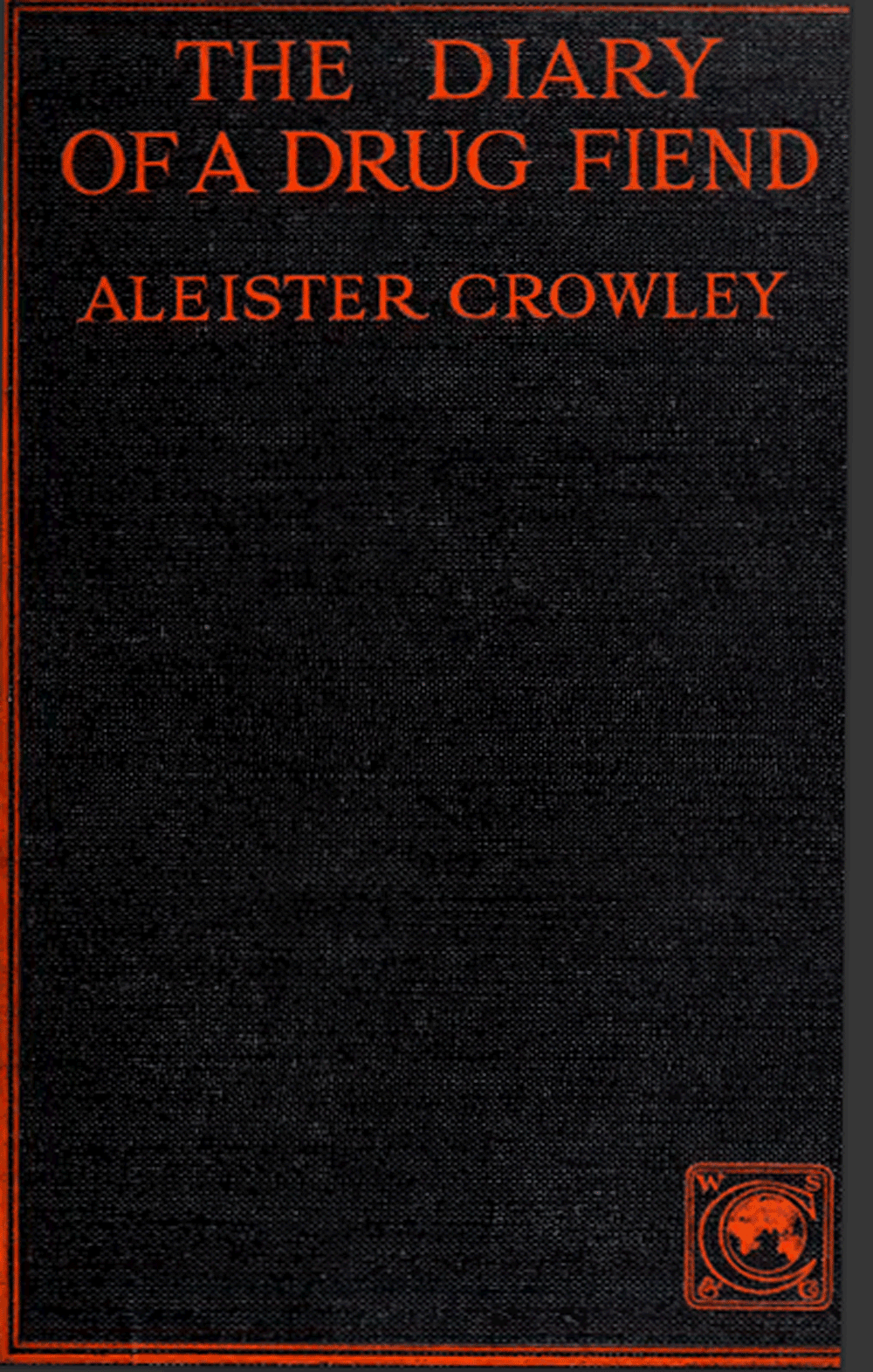
This is the only full-cast recording of Aleister Crowley's 1922 classic paeon to common sense. It is the first book -- and so far almost the only book -- to stake out a philosophy of drug use that is compatible with human freedom, one in which we learn to use drugs as wisely as possible for the benefit of humanity. This recording was produced by the Drug War Philosopher and your purchases help support his effort to push back against the tragically counterproductive policy of drug prohibition, in the name of human freedom and of humanity's right to heal.
No cookies, no ads paid for by amoral and immoral billionaires (or trillionaires).
Unless otherwise indicated, no AI is used in the creation of site content. These essays represent the original ideas of their author and not the ideas that the author SHOULD have based on an algorithmic parsing of existing data. For more on this subject, consider the AI-related viewpoints to which the author subscribes as delineated in the New York Times opinion piece entitled "What 370,000 College Essays Tell Us About A.I.’s Effects on Creativity" by Rebecca Winthrop of the Brookings Institution.










 (up)
(up)