and what they tell us about American drug attitudes
by Brian Ballard Quass, the Drug War Philosopher
October 9, 2026
As both of my readers know, I recently published an essay revealing the fact that both Harvard University and Stanford University have censored the work of William James with respect to nitrous oxide, and that each institution has ignored my requests that they remedy this oversight1. James credits his experiences under the gas with awakening him to the existence of multiple worlds of consciousness, worlds that he believed that philosophers must study in order to learn the truth about consciousness and the nature of reality itself. "No account of the universe in its totality," wrote James, "can be final which leaves these other forms of consciousness quite disregarded.2" And yet this is exactly what these institutions have chosen to do: they have chosen to disregard James's work on consciousness, to pretend that it never happened, apparently so that modern students will not be tempted by James's writings to become heretics with regard to the reductionist understanding of life that prevails in today's ivory tower. "Nothing to see here," shouts the editors of the Stanford Encyclopedia of Philosophy, whose almost 9,000-word article on James says nothing about his experiments with altered states3. "Nothing to see here," shouts the Harvard Psychology Department, despite the fact that James created the very department that is now distorting the man's legacy in his online biography4.
Why are these institutions re-writing James' life story? The answer is clear to me, as a lifelong victim of this modern materialist mindset of "nothing to see here." Such consciousness studies are dismissed out of hand for the same reason that modern scientists tell us that laughing gas has no beneficial uses for the depressed5: because reductionist scientists insist that all truth must be discovered analytically. It must be quantifiable and expressible in words. To state this philosophically, today's scientists deny a priori that there can be such a thing as an experiential epistemology. It does not matter how hard the depressed person may laugh under N2O, nitrous oxide can only "really" help the depressed if scientists can find a biochemical reason that it should do so. Otherwise, when the depressed laugh under the influence, our scientists will implicitly tell them that they are laughing ill-advisedly. Just so, scientists ignore multiple forms of consciousness because they have yet to find a materialistic theory that could account for such states. Rather than humbly admitting their ignorance, they project their own shortcomings onto these altered states themselves, telling us that they are mental static and of no importance whatsoever.
But my purpose today is not to wrestle with the shortcomings of modern scientific presuppositions, notwithstanding the fact that these presuppositions have played an outsized role in depriving me as a chronic depressive of my right to heal for the last half a century now by seeming to scientifically justify the policy of drug prohibition. I would like instead to share an extended quotation from James' correspondence as compiled by his son Henry after his father's death. I began reading that correspondence after my recent rebuffs by Harvard and Stanford. I did so because their institutional censorship of the man made me wonder what else William James may have said that my betters in the academy did not want me to know about. There was one extended quotation that struck me as particularly important for the reasons that I will attempt to explain in the annotations below. This extended quotation is taken from a letter that James wrote in June 1866 to a politician by the name of Thomas W. Ward.
I think we ought to be independent of our moods, look on them as external, for they come to us unbidden, and feel if possible neither elated nor depressed, but keep our eyes upon our work and, if we have done the best we could in that given condition, be satisfied.
If I were just a little more vain, I could imagine that James was writing this part of his letter to me personally and not to a former brigadier general of the US Army. James and I do have at least two things in common, after all: James suffered a deep depression early in his life, and James was also philosophically minded -- although he had a greater interest in psychology than do I, and he even warned against an exclusive focus on philosophy in his letters. I should say that we have three things in common, in fact, as the next portion of this quotation will show, as I myself went through a phase of life in which I myself would frequently turn to the Meditations of Marcus Aurelius for advice and comfort.
I began the other day to read the thoughts of Marcus Aurelius... He certainly had an invincible soul; and it seems to me that any man who can, like him, grasp the love of a "life according to nature," i. e. , a life in which your individual will becomes so harmonized to nature's will as cheerfully to acquiesce in whatever she assigns to you, knowing that you serve some purpose in her vast machinery which will never be revealed to you—any man who can do this will, I say, be a pleasing spectacle, no matter what his lot in life.
As a chronic depressive, I used to be "put off" by Marcus Aurelius for the same reason that I was "put off" by people who would tell me to exercise or meditate or get more sleep or to go out and socialize. I felt that these were what the poet Shelley might have called "frail spells" in light of my deep depression, suggestions from satisfied self-help authors who wanted me to get "high on sunshine" without even noticing the fact that I had been barred from using all of Mother Nature's invigorating and motivating psychoactive substances. Then one day I stumbled across a truly mind-blowing factoid: it turned out that Marcus Aurelius was a fan of opium. Wow. That could be fodder for a whole semester worth of drug-war study, the fact that Marcus Aurelius, the ultimate self-help coach, was a fan of opium. From that factoid, we can infer at least three things:
1) that there was a time when people were judged by how they behaved in life rather than by what substances they had in their digestive systems
2) that the self-help protocol of "getting high on sunshine" is not mutually exclusive of or incompatible with the protocol of using drugs
3) that a drug that inspires the user can motivate that user to actually FOLLOW THROUGH on the advice of the self-help authors who tell us to get "high on sunshine"
But these motivational benefits of drug use are precisely what the reductionist scientists ignore: these benefits are just anecdotal, after all, they say. These are claims that must be verified (or more often "explained away") with the help of an endless series of expensive clinical trials. You SAY that a drug helps you, but the scientists will be the judge of THAT. We cannot use our common sense on these matters lest we put drug researchers out of work. "You say you feel great? Fine, but what does that even MEAN?" ask the scientists. "No, no, we need clinical trials to see if you REALLY feel good, bucko, trust me."
I have had people try to tell me that science does not work this way, that all is well in Lab-ville -- but the proof is extant that science does indeed work this way today. Scientists have gone along with the idea that drugs are bad -- in part because that default assumption gives them jobs for life. As drug attitudes morph and evolve, scientists can launch clinical trials for now this substance, now that, seeing how this drugs might help this demographic and how that drug might help that demographic -- all the time ignoring the common sense psychology which tells us that "feeling good in one's skin" has positive knock-on effects in a person's life, regardless of demographic or the psychological indisposition in question. Motivation and inspiration have positive knock-on consequences, screams common sense. As the Bard would put it, "There needs no ghost come from the grave to tell us that." There needs no scientist come from the FDA to tell us that feeling good helps -- and in all sorts of ways.
James continues:
I have come to feel lately, more and more... like paying my footing in the world in a very humble way, and then living my free life in my leisure hours entirely within my own breast as a thing the world has nothing to do with; and living it easily and patiently, without feeling responsible for its future.
Here a young James is trying to make his peace with the possibility that he may end up stuck for life as a doctor, in a job that he does not love, which luckily for us turned out to be an unjustified fear on his part. And yet his advice is meaningful for folks in my position. It is meaningful for anyone who is trying to get a message across that nobody wants to hear, something that the world will have "nothing to do with." James understood, decades before I came to at least partially accept the fact, that our only concern in life should be that we do our best and then leave the results to fate, God, or chance. "But something too much of this," as the aforesaid Bard would say. The cynical side of my bipolar personality is starting to bridle at this unwonted display of sentimental metaphysics on my part. In fact, don't be surprised if I deny ever having written this paragraph should we meet in person someday.
I hope that the reader has enjoyed these outtakes from the letters of William James and found them edifying viz. American drug attitudes. I hope to confront you with more thought-provoking apercus soon from America's greatest censored philosopher. In the meantime, I will close this particular essay with an extended quotation from a pencil-written memo that James wrote to his close friend Oliver Wendell Holmes Jr., also in 1866. This excerpt is a whimsical attack on the philosophy of reductive materialism that I have alluded to above. It is not exactly self-explanatory, especially for a non-philosopher, but it clearly demonstrates the antipathy that James had for that philosophy -- and for reasons that were similar to my own, I might add: namely, that it is inherently dismissive of the holistic phenomenon of human feeling.
Why I'm blest if I'm a Materialist:
The materialist posits an X for his ultimate principle.
Were he satisfied to inhabit this vacuous X, I should not at present try to disturb him.
But that atmosphere is too rare; so he spends all his time on the road between it and sensible realities, engaged in the laudable pursuit of degrading every (sensibly) higher thing into a (sensibly) lower...
But as a man's happiness depends on his feeling, I think materialism inconsistent with a high degree thereof, and in this sense maintained that a materialist should not be an optimist, using the latter word to signify one whose philosophy authenticates, by guaranteeing the objective significance of, his most pleasurable feelings.
Most enemies of inner-city gun violence refuse to protest against the drug prohibition which caused the violence in the first place.
It's almost impossible not to have a problem with drugs in a world in which the government is spending over $50 billion a year to render drug use problematic.
The drug war is is a multi-billion-dollar campaign to enforce the attitude of the Francisco Pizarro's of the world when it comes to non-western medicine. It is the apotheosis of the colonialism that most Americans claim to hate.
Musk vies with his fellow materialists in his attempt to diss humans as insignificant. But we are not insignificant. The very term "insignificant" is a human creation. Consciousness rules. Indeed, consciousness makes the rules. Without us, there would only be inchoate particles.
I have dissed MindMed's new LSD "breakthrough drug" for philosophical reasons. But we can at least hope that the approval of such a "de-fanged" LSD will prove to be a step in the slow, zigzag path toward re-legalization.
If you're looking for an anti-Christ, just look for an American presidential politician who has taught us to hate our enemies. Gee, now, who could that be, huh? According to Trump, Jesus was just a chump. Winning comes before anything at all in his sick view of life.
Americans HATE big government -- and yet they have no problem with government using drug prohibition to control their pain relief and how and how much they can think and feel in this life.
Psst! Drug use has benefits too. Pass it on!
Drug warriors have taught us that honesty about drugs encourages drug use. Nonsense! That's just their way of suppressing free speech about drugs. Americans are not babies, they can handle the truth -- or if they cannot, they need education, not prohibition.
The reasons that people use drugs are psychologically obvious. Academics gaslight us on this topic and invent new diseases to explain away our desire to live large.
Break the ice with a sledgehammer: place this book on your coffee table.
This book features 150 annotated images, designed to force brainwashed Americans to confront the fact that drug prohibition is wrong. Here is what author Richard Parrish II says of the book's compiler: "The drug prohibition philosopher provides first-hand, principled, persuasive, and insightful arguments against the current drug prohibition regime..."
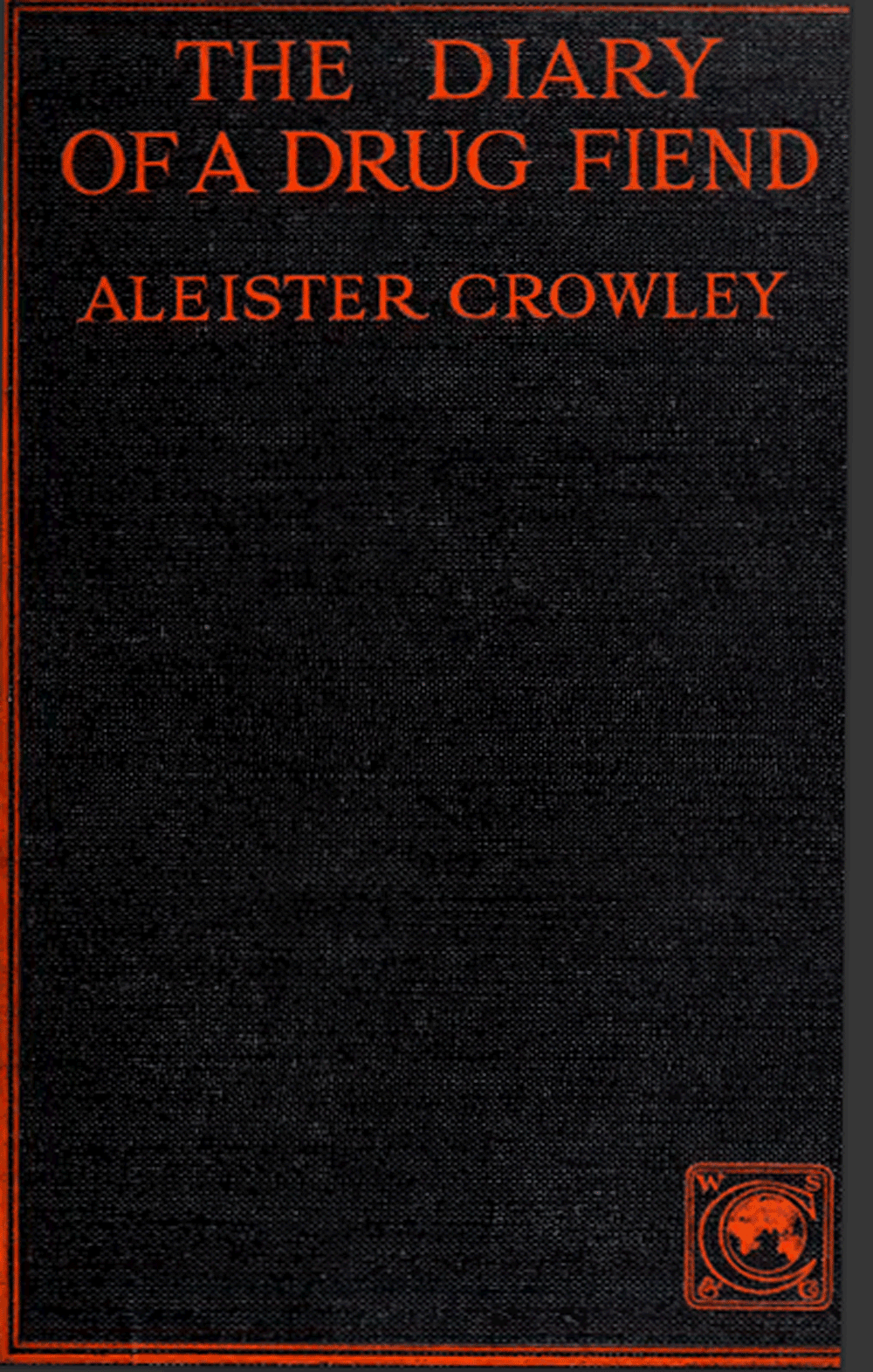
This is the only full-cast recording of Aleister Crowley's 1922 classic paeon to common sense. It is the first book -- and so far almost the only book -- to stake out a philosophy of drug use that is compatible with human freedom, one in which we learn to use drugs as wisely as possible for the benefit of humanity. This recording was produced by the Drug War Philosopher and your purchases help support his effort to push back against the tragically counterproductive policy of drug prohibition, in the name of human freedom and of humanity's right to heal.
No cookies, no ads paid for by amoral and immoral billionaires (or trillionaires).
Unless otherwise indicated, no AI is used in the creation of site content. These essays represent the original ideas of their author and not the ideas that the author SHOULD have based on an algorithmic parsing of existing data. For more on this subject, consider the AI-related viewpoints to which the author subscribes as delineated in the New York Times opinion piece entitled "What 370,000 College Essays Tell Us About A.I.’s Effects on Creativity" by Rebecca Winthrop of the Brookings Institution.











 (up)
(up)