A philosophical review of 'Dynamics of Intervention in the War on Drugs' by Audrey Redford and Benjamin Powell
by Brian Ballard Quass, the Drug War Philosopher
June 18, 2026
INTRODUCTION
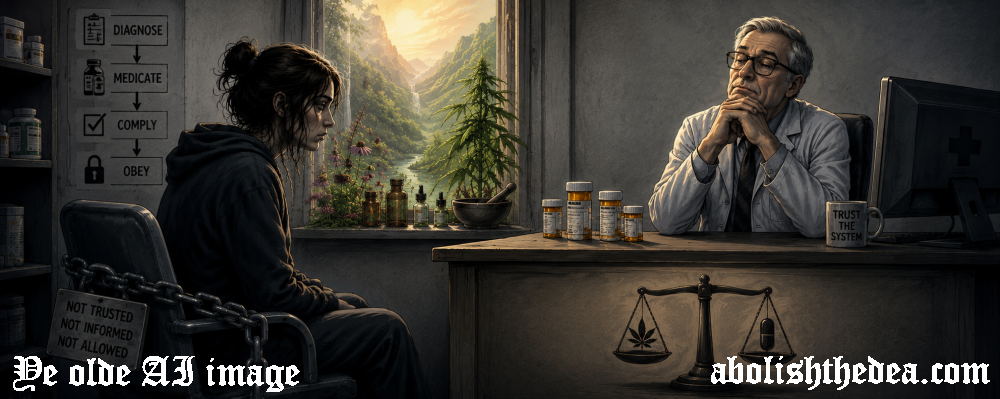
Before I begin my review of "Dynamics of Intervention in the War on Drugs,"1 I must warn the reader that I come at the subjects discussed by Redford and Powell from a very different perspective, indeed, a perspective that I fear has never been adequately represented in academia and one which, at least in some ways, has never been represented at all. I am referring to the perspective of a 67-year-old chronic depressive who was "saved" from apparently "evil" drugs like opium and cocaine by being shunted off onto a Big Pharma med that is harder to kick than heroin. 2 Drug prohibition -- or market interventionism, as the authors would have it -- has turned me into a ward of the healthcare state. I have to see a doctor one-third my age, every three months of my life, in order to qualify for purchasing a prescription that I do not even want to be taking. I am treated like an eternal patient, and an eternal pediatric patient at that. Before every session with my seemingly teenage doctor, I have to answer humiliating questions like, "Do you feel that you are misunderstood by others?", "Do you hear voices?", and "Have you considered suicide over the last three months?", to which I always want to respond: "Only when I consider how drug prohibition has turned me into an eternal child, an eternal patient, and a ward of the healthcare state."
Seen from my perspective, drug prohibition is something quite different from a well-meaning but misguided attempt to intervene in an otherwise free market, as the authors seem to believe. Drug prohibition has outlawed my right to heal, by outlawing all those medicines that could divert and/or focus my mind and help me relax -- and even help me to follow through on the research of William James as to the philosophical importance of new forms of consciousness. Yet the authors seem to believe in the party line of the self-interested medical field that drugs cannot help anybody, psychologically speaking, let alone the depressed, that the depressed can only be helped by "scientifically" created cures from Big Pharma, i.e. "meds" (as if "meds" were not the exact same thing as "drugs" -- namely, psychoactive substances). They seem to believe with the Drug Warriors that opium, a drug that has been considered the closest thing to a panacea since the time of Galen, has no positive uses whatsoever, at least in the spiritual, philosophical or religious realms. The psychiatrists, for their part, will tell us that a drug like opium is not a "real" cure -- to which I respond: so much the worse for real cures (that is, the kind of cures that have turned 1 in 4 American women into patients for life 3)!
DRUG BENEFITS 101
The authors' unqualified disdain for psychoactive substances suggests that they are unfamiliar with basic drug-related history. The use of laughing gas by William James changed his beliefs about the nature of consciousness and of reality itself.
The whole drift of my education goes to persuade me that the world of our present consciousness is only one out of many worlds of consciousness that exist, and that those other worlds must contain experiences which have a meaning for our life also.
William James, The Varieties of Religious Experience: A Study In Human Nature
The user reports of the phenethylamines and tryptamines synthesized by chemist Alexander Shulgin4 in the 1990s read like an attitudinal wish list for the treatment of a wide variety of so-called mental health disorders, including ADHD...
I find that I can just slightly redirect my attention so that it applies more exactly to what I am doing. I feel that I can learn faster. This is a 'smart' pill!
...Aggressive Personality Disorder...
I am experiencing more deeply than ever before the importance of acknowledging and deeply honoring each human being. And I was able to go through and resolve some judgments with particular persons.
...and depression.
I experienced the desire to laugh hysterically at what I could only describe as the completely ridiculous state of the entire world. 5
Nor do the authors seem to understand that drug use inspired the creation of the Vedic (and hence the Hindu) religion. The Rig Veda is full of references to the "gladdening draught."
This Soma flows like gladdening oil...
This sweet juice here had mightiest power to gladden...
He streams on liberal worshippers like a hill with springs, when juices poured have gladdened him.6
Were the authors unaware of such "drug use"? What about the fact that Benjamin Franklin and Marcus Aurelius were fans of opium? The most generous assumption we can make is that the authors were aware of these inconvenient truths but thought fit to ignore them insofar as they believed in the "fire bad" doctrine of the Drug War demagogues, that human beings can never learn how to use such substances wisely and that we therefore need not discuss those drugs in any detail.
MERCY ME, THE THEOCRACY
To be honest, I find it hard to write diplomatically on this subject, because I am really quite bothered by the presumption behind the laws that have kept me unnecessarily depressed for an entire lifetime now. I agree with Thomas Szasz that my right to the use of the healing medicines of Mother Nature is anterior to and more basic than my right to vote. To the extent that there are real drug-use problems out there (apart from the fact that we hate and disdain the kinds of people whom we assume are using given drugs), those problems simply have to be confronted without using the blunt tool of drug prohibition -- at least if we wish to maintain our status as a free country. We cannot have drug prohibition and healthcare freedom at the same time. We cannot have drug prohibition and religious liberty at the same time. We cannot have drug prohibition and academic freedom at the same time. We have to choose between a Christian Science theocracy and a free country.
Of course, we have already chosen the former, but we have not had the courage to acknowledge that fact. We are not honest enough yet to change our government stationery to reflect the new reality, or rather the reality that has been in place since the Pure Food and Drug Act of 1906. This is because those who profit from my healthcare disempowerment have created a Newspeak to render the status quo acceptable to freedom-loving Americans. According to their new self-interested dictionary, being a responsible patient is now defined as being dependent on Big Pharma "meds" for life.
"The literature on the legislation and outcomes of the period leading up to the Harrison Act, written primarily within the history and medical professions, falls short in explaining how the Harrison Act came about because it does not have a suitable economic framework to interpret the events."
Page 509-510
Comment: In other words, the literature came from self-interested parties. We must remember that it was the medical professionals, not the depressed, who reacted in horror to Sigmund Freud's plans to help the depressed with cocaine.8 The depressed were never even consulted. The medical professionals studied the drug by looking only at downsides, exactly as if they were to study alcohol by looking only at alcoholics. They realized, consciously or not, that their very jobs were at stake to the extent that near-panaceas like cocaine and opium were legal. As for historians, they wrote history in line with their own prejudices. And so they turned Britain's war with China into a morality tale about geopolitical drug pushing. And yet those who were actually on the scene at the time knew better.
As William Brereton wrote in The Truth About Opium, "The sole object of the Government of China in objecting to the importation of Indian opium into the country... was to protect the native drug, to prevent bullion from leaving the country, and generally to exclude foreign goods."9 To their credit, the authors do seem to understand that financial concerns, not opium, were the real concerns of the Chinese leaders during this conflict.
Yet while the authors lament the absence of economic interpretations of opium policy, I myself lament the absence of any appreciation whatsoever of opium benefits. I lament the doctrinal insistence on focusing only on potential downsides. After all, we are speaking here of a drug that the famous 19th-century pharmacologist Jonathan Pereira referred to as "the most important and valuable remedy of the whole Materia Medica."10 How busy we moderns must be in hating opium that we are unable to recognize any benefits whatsoever in the drug!
During the period from the 1880s to the 1910s, the federal government and state governments enacted a series of interventions to try to address and eradicate a growing opium problem in the United States.
Page 511
Comment: The authors seem to be assuming here that an increase in opium use (by white people, apparently) constitutes an obvious problem. The assumption is that all users are addicts and that there is no good reason for them to be using in the first place. This is something that I have learned after studying modern drug attitudes for the last seven years from a philosophical point of view: when somebody tells you that drug use is a problem, ask them "For whom?" Is it a problem for the users, or is it a problem for the people who have moral, economic, political, religious and/or bigoted reasons of any other kind for despising those users?
As Thomas Szasz wrote in Our Right to Drugs, "Lacking the usual grounds on which people congregate as a nation, we habitually fall back on the most primitive yet most enduring basis for group cohesion, namely, scapegoating."
As Mark Thornton describes this cycle, 'The demand for interventionist policies such as prohibition arises from the perception that the market process has caused an inefficient outcome or that the market will not correct inefficiencies'.
Comment: I disagree. Drug warriors clearly wanted to scapegoat drugs and drug users regardless of what this did to the economy. There was no lofty desire to employ economics in just the right way to create healthy outcomes. The demagogues saw that drug prohibition effectively punished the sorts of people about whom mainstream Americans were suspicious, and this was their motive for pursuing interventionist policies on drugs to the hilt. Politicians wanted to win elections by appealing to the latent bigotry of their constituents. Economics had nothing to do with it.
It is during this period that smoking-opium use spread across the United States, no longer remaining an isolated vice in California.
Page 513
Comment: Here is one of several places in this paper where the authors "tip their hand," showing us that they are not even trying to be objective on the subject of drugs. The idea that the use of a time-honored panacea can be nothing but a vice is not exactly self-evident, after all.
Wright pointed out in 1910 that 'though Chinese subjects resident in the United States are prohibited in the importation of opium, American citizens have continuously imported the drug in a form prepared for smoking, and have immediately handed it over to Chinese subjects, who have distributed it throughout the country, not only to Chinese, but to any and all who have become addicted to the smoking opium habit'.
Comment: More bias. Neither Wright nor the authors can imagine that any purchasers of opium might be interested in something other than excessive use of the drug. They must all be addicts. Yet, as Richard Middleton wrote of his protagonist in his short story "The Last Adventure" in 1910: "He took life as young poets take opium : in a series of magnificent quarterly carouses." In other words, the poets were using opium wisely, for inspirational purposes -- the kind of uses that Drug Warriors insist are impossible.
To put it another way, the number of addicts whose habit could be sustained for an entire year from the annual import poundage rose from approximately 14,804 individuals to about 57,180 individuals.
Page 514
Comment: This is a very prejudicial way of discussing the effects of the ban on the importation of Chinese opium by the United States in the late 19th century. To see this, we have only to do a quick thought experiment. Suppose that the authors had been discussing a ban on the importation of alcohol instead. Would they be telling us how many drunkards could be "sustained" for an entire year from the annual import poundage (or, in this case, volume)? Of course not. In that hypothetical case, the authors would assume that the majority of stateside "users" were adults and would use alcohol in a way that proved sustainable for them personally. Clearly, when the authors think of opiates, they think of the delusional maunderings of Mary Cavan Tyrone in "Long Day's Journey into Night", not the pithy insights of Benjamin Franklin in "Wit & Wisdom."
In an interview with the San Francisco Chronicle regarding raids on opium dens in San Francisco’s Chinatown, police officer James Mahoney mentioned how white smokers had been spread outside of Chinatown due to raids, and he suspected the smoking-opium habit would continue to rise: 'Now that there are scores of places where the habit can be contracted in clean rooms and in respectable portions of the city, the practice will gradually extend up the social grade'.
Page 517
Comment:Again, consider the disdainful and presumptive use of the word "habit" here. James Mahoney would never be happy with using the word "pastime" instead; he clearly wanted to use every linguistic opportunity he had to evince his scorn for the suspiciously foreign-looking practice of opium smoking.
Notice also how Mahoney resembles modern Drug Warriors like William Bennett. Nothing irritates such fearmongers more than the safe use of drugs in a clean and respectable environment. Bennett reserved his greatest scorn for people who used drugs wisely and safely, under the perverse assumption that they were thereby setting a bad example. It would take an entire essay to unpack and rebut all the false assumptions that have to be firmly ensconced in the human mind before it can accept such a counterintuitive position as common sense -- especially when the owner of that mind is a notorious drug user himself. Let's see now, what drug has Bennett been hooked on for ages? The name escapes me at the moment. Oh, yes, it's cigarettes: you know, tobacco, nicotine.
Following the Spanish-American War (1898), the United States acquired the Philippines, and opium addiction among the Filipinos became apparent. The Philippines Opium Commission of 1903 'found that the unregulated sale of opium had grave effects on the health and moral capacity of users.'
Page 520
Comment: Given the biases against drug use that are expressed both by the authors and the "authorities" whom they cite, one has to ask in what sense words like "addiction" are being used in this context. If the American authorities had found Filipinos drinking joyously every night, would they have come away concluding that the population was composed entirely of drunkards? Consider also the presumption of foreigners opining on the moral capacity of the Filipinos. It sounds to me like the members of the Opium Commission were subjecting the locals to the Francisco Pizarro treatment, scorning the local ways and speculating about how to bring the population in line with the imperialist prejudices of a land thousands of miles away.
It is worth contrasting the Commission's findings with the opinion of Dr Philip Ayres, the Colonial Surgeon of Hong Kong, with respect to opium use in China during the same time period: "Nine out of twelve men smoke a certain number of pipes a day, just as a tobacco smoker would, or as a wine or beer drinker might drink his two or three glasses a day, without desiring more. I think the excessive opium smoker is in a greater minority than the excessive spirit drinker or tobacco smoker." 11
Following adoption of the Opium Exclusion Act, Eugene Block concluded his magazine article 'Fighting the Opium King' with a very important insight into the unintended consequences of the importation ban: 'The present scarcity of smoking opium . . . has caused an enormous increase in the use of morphine among drug fiends, for medicinal opium, which may be imported in unlimited quantities, can be refined into morphine very cheaply. But still more important, perhaps, is the attempt now being made on the Pacific Coast to grow the poppy from which opium can be extracted.'
Page 523
Comment: First, notice the use of the term "drug fiends." This is far from an objective term. That term betrays an almost racial animus against the drug, as if Block were channeling the puritan disgust of his Anglo-American ancestors about the use of a substance that is associated with the Chinese. If we wish for a semblance of objectivity in our writing, we should reserve terms like "drug fiend" for the sorts of people who force babies to consume handfuls of aspirin -- or of any other drug, for that matter. Now, THAT'S a drug fiend.
But it is not just Block's language that is problematic; so is his sense of logic. He first laments the fact that opium scarcity is causing an increased use of morphine, which is a far more potent opiate. Then he tells us that the REAL problem is that people are growing more opium on the Pacific Coast. How is this the real problem? By his own logic, you would be decreasing morphine use by making opium more available. What King really seems to be saying here is that opium and morphine are both equally detestable drugs on some primordial level and so at some point, the details do not even matter. It's all just disgusting to him.
RIGHT YOU ARE
The authors did get one thing right. The Drug War did not begin with the creation of the DEA by Richard Nixon in the early 1970s, nor with the Harrison Narcotics Act of 1914, nor even with the Pure Food and Drug Act of 1906. The jaundiced attitude toward drugs in the west, and toward opium in particular, was in full evidence already in the last half of the 19th century, when the well-heeled armchair moralists of the Anti-Opium Society (officially known as The Anglo-Oriental Society for the Suppression of the Opium Trade) began decrying the smoking of opium in a country thousands of miles away, a country that most of them had never even visited before. The credulous do-gooders were particularly concerned about the claim of a yarn-spinning American missionary that two millions of Chinese were dying miserably every year from the smoking of opium, which, of course, was a complete fabrication, as the previously quoted statement of the Surgeon General of Hong Kong makes clear.
We see, in fact, that the Drug Warriors of the time were behaving just as Drug Warriors do to this very day. They were taking a bunch of half-truths, lies, and mischaracterizations as gospel truth and "running with them." The author of "The Truth About Opium," William H. Brereton, summed up this prohibitionist MO as follows:
All these anti-opium articles, speeches, and resolutions are based upon the same model. They assume certain statements as existing and acknowledged facts which have never been proved to be such, and then proceed to draw deductions from those alleged facts. 12
We could modify that statement today to begin with the phrase "All these academic papers..."
PURE NONSENSE
A quick word about the Pure Food and Drug Act of 1906. 13 It is assumed by almost all American authors today that such legislation was necessary to protect Americans against so-called patent medicines, which could contain "God knows what." But people wanted to buy these patent medicines for a reason: they knew that they contained the effective and time-honored drugs that the government was determined to deny them. As Thomas Szasz wrote in Our Right to Drugs:
Although there is no evidence that the American consumer ever complained about the free market in drugs, there is plenty of evidence that his self-appointed protectors complained bitterly and loudly. 14
And who were those "self-appointed protectors" who were complaining bitterly and loudly? They were healthcare professionals who had a vested interest in the outlawing of godsend medicines. They had a vested interest in outlawing anything that actually seemed to "work" from the point of view of the end user.
DOCTORS' MONEY ORDERS
And this brings up a subject that has always puzzled me. Despite all the focus that Libertarians place on the importance of economics when it comes to drug policies, they scarcely ever point out the fact that doctors have an enormous economic self-interest in championing (or at least in refraining from pushing back against) the outlawing of popular and powerful medicines. And yet consider the situation from the point of view of someone who, like myself, has been turned into a ward of the healthcare state by drug prohibition, which has outlawed naturally occurring godsends and shunted me off onto substances that are very close to impossible to kick. This example concerns cocaine given that drug's obvious potential uses for the depressed.... obvious, at least, to anyone who has miraculously managed to escape the thorough drug propaganda and censorship of the west that seeks to make the words "drugs" and "beneficial uses" eternally irreconcilable.
First, the doctors help to outlaw cocaine (and to keep it outlawed) by focusing only on downsides of use -- never even mentioning the blindingly obvious fact that the drug could be a godsend for the suicidal or the chronically depressed. Then they tell me that it is a sin for me to self-medicate. Then they tell me that I actually have an addiction problem if I insist, despite their nagging, on using the naturally occurring drugs that they have helped to outlaw. Eventually, they may even decide that I need to be hospitalized against my will for my own good because I refuse to admit that doctor knows best.
This may sound like a conspiracy theory, but it is just a blunt and unnuanced way of describing the healthcare world that the depressed are faced with today in the age of drug prohibition -- a fate being suffered by pain patients as well, or indeed by anyone who wishes to solve their problems in an holistic and symptomatic fashion with Mother Nature's bounty, rather than by "curing" themselves with the help of a pharmaceutical drug that will turn them into a ward of the healthcare state.
CONCLUSION
Here ends my review of "Dynamics of Intervention in the War on Drugs: The Buildup to the Harrison Act of 1914." If it sounds harsh, it is only because I have "skin in the game," and so this subject is not merely an academic one for me. If it is any consolation to the authors, they are by no means alone in their approach to drug prohibition. They just happened to be the authors of the first academic history of the subject that I happened to write about. Almost all academic papers on the subject of drug prohibition fail to see the issues to which I refer, whether they see the subject through the lens of market forces, racial prejudices, the greed of pharmaceutical companies, or any other plausible perspective.
No one has yet to see drug prohibition from the viewpoint of a med-dependent patient who has been turned into an eternal child by drug prohibition. Far from protecting me from drugs, drug prohibition has turned me into a drug-user for life, though I am always encouraged to imagine otherwise by using the term "meds" for the expensive, underperforming, dependence-causing and ultimately tranquilizing substances that I will be on for the rest of my life... that is, of course, always assuming that I can continue to convince that teenage doctor of mine that she can trust me for yet another three months of my life to use those substances wisely.
It's funny, when I was a kid, I actually believed that I would grow up someday!
AFTERWORD
I occasionally use the term "godsends" in referring to outlawed drugs thanks to my belief that "turnabout is fair play." The very term "drugs" these days, as used by the medical field, is a dysphemism for "psychoactive substances"; like the term "scabs" in a work environment, the term "drugs" is meant not simply to denote an entity but to pass judgment on that entity as well. This is why psychiatric drugs are referred to as "meds" in today's medical Newspeak. Such neologisms keep Americans from feeling a sense of cognitive dissonance when they are told on the one hand to take drugs daily while being told on the other that they are supposed to hate drugs. Problem solved, right? "Those substances that we good people are taking daily are not really drugs," says the white suburban housewife, indignantly, as she fumbles with the pharmacy worth of amber bottles in her medicine cabinet. "They are, ahem, 'meds,' thank you very much! Meds!" To which one can only respond: Fine. Whatever helps you sleep at night.
Author's Follow-up:
June 20, 2026
Many Libertarians, in their attempt to make a religion out of a cherry-picked subset of Adam Smith's ideas, end up attacking slavery on the grounds that it distorts normal economic incentives, thereby destroying the supposed magical ability of free financial markets to resolve all problems. The problem with this approach is clear, however, at least to slaves and their descendants. It blames the misery of the slave on financial miscalculations, rather than shining the spotlight on the want of humane principles in those who would even think to profit from slavery in the first place.
This same problem arises when Libertarians attempt to defend my rights to drug use on the grounds of market considerations. These people are missing the point. By denying me the right to access Mother Nature and to heal myself, the prohibitionist is violating principles that have always been thought to define a free society: the right to Mother Nature and the right to take care of one's own health. It may well be that those freedoms would naturally return if we stopped the practice of market interventionism, but to argue thus is to yield enormous ground to the Drug Warrior. In a free society, we hold certain truths to be self-evident -- which means we by no means need to justify these truths to those who would violate them for any reason whatsoever.
Redford and Powell seem to think that the game is already lost, that we no longer live in a free world thanks to drug prohibition and that we must therefore start making second-best arguments against that demonstrably deadly social policy; we must now appeal to the economic interests of our jailers to persuade them to let us go, i.e., to persuade them to allow us to live in a free world once again.
But until we reassert the importance and inviolability of the basic principles of freedom, any reprieves that we may get from the worst effects of drug prohibition will be temporary and subject to rapid and sudden reversal with the help of a little media-supported fearmongering by our self-interested politicians.
Speaking of fearmongering, the staying power of any drug re-legalization effort will depend in large part on teaching journalists to recognize their biases in covering drug-related stories. All large newspapers should be required to have a depressed person on staff -- and representatives of the many other unacknowledged demographic victims of drug prohibition -- to point out biased coverage that seeks to blame drugs for socially constructed problems and so further promote and normalize the demonstrably deadly policy of drug prohibition. Just yesterday, the New York Times published an article highlighting the potential downsides of kratom, with the subtext being, as always: "We must outlaw the sale of this menace immediately on behalf of our poor hapless young people!!!"
Someone needs to remind the journalists that "our poor hapless young people" are not the only stakeholders in the drugs debate. We need to remind them of what Thomas Szasz wrote in "Our Right to Drugs," that "the laws that deny healthy people 'recreational' drugs also deny sick people 'therapeutic' drugs.” This is not to say that we cannot do anything about apparent social problems, merely that we must do so without throwing the baby out with the bathwater, without solving the problems of a free world by ending our very status as a free world. I will not go into detail here, but I will suggest one truly radical idea: perhaps we could spend a small fraction of the $51 billion that we spend on ruining the lives of drug user on educating them instead. Just a thought. And not educating them on how to be a Christian Scientist, either, and to scorn drugs entirely, but rather learning, as if they were grownups, how to be in control of their drug use and to use drugs wisely for human benefit -- as much as such a paradigm might seem to clash with the "fire bad" mindset that Americans have been taught to adopt on this topic.
Notes for essay entitled The Prohibitive Cost of Drug Prohibition: A philosophical review of 'Dynamics of Intervention in the War on Drugs' by Audrey Redford and Benjamin Powell:
The drug war is the defeatist doctrine that we will never be able to use psychoactive drugs wisely. It's a self-fulfilling prophecy because the government does everything it can to make drug use dangerous.
Anytime you hear that a psychoactive drug has not been proven to be effective, it's a lie. People can make such claims only by dogmatically ignoring all the glaringly obvious signs of efficacy.
There is an absurd safety standard for "drugs." The cost/benefit analysis of the FDA & co. never takes into account the costs of NOT prescribing nor the benefits of a productive life well lived. The "users" are not considered stakeholders.
Rick Strassman isn't sure that DMT should be legal. Really?! Does he not realize how dangerous it is to chemically extract DMT from plants? In the name of safety, prohibitionists have encouraged dangerous ignorance and turned local police into busybody Nazis.
We should start taking names. All politicians and government officials who work to keep godsends like psilocybin from the public should be held to account for crimes against humanity when the drug war finally ends.
Mariani Wine is the real McCoy, with Bolivian coca leaves (tho' not with cocaine, as Wikipedia says). I'll be writing more about my experience with it soon. I was impressed. It's the same drink "on which" HG Wells and Jules Verne wrote their stories.
You can get a master's degree in healthcare today and not learn a thing about the power of hundreds of outlawed drugs to inspire and elate.
I will gladly respect the police once we remove them from Gestapo duty by ending the war on drugs. Police should also learn to live on a budget, without deriving income from confiscating houses and dormitories, etc.
Until we legalize ALL psychoactive drugs, there will be no such thing as an addiction expert. In the meantime, it's insulting to be told by neuroscience that I'm an addictive type. It's pathologizing my just indignation at psychiatry's niggardly pharmacopoeia.
The Drug Warriors say: "Don't tread on me! (That said, please continue to tell me what plants I can use, how much pain relief I can get, and whether my religion is true or not.)"
Break the ice with a sledgehammer: place this book on your coffee table.
This book features 150 annotated images, designed to force brainwashed Americans to confront the fact that drug prohibition is wrong. Here is what author Richard Parrish II says of the book's compiler: "The drug prohibition philosopher provides first-hand, principled, persuasive, and insightful arguments against the current drug prohibition regime..."
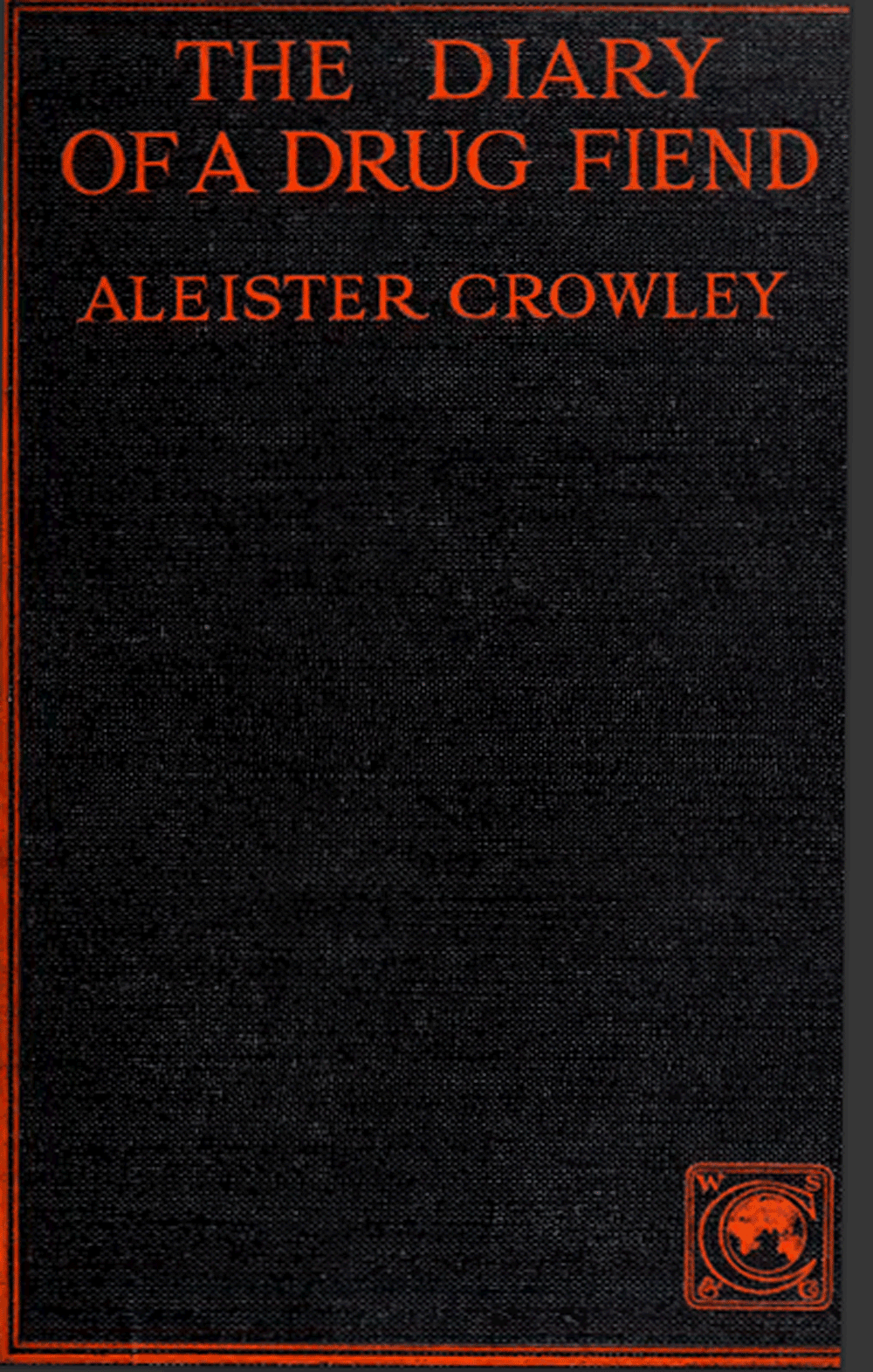
This is the only full-cast recording of Aleister Crowley's 1922 classic paeon to common sense. It is the first book -- and so far almost the only book -- to stake out a philosophy of drug use that is compatible with human freedom, one in which we learn to use drugs as wisely as possible for the benefit of humanity. This recording was produced by the Drug War Philosopher and your purchases help support his effort to push back against the tragically counterproductive policy of drug prohibition, in the name of human freedom and of humanity's right to heal.
No cookies, no ads paid for by amoral and immoral billionaires (or trillionaires).
Unless otherwise indicated, no AI is used in the creation of site content. These essays represent the original ideas of their author and not the ideas that the author SHOULD have based on an algorithmic parsing of existing data. For more on this subject, consider the AI-related viewpoints to which the author subscribes as delineated in the New York Times opinion piece entitled "What 370,000 College Essays Tell Us About A.I.’s Effects on Creativity" by Rebecca Winthrop of the Brookings Institution.









 INTRODUCTION


 (up)
(up)