








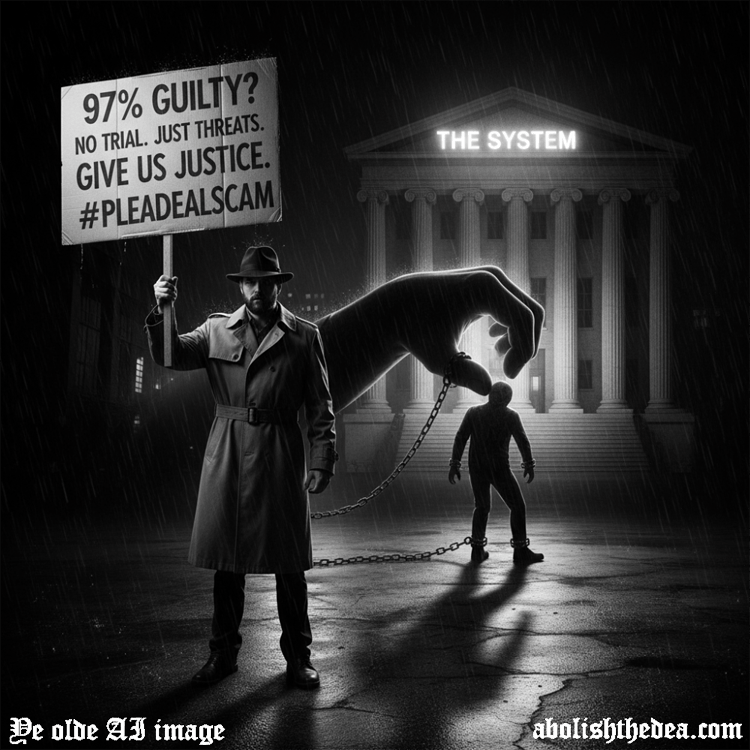
 I asked AI the following question this afternoon:
How many felonies were committed in 2025 and how many were drug-related?
"In 2025, there were over 1.5 million drug-related arrests in the United States, indicating a significant number of drug-related felonies. However, the total number of felonies committed in 2025 is not specified in the available data." -- Search Assist AI on Duck Duck Go Browser, question asked on March 16, 2026.
"This is the essential key to an understanding of federal sentencing policy today. The [Justice] Department is so addicted to plea bargaining to leverage its law enforcement resources to an overwhelming conviction rate that the focus of our entire criminal justice system has shifted far away from trials and juries and adjudication to a massive system of sentence bargaining that is heavily rigged against the accused citizen."3
 The drug war outlaws everything that could help both prevent addiction and treat it. And then they justify the war on drugs by scaring people with the specter of addiction. They NEED addiction to keep the drug war going.
In an article about Mazatec mushroom use, the author says: "Mushrooms should not be considered a drug." True. But then NOTHING should be considered a drug: every substance has potential good uses.
To say that taking SSRIs daily is better than using opium daily is a value judgement, not a scientific one.
It's disgusting that folks like Paul Stamets need a DEA license to work with mushrooms.
Prohibition is wrong root and branch. It seeks to justify the colonial disdain for indigenous healing practices through fearmongering.
The press is having a field day with the Matthew Perry story. They love to have a nice occasion to demonize drugs. I wonder how many decades must pass before they realize that people are killed by ignorance and a corrupted drug supply, not by the drugs themselves.
Drug warriors are full of hate for "users." Many of them make it clear that they want users to die (like Gates and Bennett...). The drug war has weaponized inhumanity.
And so, by ignoring all "up" sides to drugs, the DEA points to potential addiction as a knock-down argument for their prohibition. This is the logic of children (and uneducated children at that). It is a cost-benefit analysis that ignores all benefits.
A Pennsylvanian politician now wants the US Army to "fight fentanyl." The guy is anthropomorphizing a damn drug! No wonder pols don't want to spend money on education, because any educated country would laugh a superstitious guy like that right out of public office.
If Fentanyl kills, then alcohol slaughters. Drug prohibition is the real killer.
The drug war outlaws everything that could help both prevent addiction and treat it. And then they justify the war on drugs by scaring people with the specter of addiction. They NEED addiction to keep the drug war going.
In an article about Mazatec mushroom use, the author says: "Mushrooms should not be considered a drug." True. But then NOTHING should be considered a drug: every substance has potential good uses.
To say that taking SSRIs daily is better than using opium daily is a value judgement, not a scientific one.
It's disgusting that folks like Paul Stamets need a DEA license to work with mushrooms.
Prohibition is wrong root and branch. It seeks to justify the colonial disdain for indigenous healing practices through fearmongering.
The press is having a field day with the Matthew Perry story. They love to have a nice occasion to demonize drugs. I wonder how many decades must pass before they realize that people are killed by ignorance and a corrupted drug supply, not by the drugs themselves.
Drug warriors are full of hate for "users." Many of them make it clear that they want users to die (like Gates and Bennett...). The drug war has weaponized inhumanity.
And so, by ignoring all "up" sides to drugs, the DEA points to potential addiction as a knock-down argument for their prohibition. This is the logic of children (and uneducated children at that). It is a cost-benefit analysis that ignores all benefits.
A Pennsylvanian politician now wants the US Army to "fight fentanyl." The guy is anthropomorphizing a damn drug! No wonder pols don't want to spend money on education, because any educated country would laugh a superstitious guy like that right out of public office.
If Fentanyl kills, then alcohol slaughters. Drug prohibition is the real killer.


 (up)
(up)