








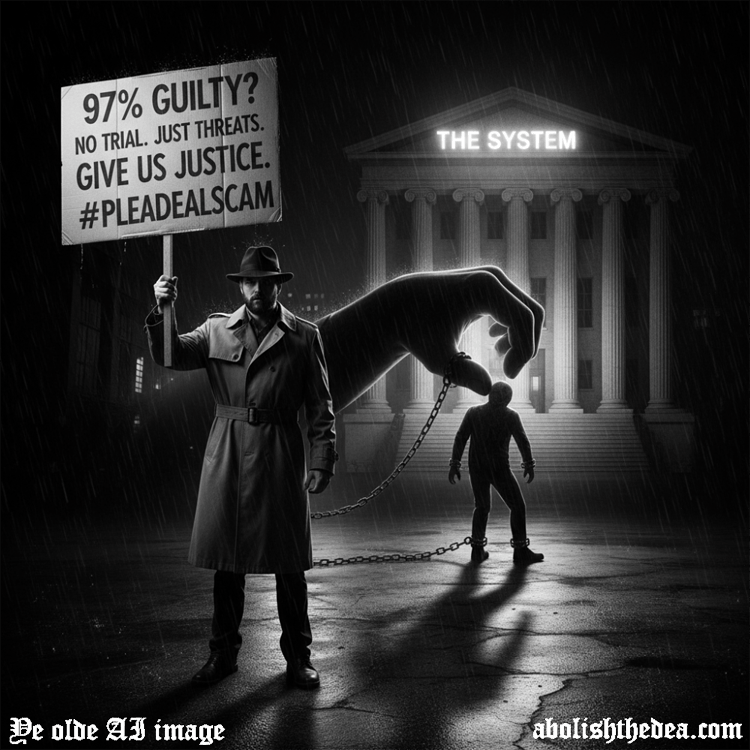
 I asked AI the following question this afternoon:
How many felonies were committed in 2025 and how many were drug-related?
"In 2025, there were over 1.5 million drug-related arrests in the United States, indicating a significant number of drug-related felonies. However, the total number of felonies committed in 2025 is not specified in the available data." -- Search Assist AI on Duck Duck Go Browser, question asked on March 16, 2026.
"This is the essential key to an understanding of federal sentencing policy today. The [Justice] Department is so addicted to plea bargaining to leverage its law enforcement resources to an overwhelming conviction rate that the focus of our entire criminal justice system has shifted far away from trials and juries and adjudication to a massive system of sentence bargaining that is heavily rigged against the accused citizen."3
 This is why it's wrong to dismiss drugs as "good" or "bad." There are endless potential positive uses to psychoactive drugs. That's all that we should ask of them.
Getting off antidepressants can make things worse for only one reason: because we have outlawed all the drugs that could help with the transition. Right now, getting off any drug basically means becoming a drug-free Christian Scientist. No wonder withdrawal is hard.
I'm interested in CBD myself, because I want to gain benefits at times without experiencing intoxication. So I think it's great. But I like it as part of an overall strategy toward mental health. I do not think of CBD, as some do, as a way to avoid using naughty drugs.
Prohibitionists have the same M O they've had for the last 100+ years: blame drugs for everything. Being a drug warrior is never having the decency to say you're sorry -- not to Mexicans, not to inner-city crime victims, not to patients who go without adequate pain relief...
Drug warriors are too selfish and short-sighted to fight real problems, so they blame everything on drugs.
Self-medicating has always been the most basic of human rights, until the medical industry demonized the practice for obvious financial reasons.
Even fans of sacred medicine have been brainwashed to believe that we do not know if such drugs "really" work: they want microscopic proof. But that's a western bias, used strategically by drug warriors to make the psychotropic drug approval process as glacial as possible.
The Drug War has turned America into the world's first "Indignocracy," where our most basic rights can be vetoed by a misinformed public. That's how scheming racist politicians put an end to the 4th amendment to the US Constitution.
Reagan paid a personal price for his idiocy however. He fell victim to memory loss from Alzheimer's, after making a career out of demonizing substances that can grow new neurons in the brain!
Until prohibition ends, rehab is all about enforcing a Christian Science attitude toward psychoactive medicines (with the occasional hypocritical exception of Big Pharma meds).
This is why it's wrong to dismiss drugs as "good" or "bad." There are endless potential positive uses to psychoactive drugs. That's all that we should ask of them.
Getting off antidepressants can make things worse for only one reason: because we have outlawed all the drugs that could help with the transition. Right now, getting off any drug basically means becoming a drug-free Christian Scientist. No wonder withdrawal is hard.
I'm interested in CBD myself, because I want to gain benefits at times without experiencing intoxication. So I think it's great. But I like it as part of an overall strategy toward mental health. I do not think of CBD, as some do, as a way to avoid using naughty drugs.
Prohibitionists have the same M O they've had for the last 100+ years: blame drugs for everything. Being a drug warrior is never having the decency to say you're sorry -- not to Mexicans, not to inner-city crime victims, not to patients who go without adequate pain relief...
Drug warriors are too selfish and short-sighted to fight real problems, so they blame everything on drugs.
Self-medicating has always been the most basic of human rights, until the medical industry demonized the practice for obvious financial reasons.
Even fans of sacred medicine have been brainwashed to believe that we do not know if such drugs "really" work: they want microscopic proof. But that's a western bias, used strategically by drug warriors to make the psychotropic drug approval process as glacial as possible.
The Drug War has turned America into the world's first "Indignocracy," where our most basic rights can be vetoed by a misinformed public. That's how scheming racist politicians put an end to the 4th amendment to the US Constitution.
Reagan paid a personal price for his idiocy however. He fell victim to memory loss from Alzheimer's, after making a career out of demonizing substances that can grow new neurons in the brain!
Until prohibition ends, rehab is all about enforcing a Christian Science attitude toward psychoactive medicines (with the occasional hypocritical exception of Big Pharma meds).


 (up)
(up)