








"The psychic effect of cocainum muriaticum in doses of 0.05-0.10 grams consists in a general raising of the spirits and constant euphoria, which differs in no way from the normal euphoria of healthy human beings.... One feels an increase in self-control, and feels revitalised and better able to work...."

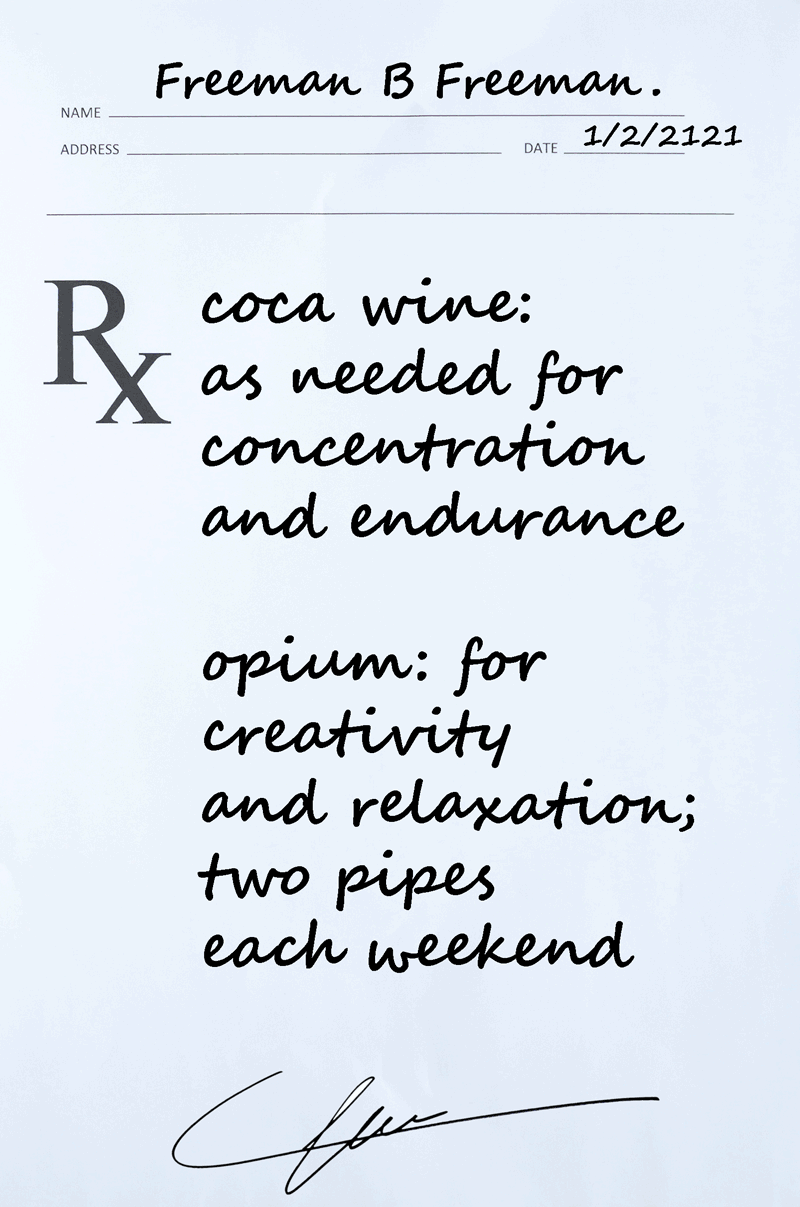 When we judge (or rather demonize) drugs in this way, we are judging far more than drugs. If we say, for instance, that cocaine should be illegal, we are tacitly also pronouncing on the importance of having a focused and cheerful mindset, on the propriety of living life like Sherlock Holmes or Robin Williams. We are saying, in effect, that such ways of "being in the world" are not as important as 100% safety. We are saying, to be specific, that solving my depression is not as important as 100% safety for all parties who are even remotely concerned. This is easy for scientists and moralists to say, because they have no skin in this game. They are like a landlubber calling for the outlawing of boat racing. They therefore feel free to run roughshod over the rights to godsend healthcare for the depressed. Unfortunately, I seem to be the only depressed person in the world who recognizes this fact, however, this failure on the part of the mainstream to honor me as a stakeholder in the drug legislation game. Otherwise, every self-help group for the depressed would be demanding the end of this drug prohibition which refuses to consider the depressed as stakeholders in our government's drug-related policy decisions. And yet almost all such groups have been bamboozled into viewing drugs as a problem, not as an answer.
"The White Man goes into his church house and talks about Jesus, but the Indian goes into his tipi and talks to Jesus."
 We might paraphrase Parker's observation as follows:
"The westerner goes into their local library and reads self-help books about feeling great; the free individual uses the world's many godsend medicines to actually feel great."
"My impression has been that the use of cocaine over a long time can bring about lasting improvement..." --Sigmund Freud, On Cocaine, 1884

"The White Man goes into his church house and talks about Jesus, but the Indian goes into his tipi and talks to Jesus." 9
"The White Man goes to an expensive psychoanalyst to find out WHY he feels lousy -- the Native American uses Mother Nature's medicines so that he no longer feels lousy."
 Unfortunately, the American chemist seems to have considered the testimony of such users as merely one input in determining what drugs might help the depressed. He felt that any true antidepressant had to be a one-size-fits-all pill that will affect different people in more or less identical ways. This approach was certainly in Shulgin's financial interests given his work for pharmaceutical companies. However, had Shulgin risen above his own self-interest, he would have seen that the testimony of the drug users is EVERYTHING. We need to trust them to tell us what works for THEM -- and in which particular circumstances it works. In other words, we have to embrace all the unique variables of drug use that the Drug Warrior completely ignores! Only in this way can we find out what works for whom and under which circumstances.
Freud had the right idea: He noticed that cocaine use actually ended depression in his patients. Unfortunately, he was ambitious and was more interested in making a name for himself than in pushing back against the statistically challenged fear mongering of prohibitionists.
It's a category error to say that scientists can tell us if psychoactive drugs "really work." It's like asking Dr. Spock of Star Trek if hugging "really works." ("Hugging is highly illogical, Captain.")
Here's one problem that supporters of the psychiatric pill mill never address: the fact that Big Pharma antidepressants demoralize users by turning them into patients for life.
That's another problem with "following the science." Science downplays personal testimony as subjective. But psychoactive experiences are all ABOUT subjectivity. With such drugs, users are not widgets susceptible to the one-size-fits-all pills of reductionism.
Even the worst forms of "abuse" can be combatted with a wise use of a wide range of psychoactive drugs, to combat both physical and psychological cravings. But drug warriors NEED addiction to be a HUGE problem. That's their golden goose.
Another problem with MindMed's LSD: every time I look it up on Google, I get a mess of links about the stock market. The drug is apparently a godsend for investors. They want to profit from LSD by neutering it and making it politically correct: no inspiration, no euphoria.
The real value of Erowid is as a research tool for a profession that does not even exist yet: the profession of what I call the pharmacologically savvy empath: a compassionate life counselor with a wide knowledge of how drugs can (and have) been used by actual people.
I could tell my psychiatrist EXACTLY what would "cure" my depression, even without getting addicted, but everything involved is illegal. It has to be. Otherwise I would have no need of the psychiatrist.
The U.S. Congress considered the following to be a scientific fact back in 1924:
"A person taking narcotics regularly impedes evolutionary progress and tends to degenerate backwards toward the brute." -- Richmond Hobson
Aleister Crowley actually TRIED to get addicted to drugs and found he could not. These things are not inevitable. The fact that there are town drunkards does not mean that we should outlaw alcohol.
Americans won't be true grown-ups until they learn to react to drug deaths the same way that they react to deaths from horseback riding and mountain climbing.



 (up)