




Homepage of the Drug War Philosopher, Brian Quass
blog icon orange rss icon with stylized radio waves bird icon for twitter bird icon for twitter substack icon


back navigation arrow


What Is It Like to Be a Human Being?

The question that Thomas Nagel SHOULD have asked

by Brian Ballard Quass, the Drug War Philosopher (Substack version)

November 6, 2026


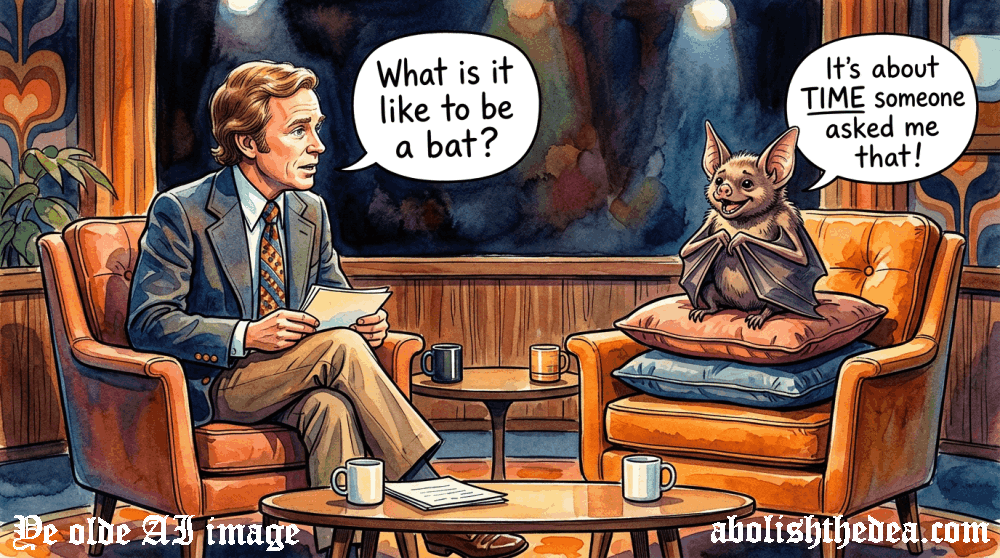
In October 1974, American philosopher Thomas Nagel posed the question "What is it like to be a bat?" in a paper in The Philosophical Review.1 Nagel was not asking what it was like to squeak and to hang upside down in a cave and to navigate via echolocation; he wanted to know what it FELT like to do all of those things, what it FELT like to be a bat. This might have been an obvious question to ask in an holistic society, but it had never occurred to our scientists to ask it. Nor is this surprising, since consciousness was an embarrassing subject for them. As long as they left consciousness out of consideration, they could claim that they were experts on animals and animal behavior. If consciousness was important, they would have to go back to school: they would have to study neuroscience and philosophy and learn about potential alternatives to materialism, given the failure of that latter philosophy to accord with the findings of quantum theory and especially with the phenomenon of entanglement, or what Albert Einstein referred to as "spooky action at a distance."2 They might even have to learn from Indian mystics who harness mind in ways undreamed of by westerners. No wonder that our scientists decided to brand themselves as positivists instead, rather than admit that consciousness mattered. In this way, they could hide their ignorance behind a scientific-sounding credo and "blow off" consciousness as a mere epiphenomenon, as a touchy-feely subject unworthy of their time, as the ontologically meaningless byproduct of an overly developed brain. But Nagel's paper rained on the self-satisfied parade of these scientists by reminding them that they were avoiding a huge part of the story of animal life. This criticism was not new -- it had been leveled against scientists over a hundred years earlier by Romantic poets such as Shelley and Wordsworth and later echoed in prose by philosophers such as Whitehead and Bergson -- but Nagel's paper phrased the issue in a new and interesting way for scientists in the age of quantum physics.

While Nagel's question is eye-opening, it makes me wonder, why was his paper about bats? Why did he not ask "What is it like to be a human being?" instead. Nagel would respond, of course, by saying that we all know what it is like to be a human being by dint of being human beings ourselves, but he would be wrong. Some of us have forgotten what it is like to be a human being. This is clear when we consider the obtuseness of drug researchers and behavioral health experts when it comes to psychological common sense. Our scientists see no benefits to drugs that inspire and elate and that have been considered panaceas since the time of Galen. They are so blind to the psychologically obvious that they deny the ability of laughing gas itself to cheer up the depressed. Laughing gas. These scientists clearly do not know "what it is like to be a human being," or else they are determined to ignore that knowledge whenever they put on a lab coat, figuratively or otherwise. Take myself, for instance. As a chronic depressive, I would be cheered up this very instant if I could just look forward, say, to the weekly use of laughing gas or cocaine or DMT or opium or one of the many non-addictive phenethylamines synthesized by Alexander Shulgin, some of which inspire creativity and give what Wordsworth called intimations of immortality. This is not some claim requiring formal proof on my part; we need no clinical trials to tell us such things. It is psychological common sense to say that there is therapeutic value, both in mood-elevating experiences themselves and in looking forward to those experiences. If scientists knew "what it was like to be human," they would see this at once. The fact that they don't suggests that they are no longer human beings, at least as far as drugs are concerned, that they are a new species, Homo scientificus, having more in common with the residents of Planet Vulcan than those of Planet Earth.

I'm all in favor of having scientists find out what it's like to be a bat, but I'd prefer that they first remember what it's like to be a human being. Then maybe they'll understand why drugs that inspire and elate could -- surprise, surprise -- actually help the depressed. Maybe then they'd understand that the propriety of assisted suicide for the depressed cannot be discussed ethically without also discussing the propriety of drug prohibition, which has outlawed all drugs that could help make the depressed wish to live. Maybe then they would remember, despite all the brainwashing that they've received since childhood from a Christian Science media, that drug use is actually better than death. 3 4 5 6 7 8


Notes for essay entitled What Is It Like to Be a Human Being?: The question that Thomas Nagel SHOULD have asked:

1: “What Is It Like to Be a Bat?” 1974 n.d. Accessed November 4, 2026. https://ia800100.us.archive.org/5/items/thomas-nagel-what-is-it-like-to-be-a-bat/Thomas%20Nagel %2C%20What%20Is%20It%20Like%20to%20Be%20a%20Bat.pdf. (up)
2: Rosenblum, Bruce, and Fred Kuttner. 2006. Quantum Enigma: Physics Encounters Consciousness. Oxford University Press. https://books.google.com/books?id=YTytWHT-ReUC. (up)
3: Nolen, Stephanie, and Chloë Ellingson. 2025. “Claire Brosseau Wants to Die. Will Canada Let Her?” The New York Times, December 29, 2025. https://www.nytimes.com/2025/12/29/health/assisted-death-mental-illness-canada.html. (up)
4: Claire Brosseau does not need the right to assisted suicide: she needs the right to take care of her own health as she sees fit DWP (up)
5: Claire Brosseau should be fighting for her right to take care of her own health, not for her right to assisted suicide DWP (up)
6: No one would need assisted suicide if we ended drug prohibition: what Claire Brosseau's case tells us about the warped mindset of the west when it comes to drugs DWP (up)
7: Open Letter to Claire Brosseau DWP (up)
8: Elizabeth, I'm comin' to join ya! DWP (up)
9: Depressed? Ask Your Doctor if Assisted Suicide is Right for You DWP (up)


read more essays here


Ten Tweets

against the hateful war on US


And we should not insist it's a problem if someone decides to use opium, for instance, daily. We certainly don't blame "patients" for using antidepressants daily. And getting off opium is easier than getting off many antidepressants -- see Julia Holland.

Prohibition is wrong root and branch. It seeks to justify the colonial disdain for indigenous healing practices through fearmongering.

When we outlaw drugs, we are outlawing far more than drugs. We are suppressing freedom of religion and academic research.

America created a whole negative morality around "drugs" starting in 1914. "Users" became fiends and were as helpless as a Christian sinner -- in need of grace from a higher power. Before prohibition, these "fiends" were habitues, no worse than Ben Franklin or Thomas Jefferson.

The Partnership for a Drug Free America should be put on trial for having blatantly lied to Americans in the 1980s about drugs, while using our taxpayer money to do so!

Wanna show drug warriors the error of their ways? Legalize all less dangerous drugs than alcohol and then deny work to those who test positive for liquor and confiscate their property if beer cans are found on-site.

This is why we would rather have a depressed person commit suicide than to use "drugs" -- because drugs, after all, are not dealing with the "real" problem. The patient may SAY that drugs make them feel good, but we need microscopes to find out if they REALLY feel good.

There is something wrong with a country that thinks it can decide what human beings around the world are allowed to ingest.

Americans believe scientists when they say that drugs like MDMA are not proven effective. That's false. They are super effective and obviously so. It's just that science holds entheogenic medicines to the standards of reductive materialism. That's unfair and inappropriate.

I'm told that most psychiatrists would like to receive shock therapy if they become severely depressed. That's proof of drug war insanity: they would prefer damaging their brains to using drugs that can elate and inspire.


Click here to see All Tweets against the hateful War on Us


back navigation arrow
Book Cover

Break the ice with a sledgehammer: place this book on your coffee table.

This book features 150 annotated images, designed to force brainwashed Americans to confront the fact that drug prohibition is wrong. Here is what author Richard Parrish II says of the book's compiler: "The drug prohibition philosopher provides first-hand, principled, persuasive, and insightful arguments against the current drug prohibition regime..."

Purchase Your Copy
Book Cover

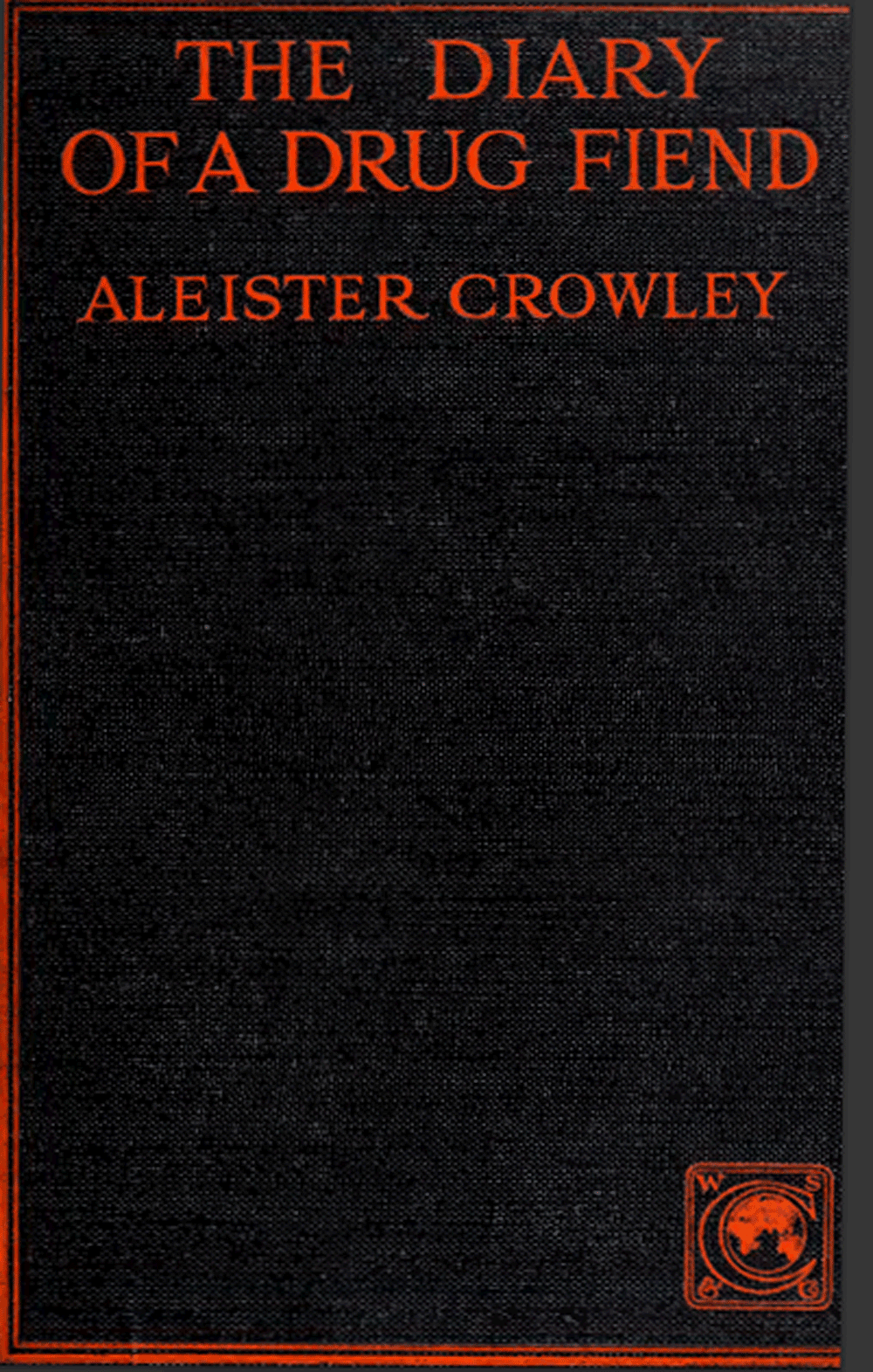
Diary of a Drug Fiend

This is the only full-cast recording of Aleister Crowley's 1922 classic paeon to common sense. It is the first book -- and so far almost the only book -- to stake out a philosophy of drug use that is compatible with human freedom, one in which we learn to use drugs as wisely as possible for the benefit of humanity. This recording was produced by the Drug War Philosopher and your purchases help support his effort to push back against the tragically counterproductive policy of drug prohibition, in the name of human freedom and of humanity's right to heal.

Purchase Your Copy


No cookies, no ads paid for by amoral and immoral billionaires (or trillionaires).


Unless otherwise indicated, no AI is used in the creation of site content. These essays represent the original ideas of their author and not the ideas that the author SHOULD have based on an algorithmic parsing of existing data. For more on this subject, consider the AI-related viewpoints to which the author subscribes as delineated in the New York Times opinion piece entitled "What 370,000 College Essays Tell Us About A.I.’s Effects on Creativity" by Rebecca Winthrop of the Brookings Institution.

The Partnership for a Death Free America is a proud sponsor of The Drug War Philosopher website @ abolishthedea.com.


Copyright 2026, Brian Ballard Quass Contact: quass@quass.com

tombstone for American Democracy, 1776-2024, RIP (up)