








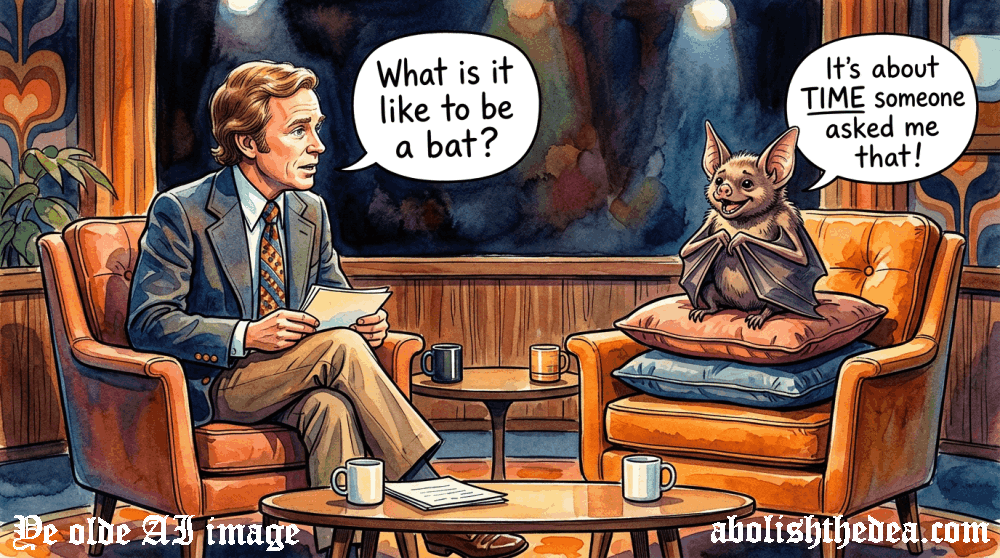
 In October 1974, American philosopher Thomas Nagel posed the question "What is it like to be a bat?" in a paper in The Philosophical Review.1 Nagel was not asking what it was like to squeak and to hang upside down in a cave and to navigate via echolocation; he wanted to know what it FELT like to do all of those things, what it FELT like to be a bat. This might have been an obvious question to ask in an holistic society, but it had never occurred to our scientists to ask it. Nor is this surprising, since consciousness was an embarrassing subject for them. As long as they left consciousness out of consideration, they could claim that they were experts on animals and animal behavior. If consciousness was important, they would have to go back to school: they would have to study neuroscience and philosophy and learn about potential alternatives to materialism, given the failure of that latter philosophy to accord with the findings of quantum theory and especially with the phenomenon of entanglement, or what Albert Einstein referred to as "spooky action at a distance."2 They might even have to learn from Indian mystics who harness mind in ways undreamed of by westerners. No wonder that our scientists decided to brand themselves as positivists instead, rather than admit that consciousness mattered. In this way, they could hide their ignorance behind a scientific-sounding credo and "blow off" consciousness as a mere epiphenomenon, as a touchy-feely subject unworthy of their time, as the ontologically meaningless byproduct of an overly developed brain. But Nagel's paper rained on the self-satisfied parade of these scientists by reminding them that they were avoiding a huge part of the story of animal life. This criticism was not new -- it had been leveled against scientists over a hundred years earlier by Romantic poets such as Shelley and Wordsworth and later echoed in prose by philosophers such as Whitehead and Bergson -- but Nagel's paper phrased the issue in a new and interesting way for scientists in the age of quantum physics.
Just saw a prosecutor gloating about the drug dealers she has taken down.How much is she getting paid to play whack-a-mole?
In the board game "Sky Team," you collect "coffees" to improve your flying skills. Funny how the use of any other brain-focusing "drug" in real life is considered to be an obvious sign of impairment.
I'm told antidepressant withdrawal is fine because it doesn't cause cravings. Why is it better to feel like hell than to have a craving? In any case, cravings are caused by prohibition. A sane world could also end cravings with the help of other drugs.
After a long life, I have come to the conclusion that when all the establishment is united, it is always wrong. (Harold MacMillan)
I've always wondered why we don't just let heroin users be -- or better yet, re-legalize drugs and give them choices. Why are they punished for using heroin daily while we praise 1 in 4 women for taking an even more dependence-causing drug every day of their life?
Doc to Franklin: "I'm sorry, Ben, but I see no benefits of opium use under my microscope. The idea that you are living a fulfilled life is clearly a mistake on your part. If you want to be scientific, stop using opium and be scientifically depressed like the rest of us."
At best, antidepressants make depression bearable. We need not settle for such drugs, especially when they are notorious for causing dependence. There are many drugs that elate and inspire. It is both cruel and criminal to outlaw them.
Using the billions now spent on caging users, we could end the whole phenomena of both physical and psychological addiction by using "drugs to fight drugs." But drug warriors do not want to end addiction, they want to keep using it as an excuse to ban drugs.
I'm told antidepressant withdrawal is fine because it doesn't cause cravings. Why is it better to feel like hell than to have a craving? In any case, cravings are caused by prohibition. A sane world could also end cravings with the help of other drugs.
I can't imagine Allen Ginsberg writing "Howl!" while under the influence of mood-damping drugs like Inderal and Prozac -- but then maybe that's the point: the powers-that-be do not want poets writing poems like "Howl!"


 (up)